Number of Christian Converts in Japan, 1549–1700
Christianity rose to perhaps 300,000 active believers in 70 years and was driven underground in 25. A guided tour of the demographic curve, the contested numbers behind it, and the men who pushed it up and down.
This is a demographic study of Christianity in Japan from 1549 to 1700, tracing how the faith rose to perhaps 300,000 active believers within 70 years and was then driven underground within 25. It surveys the contested numbers behind the curve and the men who pushed the total up and down.
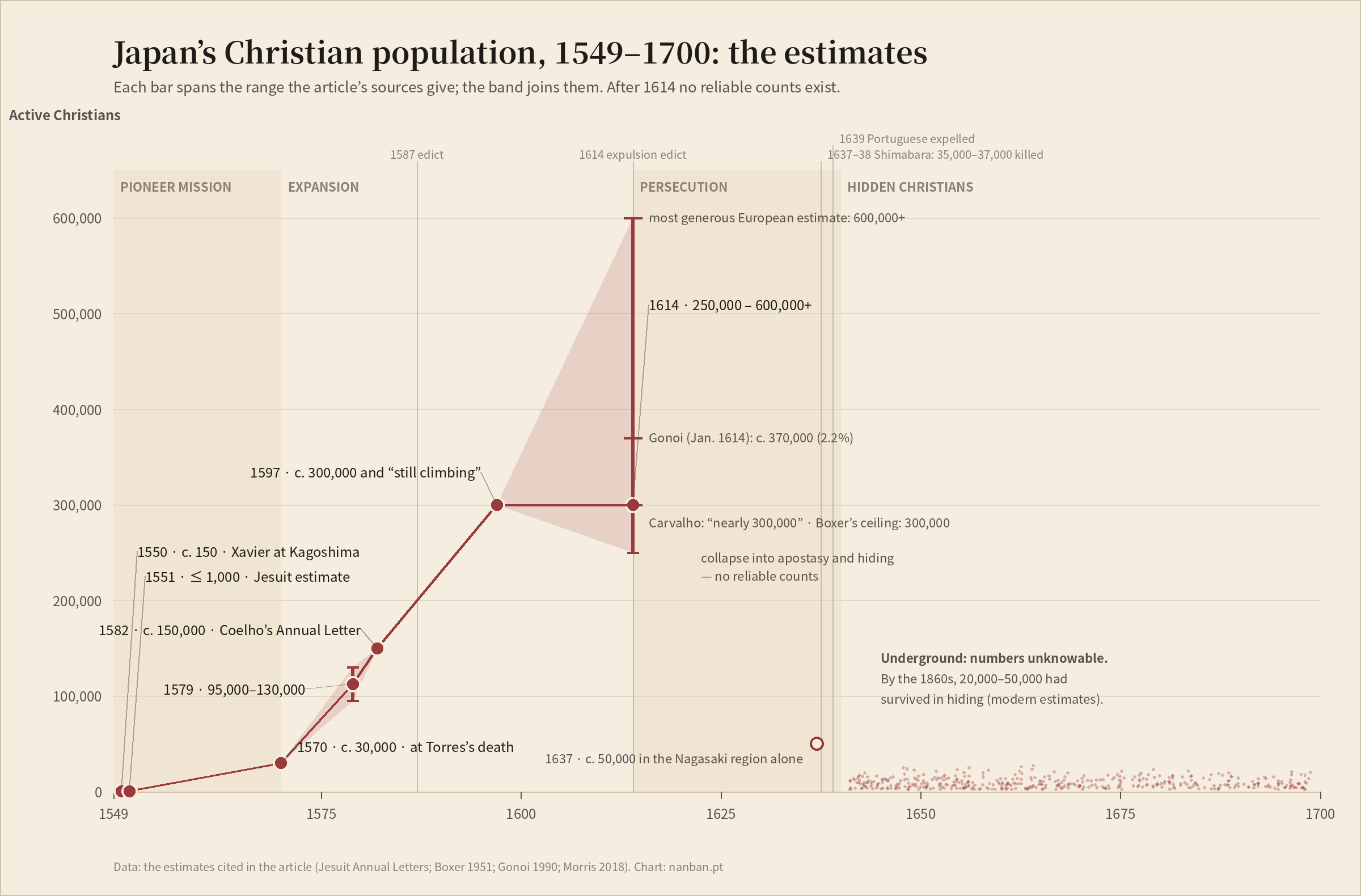
This chart, if you stare at it long enough, will tell you almost the entire story.
It begins in 1549 at the bottom-left corner with a single dot, about 100 souls baptized in Kagoshima by a Navarrese Jesuit who could not yet speak the language of the people he was converting. It ends, in 1700, at the bottom-right corner, with another small smear of dots: the hidden Christians scattered across the islands and coves of western Kyūshū, praying in code, baptizing in secret, raising children who would have to be told what they actually were only when their parents judged them old enough to die for it. Between these two endpoints rises a vast pink mountain, the disputed peak of perhaps 300,000 active believers around 1614, and then a near-vertical cliff.
This article is a guided tour of that curve. The numbers are contested at almost every point: Jesuit Annual Letters were partly fundraising documents, modern historians from C.R. Boxer to Takashi Gonoi systematically discount the most flattering totals, and the persecution-era tallies count ‘punished’ persons rather than executions in ways that have been routinely misread for three centuries. Where the figures diverge sharply, this piece shows ranges rather than single points. The cast of characters, however, is not in dispute. What follows is who pushed the curve up, who held it there, and who, with extraordinary and sustained competence, pushed it down.
Francis Xavier: The First Hundred
The curve begins as a near-flat line because Francis Xavier, the patron of all Asian missions, had not yet learned to speak Japanese. He landed at Kagoshima in August 1549 with two Jesuit companions and an interpreter, a fugitive samurai called Anjirō who had picked up Portuguese in Malacca, and over the next 10 months he baptized perhaps 150 people in the Satsuma capital. By the time he sailed for India in 1551, the Jesuits’ own most generous estimate stood at 1,000 converts spread across Satsuma, Hirado, Yamaguchi, and Bungo; the modern historian James Murdoch thought the real figure closer to 100. Xavier was learning, painfully, that translating Deus as Dainichi (a borrowed Buddhist term) had handed his audience a category error from which the mission would spend decades recovering. The full story of those first two years, including the disastrous winter trek to Kyoto and the moment Xavier swapped his rags for silk to gain audience with the daimyō of Yamaguchi, is told in detail elsewhere on this site.
Cosme de Torres: The Long Plateau
After Xavier’s departure the curve does almost nothing for nearly two decades, and the man responsible for keeping it from collapsing entirely was Cosme de Torres. A Valencian priest, Torres ran the Japan mission from 1551 to 1570 with a skeleton staff of perhaps half a dozen Europeans and a growing cadre of Japanese catechists called dōjuku. He moved on from Xavier’s Dainichi-translation error, switched to the loan-word Deus, weathered the destruction of the Ōuchi clan that had patronized the Yamaguchi mission, and watched a great deal of his work burn in the civil wars of the 1550s and 1560s. Torres himself wrote that he was ‘very sorry to see how time passed without there coming about any new conversion of substance.’ By his death in 1570, however, he had moved the active Christian population in Japan from perhaps 1,000 nominal converts to roughly 30,000, with a working seminary, a translated catechism, and a cadre of native preachers ready to inherit the operation. The man who held the line during the Jesuits’ lost decade has his own article, and he deserves it.
Challenged Growth: The 1570s Boom
The 1570s are where the chart breaks free of the floor. Several things happen at once. Oda Nobunaga, the warlord then methodically dismembering the great Buddhist establishments that had functioned as quasi-states inside Japan for centuries, takes a tactical interest in the foreign priests as counterweights to Tendai and Pure Land power. Gaspar Vilela, a Portuguese Jesuit operating largely without backup, secures the first stable Christian presence in Kyoto and the Home Provinces, where for the first time the faith is not merely a Kyūshū phenomenon. The 1579 Azuchi Debate, staged before Nobunaga between two rival Buddhist sects, ends in a political verdict against the mission’s fiercest Buddhist opponents that effectively licenses missionary activity in central Japan. And in 1580, the Ōmura daimyō Sumitada hands the Society of Jesus the harbor-and-village of Nagasaki, which over the next 20 years will become a Christian city of 15,000 souls and the demographic anchor of the entire mission. By 1579 the rolls show somewhere between 95,000 and 130,000 Christians, depending on whose count you trust, with 60,000 of them in Ōmura alone.
Francisco Cabral: The Wrong Man at the Right Moment
The curve climbs in spite of, not because of, the man who ran the Japan mission from 1570 to 1581. Francisco Cabral was a Portuguese aristocrat who arrived in Japan with the conviction, never abandoned despite a decade of contrary evidence, that the Japanese were intellectually and morally inferior to Europeans, that they should not be admitted as full priests, and that the Society of Jesus would be debased by accommodating their customs. He forbade the Jesuits to wear silk (despite Japanese expectations that men of religion dress for their station), kept the dōjuku in subordinate roles regardless of competence, and prosecuted what amounted to a one-man cold war against Japanese clerical advancement. The mission grew under him because his subordinates ignored him, the daimyō of western Kyūshū were converting whole domains for reasons of their own, and the dōjuku themselves were doing the actual evangelism.
Alessandro Valignano: The Visitor Who Rebuilt the Operation
The man who replaced Cabral and rebuilt the mission from scratch was the most consequential European in the entire Christian Century. Alessandro Valignano, a Neapolitan jurist-turned-Jesuit and the Society’s Visitor for the East Indies, arrived in 1579, took one comprehensive look at what Cabral had built, and reorganized it from the floorboards up. He imposed the policy of accommodatio, that Jesuits would adopt Japanese dress, etiquette, food, and, where possible, language, overruled Cabral on Japanese ordinations, established seminaries at Arima and Azuchi, ordered a Japanese translation program, set up a printing press at Nagasaki, and dispatched four teenage Japanese Christian noblemen to Europe in the Tenshō Embassy of 1582–1590, where they were received by Philip II and successive Popes and turned into a continent-spanning piece of Counter-Reformation public relations. Under Valignano’s three Visitations, the active Christian population rises from roughly 100,000 to a contested peak of 300,000-plus. Almost every successful element of the late mission is, if you trace it back, his.
Gaspar Coelho: The Vice-Provincial Who Talked Too Much
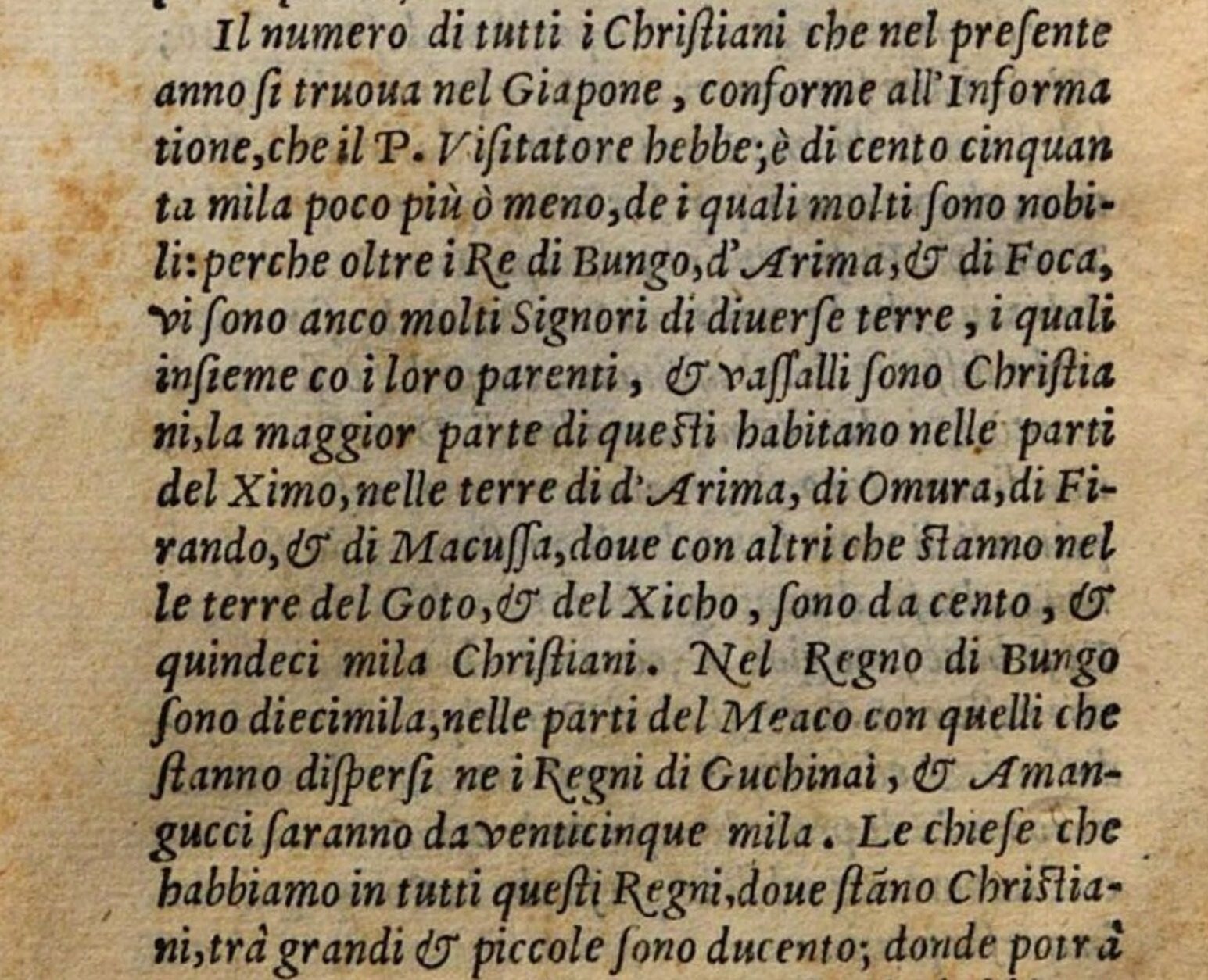
Mission Superior Gaspar Coelho, Portuguese, ambitious, politically unsubtle, ran the mission day-to-day from 1581 to 1590 and produced both the most informative Annual Letter of the period, the 1582 letter that gives us the figure of ‘150,000, a little more or less’ Christians in Japan, and the single worst tactical decision in mission history. In 1586, granted an audience with Toyotomi Hideyoshi at Osaka Castle, Coelho not only requested armed support for the Jesuit-protected daimyō of Kyūshū but offered to provide Portuguese ships and soldiers to assist a Hideyoshi invasion of Korea and China. Hideyoshi, who at that moment was disposed to let the Christians alone, registered the offer for what it was: a proposal that Iberian military power could be deployed inside Japan. The hand-grenade he received from Coelho went off the following year. Coelho’s biography sits at the precise pivot point where the curve stops climbing and begins, for the first time, to wobble.
Hideyoshi: The First Edict
In July 1587, 11 days after the same banquet at which Coelho had once again pushed his luck, Hideyoshi issued a midnight edict expelling all Christian missionaries from Japan within 20 days. The 1587 edict was, in retrospect, more theatrical than operative, Hideyoshi made no serious attempt to enforce expulsion against the Jesuits because he did not, yet, want to lose the Portuguese silk trade, but it changed the legal status of the mission overnight. Christianity went from tolerated to nominally illegal, and would remain so. The most prominent victim of the edict’s first wave was Takayama Ukon, the Christian daimyō of Akashi, who refused to apostatize, lost his fief, and would spend the next 27 years in internal exile, most of them in Maeda service, before being deported to Manila in 1614 and dying there 40 days after his arrival.
Augustinians and Franciscans: The Friars Arrive
The 1593 arrival of the Franciscans, and shortly afterward the Dominicans and Augustinians, complicates both the demographic picture and the politics that will eventually bring it down. The mendicant orders, operating out of the Spanish Philippines rather than Portuguese Macau, brought a different theology of mission, open street preaching, ostentatious poverty, hospitals for lepers, and a frank suspicion that the Jesuits had gone native. They picked up tens of thousands of additional converts, particularly around Kyoto and the Kantō, but their visible activity also gave Hideyoshi’s officials reason to believe the foreign priests were not in fact obeying the 1587 edict. Inter-order squabbling between Jesuits and friars filled the Annual Letters for the next 40 years and provided the Tokugawa intelligence services with a reliable stream of information about the Christian network’s internal tensions. By 1614 the Jesuit and friar establishments together would oversee a peak active population on which the most generous European estimate sat above 600,000 and the more sober missionary count, that of Provincial Valentim de Carvalho, gave ‘nearly 300,000.’
San Felipe, 1596: The Galleon That Lit the Fuse
In October 1596 a Spanish Manila galleon, the San Felipe, was wrecked on the coast of Tosa with a vast and visible cargo of silver and silks. The San Felipe Incident is, in the conventional telling, the moment a panicking pilot, attempting to convince Hideyoshi’s officials that he was not worth confiscating, produced a map of the world and informed them that conversion was always Spain’s first step to military conquest. Whether the pilot actually said this, Spanish and Japanese sources disagree, and the documentation has been argued over for four centuries, Hideyoshi, by then ill, paranoid, and obsessed with consolidating his Korean campaign, treated the cargo as forfeit and the friars as fifth-columnists. On 5 February 1597, 26 Christians, six Franciscan friars, three Japanese Jesuits, and 17 Japanese laymen, three of them children, were crucified on the hill of Nishizaka outside Nagasaki. The active Christian population at this moment stood at perhaps 300,000 and was still climbing. 26 bodies on a hillside did nothing to slow it. The ideological precedent, however, had been set: that the Japanese state was prepared, when its leadership decided the moment had come, to kill foreign priests as priests.
Tokugawa Ieyasu: The Patient Calibrator
Hideyoshi died in 1598. Two years later Tokugawa Ieyasu won the Battle of Sekigahara and inherited Japan, and for the first decade of his unchallenged rule the curve resumed its climb, reaching a probable point-in-time peak somewhere around 1612. Ieyasu was not, by inclination, a persecutor: he wanted European trade, European cannon, and European knowledge, and he tolerated the Christian establishment as the price of those things. What he was not prepared to tolerate was a faith whose loyalties pointed outside the chain of command he had spent 50 years building. The wedge that allowed him to start prising the Christian establishment apart was provided, almost as a gift, by William Adams, the English Protestant pilot of the De Liefde, the first non-Catholic European Ieyasu had ever met, who patiently and accurately explained to the shogun-in-waiting that Catholic Europe was at religious war with Protestant Europe and that Spain and Portugal were not, in fact, the only Christian power. The Dutch and the English began trading at Hirado from 1609. The Jesuits’ commercial monopoly evaporated. And Ieyasu had options.
The Madre de Deus and the Okamoto Daihachi Scandal
In 1610 the Portuguese carrack Nossa Senhora da Graça (called by the Japanese the Madre de Deus) blew up in Nagasaki harbor rather than surrender to Arima Harunobu’s troops in a contested affray over a previous year’s killing of Japanese sailors in Macau. Two years later a corruption scandal burst open at the Tokugawa court: Okamoto Daihachi, a Christian convert and retainer of Ieyasu’s senior counselor Honda Masazumi, had defrauded Arima Harunobu of a great deal of silver by forging documents promising the restoration of ancestral lands. Both men were Christians. The scandal, prosecuted in 1612, gave Ieyasu the political cover he had been waiting for: he ordered the demolition of churches in the Kantō, banned Christianity among his direct retainers, and began the process of reclassifying the foreign religion from a tolerated curiosity into a proven security threat. The active Christian population was at or very near its all-time peak. The political conditions for the cliff-edge had now been assembled.
1614: The Expulsion Edict
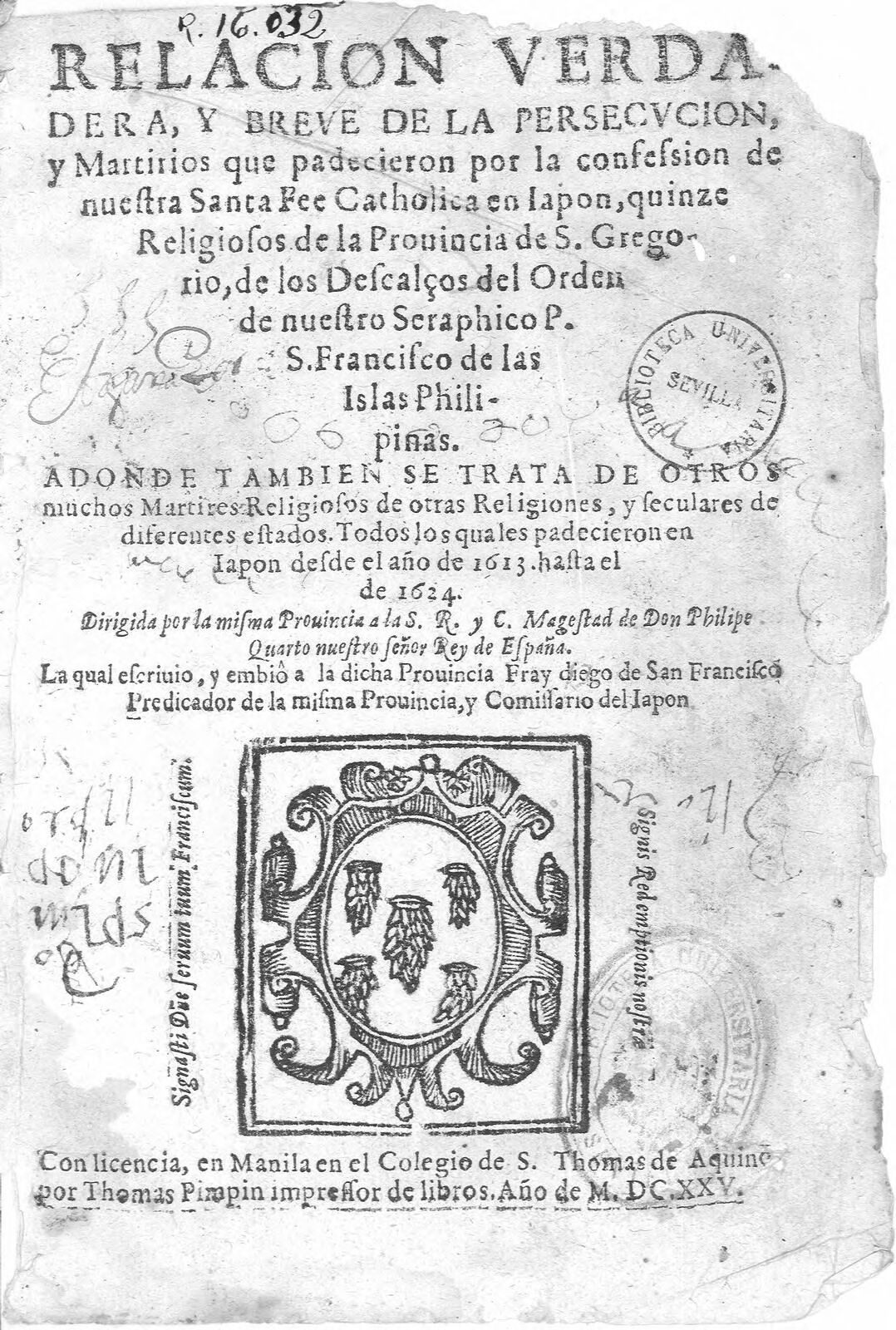
In January 1614, the definitive expulsion edict was promulgated under Ieyasu’s name. The text, drafted with the shogunate’s senior Buddhist ideologue Konchiin Sūden, condemned the kirishitan religion in terms that left no room for tolerance: the missionaries had come to Japan ‘longing to disseminate an evil law, to overthrow right doctrine, so that they may change the government of the country and obtain possession of the land.’ All foreign missionaries were to leave. All churches were to be destroyed. All Japanese Christians were to apostatize. The active Christian population at this exact moment, depending on whose count you accept, stood between a quarter of a million and 600,000. The most prominent deportee was Takayama Ukon. The most consequential single decision of the period was that, of perhaps 150 foreign priests then in Japan, roughly 40 refused to leave and went underground. Among them was a 34-year-old Portuguese Jesuit from Torres Vedras called Cristóvão Ferreira.
1615: Osaka and the End of the Old Order
The 1615 Siege of Osaka annihilated the Toyotomi house, Hideyoshi’s son and heir Hideyori, holed up in his father’s castle, finally fell to Tokugawa cannon and Ieyasu’s overwhelming force, and with it the last meaningful political alternative to Tokugawa rule. The Christians had a stake in this outcome that has often been understated: a substantial proportion of the rōnin who fought on the Toyotomi side at Osaka were Christian, including units bearing crosses on their banners, and after the castle fell those who survived dispersed into the Kyūshū countryside carrying both their faith and a particular set of grievances. By Gonoi Takashi’s careful estimate for January 1614 the active Christian population stood at around 370,000, roughly 2.2% of all Japanese. It was also, though no one yet knew it, the high-water mark.
The 1620s: Hidetada’s Persecution and the Great Martyrdom
Tokugawa Hidetada, Ieyasu’s son, who took over the shogunate in 1605 and ruled effectively from his father’s death in 1616, prosecuted a steady, escalating campaign against the surviving Church. Where his father had calibrated, Hidetada hammered. The 1619 Great Martyrdom of Kyoto burned 52 Christians, including pregnant women and children, on a sandbar in the Kamo River. The 1622 Great Martyrdom of Nagasaki, 55 Christians killed on the same Nishizaka hill where the original 26 had died in 1597, was, however, the persecution’s miscalculation: a crowd of some 30,000 sang and prayed as the martyrs died, and the shogunate emerged from it with the realization that public spectacle was producing not deterrence but martyrology. From this point the strategy shifts toward private breaking. The pivotal expression of that shift is the apostasy of Cristóvão Ferreira in October 1633: the Jesuit Vice-Provincial, the highest-ranking Catholic official in Japan, suspended head-down in a pit of excrement on the orders of the Nagasaki governors, broke after roughly five hours and renounced his faith. He spent the next 17 years assisting his captors.
1637: The Shimabara Rebellion
By the time Tokugawa Iemitsu, grandson of Ieyasu and the third Tokugawa shōgun, was confronted with serious open Christian resistance, the active Church had been driven down to perhaps 50,000 in the Nagasaki region alone, with most other regional populations already collapsed into apostasy or hiding. The Shimabara Rebellion of 1637–1638 was, on its surface, a peasant tax revolt in a province whose lord had ruined his subjects with extractive taxation; but the rebels’ iconography was unmistakably Christian, banners reading Lovvado seia o Sanctissimo Sacramento, processions led by a teenage charismatic called Amakusa Shirō, and a final defense of the ruined castle of Hara that produced perhaps 35,000 to 37,000 killed when the bakufu, with Dutch naval gunnery support, finally overwhelmed the position in April 1638. There were, by some accounts, no Christian survivors. The rebellion converted what had been an incremental, locally-administered persecution into a national emergency, and provided the political consensus for what came next.
The 1640s: Sakoku and the Hidden Church
In a series of edicts between 1633 and 1639, the Tokugawa state narrowed Japan’s contact with the outside world to a few tightly controlled channels. The Portuguese were expelled. Japanese subjects were forbidden, on pain of death, to leave the country or, having left, to return. A 1640 Macau diplomatic embassy attempting to reopen the Portuguese trade had its 61 members beheaded on Nishizaka. Inoue Masashige’s Office of the Inquisition formalized the registration system, terauke, by which every household had to certify its Buddhist temple affiliation; fumi-e, the annual tread-on-the-image inspection by which rural populations had to demonstrate non-Christianity by stamping on a metal Christ, and turned what had been an outwardly visible Church into an underground one. From 1640 the curve effectively flatlines. Modern estimates put the hidden Christians who survived in secret to the end of the Edo period at 20,000 to 50,000, concentrated in the islands and inlets of western Kyūshū, the senpuku Kirishitan, who would emerge in 1865 and astonish a French priest at the newly-built Ōura cathedral by informing him that they had been waiting for him for 250 years.
The Numbers
300,000 at the peak. 2,000 to 6,000 actual martyr-executions. Perhaps 280,000 ‘punished’ between 1614 and 1635, a tally that counts penalties, not deaths, and which has been routinely misread for three centuries as a death toll.
These figures are imperfect. The Jesuit Annual Letters were partly fundraising documents written for a European audience that wanted to hear about a ripening harvest. The Tokugawa registers count behavior rather than belief. The hidden-Christian numbers are inferred backwards from the 1865 emergence and forwards from the kuzure arrest counts of the 1660s and 1680s. Boxer’s ‘realistic ceiling’ of 300,000 active believers in 1614 represents the best informed scholarly judgment of where the truth probably lay; even that number remains a best guess, defended against alternatives that range from a 250,000 on the low end to 2,000,000 on the rejected high.
Sources & Further Reading
Boxer, C.R. The Christian Century in Japan, 1549–1650. University of California Press, 1951. The foundational English-language study of the period; the single most important work for any reader engaging the demographic numbers seriously, and the source of the ‘realistic ceiling’ of 300,000 active believers in 1614.
Murdoch, James. A History of Japan, Volume II: During the Century of Early Foreign Intercourse (1542–1651). Kobe: Office of the “Chronicle”, 1903. The earliest comprehensive English-language treatment, and still indispensable for its detailed analysis of the Annual Letters and population estimates by region.
Elison, George. Deus Destroyed: The Image of Christianity in Early Modern Japan. Harvard University Press, 1973. The best treatment in English of the intellectual confrontation between the Christian mission and Japanese Buddhist and Confucian thought, with substantial demographic analysis.
Higashibaba, Ikuo. Christianity in Early Modern Japan: Kirishitan Belief and Practice. Brill, 2001. A demographically careful regional study, particularly useful for the western Kyūshū conversion booms of the 1570s and 1580s.
Miyazaki, Kentarō. Various contributions to the Handbook of Christianity in Japan, ed. Mark Mullins. Brill, 2003. The standard Japanese scholarly perspective on cumulative baptism counts and the hidden-Christian survival.
Gonoi, Takashi. Nihon Kirisutokyō shi. Yoshikawa Kōbunkan, 1990. The fundamental modern Japanese demographic study, source of the 1614 figure of 370,000 active Christians (~2.2% of population).
Laures, Johannes. The Catholic Church in Japan: A Short History. Charles E. Tuttle, 1954. A Jesuit historian’s account, source of the cumulative 1549–1639 baptism estimate above one million.
Üçerler, M. Antoni J. The Samurai and the Cross: The Jesuit Enterprise in Early Modern Japan. Oxford University Press, 2022. The most recent major English-language synthesis, with revised peak estimates running considerably higher than Boxer’s.
Ward, Haruko Nawata. Women Religious Leaders in Japan’s Christian Century, 1549–1650. Ashgate, 2009. Major treatment of the women’s contribution to mission demographics and the role of female catechists.
Turnbull, Stephen. The Kakure Kirishitan of Japan: A Study of Their Development, Beliefs and Rituals to the Present Day. Routledge, 1998. The standard treatment of the underground period, 1640–1865.
Morris, J.H. Rethinking the History of Conversion to Christianity in Japan, 1549–1644. PhD thesis, University of St Andrews, 2018. An invaluable source-critical revisitation of the major demographic claims, comparing Annual Letter figures against modern reconstructions and the shūmon aratame registers.
Cooper, Michael (ed.). They Came to Japan: An Anthology of European Reports on Japan, 1543–1640. University of California Press, 1965. The most accessible English-language collection of primary missionary observations, including population and conversion figures from a wide variety of contemporary witnesses.
Common questions
How many Christians were there in Japan at the peak?
About 300,000 active believers around 1614. That figure is C.R. Boxer's "realistic ceiling" and represents the best informed scholarly judgment rather than a count — it is defended against alternatives ranging from 250,000 at the low end to a rejected 2,000,000 at the high.
Read the full account →How many Japanese Christians were executed?
Between 2,000 and 6,000 actual martyr-executions. The much larger figure of roughly 280,000 that circulates is not a death toll: it counts those "punished" between 1614 and 1635, a tally of penalties rather than deaths, and it has been routinely misread for three centuries.
Read the full account →When did Christianity begin in Japan, and how fast did it grow?
It begins in 1549 with about 100 souls baptized at Kagoshima by Francis Xavier, who could not yet speak the language. Growth was slow for two decades, then accelerated sharply: under Alessandro Valignano's three Visitations from 1579 the active Christian population rose from roughly 100,000 to the contested peak of 300,000-plus.
Read the full account →How many hidden Christians survived the persecution?
Modern estimates put those who survived in secret to the end of the Edo period at 20,000 to 50,000, scattered across the islands and coves of western Kyūshū. They prayed in code and baptized in secret, and told their children what they were only when the parents judged them old enough to die for it.
Read the full account →Why are the numbers of Japanese Christians disputed?
Because every source counts something slightly different. The Jesuit Annual Letters were partly fundraising documents written for a European audience that wanted to hear of a ripening harvest. The Tokugawa registers count behavior rather than belief. And the hidden-Christian totals are inferred backwards from the 1865 emergence and forwards from the kuzure arrest counts of the 1660s and 1680s.
Read the full account →Cite this page
Nanban.pt. “Number of Christian Converts in Japan, 1549–1700.” Last modified 28 September 2026. https://nanban.pt/articles/christian-population-japan-1549-1700/.
@misc{nanban-christian-population-japan-1549-1700,
  author = {Nanban.pt},
  title = {Number of Christian Converts in Japan, 1549–1700},
  year = {2026},
  url = "https://nanban.pt/articles/christian-population-japan-1549-1700/",
  note = {Last modified 2026-09-28}
}