Takayama Ukon: The Samurai Who Chose God Over Japan
He was one of the finest generals of the Sengoku age, a master of the tea ceremony, and the most powerful Christian lord in Japan. When forced to choose between his faith and everything else, he chose his faith, and lost everything else
Takayama Ukon was one of the finest generals of Japan's Sengoku age, a master of the tea ceremony, and the most powerful Christian daimyō in Japan. He chose his Christian faith over rank, wealth, and homeland, and in the end lost everything he had.
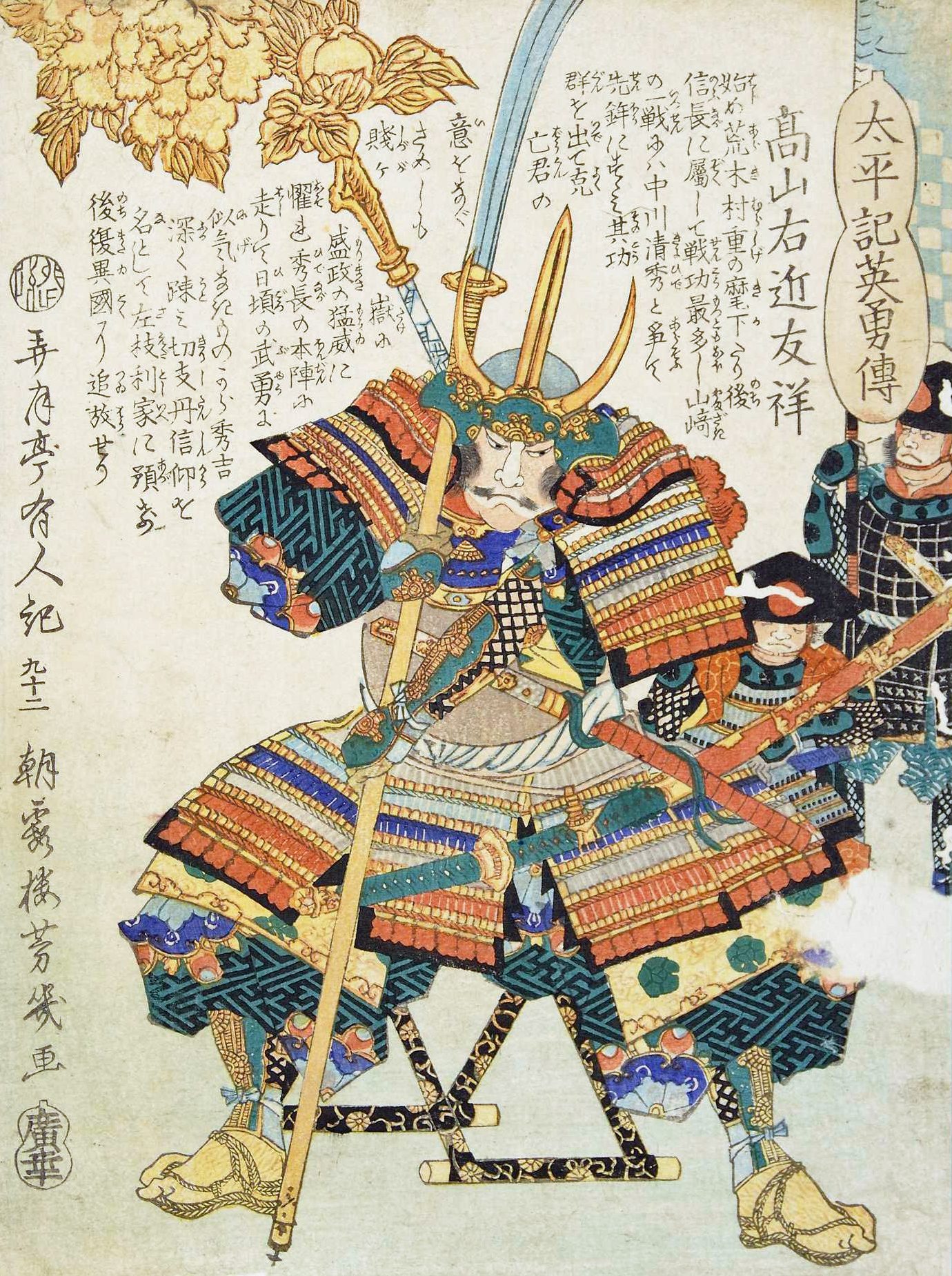
How the Takayama Family Became Christian in 1563
The Inquisitors’ Mistake
In 1563, two celebrated scholars received an assignment from the warlord Matsunaga Hisahide that should have been straightforward. Matsunaga, who controlled Yamato Province, held the office of Minister of Justice in what remained of the Ashikaga Shogunate, and was a devout Nichiren Buddhist with no tolerance for foreign novelties, wanted the Christian missionaries expelled from the capital region. The Jesuit Padre Gaspar Vilela and his Japanese catechist, Brother Lourenço, had been making converts, and Matsunaga wanted it stopped. At the urging of the Buddhist clergy of Kyoto, he ordered the two, Yūki Tadamasa and Kiyohara Ekata, to conduct an official investigation into the Christian doctrines: interrogate the priests, expose the absurdity of their teachings, and provide the legal grounds for their removal.
The scholars did as they were told. They summoned Brother Lourenço. They listened to the arguments. They examined the doctrines. Then they asked to be baptized.
It was one of those moments in history where an instrument of suppression becomes an instrument of conversion. The sources do not dwell on Matsunaga’s reaction, which one imagines was spectacular. The scholars were not alone. When Padre Vilela came to Nara to baptize them, word reached a minor feudal lord in Matsunaga’s service named Takayama Zusho. Sent off in haste with a message from his master, he pretended to leave but hid in a house in the city for two days and nights, listening to the doctrine. Then he, too, asked to be baptized. Zusho took the baptismal name Dario, invited the missionaries to his castle at Sawa in Yamato Province, and promptly had his entire household evangelized. His wife, baptized Maria, his children, his retainers, around 150 people received the sacrament in what amounted to a wholesale conversion of the castle garrison.
Among the newly baptized was Zusho’s eldest son, a boy of about 10 or 11. He was given the name Justo. The boy would grow into one of the finest military commanders of the Sengoku age, a celebrated master of the tea ceremony, the most powerful Christian feudal lord in Japan, and, ultimately, a man who would be stripped of everything, his lands, his status, his country, because he refused to deny the faith his father had discovered in hiding, while his master thought him gone. His full name was Takayama Ukon.
Takayama Ukon’s Upbringing and Family
The Education of a Christian Warlord
The Takayama family’s origins were modest by the standards of the Sengoku aristocracy. They traced their roots to Takayama Village in Settsu Province, and Ukon’s father had initially controlled Sawa Castle as a vassal of Matsunaga Hisahide, a subordinate of a subordinate, in a hierarchy that was itself dissolving. When Sawa Castle fell during one of the era’s innumerable military reshufflings, the family fled and entered the service of Wada Koremasa, who held Takatsuki Castle in Settsu.
The young Justo, meanwhile, was educated by the Jesuits. This was not an unusual arrangement for a convert’s son in 1560s Japan, the Jesuits instructed the sons of the Christian elite years before they founded seminaries to train them, and they were, by the standards of the era, excellent educators. What it meant in practice was that Ukon absorbed two parallel curricula: the classical military training of a samurai heir, with its emphasis on swordsmanship, horsemanship, fortification, and the art of command, and the theological and humanist education of a Jesuit pupil, with its emphasis on catechism, moral philosophy, and the conviction that a Christian lord’s authority derived not merely from military prowess but from divine mandate.
The combination produced a man who was both deeply practical and deeply devout, qualities that, in the context of 16th-century Japan, would prove alternately useful and catastrophic.
His first major test came early and violently. Wada Koremasa died in battle in 1571, and his son Wada Korenaga, who inherited Takatsuki at 17, turned out to be precisely the kind of volatile, paranoid ruler that the Sengoku period manufactured in bulk. He grew suspicious of the Takayamas and began plotting their murder. The Takayamas, being samurai who had survived this long by not being slow about these things, got word of the conspiracy, allied themselves with the rising warlord Araki Murashige, and walked into the “consultation” Korenaga had called at the castle with their eyes open. The consultation went poorly for Korenaga. In the close-quarters brawl that followed, the lamps went out, and Ukon was seriously wounded but managed to strike the mortal blow against his lord, who died of it days later. The Takayamas emerged from the room as the new masters of Takatsuki Castle, vassals now of Araki Murashige.
It was a perfectly conventional Sengoku career move: identify the threat, forge a better alliance, eliminate the problem, take the castle.
The 1578 Crisis: Ukon Caught Between Lord and Faith
The Abraham of Takatsuki
In November 1578, Araki Murashige rebelled against Oda Nobunaga.
This was a serious miscalculation. Nobunaga was in the process of unifying Japan through a combination of military genius and the systematic destruction of anyone who stood in his way, and he was not known for his leniency toward traitors. Araki had allied himself with the Ishiyama Honganji warrior-monks and the Mōri clan, which meant that every vassal under Araki’s command was now, technically, at war with the most dangerous man in Japan.
For Takayama Ukon, the rebellion created a dilemma so perfectly constructed that it could have been designed by a Jesuit moral philosopher as a hypothetical examination case. His feudal obligations bound him to Araki, his immediate lord. But Nobunaga held the balance of power, and, more critically, the future of Christianity in Japan. Nobunaga had been the Jesuits’ most valuable patron: not himself a Christian, but fascinated by European technology, amused by the missionaries, and perfectly willing to tolerate a religion that served as a useful counterweight to the Buddhist monasteries he was busily burning down.
Nobunaga’s message to Ukon was blunt. Surrender Takatsuki Castle, or Nobunaga would exterminate every Christian in Japan and crucify the missionaries. The threat was entirely credible. In 1574, Nobunaga had penned some 20,000 Ikkō-ikki sectarians inside their strongholds at Nagashima and burned them alive. He had burned the great monastery complex of Mount Hiei to the ground, slaughtering monks, women, and children indiscriminately. He was not a man who made threats he did not intend to carry out.
The situation was further complicated by the fact that Araki held hostages: Ukon’s younger sister and his infant son. If Ukon surrendered to Nobunaga, Araki would almost certainly execute them.
The Jesuit Father Organtino, who had been Ukon’s spiritual advisor and close friend, argued that Ukon’s highest loyalty belonged to God, not to a traitorous lord. The logic was clear, if agonizing: the missionaries, the Christian communities of central Japan, the entire future of the faith on the archipelago, all depended on Ukon making the right choice. His own family’s lives were, in the calculus of eternal salvation, a secondary consideration.
Ukon made his decision. Without telling his father, Dom Dario, who remained fiercely loyal to Araki and was furious when he learned what his son had done, Ukon shaved his head in the manner of a man entering religious life, slipped out of Takatsuki Castle, and surrendered himself and the fortress to Nobunaga. The Jesuits, writing up the episode for their European superiors, compared him to Abraham, willing to sacrifice his own son in obedience to God.
Nobunaga was delighted. Takatsuki was a critical strategic position between Kyoto and Osaka, and its bloodless acquisition was a significant military windfall. He rewarded Ukon lavishly, stripping off his own silk garment and draping it over the young lord’s shoulders, presenting him with a prized horse and a new fief in Settsu Province. Ukon’s hostage relatives, remarkably, survived; Araki’s rebellion collapsed within a year, and the hostages were eventually recovered.
The episode established the pattern that would define Ukon’s entire life: when the demands of faith and the demands of the world collided, faith won. It also established a pattern the Jesuits found deeply gratifying: the man who chose God was rewarded with worldly success. The problem with this second pattern was that it would not last.
Ukon’s Service Under Nobunaga and Hideyoshi
God’s General
Under Nobunaga and, after the great warlord’s assassination in 1582, under his successor Toyotomi Hideyoshi, Takayama Ukon compiled a military record that would have been remarkable even without the religious dimension.
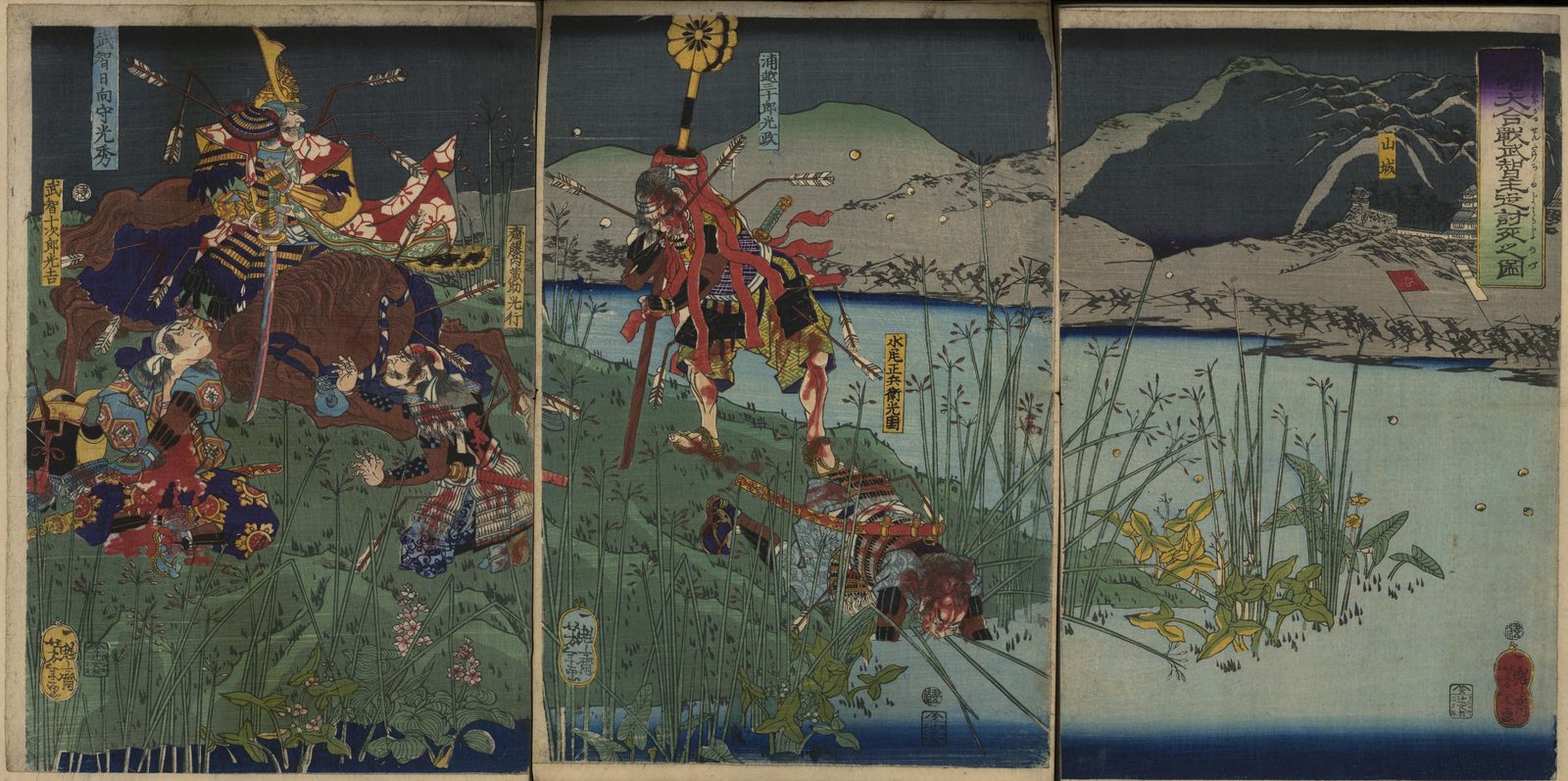
At the Battle of Yamazaki in 1582, fought just 11 days after Nobunaga’s murder by the traitor Akechi Mitsuhide, Ukon commanded the cavalry vanguard alongside Nakagawa Kiyohide. His forces struck the first blows that shattered Mitsuhide’s army, an engagement that helped make Hideyoshi the new master of Japan. At the Battle of Shizugatake the following year, when the forces of Shibata Katsuie launched a devastating surprise attack that killed Nakagawa, Ukon held his position on Iwasakiyama as long as he could, then fell back on Kinomoto, where Hideyoshi’s main force arrived to counterattack. He was made chief of Hideyoshi’s personal bodyguard, a position of extraordinary trust, and was later granted the domain of Akashi, a substantial fief of 60,000 koku.
Ukon accompanied Hideyoshi’s armies to Shikoku in 1585 and to Kyūshū in 1587, campaigns that brought the southern and western islands under central authority. He was, by any measure, one of the inner circle: a proven battlefield commander, a trusted advisor, and a man whose personal bravery was acknowledged even by those who found his religion baffling.
He was also, simultaneously, conducting one of the most aggressive campaigns of Christianization in Japanese history.
In Takatsuki, where he had ruled since the late 1570s, Ukon had systematically transformed the domain into a Christian territory. His methods were, to use a charitable description, comprehensive. He opened his own residence for the celebration of Mass. He organized targeted sermons for different social groups, separate sessions for samurai, for noblewomen, for commoners. The Jesuits noted, with evident admiration, that he preached with such eloquence that none of their own Japanese brothers could match him.
But persuasion was only half the program. As his political power consolidated, Ukon presented the Buddhist monks and Shinto priests of his domains with an ultimatum: convert or leave. Those who refused were expelled from their offices and their holdings seized. He demolished Buddhist temples and Shinto shrines, burned images and ritual objects, and converted the emptied religious sites into Christian churches. The numbers were staggering: 4,000 baptisms in 1577 alone; 8,000 Christians by the end of 1579; 18,000 out of a total population of 25,000 by 1582. By 1585, Buddhism had effectively ceased to exist in Takatsuki. At least 100 Buddhist monks had accepted baptism. The entire population of approximately 30,000 was Christian.
When Ukon was transferred to Akashi, the pattern repeated. The mere rumor of his impending arrival caused the local Buddhist priests to flee to Osaka with their sacred images. 2,000 converts followed within two years.
His influence extended far beyond his own domains. At Hideyoshi’s court, Ukon was a relentless evangelist, leveraging his personal prestige and his access to the most powerful men in Japan to promote the faith among the military aristocracy. Several prominent warlords converted through his direct influence. Ukon also played a critical role in the construction of Christian infrastructure: he personally oversaw the building of the Azuchi Seminary, petitioning Nobunaga for permission, completing the construction in a single month, and persuading reluctant Christian samurai to entrust their sons to the Jesuits’ care. When Azuchi was destroyed after Nobunaga’s death, Ukon built a replacement seminary at Takatsuki. He financed and supervised the construction of the Osaka Church, which celebrated its first Mass on Christmas Day 1583, and the Akashi Church for his new domain’s rapidly growing congregation.
The Jesuits regarded him as their greatest success story: a powerful, devout, fearless champion of the faith who demonstrated that Christianity and the samurai code were not merely compatible but synergistic. The problem was that the very qualities that made Ukon so effective, his zeal, his uncompromising methods, his vast network of Christian converts in the military class, were also the qualities most likely to alarm the man who now controlled Japan.
Takayama Ukon as a Master of the Tea Ceremony
The Sword and the Whisk
There is a dimension to Ukon’s life that the Jesuit sources, focused as they were on faith and warfare, tended to underplay: his standing as one of the foremost practitioners of the tea ceremony in 16th-century Japan.
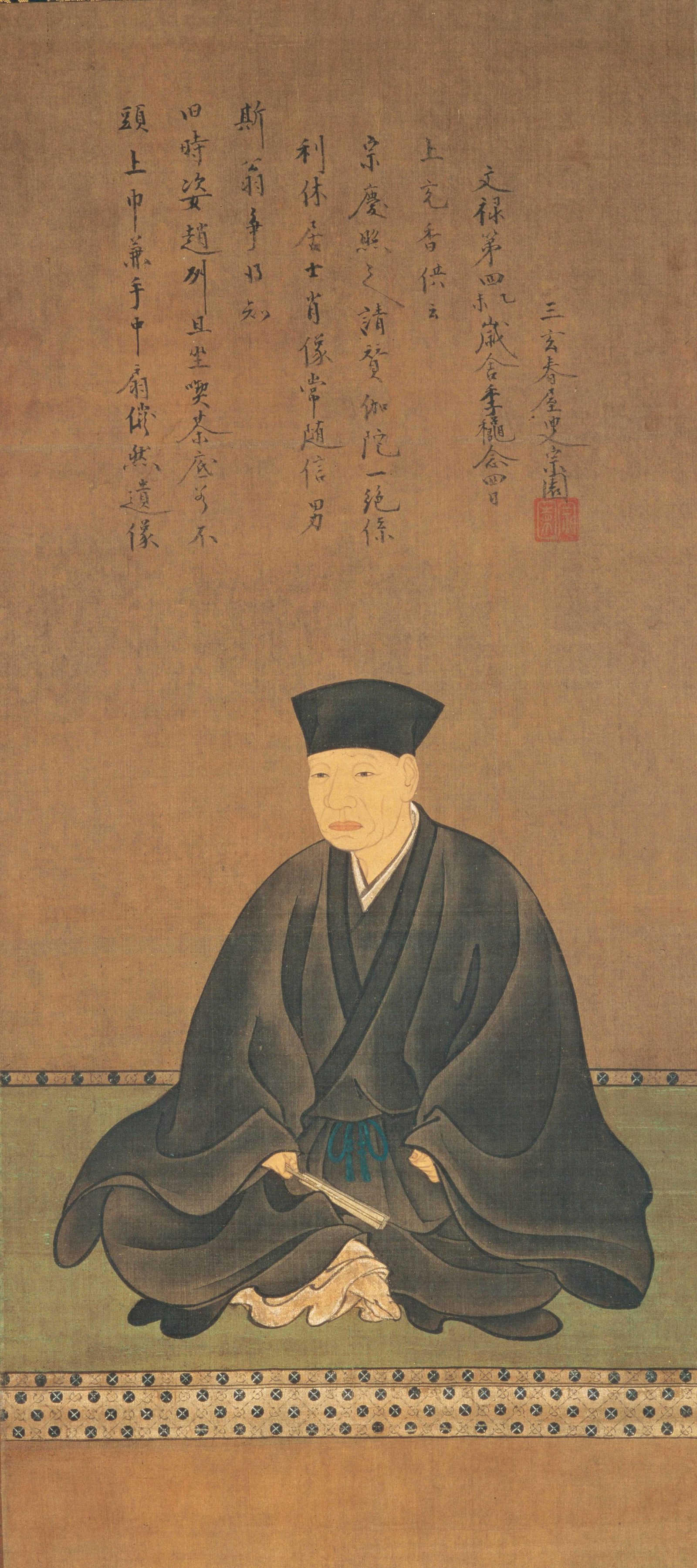
Ukon was a disciple of Sen no Rikyū, the supreme tea master whose austere wabi-cha aesthetic redefined the practice and, through it, much of Japanese culture. Rikyū’s circle was the most elite cultural network in Japan, a space where military power, aesthetic refinement, and political influence converged over a bowl of whisked green tea in a room deliberately designed to strip away the markers of rank. In the tearoom, a daimyō with 60,000 koku entered through the same low doorway as everyone else, on his knees.
Ukon was not a casual participant. He was recognized as one of Rikyū’s most accomplished students, a man whose understanding of the tea aesthetic was deep enough to earn the respect of practitioners who had no interest in Christianity and no particular admiration for military accomplishments. The tea ceremony, in Ukon’s practice, became something that the Jesuits would not have entirely understood but that the Japanese cultural world took very seriously: a space where the disciplines of the warrior, the sensibility of the artist, and the devotion of the Christian existed in a tension that was, in the best performances, resolved into something approaching grace.
This mattered politically as well as culturally. The tea ceremony was, in Hideyoshi’s Japan, a medium of diplomacy. Hideyoshi himself was an obsessive collector and practitioner, and invitations to tea gatherings functioned as political signals, indicators of favor, access, and trust. Ukon’s mastery of the form gave him a currency that transcended his military utility and his religious identity. Even after he lost his domains, even after he was stripped of his rank, the cultural capital of his tea practice remained.
Why Ukon Gave Up His Domain in 1587
The Ultimatum
It happened during the Kyūshū campaign of 1587. Hideyoshi had marched a quarter of a million men south to crush the Shimazu clan and bring the island under his authority. Ukon was with him, as he had been for every major campaign since Yamazaki. The army included several other prominent Christian daimyō, Konishi Yukinaga, Kuroda Yoshitaka, Arima Harunobu, and as the campaign progressed through the heavily Christianized territories of northern Kyūshū, Hideyoshi encountered something that altered his political calculations.
He found a fortified port city, Nagasaki, that the Jesuits had been administering as a sovereign territory since the daimyō Ōmura Sumitada had ceded it to them in 1580. He found the Jesuit Vice-Provincial Gaspar Coelho greeting him aboard an armed Portuguese galley. He found churches and seminaries where Buddhist temples had once stood. He found an entire region where the loyalty of the population ran not to the secular lord but to the foreign priests and the God they served.
The details of Hideyoshi’s reaction, the late-night interrogation of Coelho, the explosive edict issued the following morning, belong to the broader story of the 1587 crisis. What matters here is the specific demand that Hideyoshi made of Takayama Ukon.
Renounce Christianity, or forfeit everything.
The ultimatum was directed at Ukon personally because Hideyoshi understood, with the instinct of a man who had spent his life reading power dynamics, that Ukon was the keystone. He was the most prominent Christian lord. He was the man who had converted other lords. He was the nexus of a network of Christian allegiance in the military class that cut across the traditional bonds of feudal loyalty, a brotherhood that answered to a foreign God and a distant Pope rather than to the kampaku who sat in Osaka Castle. If Ukon bent, the network would bend. If Ukon broke, it might shatter.
Ukon did not bend.
He surrendered his domain of Akashi, 60,000 koku, a substantial fortune, a castle, an army, a population that he had personally converted to Christianity, and walked away. The Jesuits recorded that he did so “fearlessly”, which may be true, though one suspects that the experience involved internal turmoil.
Ukon’s Years Without Power, 1587–1614
27 Years in the Wilderness
The years between 1587 and 1614 were, for Takayama Ukon, a long exercise in surviving without power.
He was taken in by the daimyō Maeda Toshiie, a friend and admirer who held the vast Kaga domain centered on Kanazawa, on Japan’s north-western coast. Maeda successfully petitioned Hideyoshi to allow Ukon to enter his service as a simple samurai, a rank so far below his former station that the arrangement functioned as both a refuge and a humiliation. The condition was that Ukon stay entirely away from Kyoto, the political center, where his presence might provoke the kampaku’s wrath.
Ukon settled into Kanazawa and, despite his reduced circumstances, continued to do precisely what had got him into trouble in the first place. He evangelized. He founded new Christian communities across the three provinces of Kaga, Etchū, and Noto. He could not help himself, he did not regard evangelization as a political activity that could be prudently suspended but as a religious obligation that superseded political convenience.
His martial skills, meanwhile, remained sharp. At the Siege of Odawara in 1590, fighting as a landless samurai in the Maeda contingent, Ukon distinguished himself with such conspicuous bravery that Hideyoshi himself praised his performance, though the kampaku still refused to grant the exiled Christian a personal audience. It was a peculiar situation: a man whose military talent Hideyoshi openly admired, whose company Hideyoshi would not endure.
By 1592, the political temperature had cooled enough that Hideyoshi invited Ukon to his military camp at Nagoya in Hizen, the staging ground for the ill-fated invasion of Korea, and hosted him at a formal tea ceremony. It was a signal that Ukon could move more freely, though no restoration of his domains was forthcoming. For the remaining years of Hideyoshi’s life, and through the tumultuous transition to Tokugawa rule after Sekigahara in 1600, Ukon lived quietly under Maeda protection, practicing his tea, tending his Christian communities, and waiting for the political weather to shift.
It shifted, finally and definitively, in 1614, and it shifted against him.
The 1614 Ban and the Road to Exile
The Winter March
Tokugawa Ieyasu’s comprehensive ban on Christianity, issued in January 1614, was the product of years of mounting suspicion catalyzed by the Okamoto Daihachi scandal of 1612. The edict ordered the expulsion of all missionaries and the suppression of all Christian practice throughout Japan. Prominent Japanese Christians were to be exiled or forced to apostatize.
Takayama Ukon’s name was at the top of the list.
His protector, Maeda Toshinaga, Toshiie’s son and successor, received strict orders from the shogunate: deliver Ukon to Kyoto under military escort if he refused to renounce his faith. Friends and allies pressed Ukon to yield, at least outwardly. A performative apostasy, they argued, would save his family from destruction. No one would hold it against him. God would understand.
Ukon refused. He declared, according to the Jesuit accounts, that for a man of honor and firm Christian conviction, such cowardice was inadmissible.
In the middle of winter, Ukon, his wife, his children, and his grandchildren began the long march from Kanazawa to Nagasaki, the designated port of expulsion. The route crossed mountain passes deep in snow. At one point during the journey, a rumor reached the party that they were to be massacred on the road. The exiles did not flee. They knelt in the snow and prepared themselves to die.
They were not massacred. They reached Nagasaki, where they spent six or seven agonizing months in a kind of limbo, the deportation ships had not yet been arranged, and the local authorities oscillated between threats and bureaucratic delay. Finally, on November 8, 1614, Ukon and his family boarded a crowded junk bound for the Spanish Philippines, accompanied by the Christian lord Naitō Tokuan, dozens of missionaries, and hundreds of other exiles.
In Osaka Castle, meanwhile, Toyotomi Hideyori, the son of Hideyoshi, now preparing for the final, doomed stand against the Tokugawa, sent a secret delegation to Nagasaki offering Ukon supreme command of the castle’s defenses. The offer was remarkable: Ukon was 62, landless, and about to leave the country, but his reputation as a military commander was so formidable that the Toyotomi heir wanted him above all others. The delegation arrived too late. The ship had sailed.
There is one additional detail that deserves mention. Tokugawa Ieyasu, learning that Ukon’s vessel was still in the harbor, sent a last-minute order to sink the ship in Nagasaki Bay. The junk had already cleared the harbor mouth. The old shogun’s paranoia, or his respect for what Ukon represented, pursued the exile literally to the water’s edge.
Ukon’s Death in Manila, 1615
40 Days in Manila
The exiles arrived in Manila in December 1614. The reception was extraordinary. The Spanish governor, the religious orders, and the city’s populace turned out en masse to welcome the man whose reputation had preceded him across the sea. The authorities offered Ukon a royal pension, a residence, and every comfort the colonial capital could provide. Ukon, with the courtesy of a man who had spent his life in the highest circles of Japanese society, declined the pension. He asked only to be allowed to offer military service in return, a request that was both a gesture of dignity and, given his condition, impossible to fulfill.
The journey had broken him. The winter march from Kanazawa, the months of uncertainty in Nagasaki, the cramped and squalid sea voyage, all of it had accumulated in the body of a 62-year-old man who had spent the last three decades in a state of chronic political stress. About 40 days after arriving in Manila, Ukon fell gravely ill with a fever.
He died at midnight between February 4 and 5, 1615, with the names of Jesus and Mary on his lips, according to the Jesuit accounts. His confessor, Father Pedro Morejón, was at his side.
Manila mourned him for eight days. The funeral drew enormous crowds, and the Jesuit and Franciscan communities competed for the honor of hosting his remains. He was buried in the Jesuit church of St. Ann. In 1634, his remains were transferred to the chapel of the Jesuit College of San José in a specially decorated shrine. When the Jesuits were expelled from the Spanish empire in 1767, the shrine was dismantled and Ukon’s remains were lost, a final, posthumous dispossession.
Takayama Ukon’s Beatification
400 Years to the Altar
The question of what to do with Takayama Ukon has occupied the Catholic Church for over four centuries.
The problem was theological as much as procedural. Ukon did not die a conventional martyr’s death. He was not executed for his faith. He was not tortured. He was not given the choice between apostasy and the sword. He died of a fever in a bed in Manila, attended by priests and surrounded by his family. By the strict criteria of the canonization process, this was not martyrdom.
The Jesuits, beginning with his confessor Morejón, advanced an alternative framework: martirio prolongado, prolonged martyrdom. The argument was that Ukon’s death, though bloodless, was directly caused by the sufferings he endured for his faith, the loss of his domains in 1587, the 27 years of exile within Japan, the winter march, the deportation, the sea voyage. Each deprivation was an act of persecution; the cumulative effect was fatal. The fever that killed him in Manila was, in this reading, the last wound in a decades-long execution.
The argument was theologically plausible but administratively inconvenient. The Church’s canonization process required on-the-ground investigation in the candidate’s homeland, and Japan, after 1639, was hermetically sealed to Christians. The sakoku edicts made it impossible to conduct the necessary inquiries. Ukon’s cause stalled and languished for centuries.
It was not until the 1960s that the Archdiocese of Osaka formally resumed the process, completing the preliminary investigation in 1971. The case moved through the Vatican bureaucracy with the deliberation for which that institution is renowned. Finally, on February 7, 2017, in a large ceremony in Osaka, Cardinal Angelo Amato beatified Takayama Ukon in the name of Pope Francis as a martyr of the faith.
It had taken 402 years.
Sources & Further Reading
Boxer, C.R. The Christian Century in Japan, 1549–1650. University of California Press, 1951. The indispensable foundation for any study of the period, with extensive treatment of the Christian daimyō and the political dynamics that shaped their careers.
Cooper, Michael. They Came to Japan: An Anthology of European Reports on Japan, 1543–1640. University of California Press, 1965. Primary source translations that include several firsthand accounts of Ukon’s activities and his standing at the courts of Nobunaga and Hideyoshi.
Elison, George. Deus Destroyed: The Image of Christianity in Early Modern Japan. Harvard University Press, 1973. Essential for understanding the ideological context of the anti-Christian edicts and the Japanese state’s perception of figures like Ukon.
Hesselink, Reinier H. The Dream of Christian Nagasaki: World Trade and the Clash of Cultures, 1560–1640. McFarland, 2016. Provides the Nagasaki context for the 1614 expulsion and Ukon’s embarkation into exile.
Laures, Johannes. Takayama Ukon und die Anfänge der Kirche in Japan. Aschendorff, 1954. An early but still valuable study by a German Jesuit scholar, particularly strong on Ukon’s role in the construction of churches and seminaries.
Moran, J.F. The Japanese and the Jesuits: Alessandro Valignano in Sixteenth-Century Japan. Routledge, 1993. Background on the Jesuit institutional culture and the “top-down” missionary strategy that Ukon exemplified.
Morejón, Pedro. Relación de la persecución de Japón. Manuscript, c. 1615–1616. The primary account by Ukon’s last confessor, written shortly after his death in Manila; the basis for most subsequent biographical treatments.
Ross, Andrew C. A Vision Betrayed: The Jesuits in Japan and China, 1542–1742. Edinburgh University Press, 1994. Places Ukon within the broader arc of Jesuit missionary strategy in East Asia, with attention to the tensions between accommodation and coercion.
Turnbull, Stephen. The Samurai and the Sacred. Osprey Publishing, 2006. Useful for understanding the intersection of warrior culture and religious practice in Sengoku Japan, with a chapter on the Christian daimyō.
Cite this page
Nanban.pt. “Takayama Ukon: The Samurai Who Chose God Over Japan.” Last modified 25 September 2026. https://nanban.pt/articles/takayama-ukon-samurai-christian-daimyo/.
@misc{nanban-takayama-ukon-samurai-christian-daimyo,
  author = {Nanban.pt},
  title = {Takayama Ukon: The Samurai Who Chose God Over Japan},
  year = {2026},
  url = "https://nanban.pt/articles/takayama-ukon-samurai-christian-daimyo/",
  note = {Last modified 2026-09-25}
}