The Sword Was at Hand: Konishi Yukinaga, the Merchant’s Son Who Refused Seppuku, c. 1555–1600
A drug shop in Sakai, a printing press hidden in the Amakusa islands, a forged letter of surrender that fooled the Ming court for three years, and a beaten general walking out of a forest to ask a village headman to arrest him. Konishi Yukinaga spent 30 years brokering between two systems of obligation, and died demonstrating that they could not be reconciled.
Konishi Yukinaga (c. 1555 to 1600), baptized Dom Agostinho in 1583, was a Sakai merchant's son who became lord of southern Higo, commander of the First Division in Hideyoshi's invasion of Korea, and the chief lay protector of the Jesuit mission in Japan. After the Western Army lost at Sekigahara on 21 October 1600 he refused seppuku on the ground that suicide was forbidden to Christians, and was beheaded at Rokujo-gawara in Kyoto on 6 November 1600.
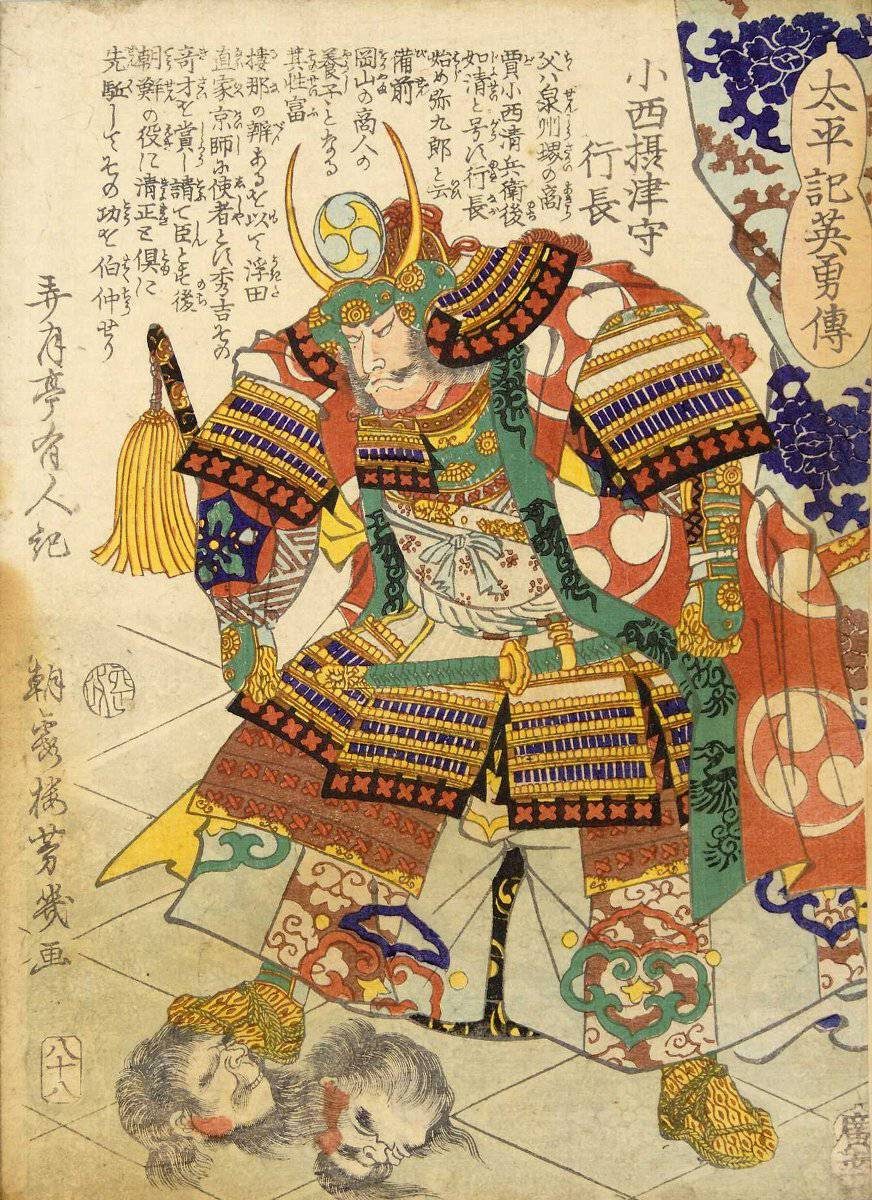
The Man Who Asked to Be Arrested
Why Konishi Yukinaga Refused Seppuku After Sekigahara
On or about 25 October 1600, four days after the largest battle ever fought between samurai armies, a man came down out of the trees on the eastern flank of Mount Ibuki and walked into the village of Kusakabe-mura. He was filthy, he had not eaten properly in days, and he was worth a considerable sum of money. He found the headman of Sekigahara, told him exactly who he was, and asked to be arrested so that the man could collect the reward.
The headman refused.
It was improper, he explained, for humble folk like himself to lay hands on so great a lord. This objection was raised, it should be noted, to a man who had commanded 18,000 troops into Korea, who had taken Seoul in 19 days, and who was at that moment a fugitive with a price on his head and no army left anywhere in the world. Konishi Yukinaga had to press the point. Eventually the headman relented, took him in, and sent word to the local daimyō, the territorial lord, who passed him along the chain to Tokugawa Ieyasu’s headquarters at Hachiman.
The story may not be true. Japanese military chronologies say instead that he was hunted down and taken by the samurai of Takenaka Shigekado, lord of Bodaisan Castle. The Tsukushi shoke kōhaiki says he took shelter in a Buddhist temple on the Ibuki slopes and was recognized and denounced by a priest named Hayashi Zōsu. The Jesuit historian Daniello Bartoli, writing 60 years later in Rome, dispenses with villagers and bounty hunters altogether and delivers Konishi straight into the custody of Kuroda Nagamasa, his old Christian friend, which makes for a tidier scene and a better sermon. The accounts cannot be reconciled and probably never will be.
What survives in all of them, Japanese and European alike, is the sentence. Asked why a defeated general with a sword on his hip and a forest at his back had not done the obvious thing, Konishi said that it was easy for him to commit suicide, but that as a Christian he could not. The other recorded formulation is blunter still. He revered the law of the Emperor of Heaven, he said, and therefore rejected suicide, and they should bind him and turn him in.
A commander on the losing side at Sekigahara who could reach a blade in time was expected to use it.
He declined it on a technicality of moral theology printed in Japanese, eight years earlier, on a press he had personally protected.
The Drug Shop at Sakai
Konishi Yukinaga’s Origins as a Sakai Merchant’s Son
The Konishi were merchants and druggists of Sakai, the free-trading port south of Osaka that functioned as the closest thing Japan had to a self-governing commercial republic. They were not samurai. They had no lineage worth forging, no ancestral holdings and no claim on anyone’s loyalty except the claim that money and competence make.
Even the year of his birth is contested, and not vaguely: three separate dates, each attached to a real document. Anthony Bryant’s index gives 1555, and the Korean record of the Imjin War agrees. Fabian Fucan, the apostate Japanese Jesuit with no reason to be generous, says Konishi was beheaded in 1600 at the age of 44, which yields 1556, and the Cambridge History of Japan hedges toward the same year with a question mark. Stephen Turnbull and the Bizen Gunki, which describes him as 20 years old in 1579, give 1558. He was born somewhere between 1555 and 1558, and nobody will ever narrow it further.
His father, Konishi Ryūsa, baptized Jōchin, which the Jesuits rendered as Joachim, is easier to track because he kept surfacing in administrative records. In 1578 he appears as Governor of Murotsu in Harima, and in 1584 he was transferred to govern Sakai itself, his own city. Under the Toyotomi administration he became Hideyoshi’s personal treasurer and, more consequentially, the regime’s official commercial factor at Nagasaki. The family had converted the skills of the pharmacy counter, inventory, credit and arbitrage, into a position at the financial center of a national government.
The son’s opening came in 1578. Ukita Naoie, who held Bizen and Mimasaka under the Mōri, decided that the future lay with the Toyotomi and needed someone to negotiate his defection. He sent the young Konishi as his emissary. When Naoie died in 1582, Konishi transferred directly into Hideyoshi’s service, and Hideyoshi, who had begun life as a peasant and was therefore congenitally uninterested in pedigree, recognized what he had acquired.
What he had acquired was a logistics officer. Konishi was made grand admiral of the Toyotomi fleet, a post the Jesuits translated as Capitão-mor do mar, and his court title, Settsu no kami, Governor of Settsu, reached European correspondence as the mysterious “Tsuno-kami-dono”. Later writers also awarded him a commission as Lieutenant-General of Kyūshū, a resounding title for which there is no documentary support at all.
In 1583 he was baptized Agostinho, Don Augustine in the Jesuit letters. The men who brought him in were not priests but colleagues in Hideyoshi’s inner circle: Kuroda Yoshitaka, Dom Simeão, and Takayama Ukon, Dom Justo, the most conspicuous Christian in the officer corps. His father Ryūsa and a younger brother followed him into the font shortly afterward. In the space of a single generation, a Sakai pharmacy had produced a Catholic naval commander, and the Japanese mission had acquired the patrons it would depend on for the next 17 years.
The Silk and the Sacraments
How the Konishi Family Financed the Jesuit Mission
The thing that made the Konishi useful to the Church was not piety. It was the silk.
In 1588 Hideyoshi confiscated Nagasaki from the Jesuits, who had been administering it as donated territory, and installed Konishi Ryūsa as his personal factor in the port, with the job of intercepting the annual Portuguese cargo before anyone else could touch it. Ryūsa was handed over 200,000 cruzados of treasury silver and instructed to buy 900 piculs of Macau raw silk for Hideyoshi. It was a state monopoly operated by a family of retail druggists on behalf of a former peasant, and it worked.
Portuguese captains arriving on the great ship from Macau had their own ideas about pricing, and Hideyoshi’s commissioners, the bugyō, had different ones. When the two collided, the Konishi reached for the only men in Japan who could argue in both languages and both commercial idioms, which meant the Jesuits, and in particular the linguist João Rodrigues.
Japan’s rulers tolerated the missionaries in large part because they believed, correctly, that the priests were part and parcel of the trade driven by the Great Ship. Silk paid for salvation. The mission’s residences, colleges, seminaries and printing costs were underwritten by a share in the Macau trade, and the men who kept the Macau trade flowing through Nagasaki were a Christian merchant family with a monopoly commission from a ruler who had already outlawed their religion.
They were not, in other words, patrons in the ordinary devotional sense of endowing a chapel and attending Mass. They were the plumbing.
Then Hideyoshi gave him a province, and the arrangement acquired a physical territory to defend.
200,000 Koku, or Thereabouts
Konishi’s Domain in Southern Higo and the Amakusa Revolt of 1589
After the Kyūshū campaign of 1587 broke the Shimazu and delivered the south to the Toyotomi, Konishi was raised from staff officer to territorial lord and, in 1588, given southern Higo Province, including the Amakusa islands off its western coast. He took Uto Castle as his capital.
James Murdoch states flatly that the domain was assessed at 200,000 koku, the measure of rice yield by which Japanese wealth and military obligation were calculated, and that is the number most subsequent accounts repeat. The contemporary land registers say something else. The Taikōsama ondai gohaibunchō gives 146,000 koku for 1597, and the Keichō sannen daimyōchō gives 146,300 for 1598. The gap, roughly a quarter of his assessed wealth, between the round nominal grant and what the land produced once surveyors had walked it, is a useful reminder of how much of 16th-century Japanese administration consisted of numbers that everyone agreed to repeat.
The islands did not come quietly. Amakusa had been divided among five independent lords, the goninshū, the five Amakusa barons, who had no intention of submitting to a cadastral survey conducted by a druggist’s son from Sakai. In 1589 they rose. Konishi put the rebellion down with considerable violence, culminating in a fierce siege at Hiondo, and then did something that his contemporaries found harder to explain than the killing.
Hideyoshi ordered the defeated executed. Konishi did not carry out the order.
Instead he absorbed the survivors, left the island communities intact, and consolidated Amakusa as a protected Christian territory under his direct administration. This was not sentiment. A depopulated island group produces no rice, no sailors and no taxes, and a defeated enemy who has been spared owes something that a corpse does not. Turnbull reads the episode as evidence of a genuine and consistent leniency. The men who spared each other in 1589 produced grandchildren who died together in 1638.
His new administration then enforced a policy of considerable audacity for a vassal of a ruler who had just outlawed the religion in question: no non-Christian was permitted to enter Amakusa.
No Pagan Enters Amakusa
How Konishi Sheltered the Jesuits After the 1587 Edict
On 24 July 1587 Hideyoshi issued the edict expelling the missionaries, giving the fathers 20 days to leave the country. 11 Jesuits sailed conspicuously for Macau so that somebody could be seen leaving. 113, including 47 Japanese irmãos, the lay brothers who did most of the actual work of the mission, went underground in western Kyūshū.
They needed somewhere to go underground to. Konishi provided it.
The Jesuit novitiate was moved out of Ōmura and the college of higher studies out of Funai in Bungo, and both were re-established inside Konishi’s Amakusa, at the harbor of Kawachinoura. The press followed. The printing equipment the Tenshō Embassy had brought back from Europe arrived in July 1590, began printing at Katsusa, and moved in May 1591 to Kawachinoura, where it went on producing the Kirishitan-ban, the Christian editions, the first books printed with movable type in Japanese.
What came off that press in the next three years says more about the ambitions of the Amakusa establishment than any annual letter. In 1592, Fides no Doxi, the Guide to the Faith, a translation of Luis de Granada. In 1593, Aesop’s fables in Japanese. In 1594, Manuel Álvares’s De Institutione Grammatica, the standard Latin grammar of the Jesuit school system, printed on an island in the East China Sea for students who would never see Coimbra.
Under this protection the numbers moved. 23,000 adult baptisms were recorded across Kyūshū in 1589 alone, and the Christian population of Amakusa passed 30,000 by the early 1590s. In 1596 the Portuguese captain-major Rui Mendes de Figueiredo reported more than 50 Jesuits teaching entirely unmolested at the Amakusa college, nine years after their religion had been formally banned. By the turn of the century Higo held something in the region of 100,000 Christians.
In August 1596 he took a boat to Nagasaki to secure travel permits for the newly arrived Bishop Pedro Martins from the governor Terazawa Hirotaka, and handed over 200 koku of rice and 200 of wheat. The following February, 26 Christians were crucified at Nishizaka Hill after the San Felipe affair convinced Hideyoshi that the friars were the advance guard of an invasion.
On 20 March 1597 Hideyoshi decreed the absolute expulsion of the Jesuits, retaining only João Rodrigues and a few others to service Portuguese shipping. Terazawa transmitted the order to Konishi, Arima Harunobu and Ōmura Yoshiaki, the three Christian lords of western Kyūshū. All three were serving in Korea and none could refuse openly. They complied in form, sending a joint letter advising the Jesuits to withdraw from their public churches, and instructed their administrators to be looking in another direction while it happened. 43 priests went into hiding. Eight of them stayed in Amakusa.
The college was closed in the autumn of 1597 and the press shipped back to Nagasaki as the searches intensified. In early 1598 a sweep destroyed 137 churches across Hirado, Ōmura and Arima. When Hideyoshi died on 18 September 1598, Konishi and Arima immediately forbade their clergy any public sign of rejoicing, on the reasonable grounds that visible Christian celebration at the death of the man who had banned Christianity would give the neighbors ideas.
By then Konishi had spent six years in Korea, and had done things there that no annual letter dwelt on.
The Crusade That Was Not One
Konishi’s First Division in the Korean Invasion of 1592
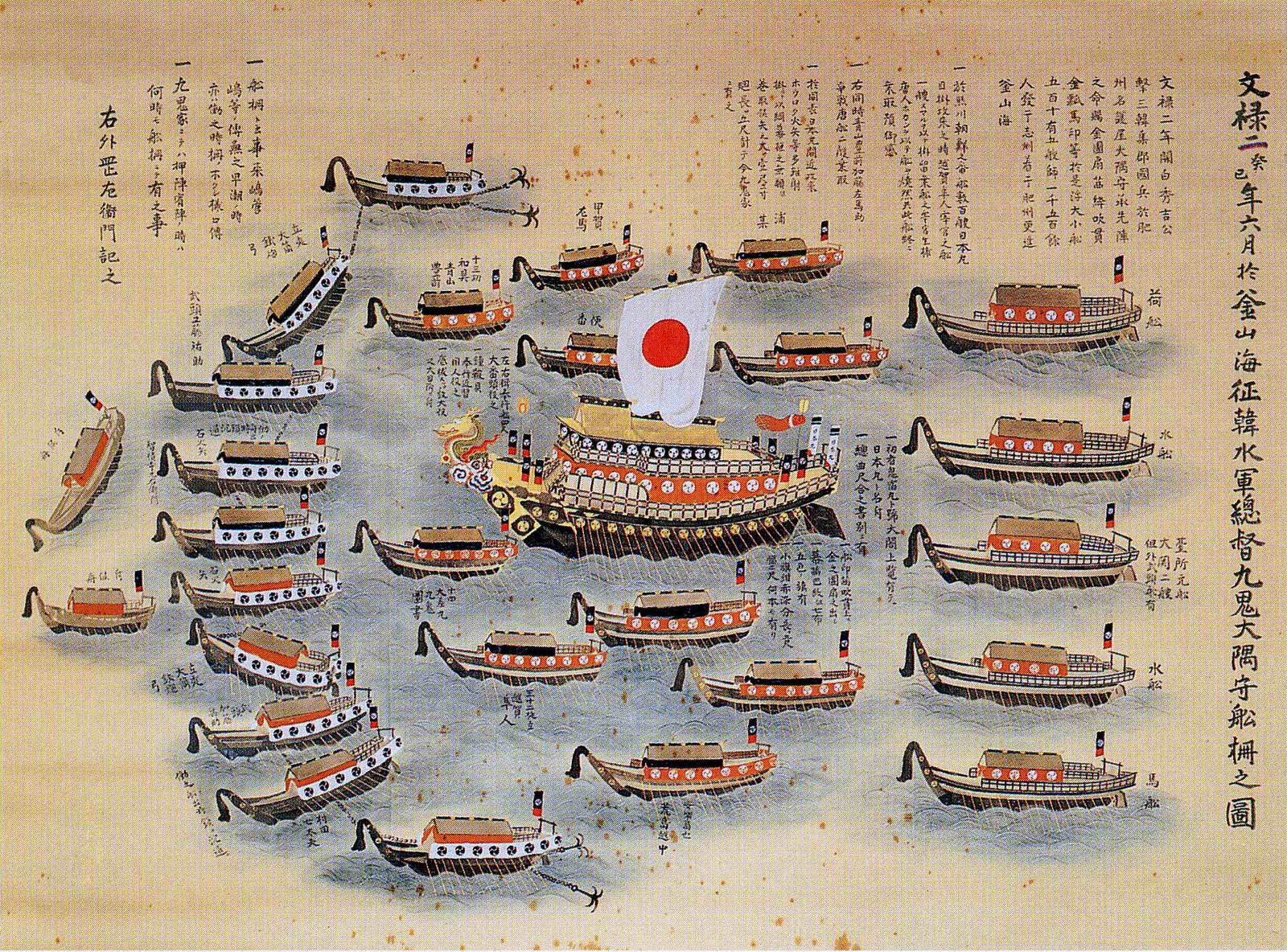
When Hideyoshi launched his invasion of Korea in the spring of 1592, the First Division was given to Konishi. Its composition was remarkable enough that Jesuit chroniclers and later historians reached, not entirely ironically, for the word crusade.
Konishi brought 7,000 men from Higo. Sō Yoshitoshi of Tsushima, his son-in-law, brought 5,000 and had been secretly baptized Dario by Alessandro Valignano the previous year. Matsuura Shigenobu of Hirado brought 3,000 and remained stubbornly non-Christian, though his wife was not. Arima Harunobu, Dom Protásio, brought 2,000 from Shimabara. Ōmura Yoshiaki, Dom Sancho, son of the first Christian lord in Japanese history, brought 1,000. Gotō Sumiharu brought 700 from the islands. 18,700 men, the majority of their senior commanders Catholic, marched north into a Confucian kingdom under standards bearing crosses.
Valignano, who never missed an opportunity, dispatched the Spanish priest Gregorio de Céspedes to join them at Konishi’s fortress at Komunkai, which makes Céspedes the first European priest documented on the Korean peninsula, an honor secured by arriving with an army that was burning it.
What followed was the most successful three months of Konishi’s life. The landing on 23 May 1592 was unopposed, Pusan fell in a day, and Seoul fell on 12 June, 19 days later, Konishi beating Katō Kiyomasa to the capital by a matter of hours, which Katō never forgave. By 23 July the Japanese had taken Pyongyang and were standing on the Taedong River looking at the Ming frontier.
That was the high-water mark, and Konishi understood it before anyone in Osaka did.
The Letter That Was Not From Hideyoshi
The Forged Surrender Document That Deceived the Ming Court
The Ming intervened, Pyongyang was abandoned on 8 February 1593, Seoul was evacuated in April, and the Japanese fell back on a chain of coastal fortresses to wait. Hideyoshi, who had never seen Korea, then produced his terms.
The seven demands, set down on 28 June 1593 and handed to Konishi and his fellow negotiators, required that a daughter of the Ming Emperor become consort of the Japanese Emperor, that the licensed kango tally trade be resumed, that oaths of amity be exchanged between high ministers, that the four southern provinces of Korea and the capital be ceded permanently to Japan, that a Korean prince and senior ministers be delivered as hostages, that the two captured Korean princes be released, and that Korea swear never to oppose Japan again.
The Ming court, which had just spent a winter and a great deal of money throwing the Japanese out of Pyongyang, regarded Japan as a peripheral tributary and Hideyoshi as an upstart. No version of this document could be presented in Peking without the presenter being executed, and Konishi knew it.
He found a counterpart with the same problem. Shen Weijing, the Ming negotiator known in Japanese records as Shin Ikei, also wanted the war over and also could not deliver what his master demanded. What the two men constructed between them, in Konishi’s Korean fortress at Ungch’on, was a document that did not exist.
The forged jiangbiao, the memorial of surrender, was written in Hideyoshi’s name and signed “the former kampaku of Japan, Your Majesty’s subject Taira no Hideyoshi.” It begged, in the appropriate register of humility, for the title of an imperially invested vassal king. It omitted all seven demands. It promised full Japanese withdrawal from Korea. It was precisely the document the Ming court expected from a chastened barbarian, and it was carried to Peking by Naitō Joan, Dom João, a Christian exile and friend of Konishi’s.
In early 1595 Joan presented the counterfeit at the Ming court. Suspicious ministers raised the obvious questions about Japanese political structure, and Joan assured them, with a straight face, that the Japanese Emperor and the Shogun were the same person. The court accepted the submission, cast a gold seal and appointed an investiture embassy to crown Hideyoshi king.
The scheme survived for three years and then collapsed in stages. When the Ming embassy reached the Japanese camp at Pusan in late 1595, the chief ambassador Li Tsung-ch’eng grasped the gap between the document he was carrying and the demands the Japanese were still making, calculated his own life expectancy, and absconded in the night. Peking promoted his deputy Yang Fangheng, and Konishi, whose authorship remained undiscovered, escorted the delegation to Japan personally.
On 22 October 1596, at Osaka Castle, an earthquake that summer having flattened the audience hall at Fushimi, Hideyoshi received the ambassadors with full ceremony, believing that the Ming Empire had surrendered to him. He put on the Chinese crown and robes. He accepted the gold seal. Asked to genuflect before the imperial edict he refused outright, and an attendant covered the moment by explaining that His Excellency had a boil on his knee.
The following day, at the celebratory banquet, Hideyoshi ordered the Zen priest Saishō Shōtai to read the rescript aloud. It contained not one syllable of the seven demands. It informed the ruler of the country, in the flat imperial formula, that he was hereby invested as king of Japan.
Hideyoshi tore off the robe and the crown, threatened to kill the ambassadors, and drove them out of the castle.
The Noses of Namwon
Konishi in the Second Korean Invasion and the Siege of Namwon
Konishi should have died in the last week of October 1596. He survived by two mechanisms, one theological and one bureaucratic.
Saishō Shōtai persuaded Hideyoshi that investiture from China was an ancient and prestigious custom among neighboring states. Konishi supplied the second argument himself, which was that the three commissioners, Ishida Mitsunari, Ōtani Yoshitsugu and Mashita Nagamori, had co-signed the truce documents and were therefore precisely as culpable as he was. It worked. Sympathetic missionary correspondents conceded, in otherwise admiring accounts, that Dom Agostinho had lied rather neatly to secular authorities on at least three occasions.
He kept Higo and he kept his command. What he lost was the entire policy that had justified his existence in the war. The peace faction was discredited overnight, Hideyoshi ordered the second invasion in early 1597, and the rift between Konishi’s civilian faction and Katō Kiyomasa’s military one hardened into something permanent that runs in a straight line from the banquet hall at Osaka to the fog at Sekigahara four years later.
Konishi’s first act in the new war was to try to have Katō killed by the Korean navy.
The operation was elegant. A double agent named Yojiro of Tsushima presented himself at the camp of the Korean commander Kim Ung-so, professed his loyalty, explained that Konishi hated Katō for wrecking the peace, and supplied the date and place of Katō’s sea crossing. Admiral Yi Sun-sin, the one Korean commander the Japanese genuinely feared, smelled the trap and refused to sail, and Katō landed near Pusan unmolested on 1 March 1597. Yojiro then returned to the Korean camp to lament, at length, Admiral Yi’s cowardice.
The Korean court did the rest. Yi was condemned on 14 March, taken in ropes on 12 April, caged, and replaced with Won Kyun, whose handling of the fleet at Chilcheollyang on 28 August resulted in the near-total annihilation of the Korean navy and his own death. Konishi had removed the finest naval commander of the age by writing a rumor.
Then came Namwon. On 23 September 1597 50,000 Japanese of the Left Army under Ukita Hideie, Konishi’s division among them, surrounded a fortress held by 3,000 Ming under Yang Yuan and 1,000 Koreans under Yi Bok-nam. On the night of 26 September, after a two-hour barrage of musketry and cannon, the Japanese piled wet green rice stalks into a ramp against the stone wall and went over the parapet.
Hideyoshi had ordered proof of the killing. Because heads were too heavy to ship in quantity, the proof took the form of noses, cut from the dead, salted, packed in barrels and sent to Japan for counting and burial. Namwon yielded 3,726. Ukita’s division supplied 622, Hachisuka Iemasa’s 468, Shimazu’s 421.
Konishi’s men supplied 879, the highest total of any contingent in the army.
The protector of the Japanese Church, the patron of the Amakusa press, the lord who had spared a defeated rebellion against Hideyoshi’s direct order, commanded the division that cut the most faces off the most corpses at Namwon.
The war ground down into fortress-holding at Suncheon, where by June 1598 Konishi held 13,700 men on a walled peninsula on Kwangyang Bay known as Waegyo, the Japanese bridge, from the causeway over its seawater moat, and a combined Chinese and Korean army could not dislodge them. Hideyoshi was already dead and the regents had ordered every man home. On 14 December 1598 Konishi bribed the Chinese admiral Chen Lin to let a vessel through the blockade with a request for a rescue fleet to Shimazu Yoshihiro at Sacheon; Yi Sun-sin, reinstated, intercepted the relief force in the Noryang Strait on 16 December and was killed there by a bullet under the arm.
While that was happening, Konishi took his transports out of Suncheon and sailed home.
The Reservation in the Oath
Why Konishi Joined the Western Army at Sekigahara
The alignments of 1600 had been set at Osaka Castle in 1596. When Tokugawa Ieyasu began consolidating power after Hideyoshi’s death, the men who had wanted the Korean war ended found themselves in one camp and the men who had wanted it fought in another, and Katō Kiyomasa was in the other one.
Konishi’s reasons for joining the Western Army were three, and only one was ideological. He was personally bound to Ishida Mitsunari, with whom he had dissembled and shared blame for four years, and was among the first to sign the secret list of lords pledged against the Tokugawa. He owed his entire existence as a lord to the Toyotomi, and when Ieyasu required a general oath of fidelity, Konishi swore it with an explicit reservation entered on the record, that nothing in it could override his primary obligation to Hideyoshi’s son Hideyori. And siding with Ieyasu would have meant accepting the permanent supremacy of Katō Kiyomasa, who held northern Higo, wanted the south, and would get it.
The battle itself has its own account. What matters here is where Konishi stood.
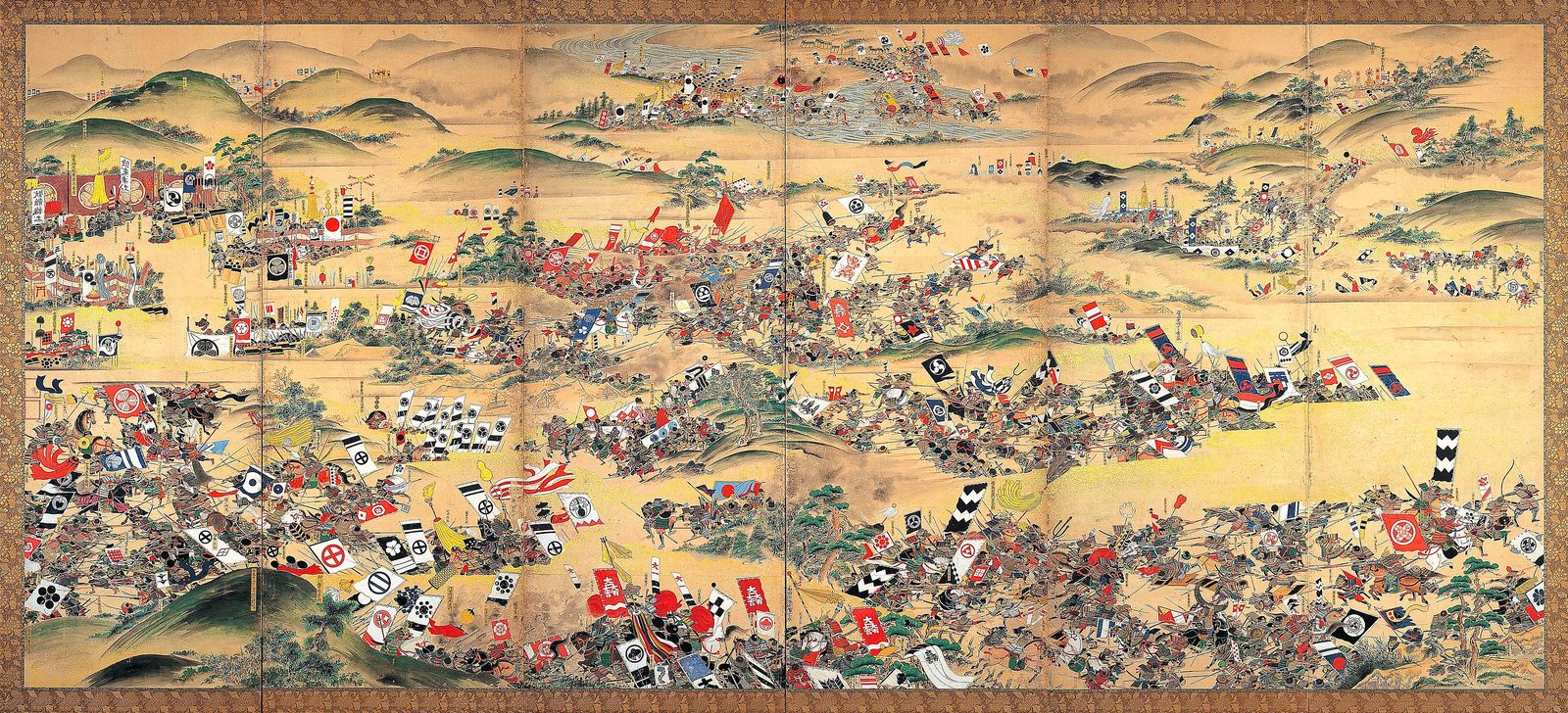
He marched out of Ōgaki Castle at seven in the evening on 20 October 1600 into a cold driving rainstorm, 12 miles of mud and darkness and wind, reached the Sekigahara defile around half past four in the morning, and deployed in the Western center beside the Shimazu contingent at Koike village, his right flank resting on Ukita Hideie’s 17,000. His own division numbered 4,000 men by Bryant’s reckoning, 6,000 by others.
When the fog lifted between half past seven and eight, it was Konishi’s units that fired the Western Army’s first signal flare. Around eleven, with his men near exhaustion, Terazawa Hirotaka, the governor of Nagasaki, cut clean through his lines and would be awarded the Amakusa islands for it.
Twice that morning, messengers from Konishi and from Ōtani Yoshitsugu climbed Mount Matsuo to plead with Kobayakawa Hideaki, whose 8,000 men, or 15,000 depending on the account, sat above the battlefield doing nothing. At half past twelve Kobayakawa came down the mountain into Ōtani’s flank, four more Western contingents changed sides within minutes, and Ōtani opened his belly.
The cry of treachery did the rest. Konishi’s division, surrounded and cut to pieces, held long enough for him to sound the nokigane, the retreat bells, and then broke. He rode into the forests of Mount Ibuki.
Four days later he walked out of them and asked a farmer to arrest him.
A Hellish Reason Introduced by the Devil
The Catholic Doctrine That Forbade Konishi to Commit Seppuku
The Catholic prohibition Konishi invoked on Mount Ibuki was not a vague scruple about violence. It was a specific doctrine, taught in Japan in Japanese, and he had paid for the press that printed it.
Louis Delplace records the instruction as the missionaries delivered it: life is the gift of an immortal God, and to take it is a grave injustice, because a man has no right to constitute himself his own judge. That last clause is the operative one, because seppuku was exactly that. The ritual was a judicial act. The samurai who opened his own belly was pronouncing sentence on himself, in public, and the whole moral force of the gesture came from the fact that he was both the condemned and the court.
The Fides no Doxi, printed at Kawachinoura in 1592 on the press Konishi had sheltered in his own islands, put it in Japanese for a Japanese readership. Self-killing was a hellish reason introduced by the Devil.
Eight years later, on a wooded hillside in Ōmi, the man who had made that printing possible applied the sentence to himself. Turnbull’s reading, which Samuel Hawley reaches by a different route, is that Konishi resolved to die by the executioner because he believed God had given him his life and it was not his to dispose of.
The Jesuits, who had spent 50 years failing to talk samurai converts out of ritual suicide, understood immediately what they had been handed. Their rhetorical problem, in a culture where the refusal to die by one’s own hand read as cowardice, was to make submission to the executioner look like courage, and the answer, worked out at length in Bartoli, was to reverse the polarity of the whole vocabulary: dying by one’s own hand became the easy path, the soldier’s reflex, and accepting capture, public parade and the executioner’s block became the harder valor.
It was a good argument and it was made in Rome for Roman readers. What it obscures is that Konishi asked for nothing at all.
The sources do not record him requesting a confessor. The Jesuits tried to reach him, using, in the phrasing of the account, every method conceivable; when Father Organtino later sent a Japanese brother to Osaka Castle to take the temperature of the new regime, Ieyasu asked him directly whether he had visited Konishi in Kyoto before the execution, and was told that he had not. Tokugawa security kept every priest out of the cell.
He went to Rokujō-gawara without Penance and without the Eucharist, on the strength of a book he had printed.
The Persimmon
Konishi’s Execution at Rokujo-gawara, 6 November 1600
On 1 November 1600 Ieyasu left for Osaka with three bound prisoners: Konishi, Ishida Mitsunari and the warrior-monk Ankokuji Ekei. They were mounted on pack animals, described in some accounts as donkeys, hung with placards identifying them as disturbers of the public peace of the empire, and paraded through Osaka, through Sakai, where Konishi’s family had kept its shop, and through Kyoto, while rival lords came out to the roadside to jeer.
Somewhere on that road, Mitsunari complained of thirst and asked for hot water. There was none. He was offered a cold persimmon instead and refused it, on the grounds that persimmons disagreed with his digestion.
Konishi observed that it hardly seemed necessary to consider one’s digestion just before decapitation.
Mitsunari’s reply is one of the few unimprovable lines in the record. That, he said, shows how little you understand. You can never tell how things will turn out the next minute, and so while you have breath in your body you have got to take care of yourself.
On 6 November 1600, 16 days after the battle, the three were taken to Rokujō-gawara, the dry gravel bed of the Kamo River where the capital had disposed of political criminals for centuries. Every source that discusses the date, European and Japanese, gives the same one; it is among the few things in this life that is not disputed.
A Japanese Christian layman, sent secretly by the Jesuits, pushed through the guards at the scaffold and urged Konishi to make a final perfect act of contrition, since no confessor could reach him. Konishi answered that he had already done so.
Buddhist bonzes were circulating among the condemned administering rites. Konishi refused them brusquely, in language the Jesuit accounts preserve with obvious pleasure, dismissing their superstitious ceremonies and apish tricks and forbidding them to touch him or chant over him. He then knelt on the sand, said his beads, held what one account describes as a curious picture of Our Lady with the Savior in her arms, and commended his soul.
Hawley notes, flagging it carefully as something transmitted by report rather than established, that it took the executioner three blows to sever his head.
The heads of all three were mounted on the public pillory at the Sanjō Bridge, which was standard procedure and is confirmed in both the Japanese and the European record. Bartoli alone adds that the head of the Misericórdia, the lay charitable confraternity, was permitted to speak with Konishi and to recover the body immediately after the beheading for Christian burial. No other source mentions it, and Bartoli had reasons to want it to be true.
What the Confraternities Remembered
Konishi’s Legacy, His Family and the Shimabara Rebellion
The dismantling took about a month. Southern Higo went to Katō Kiyomasa, uniting most of the province under a single lord at 520,000 koku and delivering to Konishi’s oldest enemy the exact prize he had wanted since Korea. Katō expelled the Jesuits and gave the tens of thousands of peasants baptized in the previous decade the choice of recanting or leaving. Amakusa, assessed at 40,000 koku, went to Terazawa Hirotaka, who tightened by degrees, destroying every church on the islands except the stations at Shiki and Kamitsura in 1604 and expelling the last hidden Jesuits by 1614.
The family took longer. His eldest son, Konishi Hyōgonokami, 12 years old, took refuge with Mōri Terumoto under a written safe-conduct, and summoned a missionary from Hiroshima to hear his confession. Terumoto broke his word, beheaded him, and sent the head to Ieyasu, who is reported to have expressed the liveliest indignation at the barbarity of the act, and who had recently betrothed one of his own granddaughters to the child.
His daughter Marta was divorced by Arima Naozumi, in flat defiance of the marriage doctrine he had been taught, so that he could marry Ieyasu’s great-granddaughter Kunihime, and spent the rest of her life in Nagasaki as a religious recluse. His other daughter Maria had been married in 1592 to Sō Yoshitoshi of Tsushima on Hideyoshi’s orders, to cement the naval alliance that made the Korean landings possible, and a Jesuit visiting in 1596 described the 22-year-old Maria running her household on a discipline of daily prayer and weekly self-flagellation. After 1600, Yoshitoshi apostatized and divorced her to protect his fief. Maria fled to Nagasaki, cut off her hair, took a vow of castidade, and died in 1605.
Mancio Konishi, probably their son, raised in exile in Macau and ordained a Jesuit in Rome, slipped back into Japan in disguise in 1632. He was the last Jesuit priest at liberty in the country, and when he was put to death in 1644 there was not a single missionary left at work in Japan.
In Europe, meanwhile, Konishi was becoming a stage character. In Genoa in 1607, audiences watched an opera called The Japanese King Agostino, Lord of Settsu, in which a provincial governorship had become a kingdom and a court title had become a name. The Jesuits in Japan were less comfortable. C. R. Boxer noted that after Sekigahara the mission was correspondingly ill at ease, and when Ieyasu later accused the Christians, good-humoredly, of having been of the counsel of his enemies, Boxer’s verdict is that the accusation was perfectly correct. Had the Western Army won, the annual letters would have celebrated Konishi’s statesmanship along with his piety. He lost, so only the piety was usable.
The historiography has been arguing about him ever since. Turnbull’s Konishi is the true Christian knight, whose refusal was consistent with a lifetime of documented leniency; Petrucci’s is a shrewd operator whose faith was both sincere and instrumental; Endō’s, in the novel Tetsu no Kubikase, is a weak believer living the double life of menjūfukuhai, outward obedience and inner opposition, resolved at last by the refusal at Ibuki. Murdoch was scathing about the ecclesiastical historians who had idealized a Sengoku warlord into a shadowy and illusive Christian Pius Aeneas.
What survived him was not the argument. It was the organization.
Konishi’s real achievement was buying the Japanese Church roughly 13 protected years, 1587 to 1600, in which a college, a novitiate and a printing press operated more or less openly on Japanese soil and the lay confraternities were built out across Higo and Amakusa. The Confraria and the Jihi no Kumi, the groups of compassion, were parish structures organized around families, with elected officers, designed to keep a village Catholic in the absence of a priest, which is precisely what they proved capable of doing.
In the winter of 1637, when famine and the extortions of Terazawa Katataka and Matsukura Katsuie pushed the Shimabara peninsula and the Amakusa islands into open rebellion, the men who organized it were his. Five Christian rōnin, all former Konishi retainers living at Oyano and Chizuka, started the Amakusa half of the rising, the villages were mobilized by headmen and elders who had been Konishi and Arima samurai before 1600 and had kept their weapons, and the rebels rebuilt themselves into combat units along the lines of the confraternities. The boy they put at the head of it, Amakusa Shirō, was the son of Masuda Jinbei, a direct retainer of Konishi Yukinaga.
37,000 of them held the ruins of Hara Castle against a shogunal army of over 120,000 for four months, until the final massacre on 12 April 1638.
Konishi’s domain had been confiscated in a month. The habit of organization he left behind took the Tokugawa state 120,000 troops and an entire winter to destroy, and the devotional habit was never destroyed at all. Along the Nishisonogi peninsula and out in the Gotō islands, the descendants of the families who had fled the Higo purges kept baptism and the prayers going in secret for two and a half centuries, and remembered, among the other things they remembered wrong and right, that there had once been a lord who was offered the honorable way out and would not take it. He is easy to describe unkindly. He is also the man who stood on a hillside above Sekigahara with a sword at his hip and a clear route to a dignified end, and worked out that it was not his to take.
The Jesuits made him a martyr, which he was not, and the chronicles made him a traitor, which is not quite it either. What he actually was is harder to file: a druggist’s son who bought the Church 13 years with silk money, and then declined to be his own judge.
Sources & Further Reading
Bartoli, Daniello. Dell’Istoria della Compagnia di Gesù: Il Giappone. Rome, 1660. The fullest early European narrative of Konishi’s capture, parade and execution, and the source of the martyrological framing, including the deathbed letter and the Misericórdia burial, that later Jesuit and Catholic historians repeated.
Boxer, C. R. The Christian Century in Japan, 1549-1650. University of California Press, 1951. Establishes the commercial foundation of the mission, the silk trade in which the Konishi family operated, and supplies the frank assessment that the Jesuits really had been of the counsel of Ieyasu’s enemies.
Bryant, Anthony J. Sekigahara 1600: The Final Struggle for Power. Osprey Publishing, 1995. The military chronology of the 1600 campaign used here, including Konishi’s night march out of Ōgaki, his deployment in the Western center and the strength of his division.
Cardim, António Francisco. Elogios e ramalhete de flores borrifado com o sangue dos religiosos da Companhia de Jesus. Lisbon, 1650. Representative of the Portuguese catalogs of those held to have died for the faith in Japan, in which Konishi was entered alongside ordained martyrs.
Crasset, Jean. Histoire de l’Église du Japon. Paris, 1689. The compilation through which the annual letters describing Rokujō-gawara reached a wide European readership, and one of the works Murdoch later attacked for idealizing its subject.
Delplace, Louis. Le catholicisme au Japon. Brussels, 1909. Sets out the doctrinal prohibition on suicide as the Jesuits taught it in Japan, and the missionary program of softening samurai custom that made Konishi’s refusal legible as virtue rather than cowardice.
Elison, George. Deus Destroyed: The Image of Christianity in Early Modern Japan. Harvard University Press, 1973. Includes the translation of Fabian Fucan’s Refutation of Deus, the hostile source that dates Konishi’s death at the age of forty-four and thus supplies one of the three competing birth years.
Endō, Shūsaku. Tetsu no Kubikase: Konishi Yukinaga Den. Chūōkōronsha, 1977. The dominant modern Japanese treatment, reading Konishi as a compromised believer living a double life under an anti-Christian overlord, and the direct counterweight to the Jesuit hagiography.
Hawley, Samuel. The Imjin War: Japan’s Sixteenth-Century Invasion of Korea and Attempt to Conquer China. Royal Asiatic Society Korea Branch, 2005. The detailed account of Konishi’s First Division, the Yojiro deception against Yi Sun-sin, the storming of Namwon and the nose count, and the siege and escape at Suncheon.
Murdoch, James. A History of Japan, Volume II: During the Century of Early Foreign Intercourse, 1542-1651. Kegan Paul, Trench, Trübner, 1925. Source of the 200,000 koku assessment of Higo, the Sekigahara casualty estimate, the persimmon exchange, and the most sustained skeptical attack on the ecclesiastical portraits of Konishi.
Petrucci, Maria Grazia. In the Name of the Father, the Son, and the Islands of the Gods: A Reappraisal of Konishi Ryusa and Konishi Yukinaga. University of British Columbia, 2005. The fullest reassessment of the family as merchants, showing how Christianity, maritime trade and the confraternity structures functioned together as instruments of Konishi rule.
Turnbull, Stephen. Samurai Invasion: Japan’s Korean War 1592-1598. Cassell, 2002. Covers the Christian composition of the First Division, the presence of Gregorio de Céspedes in Korea, and argues the case for reading the refusal of seppuku as sincere and consistent religious conviction.
Recent scholarship
- Clements, Rebekah (2026). “Hunting and Samurai Authority in Korea during the Imjin War of 1592–1598”, Japan Review, 41, pp. 31–56. — This concise study reveals how Japanese samurai tried to project authority in Korea through hunting rituals that did not resonate with the local population, offering a sharp cultural lens on the Imjin War.Free full text ↗ (opens in a new tab)
Cite this page
Nanban.pt. “The Sword Was at Hand: Konishi Yukinaga, the Merchant’s Son Who Refused Seppuku, c. 1555–1600.” Last modified 7 October 2026. https://nanban.pt/articles/konishi-yukinaga/.
@misc{nanban-konishi-yukinaga,
  author = {Nanban.pt},
  title = {The Sword Was at Hand: Konishi Yukinaga, the Merchant’s Son Who Refused Seppuku, c. 1555–1600},
  year = {2026},
  url = "https://nanban.pt/articles/konishi-yukinaga/",
  note = {Last modified 2026-10-07}
}