Softened into the Colloquial Tongue: The Jesuit Mission Press in Japan, 1586–1620
A printing press bought in Lisbon and carried home by four teenage legates, a fount of italic type cut out of wood for less than six ducats, a blind lute player arguing with a young samurai in the Japanese people actually spoke, and a mountain of books burned in Nagasaki on a July morning in 1626: the 100 books of the Kirishitan-ban recorded how 16th-century Japanese sounded, and roughly 30 of them survived to prove it.
The Kirishitan-ban were the roughly 100 books printed by the Jesuit mission press in Japan between 1590 and 1614, using European movable type bought in Lisbon and carried home by the Tensho Embassy, which landed at Nagasaki on 21 July 1590. Printed at Katsusa, Amakusa, Nagasaki and Kyoto in romanized Japanese and later in kanji and kana, they include the 1603 Vocabulario da Lingoa de Iapam and the Amakusa Feiqe no Monogatari of 1592, and only about 30 survive, most of them in European libraries.
The First Sheet
The First Printing by the Jesuit Mission Press, Goa 1588
In April 1588, in a room at the Jesuit college in Goa, a young Japanese catechist named Constantino Dourado locked a forme of Latin type into its iron chase, dampened a sheet of paper, ran it under the platen of a wooden press, and pulled the bar.
What came off was a short Latin oration, Oratio habita a Fara D. Martino, the formal address of thanks delivered by Martinho Hara to the fathers of the college. Hara was one of four boys from Kyūshū who had left Nagasaki in 1582 as legates to the Pope and were now on the long way home. The printing was an occasional piece, the sort of thing struck off to be handed around after dinner, and nobody who handled it thought of it as an event.
It was the first sheet ever produced by the press that would go on to print the Japanese language.
The equipment had been bought in Lisbon, crated, and put aboard ship, and it had been at sea or in storage ever since. It would be another two years and two more voyages before it reached the country it had been purchased for. When it finally did, it would spend 24 years printing catechisms, grammars, dictionaries, Aesop’s fables and a version of the Tale of the Heike.
Dourado, who set that first forme, was a dōjuku, a lay catechist attached to the Society without vows, born at Isahaya on the Hizen coast. He had been taught to compose, cast and print by men who assumed he would go home and do the same work in an alphabet he already knew. Nobody in Portugal appears to have thought hard about what would happen when the press was asked to print a language with two syllabaries and several thousand Chinese characters, none of which existed in any European type case.
Someone had thought about it. He was in Goa at the time, and he had been thinking about it for eight years.
An Immense Drain on Manpower
Why Valignano Ordered a Printing Press for Japan in 1580
Alessandro Valignano, the Italian Visitor of the Jesuit missions in the East Indies, had toured Japan between 1579 and 1582 and come away with a list of institutional complaints, most of them about paper.
The Japan mission ran on manuscript. Every catechism, every grammar, every list of vocabulary had to be copied out by hand, and the hands available were the missionaries’ and their Japanese assistants’, who had other work. Valignano’s own summary of the problem, as the sources preserve it, was that copying was an immense drain on the mission’s scarce manpower. Importing printed books from Europe solved nothing: the freight was ruinous, the voyage took anywhere from 18 months to four years, and a consignment could simply fail to arrive. There was also a doctrinal argument. A church expanding as fast as the Japanese church was expanding could not be allowed to teach four different versions of the same catechism in four different provinces, and manuscripts drift.
In June 1580 Valignano promulgated his Seminary Regulations for the Japanese colleges, and among the provisions for diet, discipline and the study of letters is a sentence with no European precedent behind it. A printing press, the regulations state, must be introduced so that books necessary for instruction can be readily obtained in Japan. The press was built to serve his policy of accommodation to Japanese custom, and above all his rule that every missionary learn the language properly. It was, in the strictest sense, a language-teaching machine that also printed prayers.
There was, however, a further reason, subtler and more revealing, that Valignano wanted the machine. In December 1587, writing from Goa to the Archbishop of Évora, he explained with characteristic candor that he had personally ordered the press so that the Jesuits could censor and purify books before circulating them in Japan. He wanted his Japanese seminarians to read what he considered appropriate Catholic works. He did not want them reading anything that mentioned the European Wars of Religion, the Protestant reformers, or any of the delicate theological quarrels then convulsing the universities of Louvain and Salamanca. Japan was to have a Catholicism curated by Valignano personally, scrubbed of European embarrassments, and this required that the production of books be under Jesuit physical control.
It was, in its 16th-century way, a thoroughly modern impulse. The founder of the Japan mission’s most ambitious educational project wanted a closed information environment for his students, and he was prepared to ship an industrial machine halfway around the world to get it.
What he wanted was Christian doctrine in front of Japanese readers in their own characters, in kanji and kana and not only in the Latin alphabet. The Superior General in Rome, applying himself to the problem from a distance of some 15,000 miles, wrote on 24 December 1585 to suggest that Japan simply adopt Chinese woodblock technique and forget European type altogether.
He was, from an accountant’s point of view, entirely right, and he was ignored.
The machinery to ignore him with came home with the Tenshō Embassy, the four Christian teenagers Valignano had sent to be received by Philip II and by Pope Gregory XIII, and whose progress he was also using as freight. In 1584 he wrote from the Indies to the party’s guide, Father Diogo de Mesquita, with a shopping list: European founts of type, and, crucially, matrices of the Japanese kana syllabary, which meant persuading somebody in Portugal to cut punches for a script no punchcutter there had ever seen. Whether any kana matrices were actually obtained is not clear from the record. What is clear is that the mission understood from the beginning that Roman type alone would not do.
Valignano also had members of the Japanese entourage apprenticed to the trade, in Lisbon and then in Goa: typecasting, punch-cutting, matrix-making and press-work, four distinct crafts guarded in the 16th century by four distinct sets of professionals. Three Japanese learned the work. Constantino Dourado became the principal compositor and pressman of the entire enterprise, and printed at Goa, at Macao and in Japan. The most gifted of them, by the accounts of those who knew him, was Irmão Jorge de Loyola, a Japanese Jesuit brother who had tutored the boys in Europe and mastered the press alongside Constantino.
Loyola died at Macao on 16 August 1589.
He never saw the press land in Japan, and the mission never replaced him.
Four Years and Three Oceans
How the Press Traveled from Lisbon to Nagasaki, 1586 to 1590
The press left Lisbon on 13 April 1586, in crates, on the same fleet that carried the four legates home.
What was in the crates deserves a moment, because the phrase “a printing press” flattens an assembly of objects with wildly different tolerances. There was the press itself, a timber frame the size of a door, with a screw, a bar, a platen and a sliding carriage, most of which could be replaced by any competent carpenter anywhere on earth. There was ink, which for letterpress work is not ink at all in the modern sense but a stiff varnish of boiled linseed oil and lampblack, closer to a paste than a liquid, because water-based ink beads and runs off metal type. And there was the type: tens of thousands of individual sorts cast from an alloy of lead, tin and antimony, sorted into cases, each one a manufactured object no Asian foundry could reproduce without the matrices from which it had been struck.
The type was the irreplaceable part. Everything else was carpentry.
The fleet met foul weather and was forced to winter in Mozambique, which cost the better part of a year, and reached Goa on 29 May 1587. On 22 April 1588 the press sailed again, on a vessel commanded by Captain-Major Aires Gonçalves de Miranda, and reached Macao on 28 July.
There it stopped, because Japan had changed. In July 1587 Toyotomi Hideyoshi had issued the edict expelling the missionaries, and Valignano judged that this was not the moment to land a Christian printing house at Nagasaki. He kept press, printers and type in Macao for nearly two years, and put them to work: Christiani Pueri Institutio, the schoolbook of Juan Bonifacio, in 1588, and De Missione Legatorum Iaponensium ad Romanam Curiam, turned into elegant Latin dialogue by Duarte de Sande, in 1589 and 1590.
On 23 June 1590 the crates went aboard a Portuguese carrack for the last leg. The captain-major is recorded as Henrique da Costa, though at least one source gives the name as Antonio da Costa, and the sources have never been reconciled. The ship made landfall at Nagasaki on 21 July 1590, a date on which the surviving accounts vary between the 18th and the 22nd.
Four years and three months after leaving Lisbon, the press was in Japan. It was installed within weeks at the Jesuit college at Katsusa, on the southern tip of the Shimabara Peninsula in the Arima domain, which was chosen for the excellent reason that it was about as far from Hideyoshi as a building in Japan could be.
The Alphabet That Wasn’t There
Why the First Kirishitan-ban Were Printed in Roman Letters
The first trial printing inside Japan, in October 1590, was a set of prayers in katakana. The first actual book, printed at Katsusa in 1591, was Sanctos no Gosagueo no Uchi Nuqigaqi, selections from the acts of the saints, rendered into elegant colloquial Japanese by the convert Yōhō Paulo and his son Vicente Hōin.
It was printed in the Latin alphabet.
That decision, which shaped much of what the press produced for the next decade and made the Kirishitan-ban the most valuable body of evidence in the history of the Japanese language, was not a linguistic experiment. It was a hardware constraint. The press had arrived with Roman type and nothing else. A newly arrived European priest could not read kanji and would not be able to for years, but he could read Sanctos no Gosagueo aloud from the page on the day he landed, and preach from it. Romanized Japanese was what the mission had, so romanized Japanese is what it printed.
Building the other kind of type from scratch took the better part of a decade.
The European method ran like this. A punchcutter took a bar of steel, filed and gouged the mirror image of a single letter into its end face, hardened it, and drove it with a hammer into a bar of soft copper. The resulting sunken impression, the matrix, was justified and clamped into a hand mold, molten alloy was poured in with a flick of the wrist, and the mold was opened to release one piece of type. Repeat several thousand times. The whole system depended on the punch, and punchcutting was the most specialized, slowest and most expensive craft in European printing. A single fount could take a master a year.
Japan did not have steel punchcutters. Japan had, in almost every temple town in the country, woodblock carvers of extraordinary skill, men who cut characters in mirror image on cherry blocks as a matter of routine.
So the mission substituted wood for steel. Japanese craftsmen cut the character shapes as wooden patrices and struck matrices from them, which is not how any European printing office worked and which cost a fraction as much. In 1594 Father Francisco Pasio reported that Japanese craftsmen with no previous exposure to Western printing had produced a complete fount of letra grifa, italic, for under six ducats. That first fount yielded lowercase only, and the results were evidently regretted. But the method held. In February 1599 Mesquita reported from Nagasaki that Japanese novices and lay residents had produced 2,000 punches and matrices for Roman and italic type, and that the mission would no longer need to import from Europe at all.
For Japanese characters the workshop went further, cutting dies for the individual radicals, the recurring components from which kanji are built, so that complex characters could be assembled systematically rather than cut one at a time. By 1599 the Nagasaki shop had cast over 2,500 kanji, numerous variant forms, and a large stock of kana. The European founts that had crossed three oceans were retired.
Sorts, Ligatures, and the Running Hand
How Japanese Movable Type Handled Cursive Kana
The Japanese-character books came in two sizes of type, and the difference between them is a record of the workshop learning its own business.
The large fount, about 10.5 millimeters on the body, was used for the earliest Katsusa and Amakusa work, including the 1591 Dochiriina Kirishitan and the 1593 Bauchizumono no Sazukeyō, a manual for baptism. It is a big, generous, slightly clumsy face. In 1594 the shop introduced a small fount of about eight millimeters, cut deliberately to match the width of Western Roman type so that the two could be set on the same line without fighting each other, and it is this size that carries the great reference works, beginning with the Rakuyōshū dictionary of 1598.
The genuinely difficult problem was cursive. Japanese was not written as a series of discrete separated characters but as a running hand, sōsho, in which kana flow into one another and the connection between two syllables is part of the letterform. Movable type is by definition discrete. A Japanese reader confronted with a page of separated kana would have found it correct, legible and subtly wrong, in the way a page of English set entirely in capitals is wrong.
The Nagasaki workshop solved it by casting the connections. It produced conjoined sorts, renmen-katsuji, single pieces of type carrying two or more linked kana, so that a compositor could assemble a page that looked handwritten. The bibliographer Shirai Jun has counted them across successive editions, and the numbers show the fount growing in public. Sarubatoru Munji of 1598 uses 167 conjoined sorts. The Dochirina Kirishitan of 1600 uses 265, with 18 new. The ligatures were chosen for frequency and for voicing relationships, and they were cut so that no single sort ever spanned a word boundary, which is a design decision of some sophistication for a workshop that had existed for eight years.
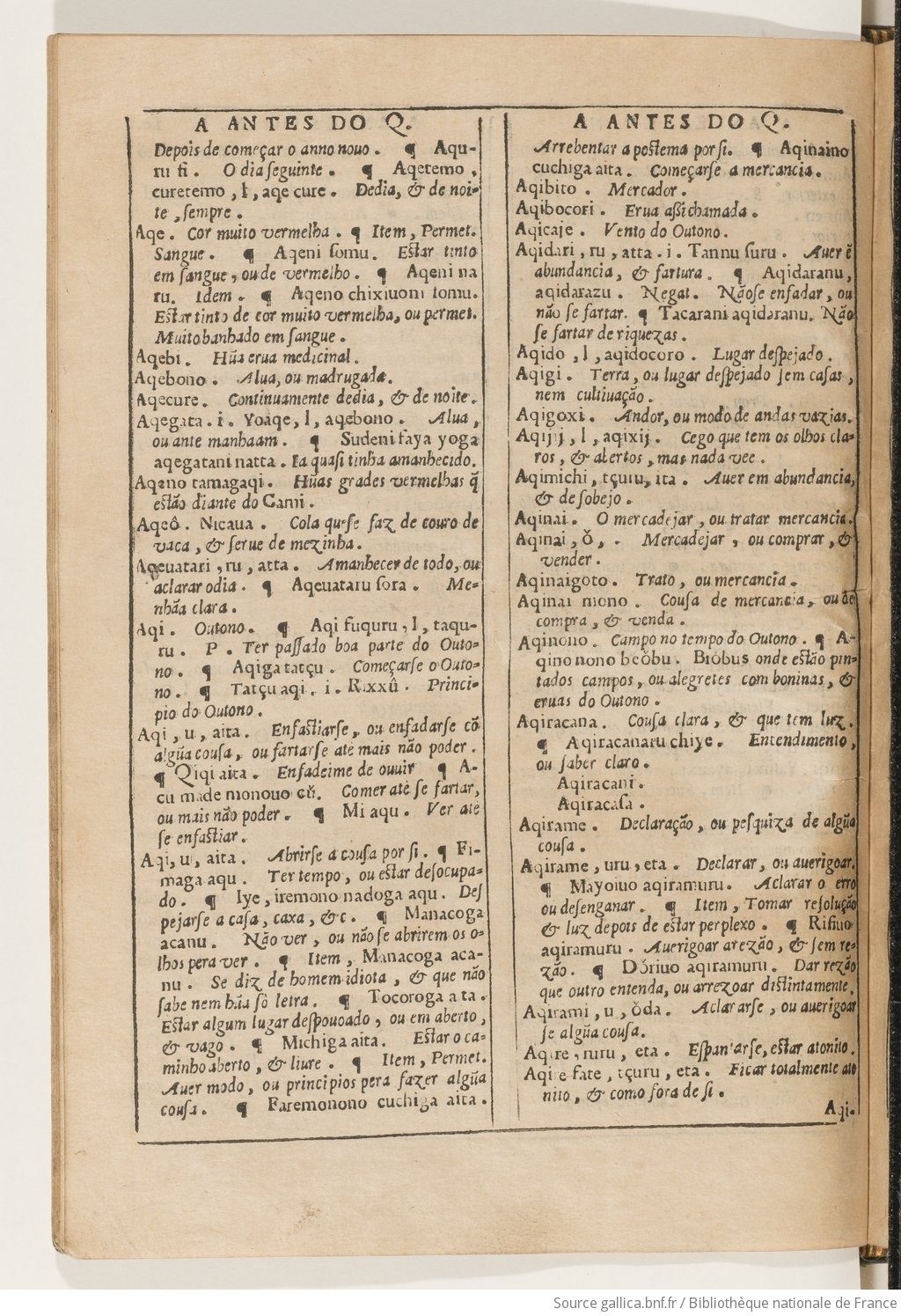
The Roman side of the case, meanwhile, was starving. Nakano (中野遙) analyzed the 1603 Vocabulario and found two entirely different uppercase A, B and C in use on the same pages, the older European casts standing 0.3 centimeters and dropping below the baseline, the newer domestic casts standing 0.2 centimeters and sitting on it. For every other capital letter, the Nagasaki shop simply lacked the resources to cut and cast Roman uppercase, and substituted italic capitals in the Japanese headword sections instead. Roman capitals from D onward were not finally cast until 1605.
That same 1605 Manuale ad Sacramenta is the only book known to have been printed in two colors, red and black, by the Christian press in Japan. Whoever set it had to run every sheet through the press twice, in perfect register, with two separate formes.
They did it once.
The Weight of the Paper
The Paper and Binding of the Kirishitan-ban
Codicological work on the surviving copies, much of it by Toyoshima Masayuki under optical microscopy, has shown that the mission press did not treat paper as a commodity. It matched the substrate to the book.
Romanized books, the dictionaries and grammars set horizontally and read left to right, were printed on both sides, in the European manner. Books in vertical kanji and kana, the kokujibon, were printed on washi, on one side of the sheet only, and bound fukuro-toji, the bag binding in which each folded leaf presents its two printed faces outward and its blank interior is sewn into the spine. That was not aesthetic conservatism. Japanese paper of the period was thin and absorbent enough that letterpress impression on one side showed through on the other, and the bag binding is the standard Japanese solution to exactly that problem. Deluxe copies used gampi or torinoko, the smooth, dense bark papers reserved for presentation work. Main-text paper in the surviving copies runs approximately 60 to 70 micrometers thick, which is to say roughly the thickness of a human hair.
The romanized editions were quarto or octavo, and octavo mattered enormously to the men doing the work, because an octavo sheet carries 16 pages, eight on each side, so the compositor had to set, impose and correct 16 pages at once, in an order that makes sense only after folding, before a single impression could be pulled.
The most delicate operation in the shop was the frontispiece. The engraved copperplate frontispieces of the finer editions could not be printed on the letterpress at all, because intaglio printing requires the paper to be forced down into the incised lines of the plate. They were printed first, on a separate rolling press, at pressures the letterpress never approached. In the Tōyō Bunko copy of the 1592 Doctrina Christa, measurement shows that the border of the plate sank about 35 micrometers into the gampi, which on paper of 60 to 70 micrometers is roughly half the sheet’s entire thickness.
A sheet deformed like that does not lie flat, and it does not take a second impression evenly, so compositors avoided printing text on the reverse of an engraving as a standing rule of the house, broken exactly twice in the whole corpus, for the 1593 Amakusa Heike and the 1607 Spiritual Exercises, where the preliminary matter was finalized after the body of the book had been printed and the first gatherings had to go back through the letterpress a second time.
The surviving sheets also record what went wrong. Double-printing. Ghosting. Offsetting, where a freshly printed sheet was laid against another and left a mirror image of itself behind.
Somebody dropped things. The evidence is bound into the books.
A Japanese Spelled in Portuguese
The Jesuit Romanization of Japanese and What It Records
The orthography the mission built for Japanese was Portuguese, with borrowings from Latin and Italian, because Portuguese was the working vernacular of the enterprise and because the men who designed the system heard Japanese through Portuguese ears.
It was built for three purposes. It supplied textbooks for the mission’s language schools, where Valignano’s rules required every new missionary to spend two full years on the language and nothing else. It enforced doctrinal precision, urgent after the early mission’s use of Dainichi for God had left a good number of converts under the reasonable impression that Christianity was a new Buddhist school, so that the load-bearing terms were left untranslated, Deus, anima, graça, sacramento, transcribed and glossed. And it standardized a language whose own script did not record phonetic value.
The system treated Japanese as having five vowels, written A, I, U, Ye and Vo, with pure e and o not standing alone. The k-row was written ca, qi, cu, que, co, using qu to preserve the hard velar where Portuguese c would have softened before a front vowel. The s-row gave sa, xi, su, xe, so, with Portuguese x standing for the sound English writes as sh. Palatal n was written nh, geminates were doubled, and every Japanese word was understood to end in a vowel, or in n, or in t.
And the h-row was written fa, fi, fu, fe, fo.
That single convention is the reason the Kirishitan-ban matter to linguistics. The Jesuits wrote Feiqe for Heike, Nifon for Nihon, Firando for Hirado, Faxiba for Hashiba. João Rodrigues states outright in his grammar that in their system h was replaced by f. They were not approximating badly. The modern Japanese h-row was still being pronounced as a voiceless bilabial fricative, the sound made by blowing out a candle, and the glottal [h] of modern Japanese had not yet emerged. The spellings caught the language mid-shift, and the point survives wherever a Portuguese loan preserves the sound, which is one strand of the longer story of Portuguese words in Japanese.
The rest of the evidence stacks up the same way. Nangasaqui for Nagasaki, Nobunanga for Nobunaga, Cangoxima for Kagoshima: the voiced stops were prenasalized, so that /g/ was heard as [ᵑg]. Yedo, Vosaka, Voari, Vomi: initial e and o carried palatal and labial onglides.
Most valuable of all, the press distinguished two long o sounds, writing ô with a circumflex for the close vowel derived from ou and ǒ with a caron for the open vowel derived from au, and it maintained the distinction with unusual discipline because confusing the two produced the wrong word. Modern Japanese has lost the opposition entirely. The only reason anyone knows it was still phonemically alive at the end of the 16th century is that a group of compositors on Amakusa found it inconvenient to abandon.
When the Case Ran Dry
What the Accent Marks Reveal About the Nagasaki Type Case
The long u is where the evidence becomes something else entirely: not a record of the Japanese language, but a record of a specific room in Nagasaki running out of a specific piece of metal.
In the early books, from 1591 to 1593, long ū was written with a single mark, the caron, ǔ. The Amakusa Heike uses it systematically, with seven instances of fǔ, 102 of iǔ and 217 of hǔ. From 1594 onward, three marks coexist, ǔ, û and ù, apparently at random. Unlike the long o, the long u had no open and close opposition to preserve. The accent was only marking length. So when the case ran short of ǔ sorts, the compositor reached for whatever accented u remained, and the meaning was unaffected.
The counts make the mechanism visible. The 1603 Vocabulario uses the caron 1,723 times in the main text and the circumflex only 88 times, but it uses the grave 346 times, and 276 of those, more than three quarters, fall in the letter C alone. Nothing about the Japanese language changes between the letter B and the letter C. The distribution swings abruptly between consecutive gatherings inside a single alphabetical section, which is what a supply shortage looks like when it is written down.
What changed was the contents of a wooden tray.
Not all of it was shortage. Compositors preferred the circumflex after tall letters, because the caron’s two upstrokes collided with the ascender of an f, i or h and made a mess of the line, which is legibility, decided at the bench.
The errata sheets tell the same story from the other end. Chiba Kento’s work on the Chigaiji Shosho, the lists of corrections bound into the volumes, shows that they were compiled not by the authors or translators but by the compositors, and that the corrections are almost entirely typographical: sorts set in the wrong order, so that mono o comes out as o mono. More revealing is what the lists never contain. In octavo work, errors on pages set in the same gathering as the errata sheet itself are never listed. In the first volume of Santosu no Go Sakugyo the errata sits at the end of the gathering beginning at page 287, and nothing between pages 287 and 294 appears in it.
The compositors could not proofread a sheet they had not yet printed. The list was being written while the book was still going through the press, which means a corrected forme and an uncorrected errata list can sit in the same volume, contradicting each other, forever.
The Blind Minstrel and the Curious Samurai
The Amakusa Feiqe no Monogatari of 1592 and Fabian Fucan
In 1592, at the Jesuit college on Amakusa, where the press had moved after Hideyoshi’s edict made the Shimabara Peninsula uncomfortable, the shop began printing a book that no one had asked Rome for.
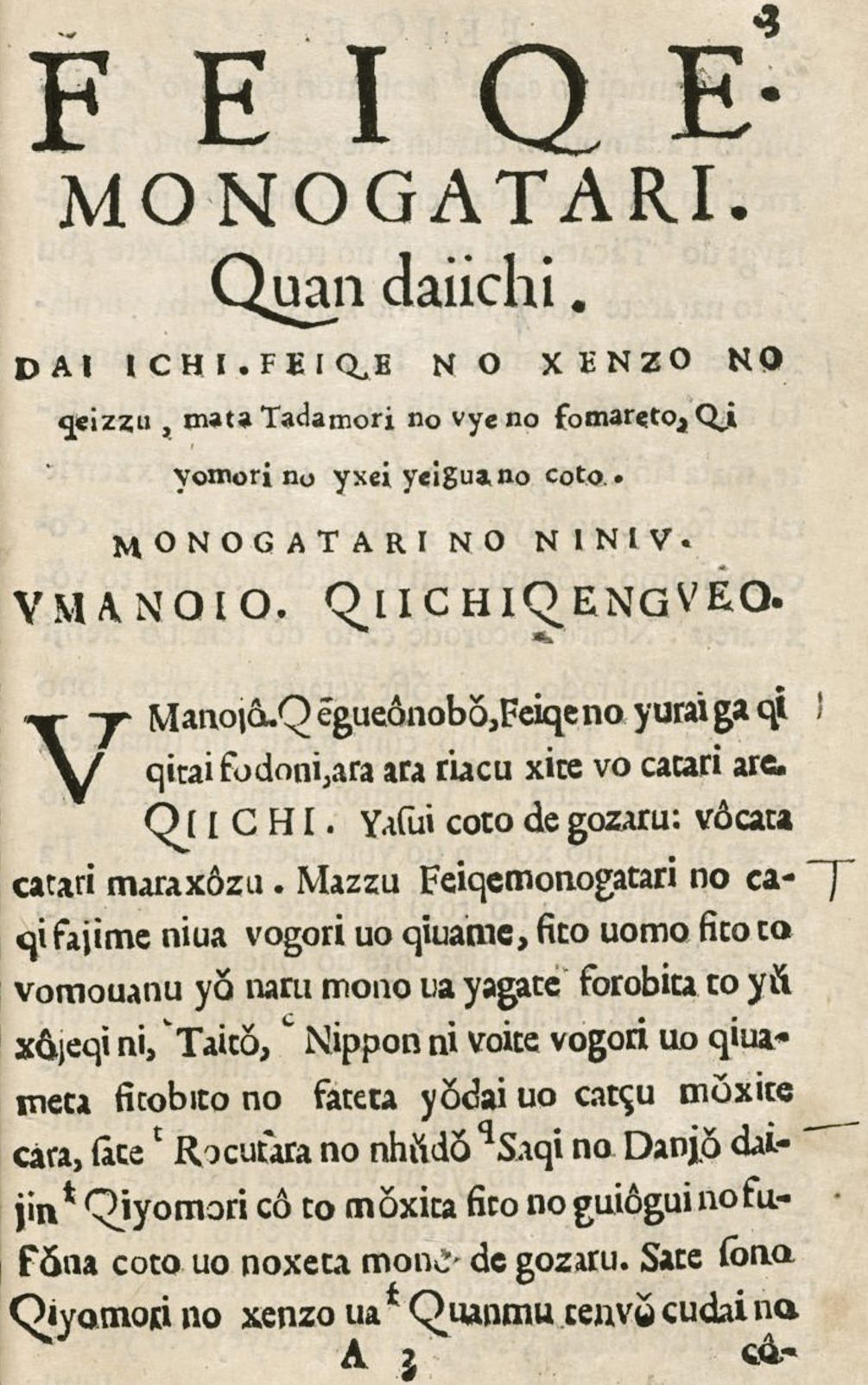
Its title page reads, in the mission’s own orthography, NIFON NO COTOBA TO Hiſtoria uo narai ſiran to FOSSVRV FITO NO TAMENI XEVA NI YAVARAGVETARV FEIQE NO MONOGATARI. The Tale of the Heike, softened into the colloquial tongue for the use of persons who wish to learn the language and the history of Japan.
The man who made it was Fabian Fucan, a Japanese irmão of the Society, raised in Kyoto and trained as a Zen monk in the Rinzai school before he entered the Society at the Osaka seminary in 1586, formidable in classical Chinese and Buddhist literature and, the catalogs note with visible restraint, possessed of some Latin. He would later leave the Society and write against it.
His instruction from his superiors survives, and it is the most consequential editorial direction in the history of the Japanese language: do not make this Heike like a book, but give it the style of a conversation between two persons.
Fabian took a recension attributed to Genyē Hōin, an abbot of Mount Hiei with a reputation for literary polish, and dismantled it. He compressed the epic into four volumes, cutting everything that served neither the missionary purpose nor the language learner. He standardized the names, because the classical text gives the same man three names and four shifting titles across a single chapter. He rewrote the prose so completely that scarcely a sentence matches any standard manuscript recension.
Then he put two people in a room.
The classical Heike opens with the bell of the Gion temple and the sound of impermanence. Fabian’s version opens in mid-conversation, with no scene-setting at all. Uma no Jō, a brash young samurai who wants to learn some history, is asking questions. Kiichi Kengyō, a blind biwa minstrel of the kind who had recited the Heike professionally for three centuries, is answering them. Kiichi’s first substantive statement is a verdict on the entire war he is about to narrate: the Heike were destroyed because they did not consider other men as human.
For the foreign reader Fabian added marginal parsing symbols, chūki kigō, repurposed from the red marginal lines of medieval Heike manuscripts: f for fito, a person, q for quan, an official rank, c for cuni, a province, t for a place or a temple. And because the marginal q would have collided with the standard spelling quni, the Amakusa compositors respelled the word cuni throughout the book.
An orthographic convention of Japanese romanization was changed to avoid a printer’s ambiguity in a margin.
The Feiqe carries three dates, which took bibliographers a long time to reconcile. The title page says 1592. Fabian’s address to the reader is dated 10 December, though the sources disagree on whether the year is 1592 or 1593, and the more specialized scholarship prefers 1592. The general preface, printed on the verso of the title page, is dated 23 February 1593. The explanation is a workflow, not a mystery: the body was set and printed through 1592, with the first leaves of the opening gathering left blank, and the preliminaries were typeset last, in early 1593, after the decision had been taken to bind the Heike with two other volumes.
What it was bound with matters. After the 406 numbered pages of the Heike dialogue comes a fresh title page dated 1593 for Esopo no Fabulas, the fables of Aesop, the only secular work of European literature the Japan mission ever translated, and from page 507 the Qincuxu, maxims drawn from the Confucian Four Books and the Chinese military classics.
One volume, in Japanese written in Portuguese letters, containing a Buddhist war epic, a Greek slave’s animal fables and a Confucian anthology, produced by a Catholic mission for the instruction of Italian and Portuguese priests.
No print run is recorded, for the Feiqe or for any other book of the press. The sources describe it only as excessively rare. They had reason to.
32,000 Entries
The Vocabulario of 1603 and Rodrigues’s Grammar of Japanese
The Amakusa shop had also been printing for the classroom. In 1594 it produced De Institutione Grammatica, an abridgment of the standard Latin grammar of Manuel Álvares, with conjugations in both Latin and Japanese, tailored for the use of Japanese seminarians. In 1595 it produced the Dictionarium Latino Lusitanicum, ac Iaponicum, a trilingual Latin-Portuguese-Japanese dictionary based on the polyglot lexicon of Ambrosio Calepino. It was one of the most ambitious reference works ever produced in early modern Asia, and it made possible every subsequent piece of serious Japanese lexicography.
The Amakusa college closed in the autumn of 1597, after the wreck of the San Felipe and the crucifixion of 26 Christians at Nishizaka in Nagasaki on 5 February of that year made the islands untenable, and the press moved to Nagasaki, first to the church of Todos os Santos and then to Misaki. It was there, between 1598 and 1614, that it did its most durable work.
Three categories dominated the output, and the bibliography can still be reconstructed with reasonable precision from surviving copies and from contemporary Jesuit correspondence. The first was devotional. The Fides no Doxi of 1592, a 600-page abridged Japanese adaptation of Fray Luis de Granada’s Símbolo de la Fe, which introduced a whole new vocabulary of Christian theological terminology calibrated to Japanese grammar. Contemptus Mundi, the Japanese adaptation of Thomas à Kempis’s De Imitatione Christi, first printed at Amakusa in 1596 and reissued at Kyoto in an abridged cursive Japanese version in 1610. Salvator Mundi, Confessionarium of 1598, the Sarubatoru Munji, a practical manual in cursive Japanese for preparing Japanese Christians for the sacrament of confession. Guia do Pecador of 1599, reissued in 1606, an abridged Japanese translation of Fray Luis de Granada’s devotional masterpiece. The Manuale ad Sacramenta of 1605, a Latin ritual book for administering the sacraments with a Japanese appendix compiled by Bishop Luís Cerqueira. The Spiritual Xuguio of 1607, the manual of spiritual exercises structured around the mysteries of the Rosary and the Passion of Christ.
The Rakuyōshū of 1598 was a Japanese character dictionary in the new small fount. The Vocabulario da Lingoa de Iapam, printed at Nagasaki in 1603 and 1604 and known ever since to Japanese scholarship as the Nippo Jisho, was something without precedent in the history of any language: a dictionary of over 32,000 Japanese entries, defined in Portuguese, covering not only the written register but Buddhist and Shinto technical vocabulary, poetic diction, everyday colloquial speech and regional words, with each entry romanized and therefore, incidentally, pronounced.
It was also opinionated. Its prologue distinguishes the pure speech of Miyako, the capital, from the vocabulary of Ximo, the western provinces of Kyūshū, which it treats as rustic and improper. The standard the Jesuits taught was the speech of the kuge, the Kyoto court nobility, and Valignano and Rodrigues both instructed new missionaries to acquire it so that they would be taken seriously by people who mattered. A missionary who learned his Japanese from his Kyūshū converts would sound, in Kyoto, like a farmhand.
Rodrigues’s Arte da Lingoa de Iapam, printed at Nagasaki between 1604 and 1608, was the first systematic published grammar of Japanese by anyone, and it is where the mission’s ear for the language is most exposed. He describes a notorious abuse at Hakata where rustic speakers interchanged initial p and q, so that padre came out as quatere and Paulo as quauro.
His central point about Japanese, however, was not phonetic. It was social. The hardest thing about the language, Rodrigues held, was that it changed entirely according to who was speaking, to whom, in whose presence, and about what. His grammar documents the honorific system in detail, and it records onnade, women’s speech, the distinct vocabulary used by noblewomen and ladies-in-waiting that men did not use: kukon for sake, hiyashi for water, umachin for rice cakes.
A grammar written to help Portuguese priests hear confessions is now the principal source for how Japanese aristocratic women spoke in the 1590s.
The three categories together describe the shape of the Jesuit intellectual project in Japan with unusual precision. The devotional titles served the pastoral mission. The linguistic works served the European learning curve. The secular works, and this is the quiet radical gesture at the heart of the Kirishitan-ban, treated classical Japanese literature as worth translating, transcribing, and preserving for its own sake. The press that Valignano had commissioned to control what his Japanese students read ended up, almost despite itself, producing the first printed editions of a Japanese literary canon that would otherwise have continued to circulate exclusively in manuscript.
The Press in the Noh Theater
What Happened to the Presses After the 1614 Expulsion Edict
By 1610 there were two presses. The original had settled at Nagasaki; a second had been set up in Kyoto under a Japanese layman named Antonio Harada, printing the Contemptus Mundi in Japanese characters and, before 1613, a partial New Testament in Japanese script, though the evidence for that last item is thinner than one would like.
The Nagasaki press was still producing books. In 1611 it issued the Fides no Quio, a further abridgment of the 1592 Fides no Doxi, bearing on its title page the name of a Japanese convert and printer named Gotō Thomas Sōin, one of the last Japanese names to be publicly associated with the Jesuit printing enterprise before the prohibition drove it underground.
Then came the expulsion edict of 1614, and with it, on 7 and 8 November of that year, the deportation of more than 150 missionaries and prominent Christians from Nagasaki to Macao and Manila.
The presses went in opposite directions.
The Nagasaki press was dismantled, crated and loaded onto the exile ships, and it arrived in Macao as freight belonging to an operation that no longer had a country to print for. It sat in the godowns for six years. In 1620 it was unpacked once, to print Rodrigues’s Arte Breve da Lingoa Iapoa, the abridged grammar he wrote in exile, using the type that had been cast in Nagasaki by Japanese hands. It printed two saints’ lives in 1621 and 1623, and then it was left, in the phrase the records use, to rust unused in the godowns. The China mission had no use for it. Following Matteo Ricci’s practice, the Jesuits in China printed by woodblock, which for a language of thousands of characters and a taste for running script was faster, cheaper and better looking than any European press could manage.
The equipment that had crossed three oceans was, in its final destination, obsolete technology.
The Kyoto press had a stranger fate. Tokugawa officials confiscated it in 1614 and carried it to Sumpu, to Ieyasu’s retirement court, along with some 80,000 Japanese metal characters in kanji and kana. Ieyasu had a printing house installed inside the Noh theater in the third enceinte of Sumpu Castle. 18 artisans worked it, under the editorial direction of the Confucian scholar Hayashi Razan and of the Zen monk Ishin Sūden, who had drafted the edict that produced the machinery. A Chinese caster recorded as Rin Go Kan supervised the founding of a further 10,368 characters, and some accounts put the total stock at 13,000 types.
Its first major product, in 1615, was the Daizō ichiranshō, a six-volume digest of the Buddhist canon, printed in an edition of 125 copies and distributed to monasteries. Its second, in 1616, was the Gunsho chiyō, a Chinese compendium of administrative precedent for the guidance of rulers, and the work was completed on 17 April 1616, which was the day Tokugawa Ieyasu died.
The press built to convert Japan spent its last working years printing Buddhist sutras and Confucian statecraft for the government that had banned it.
The Mountain of Books
The 1626 Book Burning at Nagasaki and What Survives
The bakufu understood, sooner than most governments in its position would have, that the books were the problem.
Missionaries could be deported and were. Converts could be executed and were. But the printed catechisms, the prayer books, the Dochirina Kirishitan and the Orashyo no Hon’yaku were in thousands of houses, they required no priest to operate, and they were keeping the underground church functioning without any clergy at all. Under the third shogun, Tokugawa Iemitsu, and the Nagasaki magistrate Mizuno Morinobu, the authorities ran a citywide search of Nagasaki and, on 23 July 1626, publicly burned what the sources call a mountain of books.
Practically every Christian text that could be found in the city went into it.
That fire is the reason the arithmetic of the Kirishitan-ban looks the way it does. The press printed roughly 100 titles between 1588 and 1620, and some contemporary reports put the figure closer to 150 before 1610. Johannes Laures, cataloging the corpus in the 20th century, documented 35 distinct works surviving in at least one copy, many of them in a single exemplar. At least 22 titles are attested in missionary letters and inventories as having been printed and have vanished completely.
Nearly everything that survived did so because it had been sent to Europe as a gift before Japan closed, to Rome, to Madrid, to Seville, to Oxford. The unique European copy of the 1591 Katsusa Sanctos no Gosagueo is in the Bodleian Library. The only known copy in the world of the combined Amakusa volume, the Feiqe bound with the Esopo and the Qincuxu, is in the British Library, where it arrived by an unrecorded route, probably in the later 18th century, and where Ernest Satow made the pioneering study of the mission press that he printed privately in 1888. Every modern reading of colloquial 16th-century Japanese depends, at some remove, on that one book on a shelf in London.
Whether the technology itself survived in Japan is still argued. Oouchida Sadao held that Japan’s indigenous old movable type books, the kokatsuji-ban, did not descend from the Korean equipment seized during Hideyoshi’s invasions but evolved directly out of the Jesuit workshop at Nagasaki, pointing out that the Suruga type commissioned by Ieyasu is tall and narrow and assembled in a four-piece frame resembling a Western composing stick, whereas Korean type was flat and fixed into an adhesive wax bed. Koakimoto Dan disputes the neatness of that division, showing that Korean workshops had abandoned the wax bed during King Sejong’s reign in favor of wooden and bamboo spacers, which leaves the Japanese technique firmly inside the Korean tradition after all. There is one hard piece of evidence for transmission: in September 1593 a group of 10 Japanese Christian brothers left the mission press and went to Kyoto, where in November of the same year they produced the Kobun Kōkyō, the Classic of Filial Piety in Ancient Script, the first native movable-type book printed in the capital.
The men who made it had learned the trade printing catechisms on Amakusa.
Four boys were sent to Europe to be shown to the Pope, and they came back with a machine. The machine printed for 24 years, in a language its designers could not read, using type cut from wood by carvers who had never seen a Roman letter, on paper matched sheet by sheet to the script it carried, corrected by compositors who wrote their own errata while the sheets were still damp. Then it was confiscated, exiled, obsolete, and burned out of the country it had been bought for. What is left is about 30 books, most of them abroad, and inside them a recording of how Japanese was actually spoken in the last decade of the 16th century, preserved by accident, in the wrong alphabet, by men who were trying to do something else entirely.
Sources & Further Reading
Boscaro, Adriana. Sixteenth Century European Printed Works on the First Japanese Mission to Europe: A Descriptive Bibliography. Brill, 1973. The standard bibliographical account of what Europe printed about the Tenshō legates, and the frame within which the Goa and Macao imprints of the mission press belong.
Boxer, C. R. The Christian Century in Japan, 1549-1650. University of California Press, 1951. The narrative backbone for the 1587 edict, the Amakusa retreat, the 1614 expulsion and the deportation of the press to Macao.
Chibbett, David. The History of Japanese Printing and Book Illustration. Kodansha International, 1977. Places the Jesuit press inside the wider history of Japanese book production, including the Sumpu and Suruga type and the kokatsuji-ban question.
Cooper, Michael. The Japanese Mission to Europe, 1582-1590: The Journey of Four Samurai Boys through Portugal, Spain and Italy. Global Oriental, 2005. The fullest account of the embassy that carried the press east, of Mesquita’s role, and of the itinerary and dates of the return voyage.
Cooper, Michael. Rodrigues the Interpreter: An Early Jesuit in Japan and China. Weatherhill, 1974. The essential life of the author of the Arte da Lingoa de Iapam and the Arte Breve, including the Macao exile and the last use of the press in 1620.
Doi, Tadao, Takeshi Morita, and Minoru Chōnan, eds. Hōyaku Nippo jisho. Iwanami Shoten, 1980. The modern Japanese translation of the 1603 Vocabulario, and the basis for almost all subsequent work on its orthography, dialect labels and register distinctions.
Elison, George. Deus Destroyed: The Image of Christianity in Early Modern Japan. Harvard University Press, 1973. Supplies the biography and later apostasy of Fabian Fucan, editor of the Amakusa Heike, and the intellectual context of the mission’s translation choices.
Higashibaba, Ikuo. Christianity in Early Modern Japan: Kirishitan Belief and Practice. Brill, 2001. Examines how the printed catechisms, above all the Dochirina Kirishitan, were actually used by Japanese converts and why the bakufu treated the books as the target.
Kornicki, Peter. The Book in Japan: A Cultural History from the Beginnings to the Nineteenth Century. Brill, 1998. The authoritative treatment of movable type in Japan, the Korean and Jesuit lines of descent, and the reasons woodblock ultimately prevailed.
Laures, Johannes. Kirishitan Bunko: A Manual of Books and Documents on the Early Christian Mission in Japan. Sophia University, 1957. The catalog of record for the Kirishitan-ban, source of the surviving-title counts and the identification of unique copies.
Moran, J. F. The Japanese and the Jesuits: Alessandro Valignano in Sixteenth-Century Japan. Routledge, 1993. The best account of Valignano’s accommodation policy, the seminary regulations of 1580, the language-study requirement the press was built to serve, and his correspondence with the Archbishop of Évora on the motives for ordering it.
Satow, Ernest Mason. The Jesuit Mission Press in Japan, 1591-1610. Privately printed, 1888. The pioneering Western study, made from the unique British Library copy of the Amakusa volume, and still the starting point for the bibliography of the press.
Cite this page
Nanban.pt. “Softened into the Colloquial Tongue: The Jesuit Mission Press in Japan, 1586–1620.” Last modified 30 September 2026. https://nanban.pt/articles/kirishitan-ban-mission-press/.
@misc{nanban-kirishitan-ban-mission-press,
  author = {Nanban.pt},
  title = {Softened into the Colloquial Tongue: The Jesuit Mission Press in Japan, 1586–1620},
  year = {2026},
  url = "https://nanban.pt/articles/kirishitan-ban-mission-press/",
  note = {Last modified 2026-09-30}
}