Dom Protásio of Arima: Arima Harunobu, Christian Lord of Shimabara, 1580–1612
Baptized under siege in 1580 and beheaded in exile in 1612, Arima Harunobu ruled a domain the Jesuits counted as almost wholly Christian. He also had its temples destroyed, led the attack on a Portuguese carrack and paid for a forged shogunal grant.
Arima Harunobu was the Christian daimyō of Arima, on the Shimabara peninsula in Hizen, who was baptized Dom Protásio in Lent 1580 and for three decades protected the Jesuit mission and its seminary, while having the Buddhist temples and Shintō shrines of his domain destroyed. After he led the attack on the Portuguese carrack Madre de Deus at Nagasaki in January 1610, Okamoto Daihachi sold him a forged grant of lands, and the affair cost him his domain and his life: he was put to death in exile in Kai province in June 1612.
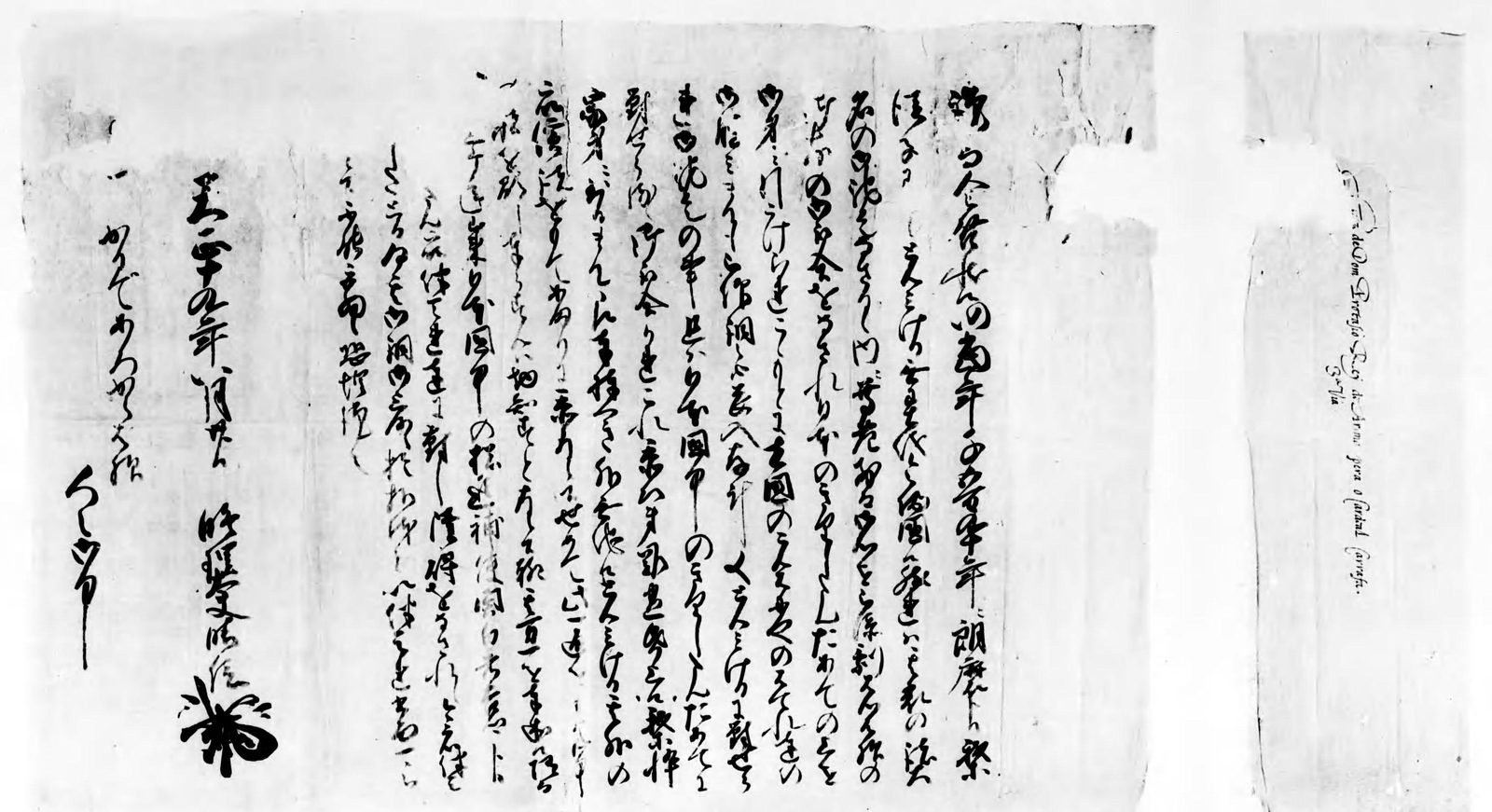
Powder and Lead at Kuchinotsu
Arima Harunobu's Baptism in 1580 and Valignano's Aid to His Besieged Forts
On 25 July 1579 Alessandro Valignano, the Jesuit Visitor sent to inspect and reorganize the mission in the East, came ashore at Kuchinotsu, the deep anchorage at the southern tip of the Shimabara peninsula. He arrived on the Great Ship of the Captain-Major Leonel de Brito, and the choice of harbor was Valignano's: he had the carrack berth there, in the territory of the Arima, rather than at Hirado. A Great Ship brought with it Chinese silk, Portuguese merchants and buyers from across Kyūshū. It also carried things a besieged lord could not easily buy elsewhere.
The lord of Arima at that moment was the young Arima Harunobu (有馬晴信), and his situation was difficult. Ryūzōji Takanobu, the warlord who had made himself master of much of Hizen province, had been subverting the Arima vassals and had taken the northern part of Takaku district (高来郡), the district that made up the Shimabara peninsula. By early 1580 Harunobu held little more than a coastal strip around his castles. He was short of food, powder and lead.
Valignano offered provisions, silver, lead and saltpeter from the ship's cargo and delivered them to Harunobu's forts. One account valued the gift at about 600 cruzados. Ryūzōji agreed to a truce. Valignano himself came to Arima in the first week of Lent. Instruction and negotiation followed. Harunobu was baptized during Lent 1580, shortly before Easter, taking the name Protásio. The sources differ over the precise day. The Jesuit historian Josef Franz Schütte, who reconstructed Valignano's movements from the mission's papers, places the baptism in March while discussing an annual letter of Luís Fróis that refers to April; the 3 April sometimes attached to the event is Easter Sunday in that account rather than a separately recorded date of baptism. Schütte also dismissed an older dating of the baptism to 1579.
The relief of the forts and the baptism belonged to the same months and the same negotiation. For the next three decades Dom Protásio was one of the leading Christian lords in Japan, the patron of a seminary and, for a time, of the mission's printing press, and the ruler of a territory in which, by Jesuit reckoning, nearly everyone was baptized.
The Temple That Became a Church
Arima Harunobu's Family, Birth Year and the Anti-Christian Reversal of 1577
The Arima were an old house of western Hizen. Harunobu's grandfather, Arima Haruzumi (1483–1566), had built their power on the peninsula and beyond it. His father, Arima Yoshisada (1521–1576/77), had a younger brother who was adopted into the neighboring Ōmura house and became, as Ōmura Sumitada, the first daimyō in Japan to accept baptism. Another uncle, Chijiwa Naokazu, was lord of Chijiwa. The Arima were thus bound by blood to the Ōmura, whose harbors were the other main point of entry for the Portuguese ships and the Jesuit mission in this part of Kyūshū.
Harunobu's own birth year is unsettled. Some modern works give 1561, with a question mark; others, including the Historical Dictionary of Japan and Madalena Ribeiro's study of the Christian nobility of Kyūshū, give 1567. The difference is not trivial, since it decides whether the boy who inherited the house was a child or an adolescent, and the ages that Japanese reference works assign him at each stage do not fit both years. What is clear is that he was a second son. His elder brother, Arima Yoshizumi (1550–1571), held the headship first, and when Yoshizumi died in 1571 Harunobu became heir while still a boy, with their father acting as his guardian.
Yoshisada was baptized in April 1576 by the Jesuit Gaspar Coelho, taking the name Dom André, together with his wife Marina, a woman of the Chijiwa, and a number of his principal retainers. Fróis, the mission's chronicler, gave a reason with a soldier's logic: Yoshisada had lost faith in the battle divinations of the Buddhist monks. A temple called Saikōji was turned into a church.
Within the year Yoshisada was dead, in late 1576 or early 1577, and the young heir took control. What followed was a reversal. According to the Jesuit accounts, Harunobu was persuaded that his father's death was punishment for the destruction of temples, and he let the Buddhist monks return. In January 1577 the Saikōji church was taken down. Public crosses were cut down, the Jesuits were expelled and converts were pressed to give up their faith. Fróis wrote of Christians on their knees before Baal. By 1578 the Arima mission had all but ceased to exist.
The same years produced Harunobu's first marriage, and with it a confusion that has found its way into some modern accounts. A Jesuit plan of 1578 proposed to marry him to a daughter of Ōmura Sumitada named Lúcia. Ribeiro, working from the Portuguese sources, shows that the match failed. Harunobu married instead his niece, the daughter of his dead brother Yoshizumi, who was also called Lúcia. The coincidence of names has led some accounts to make the Ōmura bride and the Arima wife one woman. The marriage to his brother's daughter kept the claims of the senior line inside the house.
Dom Protásio and the 40 Temples
Forced Conversion and the Destruction of Temples in Arima After 1580
The baptism of 1580 reversed the reversal of 1577, and with considerable force. The Jesuit reports make clear that conversion in Arima was not left to individual conscience. Schütte, summarizing the mission's own evidence, describes compulsory conversion in the domain and the destruction of more than 40 Buddhist temples and Shintō shrines. Their timber went into churches and into the buildings of the new seminary. In 1583 Valignano wrote that all the temples in Arima were gone and that the few people still unbaptized were being baptized every day.
These figures come from interested observers who wanted the conversion to look complete, and they should be read as reports rather than counts. They were reports, written for Jesuit superiors, and they leave little doubt about how the change was made. Christian patronage and coercion were features of the same government. Later Jesuit estimates put the Christians of Arima at no fewer than 60,000 by 1590, effectively the whole population of the domain, and a Jesuit survey of 1609 still gave a figure of about 60,000. These are the mission's estimates of a population it had every reason to count generously.
What Harunobu himself believed in 1580 is not recoverable, but having been rescued by Portuguese cargo and having accepted the religion of the people who supplied it, he governed thereafter as a Christian prince. He built and protected churches, and sheltered the mission at moments when doing so was dangerous. In 1596 he took a confirmation name, João. Whether this amounted to a sincere conversion, a durable alliance or both remains a matter of interpretation among historians.
The Japanese scholar Kanda Michitaka has traced the quarrel over Yoshisada's deathbed and funeral in 1576–77, which continued under the young Harunobu, and suggests that the hatred it left, handed down the generations, fed into the rising of 1637.
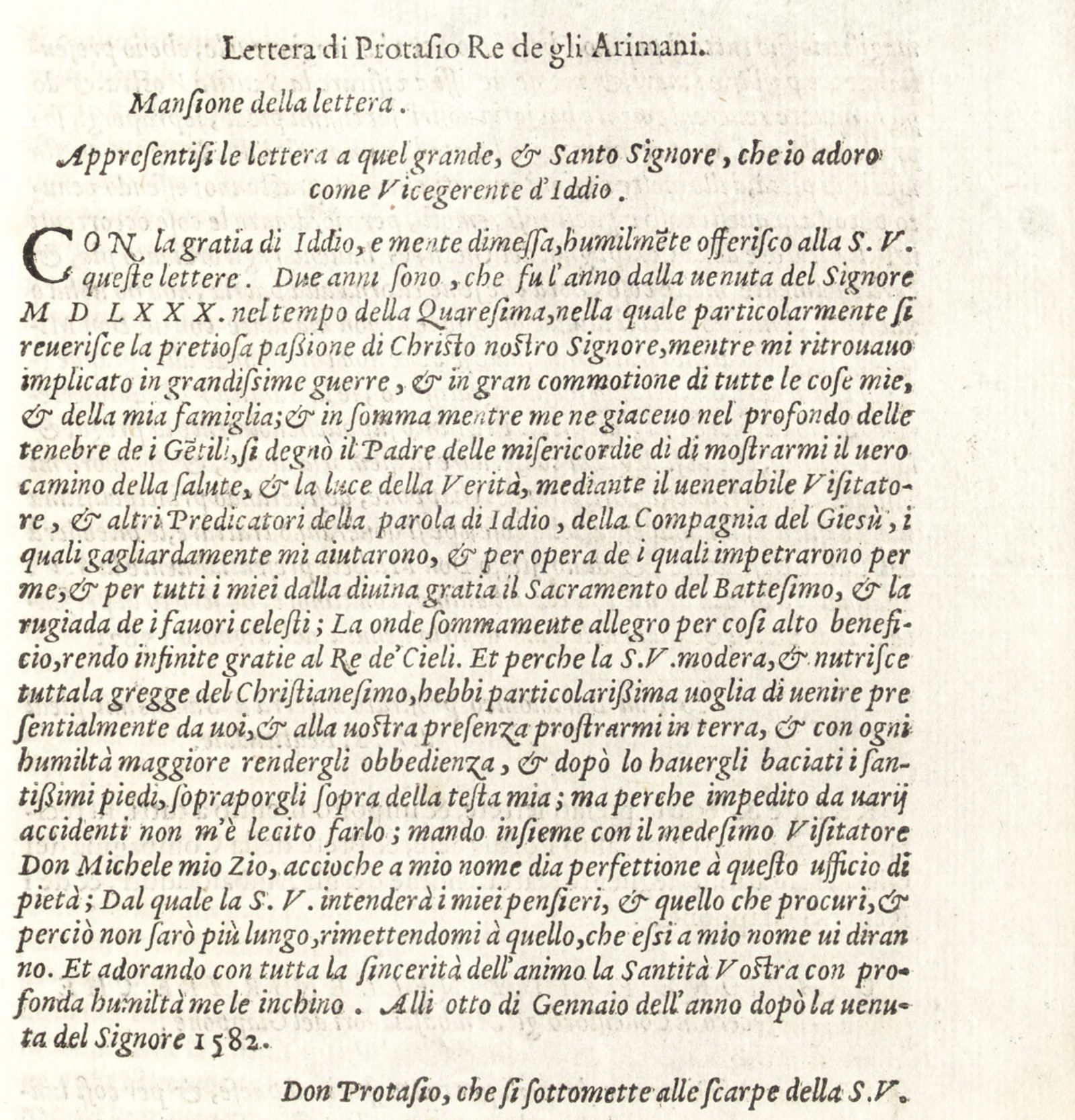
Latin and Harpsichords at Arima
The Arima Seminary and the Jesuit Press at Kazusa, 1580–1591
The most durable product of Valignano's visit was a school. Schütte places the foundation of the Arima seminary after Easter 1580 and before Valignano's departure on 24 June. By October it had 22 pupils, with provision for 30. The seminary was Valignano's instrument for educating Japanese boys for the clergy and for Christian service, and Arima offered what it needed: a lord in debt to the mission, a population being converted wholesale and timber from demolished temples.
The boys were around 12 or 13 years old at entry. According to the descriptions that survive, they wore blue robes and studied Latin and Japanese for about six hours a day, with singing and instruction on the harpsichord and viola. Among the first pupils were the boys who would become the envoys of the Tenshō embassy, the mission of four young Japanese Christians whom Valignano sent to Lisbon, Madrid and Rome. The embassy sailed from Nagasaki on 20 February 1582, and Harunobu was one of its sponsors, alongside his uncle Sumitada and the Bungo lord Ōtomo Sōrin. One of the four, Chijiwa Miguel, was Harunobu's first cousin. Harunobu's younger brother, baptized Leo, appears as one of the speakers in De Missione, the Latin dialogue about the embassy's journey printed by the mission in 1590.
The seminary did not stay put. During the periods when the mission had to keep its head down, it moved between Hachirao, Kazusa, Arie, Amakusa and Nagasaki. By 1603 it was back in Arima, with about 90 students. Attached to it was a painting school run by the Italian Jesuit Giovanni Niccolò (1560–1626), who had reached Japan in 1583 and taught oil painting, copper engraving and the making of altarpieces.
Valignano returned to Japan in July 1590, bringing the four envoys home and with them a European printing press. After a consultation of the Jesuits held at Kazusa in Arima territory from 13 to 25 August 1590, the press was set up there. Its early output included the Sanctos no gosagveo, a collection of saints' lives in romanized Japanese, in 1591. The press later moved on; its history after the Arima years is told in the account of the Jesuit mission press. One work sometimes credited to Kazusa, the romanized Feiqe monogatari, was in fact printed at Amakusa.
Guns on the Marsh at Okitanawate
How Arima and Shimazu Defeated Ryūzōji Takanobu at Okitanawate in 1584
The truce with Ryūzōji Takanobu did not end the threat. By 1584 Harunobu turned to the Shimazu of Satsuma, the other great power in Kyūshū, and Shimazu Iehisa crossed to the peninsula with an army reported at about 3,000 men. The combined Arima and Shimazu force is put in the accounts at between 6,000 and 8,000. Ryūzōji's army is given figures ranging from 25,000 to 60,000. The width of the range is itself a sign of how uncertain such numbers are, but every version has the allies badly outnumbered.
The armies met on the 24th day of the third month of Tenshō 12 (4 May 1584) at Okitanawate, on the coastal marshes between Shimabara and Mie. An Arima boat carried two breech-loading guns, and these raked Ryūzōji's beach column. When the guns had shelled the enemy fortress at Shimabara in Holy Week, a week earlier, Fróis recorded their crew as an African who loaded, a Japanese who aimed and a Malabari Indian who fired. Iehisa then counterattacked, the Ryūzōji army broke, and Ryūzōji Takanobu was killed.
The victory removed the man who had nearly destroyed the Arima, and Harunobu rewarded the Jesuits for their part in his survival. He granted them the Urakami valley north of Nagasaki, land reported to yield more than 500 cruzados a year. Nagasaki itself had been placed in the Society's hands by Sumitada a few years earlier; the Urakami grant added land beside it.
The Shimazu, who had done much of the winning, continued to extend their power northward through Kyūshū until 1587, when Toyotomi Hideyoshi brought an overwhelming army into the island and imposed his own order on all its lords.
70 Jesuits and an Edict Ignored
Arima Harunobu Under Hideyoshi: The 1587 Expulsion Edict and the Korean Invasions
Harunobu submitted to Hideyoshi during the Kyūshū campaign of 1587 and was confirmed in Takaku. His assessment under the Toyotomi survey was 40,000 koku (石), the measure of rice yield by which domains were ranked; his seat was Hinoe castle (日野江城) at Kita-Arima, with Hara castle nearby, and his port remained Kuchinotsu, which had served as a berth for the Great Ship at intervals from the 1560s into the 1580s. By the standards of the great lords this was a modest holding, and its value to the mission lay less in its size than in its people and its harbor.
In July 1587 Hideyoshi issued his edict ordering the Jesuit priests out of Japan. The response in Arima and Ōmura, where Sumitada had just died and his son Ōmura Yoshiaki now ruled, was to ignore it as quietly as possible. Arima is reported to have taken in more than 70 Jesuits, along with their novitiate, college and seminary, and conversions continued. By Jesuit reckoning in these years the Christians of Arima and Ōmura together numbered about 120,000 of some 205,000 in all of Japan. Those are the mission's estimates, not any kind of census, but they show where the mission's weight lay: well over half of its claimed flock lived in the two small domains of Harunobu and his cousin.
The seminary and the press moved between hiding places, and Hideyoshi, who wanted the Portuguese ships to keep coming, did not enforce his edict with any consistency, as long as the priests kept a low profile. Harunobu's protection of the mission in these years underpinned the reputation he later enjoyed in Jesuit memory. It was probably also the part of his career in which patronage of the Church carried the clearest risk to himself.
When Hideyoshi turned on Korea, Harunobu went with him. In the 1592 invasion the Arima contingent, reported at about 2,000 men, formed part of the first division under Konishi Yukinaga, alongside forces from Sō Yoshitoshi, Ōmura Yoshiaki, Matsura Shigenobu and Gotō Sumiharu; the figures given for each contingent vary between accounts. The first division landed at Pusan in the fourth month of Tenshō 20 and led the advance on Seoul and P'yŏngyang. Sources on the division's operations do not establish where Harunobu himself was at each action. After the Ming counteroffensive of 1593 the Japanese pulled back to fortified positions, the wajō (倭城), on the southern coast, and Harunobu was among those who held them. He served again in the second invasion of 1597–98, the last phase of Hideyoshi's war in Korea.
The war brought Korean captives to Arima and to Nagasaki. Some of them became Christians; Korean Christians in Nagasaki built a church dedicated to San Lorenzo in 1610. Others were sold as slaves and taken abroad.
A Change of Masters
How Arima Harunobu Kept His Domain After 1600 and Prospered in the Red-Seal Trade
Hideyoshi died in 1598, the same year as Lúcia. Around 1599 Harunobu married again. His second wife, baptized Justa, was a widowed woman of the Kyoto court; Ribeiro identifies her as related to the principal consort of the emperor. The match is said to have been arranged through Konishi Yukinaga, and Valignano baptized her. After her husband's fall she is reported to have sheltered missionaries in Kyoto. For a provincial lord whose house had nearly been extinguished 20 years earlier, it was a connection to be proud of.
In the crisis of 1600 Harunobu's conduct was cautious. Ribeiro describes an initial neutrality followed by alignment with the Tokugawa. Accounts of the fighting in Kyūshū that year have Arima forces, led by Harunobu's son Naozumi, joining the operations against Konishi Yukinaga's castle at Udo in Higo, though the timing and scale of that participation are less securely documented than the outcome. The outcome is clear. Konishi, Harunobu's commander in Korea and the reported go-between for his marriage, was captured after Sekigahara and executed. Harunobu kept his 40,000 koku.
His heir, Arima Naozumi (1586–1641), baptized Miguel, had married Marta, a niece or adopted daughter of Konishi, around 1599 or 1600. A Konishi connection was presumably an awkward one once Konishi had been executed and the Tokugawa were in charge. In 1610 or 1611 Tokugawa Ieyasu gave Naozumi a new bride, Kunihime, a great-granddaughter of Ieyasu's whom he had adopted as his own daughter. To accept her, Naozumi put Marta aside; she took refuge in Nagasaki.
Harunobu, meanwhile, prospered in trade. Between 1604 and 1611 he received seven shuinjō (朱印状), the vermilion-seal licenses through which the Tokugawa authorized overseas voyages, one of the larger totals held by any daimyō. The red-seal system let his ships sail to Champa, Cochinchina, Siam and Luzon, carrying silver, swords and lacquer and bringing back silk, deer hides and aromatic woods. In 1608 Ieyasu personally commissioned an Arima voyage to Champa to obtain kyara (伽羅), the finest grade of aloeswood incense. That commission put Harunobu's ship at Macao later that year.
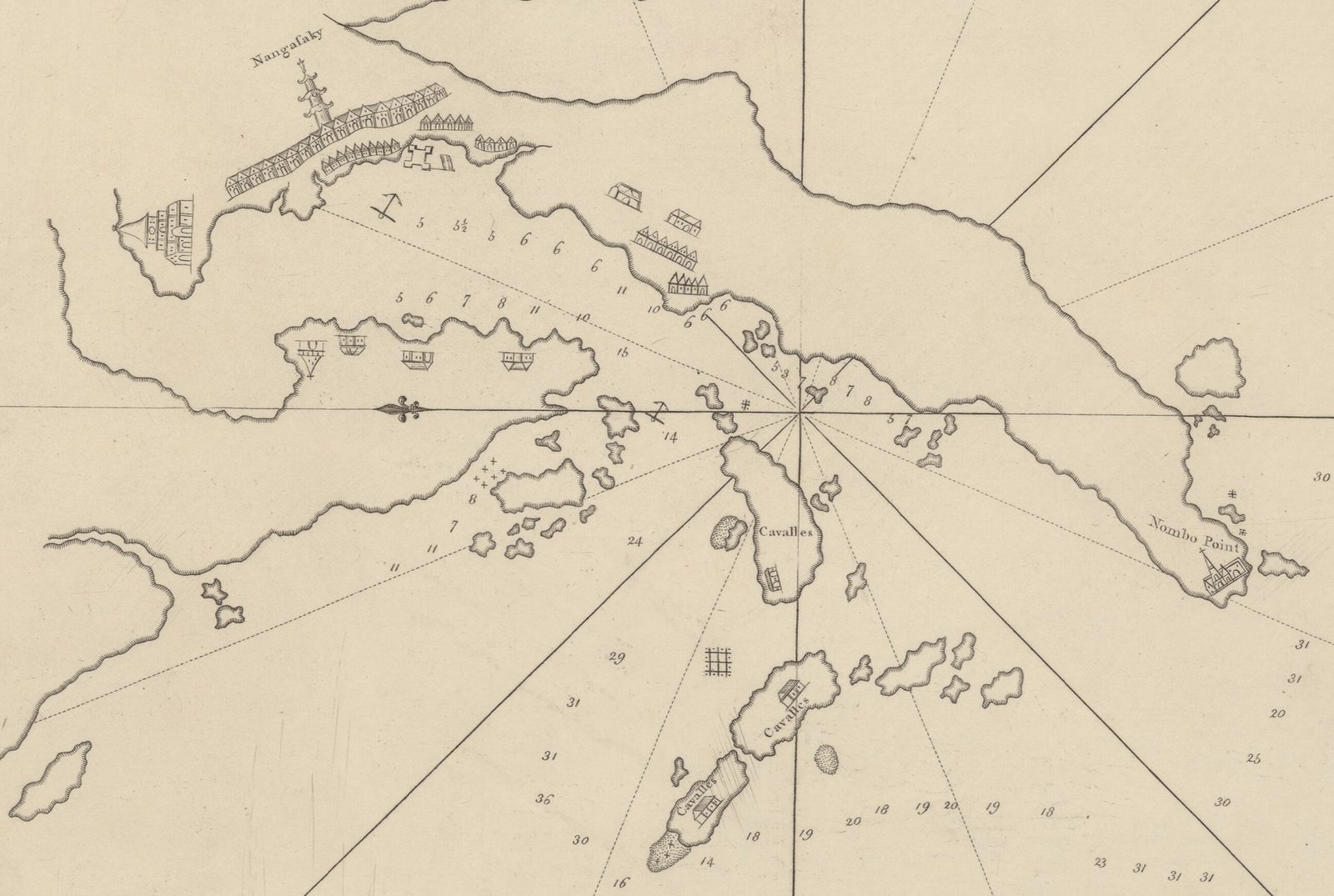
Fire in Nagasaki Harbor
Why Arima Harunobu Led the 1610 Attack on the Madre de Deus
Harunobu's kyara ship wintered at Macao in 1608 alongside the crew of a wrecked Japanese junk, so that many armed Japanese were in the Portuguese city. They went about in armed bands of 30 or 40, and on 30 November a riot broke out in which a Portuguese judge was wounded. André Pessoa, Captain-Major of the year's Japan voyage and acting governor of Macao, laid siege to the houses where Japanese had taken refuge. About 40 Japanese died, and some 50 more surrendered. The survivors were made to sign a confession taking the blame. How many of the dead were Harunobu's own men is disputed: the Japanese scholar Konishi Mizue counts five of his retainers, while the Spanish merchant-chronicler Bernardino de Ávila Girón mentions two servants.
Pessoa reached Nagasaki in the summer of 1609 in the carrack Nossa Senhora da Graça, also called the Madre de Deus, with a cargo valued at about 1 million cruzados. The Japanese survivors of Macao repudiated their confession. Harunobu and the Nagasaki bugyō (奉行), the shogunal governor Hasegawa Fujihiro, petitioned Ieyasu. Ieyasu is reported first to have satisfied himself that Dutch and Spanish traders could keep silk coming into Japan, and then to have authorized Harunobu to seize Pessoa or destroy his ship. Okamoto Daihachi, a secretary in the household of the shogunal councilor Honda Masazumi, went with the expedition as Ieyasu's inspector.
The fighting lasted from the ninth to the 12th day of the 12th month of Keichō 14, roughly 3 to 6 January 1610. Hasegawa's men cut the ship off from the shore. Pessoa tried to get away toward Fukuda, but the wind failed him, and the carrack was attacked night after night by armed boats and fought back with guns, grenades and small arms. The first attack, on 3 January, was made by about 1,200 men; reinforcements later brought the force to some 3,000. On the last night fire took hold aboard. Pessoa had the magazine fired, and the ship blew up and sank in about 35 fathoms of water. Pessoa died with many of those aboard.
Silver, gold, brocade and a quantity of silk went down with the hull. Hasegawa tried and failed to raise it, though cargo that floated free is said to have enriched a good many Nagasaki residents. The Jesuits had landed some of their own gold and cloth before the fighting began. One account has Ieyasu rewarding Harunobu with a sword by the smith Nagamitsu and with rights to the salvage.
The episode, its cargo and its consequences for the Macao trade are treated at length in the account of the Madre de Deus affair. In Harunobu's own career the attack stands out as a Christian lord's assault on a Portuguese ship, made with shogunal permission and in partnership with the shogun's governor of Nagasaki. The historian João Paulo Oliveira e Costa has argued that Harunobu separated the Portuguese traders, whom he attacked, from the Jesuits, whom he continued to defend, and nothing in his conduct in 1609–10 shows him turning against the Church as an institution. The expedition also brought him into the company of the shogun's inspector, Okamoto Daihachi, who had witnessed the fight.
A Forged Vermilion Seal
How Arima Harunobu Died: A Forged Land Grant, Exile in Kai and Death in 1612
Daihachi was a Christian, baptized Paulo, and he had access to the men around Ieyasu. After the destruction of the carrack he told Harunobu that Ieyasu meant to reward him with lands the Arima had once held in Hizen, among them Isahaya and Kōjiro, and that officials could be paid to bring the grant about. Harunobu paid. A figure of 6,000 ryō for the total appears in some modern accounts, though the sum and the stages of payment are not consistently documented. Daihachi kept the money and supplied a forged patent bearing Ieyasu's vermilion seal.
When the promised lands did not materialize, Harunobu raised the matter with Honda Masazumi, Daihachi's master, and the fraud came out early in 1612. Under interrogation Daihachi turned on Harunobu, alleging that he had plotted to kill Hasegawa Fujihiro. The allegation came from a man facing death for forgery, directed at the lord whose money he had taken. The case went through investigation and sentence in stages, and the full detail, including the court politics around Honda Masazumi, is set out in the account of the Okamoto Daihachi scandal.
Daihachi was burned alive at Sunpu on the 21st day of the third month of Keichō 17 (21 April 1612). On the same day the shogunate banned Christianity in the lands under its direct rule, ordering the churches in Edo, Kyoto and Sunpu destroyed and directing Christian retainers to recant. The order of 1612 was limited in reach, but it was the first Tokugawa prohibition, and less than two years later it was followed by the national expulsion edict of 1614, drafted by the Zen monk Sūden.
Harunobu was stripped of his domain and sent into exile in the Gunnai district of Kai province, in the lands of Torii Naritsugu, lord of Yamura. There he was ordered to die. The Japanese chronicle Sunpu-ki (駿府記) records an order that he take his own life. Ávila Girón records Harunobu's reply that he could not cut open his belly because he was a Christian, and that he died at a servant's hand. Other accounts describe the man who beheaded him as one of his own retainers. The date usually given for his death is the sixth day of the fifth month of Keichō 17, rendered as 5 June 1612.
The circumstances of his end gave Jesuit writers a martyr, and later commemoration treated him as one. Oliveira e Costa has pointed out that he was condemned for the illegal pursuit of land, and that his religion was not the charge.
The Son, the Martyrs and the New Lords
What Happened to Arima After Harunobu: Naozumi's Apostasy and the 1614 Move to Nobeoka
Naozumi kept the domain by giving up the faith. He had already put aside Marta for Kunihime; now, in the summer of 1612, he closed the mission in Arima and began to execute Christians who would not recant. In the autumn of 1613 eight members of leading Christian families of the domain, among them a woman known in the Jesuit accounts as Dona Madalena, were burned on a sandbar at the mouth of the Ōte river before a large crowd. Group executions of 20 and of 45 people are reported for 1614.
The faith was not stamped out. In 1614 Naozumi was moved to Nobeoka in Hyūga, with an assessment of 53,000 koku. The transfer ended some four centuries of Arima rule on the Shimabara peninsula. The territory was held directly by the shogunate for two years, and in 1616 it went to Matsukura Shigemasa. The heavy taxation and the torture of hidden Christians under Shigemasa and his son Katsuie are the immediate background to the Shimabara Rebellion of 1637–38, whose last stand at Hara castle, near Harunobu's old seat at Hinoe, ended in a massacre; the dead of the final siege are commonly put at about 37,000, an estimate that does not distinguish armed rebels from their families.
It is tempting to draw a single line from the execution in Kai to the siege at Hara, and some writers have done so. The evidence supports something less tidy. A quarter of a century separated the two events. In between came Naozumi's apostasy and persecution, two years of direct shogunal rule, the national ban of 1614 and some two decades of Matsukura government. The Christian population that Harunobu's conversions had created was a precondition of what happened in 1637; his death was only one event among several that influenced what came next.
Protasius on the Innsbruck Stage
How Historians Judge Arima Harunobu, from the Jesuit Letters to a 1734 Innsbruck Play
The Jesuit record of Harunobu was never a single voice. Schütte, reading the correspondence behind Valignano's policy, found compulsory conversion and the destruction of more than 40 temples reported by the Jesuits themselves, in correspondence written within the Society. The German scholar Detlev Schauwecker has argued that the official reports prepared for European readers built a hagiographic image, while private letters and Japanese records show coercion, shallow conversions, slave dealing and political bargaining. His distinction is between kinds of writing and their audiences. The annual letters and administrative papers that document the forced conversions in Arima came from the same Society that later celebrated him.
Modern historians have generally held the patron and the politician together. Oliveira e Costa describes Harunobu as one of the main pillars of the Japanese Church for three decades, from 1580 to 1611, and also as a calculating ruler. Ribeiro ties his baptism and religious posture to his house's survival and to the kinship networks that bound the Christian nobility of Kyūshū, and attributes his fall to territorial ambition. The Japanese historians Shigetō Takeo and Oka Mihoko have presented him as a merchant-daimyō of the red-seal trade whose downfall helped persuade Ieyasu that Christian networks threatened the shogunal order. Murata Akihisa has mapped the church, seminary and college of Christian Arima, and Konishi Mizue has written on the objects that survived it, among them a gold reliquary cross excavated at Hara castle. These readings overlap more than they conflict, and differ mainly in which part of the record they put at the center of his career.
The commemorative tradition took a simpler line. In 1734 the Jesuit school at Innsbruck staged a play, Protasius Arimae Rex Tragoedia, in which Harunobu appeared as the pious Christian prince, converted by grace, ruling willing subjects and dying as a martyr. It was performed 122 years after his death in Kai, and more than a century after the last Arima lord had left the Shimabara peninsula for Hyūga.
Sources & Further Reading
Hesselink, Reinier H. The Dream of Christian Nagasaki: World Trade and the Clash of Cultures, 1560–1640. Jefferson, NC: McFarland, 2016. Reproduces the account of the first attack on the Nossa Senhora da Graça on 3 January 1610 and places the affair within the politics of Nagasaki and the distinction between Portuguese traders and the Jesuit mission.
Ribeiro, Madalena Teotónio Pereira Bourbon. A nobreza cristã de Kyûshû: Redes de parentesco e acção jesuítica. MA dissertation, Universidade Nova de Lisboa, 2006. The source for Harunobu's marriages to his niece Lúcia and to the Kyoto court widow Justa, for the failed Ōmura match, and for his cautious course in 1600.
Schütte, Josef Franz. Valignanos Missionsgrundsätze für Japan. Vol. 1, part 1. Rome: Edizioni di Storia e Letteratura, 1951. Reconstructs Valignano's intervention at Arima, the Lenten baptism of 1580, the compulsory conversions and temple destruction, and the founding of the Arima seminary.
Cite this page
Nanban.pt. “Dom Protásio of Arima: Arima Harunobu, Christian Lord of Shimabara, 1580–1612.” Last modified 8 October 2026. https://nanban.pt/articles/arima-harunobu/.
@misc{nanban-arima-harunobu,
  author = {Nanban.pt},
  title = {Dom Protásio of Arima: Arima Harunobu, Christian Lord of Shimabara, 1580–1612},
  year = {2026},
  url = "https://nanban.pt/articles/arima-harunobu/",
  note = {Last modified 2026-10-08}
}