Much the Better Port: Kuchinotsu, the Harbor That Sheltered the Japan Mission, 1562–1638
A superior fleeing a burning port in an open boat at midnight, a rutter that told frightened pilots to steer northeast and stop worrying, a Visitor deliberately routed into a small fishing village to keep a bankrupt lord from surrendering, and a dismasted junk that crawled in by night after three typhoons: for a quarter of a century the little harbor at the tip of the Shimabara Peninsula was where Europe came ashore in Japan, and then it was nowhere at all.
Kuchinotsu was a small harbor at the southern tip of the Shimabara Peninsula in Hizen, designated a Nanban trade port by Arima Yoshisada in 1562, which housed the headquarters of the Jesuit Japan mission from 1564 to 1567 and received the Portuguese annual ship on several occasions, most notably on 25 July 1579, when it landed the Visitor Alessandro Valignano. Its sheltered anchorage kept laden carracks safe through the typhoon season, but Nagasaki's sheltered approaches and settled administration drew the trade away, and in 1616 the shogunate confined European shipping to Nagasaki and Hirado.
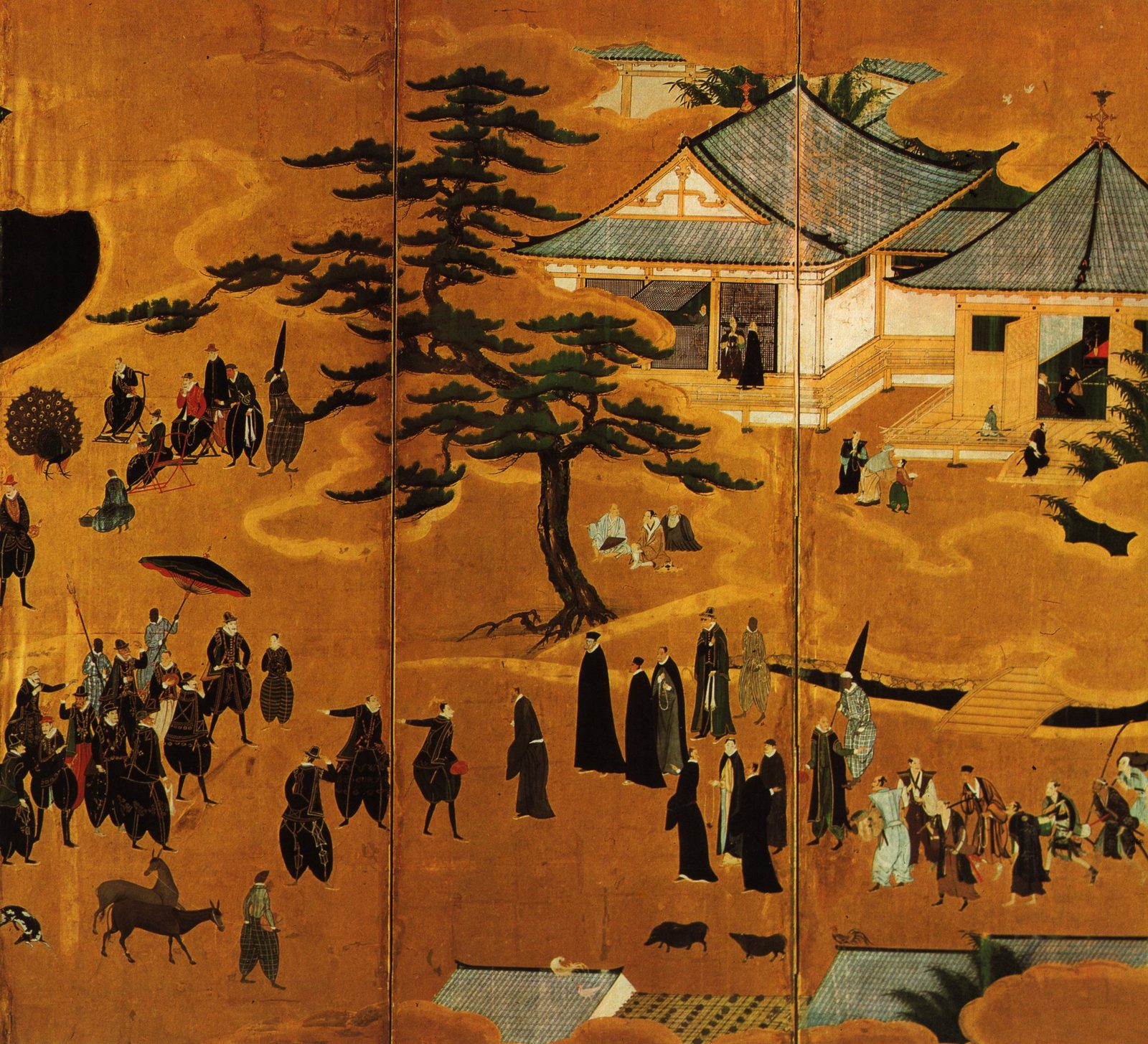
The Man in the Boat
Why Cosme de Torres Moved the Mission to Kuchinotsu in 1564
Late in 1563 the Superior of the Japanese mission got into a small boat at night and left the port he had spent a year building.
Behind him Yokoseura lay in ashes. The harbor Ōmura Sumitada had granted the Jesuits, with its church, warehouses and promise of a permanent Portuguese terminal, had burned in August in a rebellion by his own retainers. Cosme de Torres, the Valencian who had inherited the Japan enterprise from Francis Xavier and run it on a budget that would have embarrassed a parish priest, escaped with what could be lifted.
He went southeast, by way of Shimabara, to a fishing village on the southern tip of the peninsula. He made it his base the following year.
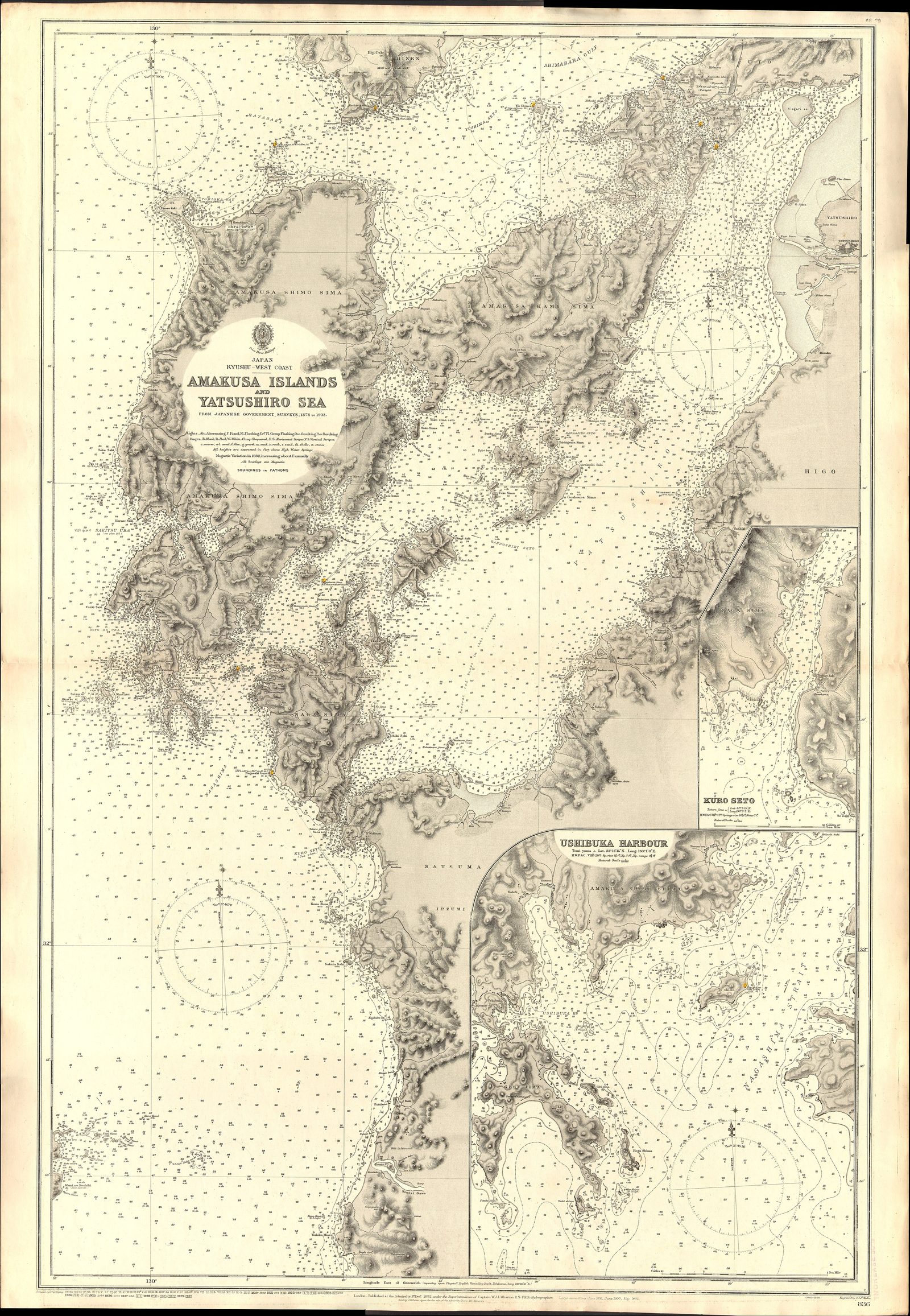
The village was Kuchinotsu, 口之津, the mouth of the port. It stood in Arima territory, overlooking the straits between the peninsula and the Amakusa islands. Portuguese pilots rendered its name as Choçhinouco, Chochinouqo and Cochinocho. Jesuit correspondence generally settled on Kochinotsu.
Torres already had somewhere to go. Around 1562 or 1563, Luís de Almeida, the Lisbon surgeon turned merchant turned Jesuit brother, had established a chapel in nearby Sasaki and baptized 250 people. By the time the Superior arrived, the community numbered perhaps 450 Christians.
Arima Yoshisada, the lord of the district, gave permission to land.
The Good Road
The Macau to Kuchinotsu Sailing Route and Its Rutters
The ships came from Macau, leaving between late June and early August on the southwest monsoon. The crossing took 14 to 30 days — unless the weather took a hand: the Santa Cruz needed 42 in 1564. Then they stayed. The winds that would carry them home did not arrive until late October or November.
That three-month wait explains why shelter mattered as much as access. Any beach can take a ship. Very few places can keep a laden carrack safe through the typhoon season while its cargo is sold in installments.
The route followed the Chinese coast before crossing the golfão, the open gulf, toward Meshima in the Danjō archipelago. The rutters, or sailing directions, described this island as high, ragged and uninhabited.
It was also frequently invisible. Haze, rain and the imprecision of dead reckoning could leave a pilot staring at empty water where an island ought to be. The Portuguese directions offered an unusually soothing instruction: governareis ao nordeste que este he o bom caminho. Steer northeast, for that is the good road.
From Meshima the route led toward the Bar of Arima and Kabashima, an island offering a safe anchorage before the final approach. Here a deep-draft ship waited for water and daylight. The last seven or eight leagues were sailed northeast and a quarter north.
Kuchinotsu was reached by bearing and landmark. The surviving rutters gave it no latitude.
Much the Better Port
Why Kuchinotsu Was a Good Anchorage for Portuguese Carracks
What made the place worth the run was the water.
The rutter that carried ships there rated Kuchinotsu above Ōmura’s own harbor: much the better port, it said, where the ships could lie very much at their ease. Its author had sounded the entrance himself, against older directions that called it poor.
For anyone who has never held 1,000 tons of timber in place with an iron hook, holding ground was the commercial argument. An anchor held by burying its fluke. On rock it could skate; in mud it could dig deep and stay.
The ships were substantial. By the end of the century, carracks commonly ran between 1,200 and 1,600 tons. They drew deeply, carried towering upperworks and could not be moved casually once loaded. A captain who chose a bad anchorage in August was gambling an extraordinary concentration of capital against the weather.
Kuchinotsu was not perfect. But a sounded entrance and room to lie at ease, in Arima’s own water, was close to what a 16th-century master would have ordered.
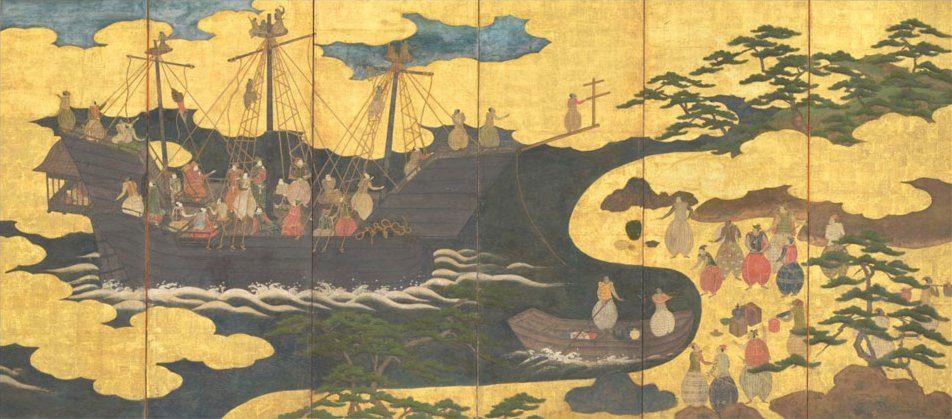
Three Ways to Open a Port
When Did Kuchinotsu Open to the Nanban Trade, 1562 or 1567
Ask when Kuchinotsu opened to foreign trade and the sources give two answers, five years apart. The disagreement is about what open means.
Japanese local histories date the opening to 1562, when Arima Yoshisada designated the village as a Nanban trade port. The Portuguese shipping record points elsewhere. In 1562 and 1563 the principal ships used Yokoseura; in 1564, Hirado; in 1565 and 1566, Fukuda.
Yokoseura, Yokoseura, Hirado, Fukuda, Fukuda. Not one of them Kuchinotsu.
A lord authorizing trade, a mission establishing a residence and a Great Ship dropping anchor are three different events. The 1562 date is best understood as designation, alongside the establishment of the chapel, rather than proof of a carrack in the basin.
Tristão Vaz da Veiga is named as the first Portuguese captain to arrive, in 1567; three Portuguese ships reached Japan that year, but nothing is recorded of the other two. That chronology remains uncertain: accounts differ over his movements and connect the visit with discussions about opening Nagasaki that are themselves reconstructed.
The arrival on which the evidence most clearly agrees came 12 years later, on a saint’s day in July. It was not an accident.
The Pagoda and the Tatami
Kuchinotsu as Headquarters of the Japan Mission, 1564 to 1567
From mid-1564 until the end of 1567, the administrative center of Christianity in Japan was a building in a fishing village beneath a volcano.
The volcano was Unzen. Its pilgrimage sites and wealthy monastery represented a landed institution with revenues, tenants and influence. The Jesuits were competing with something considerably more substantial than local superstition.
Their first difficulty, however, was flooring.
When Almeida returned in 1564, he found Christians reluctant to attend the chapel in the lord’s former residence because they feared damaging its fine tatami. A congregation afraid to enter its church for fear of scuffing the mats does not have a theological problem.
Almeida obtained an abandoned Buddhist temple instead. 100 workers removed its images and converted it into a church in two days. The Jesuit letters present this as evidence of enthusiasm. It is also a fairly precise description of what the neighbors would remember.
By October Almeida was reporting Kuchinotsu entirely Christian. The village received missionaries, dispatched them to other islands and, at Easter 1567, staged decorated streets and sacred plays through the night.
These were reports written by men describing their own work to the superiors who funded it. What they establish more securely than the conversion totals is that, for four years, the Japan mission conducted its business from a village without reliable ship service.
It could do so because Yoshisada protected a religion he had not joined. He sheltered the mission from 1563 but accepted baptism only in April 1576, as Dom André. 13 years is a long time to host a religion without joining it. Housing priests was one thing; alienating the Buddhist clergy, retainers and neighboring lords was another.
After his baptism, the reported conversions accelerated: 12,000 by the end of 1576, or 15,000 according to Francisco Cabral. The discrepancy is a useful reminder of how these totals were produced.
Yoshisada died the following year. Buddhist monks refused prayers, Cabral’s demand for a Christian procession was rejected, and the body was cremated according to Buddhist rite.
His son Harunobu then reversed the policy. Priests were expelled, crosses cut down, the Kuchinotsu church burned and converts compelled to abandon their faith. Cabral nevertheless found refuge in the harbor town and continued writing to Europe.
The mission’s address was a port whose church had been burned by the son of the lord who had sheltered it.
St James’s Day
Valignano’s Arrival at Kuchinotsu, 25 July 1579
On 25 July 1579, the feast of Saint James, Leonel de Brito’s ship entered Kuchinotsu after an 18-day crossing from Macau.
Aboard was Alessandro Valignano, Visitor of the Indies. Fróis met him and interpreted. The ship had come to Arima territory because Valignano had ordered it there.
Harunobu, who had persecuted the mission, was losing a war against Ryūzōji Takanobu of Saga. His shrinking domain still possessed one valuable asset: a harbor.
Sending the year’s ship there meant revenue, gifts, prestige and access to imported military supplies. Valignano was rewarding Harunobu and pressuring him with the same act.
Early in 1580, as the lord’s outposts burned, the Visitor spent roughly 600 cruzados from the cargo’s proceeds on food, silver, lead and saltpeter. The last two were military aid. Japan had abundant sulfur but little natural nitrate; a lord who ran out of saltpeter ran out of war.
Harunobu was baptized Dom Protásio that year. He then ordered the destruction of Buddhist and Shinto images, temples and shrines, and banished the native priesthood.
The harbor had helped preserve his domain. Conversion did not bring peace to it.
A Very Small Passenger
The Silk, the Silver and the Jesuit Share of the Macau Trade
No ledger survives for an individual Kuchinotsu arrival. The figures describe the wider Macau–Kyūshū trade, of which the port was one intermittent beneficiary.
At its peak, the Great Ship carried around 1,600 piculs of Chinese raw silk, roughly 96 metric tons. It entered a Japanese market cut off from direct Chinese trade and returned with silver. A captain-major could expect a personal profit of between 150,000 and 200,000 ducats from one voyage.
The Jesuits’ annual allocation was 50 piculs, secured through an agreement with the merchants of Macau in 1578. It yielded roughly 4,000 to 6,000 gold cruzados and supported the mission.
The Society of Jesus was a very small passenger on a very large commercial vessel. Its influence over destinations gave it leverage with lords who wanted the ship. It did not give it control over the merchants paying for the hull.
One sympathetic merchant was Bartolomeu Vaz Landeiro, whose large junk appeared at Kuchinotsu in 1580. He refused to trade where the fathers were unwelcome. Whether this reflected piety or a sound judgment about protection is difficult to separate. When his operation suffered a wreck off Taiwan in 1582, the Jesuits lost 8,000 cruzados in capital and 4,000 in expected profit.
There was other cargo. Kuchinotsu and Nagasaki also served the trade in enslaved people. During and after the Korean invasions of 1592–1598, Korean captives were sold onward through these ports to Macau and other colonies.
The Jesuits issued títulos, licenses intended to condition servitude on Christian instruction and eventual freedom. Bishop Luís de Cerqueira abolished the system at Nagasaki in September 1598, finding that scarcely anyone had been legitimately purchased.
Why the Ships Stopped Coming
Why Nagasaki Replaced Kuchinotsu as the Portuguese Port
Kuchinotsu was outcompeted, then legislated out of the question.
Nagasaki offered a long, deep harbor sheltered by hills and islands. Kuchinotsu had a fine basin but exposed approaches. Merchants also wanted a fixed destination, with familiar pilots, warehouses, interpreters and officials.
Credit mattered particularly. A lender could advance money against next year’s cargo at a known port. Wherever the fathers thought the ship should go was a less satisfactory address.
Nagasaki opened to the Portuguese trade in 1571 and was ceded to the Jesuits in 1580. Its settled administration and clerical protection offered merchants something a small port under a changeable provincial lord could not.
War sharpened that distinction. Ryūzōji expansion and the Shimazu advance repeatedly disrupted the smaller domains and their roads.
Then came law. Hideyoshi confiscated Nagasaki in 1587 and concentrated foreign trade at ports he controlled. In 1616, the shogunate restricted European shipping to Nagasaki and Hirado.
Kuchinotsu remained a fishing harbor. Around it lived thousands of Christians in a country that had begun killing them.
The Long Shadow
Kuchinotsu in the Persecution Years and the Shimabara Rebellion
In the persecution years, Kuchinotsu appears as a place of exile and arrest.
Arima Harunobu fell in the Okamoto Daihachi bribery scandal and was executed in 1612. In November 1614, the Korean-born Christian samurai Miguel Akahochi was exiled from Kuchinotsu during the general expulsion.
The Jesuit Provincial Francisco Pacheco was captured there in December 1625. His presence exposed the survival of the mission’s clandestine routes despite years of restrictions.
By 1627, Unzen’s boiling springs had become an execution ground. The mountain whose monastery had opposed the mission was now used to kill Christians slowly enough that they might recant.
The Shimabara rebellion followed in 1637. Its immediate causes were taxation and famine under the Matsukura. Religion formed part of a longer history.
Kanda Michitaka argues that the temple burnings and destruction of crosses had created resentments that families carried across generations. This is an interpretation, not a documented chain of cause and effect. But the connections between the earlier Christian community and the later rising were real: figures associated with the rebellion belonged to families marked by persecution.
The Christians who had written collective letters to Rome in 1620 and 1621 represented a community with almost 60 years of history. Their district had once housed the mission’s headquarters.
The later record becomes a register of deaths: Thomas Araki Choyemon of Kuchinotsu, date uncertain. Gaspar Nagai Sosan, 1627. Joachim Mine Suqedayu, at Unzen, 1627. Michael Nacaxima, at Unzen on Christmas Day 1628.
Sources & Further Reading
Anesaki, Masaharu. A Concordance to the History of Kirishitan Missions. 1930.
Boxer, C. R. The Christian Century in Japan, 1549–1650. 1951; The Great Ship from Amacon. 1959.
Cooper, Michael. Rodrigues the Interpreter. 1974.
Ehalt, Rômulo da Silva. Jesuits and the Problem of Slavery in Early Modern Japan. 2018.
Elison, George. Deus Destroyed. 1973.
Fróis, Luís. História de Japam. Edited by Josef Wicki, 1976–1984.
Hesselink, Reinier H. The Dream of Christian Nagasaki. 2016.
Kanda, Michitaka. On the Emotions of “Hatred” and “Resentment” in the Relationship between Kirishitans and Buddhists: A Case Study Surrounding the Daimyō Arima Yoshisada. 2024.
Linschoten, Jan Huygen van. Itinerario. 1596.
Moran, J. F. The Japanese and the Jesuits. 1993.
Schütte, Josef Franz. Valignano’s Mission Principles for Japan. 1980–1985.
Cite this page
Nanban.pt. “Much the Better Port: Kuchinotsu, the Harbor That Sheltered the Japan Mission, 1562–1638.” Last modified 25 September 2026. https://nanban.pt/articles/kuchinotsu-arrival-point/.
@misc{nanban-kuchinotsu-arrival-point,
  author = {Nanban.pt},
  title = {Much the Better Port: Kuchinotsu, the Harbor That Sheltered the Japan Mission, 1562–1638},
  year = {2026},
  url = "https://nanban.pt/articles/kuchinotsu-arrival-point/",
  note = {Last modified 2026-09-25}
}