The Chronicler: Luís Fróis and the 34-Year Report
A Lisbon courtier's son became the most observant European in 16th-century Asia, wrote the definitive history of Christian Japan, and watched his own superiors bury the manuscript for 400 years.
Luís Fróis (1532 to 1597) was the Portuguese Jesuit whose Japan mission spanned 34 years and who wrote the Historia de Japam, the fullest European account of the country's Christian Century, alongside more than 130 letters and a 611-entry treatise contrasting European and Japanese customs. He interpreted for Oda Nobunaga and Toyotomi Hideyoshi and witnessed the crucifixion of the Twenty-Six Martyrs at Nagasaki in 1597, but Valignano judged his chronicle too long to send to Rome unabridged, and the complete text was not published until 1976 to 1984.
In the late summer of 1593, in a stifling residence in Macau, a 61-year-old Portuguese Jesuit sat with a quill in his shaking hand and wrote, at dictation, a letter he had not composed, on behalf of a superior he had come to resent, about a mission he was forbidden to return to. He had spent most of his life writing. Over 130 extensive letters on the political, military, and domestic minutiae of 16th-century Japan. A 600-entry comparative ethnography that remains one of the most peculiar documents of the entire Counter-Reformation. And a three-part chronicle of the Jesuit mission that covered 44 years of the most dramatic period in Japanese history.
The chronicle was sitting in a drawer. Valignano had decided it was too long, too secular, too interested in the color of Hideyoshi's sword-bearer's kimono and not interested enough in the glory of the faith. He had also decided that the man best placed to edit it — which is to say, its author — could be more usefully employed writing other men's correspondence for eight hours a day. The shaking in his arms was getting worse. One of his legs was beginning to swell alarmingly. He wrote anyway, because writing was, at this point, what he did.
His name was Luís Fróis. He is the reason we know most about what we know about the Christian Century in Japan.
Who Was Luís Fróis? From Lisbon Clerk to Jesuit in 1548
The Boy at the Royal Secretary's Desk
Fróis was born in Lisbon in 1532, he grew up in a city that already believed itself to be the navel of the world and had some of the numbers to back it up. The Carreira da Índia was running annually. Silver from the Indies and silk from Canton moved through the Tejo. The court of King João III was a functioning center of European diplomacy, and it had room in its bureaucracy for clever boys of good family.
Luís was one of them. It is almost certainly no accident that a relative — probably his uncle, Bartolomeu Fróis — held a position as escrivão da fazenda, a scrivener in the royal treasury, and that young Luís found his way, in his adolescence, to a clerk's desk in the Royal Secretary's office. This was not quite the start of a glittering career, but it was the antechamber. For a boy of his station, the path ahead was predictable: Latin, law, perhaps a benefice, a safe position writing letters for men of influence until he became one himself.
He was an extraordinarily quick study. The men who met him later would remark on his copia de palavras — his fluency, his eloquence, the sheer volume of well-turned sentences he could produce on command. They would also remark, rather more ambivalently, on his handling of other people's paperwork. They also remarked that he was not to be trusted with a secret he thought interesting enough to share.
On the fourth of February 1548, a month short of his 16th birthday, he walked into the Jesuit house in Lisbon and asked to be received into the Society. Father Simão Rodrigues admitted him. A month later he was aboard the Galega, one of the six ships of the annual India fleet, sailing for Goa.
He was, one suspects, delighted. He was also about to spend eight months at sea, during one of which the fleet would be nearly destroyed by a storm off the Cape of Good Hope. Fróis — 16, untested, and so far from home that the concept had lost its meaning — spent the worst days of the voyage nursing the sick among his fellow passengers. He arrived in Goa that autumn and almost immediately met the man who was about to make Japan the new frontier of the European imagination: Francis Xavier, then in Goa preparing for the journey that would take him to Kagoshima the following year. (Xavier's mission is the subject of a dedicated article on this site).
Fróis would spend the next 14 years in India and Malacca, finishing his training and serving as secretary to Vice-Provincial Belchior Nunes Barreto, before returning to Goa to study scholastic philosophy and theology under some of the most intimidating intellectuals the Society could field. His superiors' dossiers describe him in terms that would follow him to his grave. Intelligent. Eloquent. Tough. Good-humored. Tireless with paperwork. And — in the words of Father António de Quadros — "not very soft at heart," and "not religious" in the soft, pious, interior sense that Jesuits of the time tended to admire. He was, in short, a courtier who happened to be wearing a cassock. In 1561 he was ordained priest in Goa. A year later, he received the assignment he had been waiting for without knowing it.
Japan.
How Fróis Learned Japanese and Reached Kyoto, 1563–1565
Hirado, the Language, and the Blind Brother
He arrived in 1563 and was sent to the port of Hirado and the nearby island of Takashima, where the Jesuits maintained a small residence and a considerably larger problem: almost none of the Europeans could speak the language they were attempting to preach in. Fróis, who at this point already commanded Portuguese, Latin, Spanish, and Italian, was placed in the tutelage of the one Jesuit who could actually talk to the Japanese — Brother Juan Fernández, the Spaniard Xavier had brought with him in 1549, who had spent a decade accumulating a functional grasp of the spoken vernacular through sheer immersion.
What happened next was unusual. Fróis did not merely learn Japanese well enough to preach; he learned it well enough to argue theology in it, to compose letters and chronicles in its registers, and — most importantly for what was coming — to interpret in real time for men whose moods could kill him. It is not an exaggeration to say that by the end of the 1560s he was one of perhaps three or four Europeans alive capable of performing at the highest diplomatic register in Japanese. The other candidates, conveniently, all worked for him.
In November 1564, the Mission Superior Cosme de Torres sent him to Kyoto to assist Father Gaspar Vilela, who had been struggling to keep a tiny congregation alive in the imperial capital for nearly five years. Fróis arrived on the last day of January 1565, bearing gifts and introductions. He was met, in what would become the defining relationship of his Japanese career, by a short, partially blind, six-fingered Japanese lay brother who had once been a biwa hōshi — an itinerant minstrel playing the four-stringed lute for roadside audiences — and who, at this point, was the most accomplished preacher the mission possessed. His name was Brother Lourenço, and his life is the subject of another article on this site. For the next 30 years, whenever Fróis needed to say something important to a Japanese warlord in Japanese, Lourenço was at his elbow.
The Kyoto assignment lasted barely five months before it collapsed. On the 17th of June 1565, the sitting shōgun — Ashikaga Yoshiteru, protector of the mission, and a man Fróis and Vilela had met only weeks earlier at a stiff New Year's audience in which Vilela had worn pontifical robes that the shōgun found bewildering but impressive — was attacked in his palace by the forces of Matsunaga Hisahide and Miyoshi Yoshitsugu. Yoshiteru fought his killers off for as long as the supply of swords being handed to him would permit, and then died. The full drama of that day, and the ensuing collapse of the Kyoto mission, is covered in the Gaspar Vilela article.
What concerns us here is Fróis. He fled south to the free city of Sakai. He spent the next four years there, ministering to Christians in a merchant town whose council was pragmatic enough to protect him but not interested enough to convert. And he acquired, in that interval, the patron who would change his life.
Wada Koremasa was a senior retainer of the Ashikaga faction — a samurai of consequence, politically agile, a man who possessed the three attributes most useful to a 16th-century Jesuit: military authority, theological curiosity, and a genuine fondness for foreigners. Fróis, who had an aristocrat's instinct for aristocrats, gravitated to him immediately. The two became close. At one point, Fróis — overwhelmed by Wada's generosity — asked whether Wada might consider formal baptism. Wada smiled, paused, and said that he was already a Christian in his heart. It is the kind of answer a courtier gives. Fróis, who was himself a courtier, understood it perfectly.
Wada was killed in battle in 1571. Fróis wrote an account of his death that reads like a passage from a chanson de geste. But before that, in the spring of 1569, Wada had arranged the single most consequential introduction of Fróis's career.
How Fróis Won Oda Nobunaga's Protection in 1569
Nijō, the Alarm Clock, and the Monk with the Sword
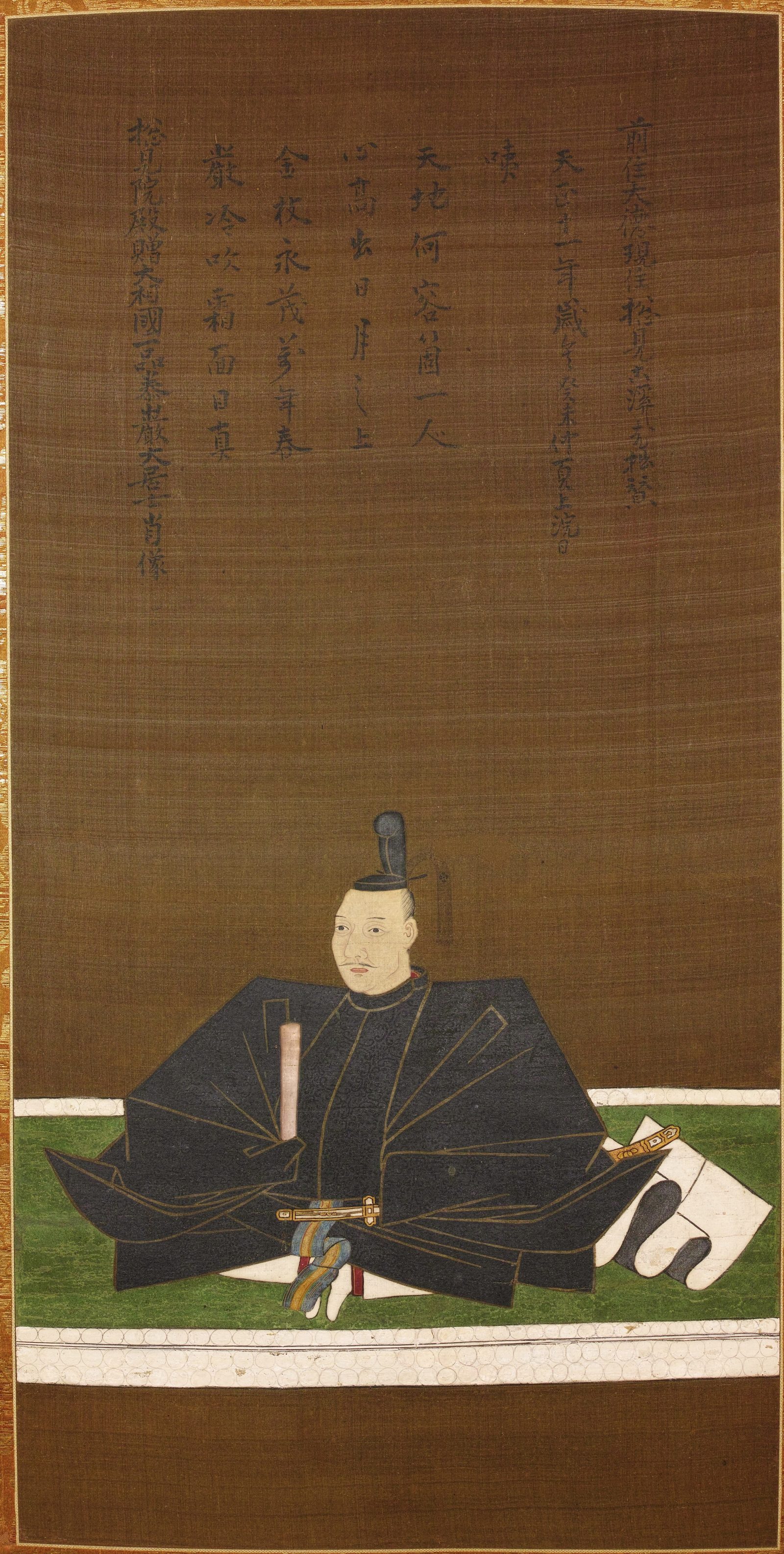
Oda Nobunaga was, in the spring of 1569, supervising the construction of Nijō Castle in Kyoto. He was 34 years old, in the early ascendancy of his campaign to pacify central Japan, and — crucially for the missionaries' purposes — he despised the militant Buddhist sects with the white-hot enmity of a man who had been inconvenienced by them once too often. The Jesuits were, by default, aligned with his enemies' enemies. Wada, who knew this, brought Fróis to the construction site for an audience.
Fróis came bearing two gifts. The first was a glass flask of konpeitō, the colored Portuguese sugar candy whose star-shaped lumps had been bewildering the Japanese aristocracy for a generation. The second was a set of wax candles. These were modest offerings; Nobunaga accepted them with the distracted courtesy of a man supervising a building site. Then, a few days later, the gift that mattered made its way to him, via Wada: a small mechanical alarm clock.
Nobunaga was fascinated. He examined the mechanism, listened to it strike, asked how it worked. He refused to keep it. It would be useless to him, he said, because he would never be able to regulate it properly. This was, characteristically, the judgment of a man who had already identified the object's core weakness. He turned instead to the delegation in front of him, twice had tea served to Fróis in his own bowl, and sent him away with silk garments.
Nobunaga arranged a formal disputation between Fróis, assisted by Brother Lourenço, and a senior Buddhist monk named Nichijō Shōnin. The subject was the customary one. God, creator of all things, invisible, eternal. Buddhist deities, said the Jesuits via Lourenço, were merely mortal men who had failed to save themselves. Nichijō — who had not expected to be losing the argument on rhetorical grounds to a blind lute-player — lost his composure. He then lost his self-control. He then grabbed a glaive, or perhaps a scimitar, from somewhere in the room and attempted to strike the Jesuits dead on the spot.
He was physically disarmed, by Nobunaga himself, Wada and Sakuma Nobumori. In the room, and by his own later account on the Jesuits' side, was a rising general in Nobunaga's service named Kinoshita Tōkichirō. Kinoshita would later be known as Toyotomi Hideyoshi, the second unifier of Japan and, eventually, the man who would sign the expulsion order that ended Fróis's career in the capital. But that was 18 years away. On this afternoon, the future autocrat of Japan watched a weapon pried out of the hand of a Buddhist monk who had been thoroughly outmaneuvered by a foreign priest and a six-fingered minstrel.
Nobunaga laughed. He had his answer. The Jesuits were useful. They were also amusing. From that moment until his assassination at Honnō-ji in 1582, he gave them his protection, and Fróis was granted a personal access to the warlord that no other European ever matched. The broader campaign of destruction that Nobunaga waged against the Buddhist establishment — culminating in the 1571 holocaust at Enryakuji on Mount Hiei — is covered in a dedicated article on Nobunaga's war on Buddhist power.
What Fróis saw, he recorded. The intimate tour of Gifu Castle, with Nobunaga himself acting as cicerone. The stunning architectural detail of Azuchi. The moments of casual brutality. The hubris. When Nobunaga was betrayed and killed at Honnō-ji in June 1582 — in flames, or by his own hand, the sources disagree — Fróis interpreted his death as a judgment of God against a man who had, in his final years, demanded to be worshipped as a living kami from the top of his own castle keep. The Jesuit chronicler could be wry about a great many things. He was not wry about divine retribution. It was the one register in which his hand steadied.
Why Rome Commissioned the Historia de Japam, 1577–1586
Bungo, the Commission, and the Dictator's Tour
In 1577, Fróis was transferred back to Kyūshū to serve as Jesuit Superior at Bungo, based in Usuki — the domain of the powerful and temperamentally Christian-sympathetic daimyō Ōtomo Sōrin, who would be baptized the following year as Dom Francisco. Fróis's administrative record in Bungo is, in the assessment of his peers, mixed. He was a brilliant writer, a gifted linguist, and a beloved confessor. He was not, by all surviving accounts, a great manager. The mission accounts were not always kept as they should have been, personnel disputes were not always resolved with maximum tact, and his attention wandered, in ways that his superiors noted, toward the subjects that actually interested him: the politics of Ōtomo's household, the intellectual life of Sōrin himself, the Christian education of Sōrin's daughter, the bitter quarrels between Sōrin and his fiercely anti-Christian wife, whom the Jesuits delightedly nicknamed Jezebel.
What he produced in Bungo was not an efficient administration. It was a reservoir of domestic detail — the kind of texture no other European observer of 16th-century Asia thought worth recording — that would later find its way into the História. Sōrin told him stories. Fróis wrote them down. At 16, Sōrin had defied his own father's plot to murder the Portuguese merchant Jorge de Faria and steal his cargo, protecting the foreigners instead. Ōmura Sumitada — Japan's first Christian daimyō — had, on his deathbed in 1587, ordered his retainers to free all the slaves and captives they held. Hosokawa Gracia, born Akechi Tama, had mastered Christian doctrine from inside the confinement of her husband's jealous household almost entirely by correspondence. Fróis wrote to her. He seems never to have met her face to face after a single secret visit she made to the Osaka church in 1587. He wrote about her as if she were a saint in progress, which, in a Catholic reading, she probably was.
In 1581, Fróis returned to Kyoto to act as interpreter for the newly arrived Jesuit Visitor, Alessandro Valignano. Valignano — a Neapolitan aristocrat whose own improbable career is the subject of a dedicated article on this site — had, by this point, identified Fróis as the most capable translator and observer the mission possessed. He was also, it would become clear, beginning to worry that Fróis was the wrong man for the other job Rome wanted done.
Around 1583 or 1584, the Jesuit Superior General in Rome, Claudio Acquaviva ordered Fróis to step back from frontline missionary work and compose a comprehensive history of the Japan mission. He had been commissioning such histories elsewhere in the Society's empire; the Japan mission, by far the strangest and most politically consequential of all the enterprises, badly needed one. Fróis was — everyone agreed — the obvious choice. He had been there since 1563. He had met almost everyone of consequence. He had an encyclopedic memory for names, dates, exact numbers, and geographic specifics. He wrote with, as one later historian would put it, "the insight and breadth of view of a statesman."
He began work at Kazusa on the Shimabara peninsula. The following year, on the 14th of June 1585, he completed a curious preliminary exercise: the Tratado das Contradições e Diferenças de Costumes entre a Europa e o Japão, 611 paired couplets establishing direct contrasts between European and Japanese habits. In Europe we do this. In Japan they do that. The Tratado was likely drafted at Valignano's suggestion as a pedagogical manual for new missionaries arriving in Japan; it is now recognized as one of the earliest coherent works of comparative cultural anthropology ever produced.
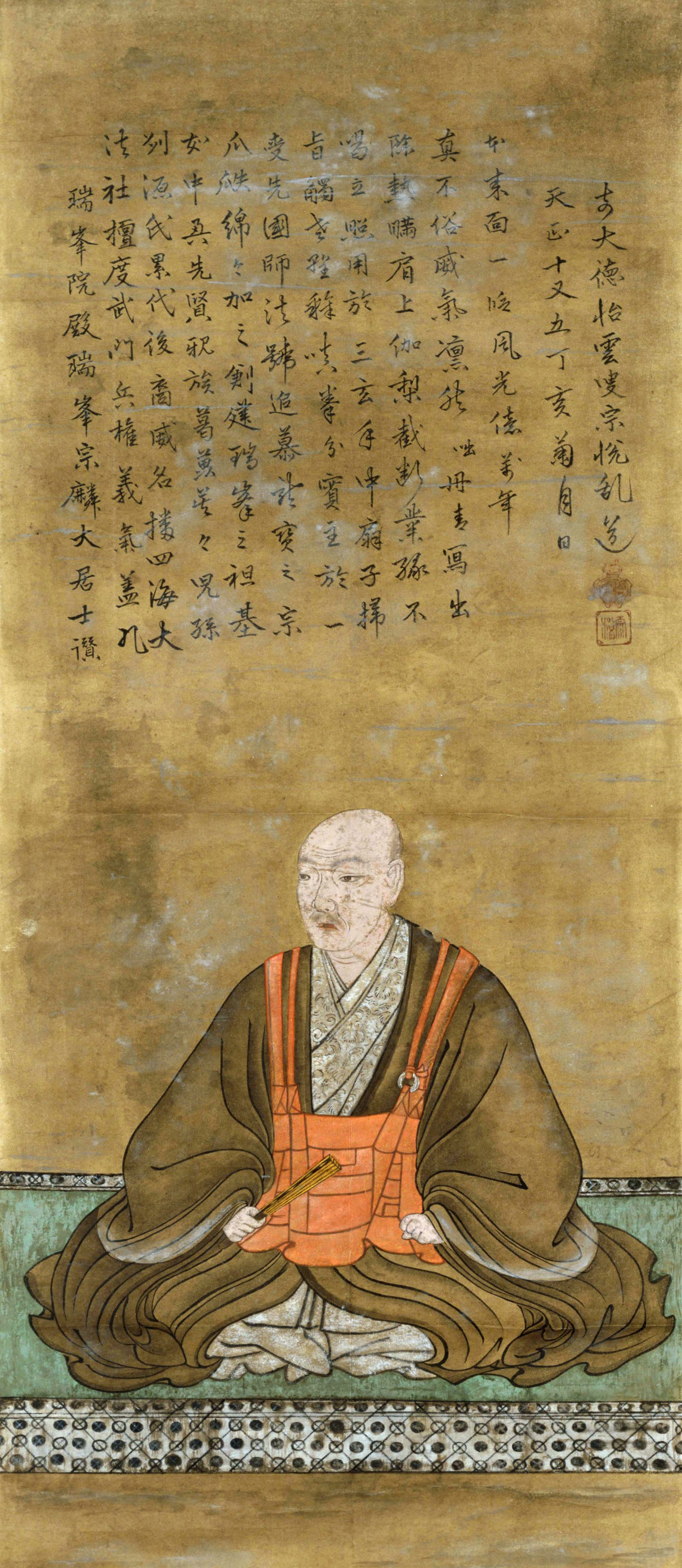
The year after that, in May 1586, Fróis was summoned to interpret at the single most surreal diplomatic audience of his career. Toyotomi Hideyoshi — the general who had sided with the Jesuits against Nichijō Shōnin 17 years earlier, and who was now the effective unifier of Japan — invited Vice-Provincial Gaspar Coelho and his entourage to Osaka Castle. Hideyoshi was in his most expansive mood. He personally guided the Jesuits through the upper floors, showing off the gold, the silver, the lacquered screens, the silk. He was preceded on the tour, Fróis noticed and carefully recorded, by a richly dressed young girl carrying his sword, with whom the warlord joked continuously. He boasted of his plans to conquer Korea and then China, and asked the Jesuits to procure two armed Portuguese galleons for the campaign. In return, he said, he would build churches throughout China. Fróis translated. Coelho agreed. Both of them, in hindsight, had overreached. But on that afternoon, in those rooms, the mission seemed — to everyone present — as if it might be on the verge of something spectacular.
14 months later, in Hakata, the same man who had served them tea issued the edict that ended Christian Japan's honeymoon.
The 1587 Expulsion Edict and Why Valignano Shelved the Historia
The Four Questions and the Long Collapse
On the night of the 24th of July 1587, messengers arrived at the Jesuit residence in Hakata with four angry questions for Vice-Provincial Coelho. Why did the missionaries force conversions on people? Why did they destroy Buddhist and Shinto temples? Why did they eat useful animals like cows and horses? And why did the Portuguese merchants buy Japanese people as slaves? Fróis was with Coelho that night. He wrote the scene up in detail the next day — the confusion, the scramble for an adequate reply, the growing realization that no adequate reply existed. At dawn, Hideyoshi issued the expulsion edict declaring Japan the Land of the Gods and ordering all missionaries out of the country within 20 days. The full story of that edict, and the reasons Hideyoshi did not in the end enforce it, is covered in the article on Hideyoshi's 1587 decree.
Fróis did not leave. No one did. The edict was, in practice, a warning — Hideyoshi needed Portuguese trade too badly to slam the door — but the political atmosphere of the mission changed permanently that week.
In March 1591 came Valignano's audience with Hideyoshi, at which the four young samurai envoys of the Tenshō Embassy — just returned from their journey to Europe — were presented. (Their improbable voyage is the subject of a dedicated article on this site). Hideyoshi was delighted. He shared a sakazuki of sake with Valignano. He asked the young men to play harpsichords, lutes, and viols, and they obliged. João Rodrigues interpreted; Fróis, who was not there, wrote the scene up from the reports of those who were.
A year and a half later, in October 1592, Valignano decided that Fróis was coming with him to Macau. The official justification was editorial: the História de Japam — the third part of which Fróis would complete in Macau in 1593 — needed to be prepared for shipment to Rome, and its author was obviously the only man who could properly do the work.
The actual purpose, as everyone involved seems to have recognized, was different. Valignano wanted a personal secretary of genius, and Fróis — the best writer in the Society in Asia — was it. Fróis spent the next three years in Macau dictating Valignano's correspondence for up to eight hours a day, with an arm that had begun to tremble uncontrollably and a body that was beginning to fail him in other ways. He pleaded with Rome to release him, to publish his manuscript, to send him back to Japan. Valignano considered the manuscript and Valignano refused to send it.
The História de Japam was, in Valignano's judgment, too long. It devoted enormous energy to secular political detail — to warlords' sword-bearers and daimyō's domestic disputes and the exact color of lacquer on scabbards — and not enough to the edification of European readers. It contained passages that could embarrass the Society. It would not be published in Fróis's lifetime, or for a very long time afterwards. The complete Portuguese text finally appeared between 1976 and 1984, in five volumes edited by the Jesuit historian Josef Wicki, nearly 400 years after Fróis laid down the pen.
Meanwhile, in Macau, Valignano began composing his own, much shorter, much more restrained history of the Japan mission. Fróis's manuscript sat in a cupboard.
The Twenty-Six Martyrs of 1597 and the Death of Luís Fróis
Nagasaki, the Twenty-Six, and the Long Silence
In July 1595, broken in health, Fróis was finally permitted to return to Nagasaki. He was 63. One of his legs was severely swollen. His hands still shook. He continued to write.
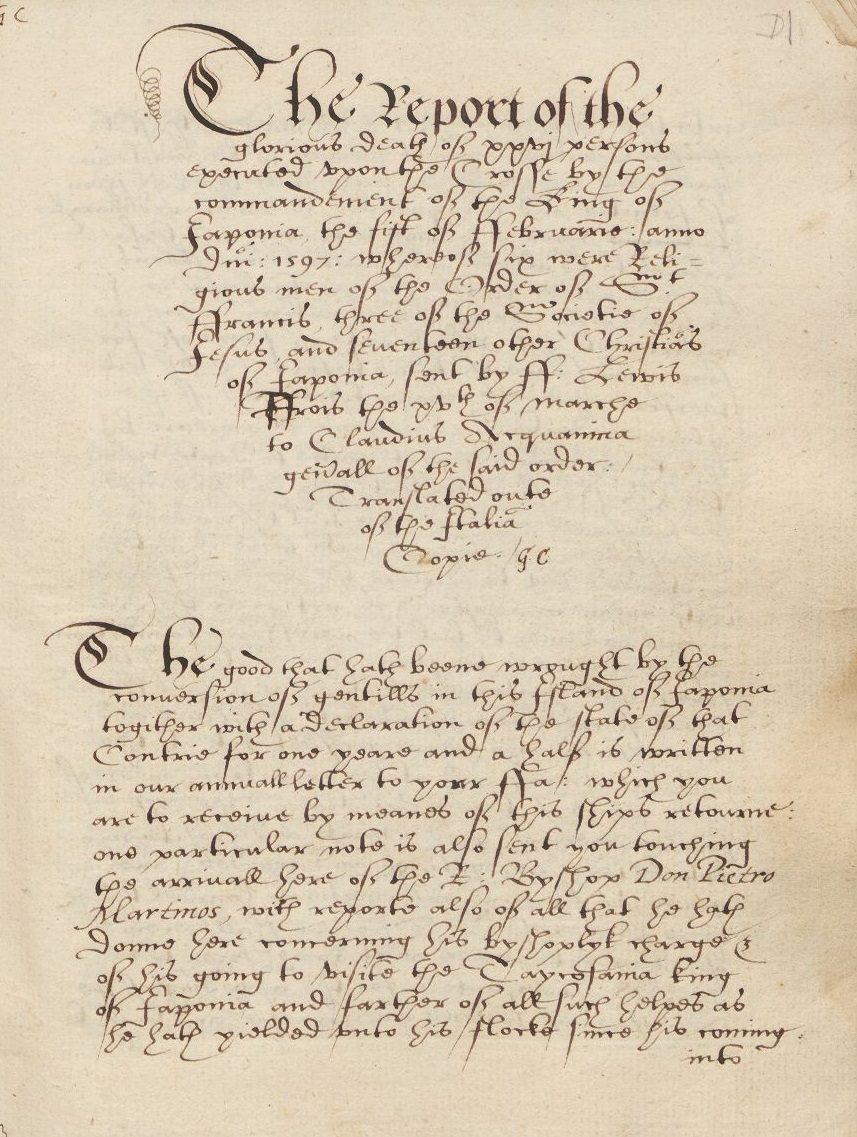
He witnessed, in his final 18 months, the culminating tragedy of Hideyoshi's turn against Christianity. In October 1596 the Spanish galleon San Felipe was wrecked off the coast of Shikoku; the indiscreet boasting of a pilot — that the missionaries were the forward detachment of a Spanish military conquest — reached Hideyoshi, and the regent's long-smoldering fury at the Franciscans and the unauthorized conversions in the capital region finally combusted. The full chain of events is covered in the article on the San Felipe Incident. 26 Christians — six Franciscan friars, three Japanese Jesuits, 17 laymen among whom were three young boys — were arrested, marched across the width of Honshū in the depths of winter, and crucified on the hill of Nishizaka overlooking Nagasaki harbor on the fifth of February 1597. Fróis was there. He watched the entire procedure, from the setting of the crosses to the final lance-thrusts, and then went home and wrote the most detailed surviving account of what he had seen. He finished it on the 15th of March 1597. A subsequent generation of Christian executions on the same hill is covered in the dedicated article on the Great Martyrdom of Nagasaki of 1622.
On the eighth of July 1597, less than four months after completing his report on the Twenty-Six Martyrs, Luís Fróis died in Nagasaki. He was 65 years old. He had been in Asia for 49 years. He had first reached Japan 34 years before.
Behind him lay more than 130 extensive letters, the still-unpublished História de Japam, and the Tratado das Contradições e Diferenças de Costumes. He had personally witnessed the assassination of a shōgun, the rise and fall of Nobunaga, the meteoric ascent of Hideyoshi, the Osaka Castle tour, the expulsion edict of 1587, the return of the Tenshō envoys, and the martyrdom on Nishizaka hill that would prefigure four decades of escalating persecution. He had interpreted for Vice-Provincials and for warlords. He had argued theology with Buddhist monks. He had defended Japanese women against the indigenous notion that menstruation and childbirth were spiritually polluting, on the grounds that both had been designed by God for the nourishment of infants — a line of reasoning unusually free of 16th-century European squeamishness, and one of a thousand small signs that the man taking the notes had a mind that worked differently from almost any of his contemporaries.
His superiors had thought him charming, gifted, and a touch too interested in things that did not concern him. His peers had thought him indispensable as an interpreter, unreliable as a confidant, and maddening as a writer. Valignano had dismissed his prose as "utterly indigestible" and would not send it to Rome. And his manuscript had then sat, in a succession of ecclesiastical cupboards, for longer than the United States has existed.
When the História de Japam finally saw print, readers discovered what Valignano had been so determined to cut: an author who described Japanese customs as simply different, not inferior; who devoted pages to the fashion choices of warlords' sword-bearers and the folding-paper handkerchiefs of urban women and the construction details of castles and gardens; who wrote up every audience with a dictator as if it were a scene from a play, with stage directions and props and the occasional absurd detail about what someone's child was wearing. The very qualities that made Valignano shelve the book are the qualities that have made modern historians rely on it. There is no other source for the Christian Century with anything remotely like its granularity.
Sources & Further Reading
Cooper, Michael. They Came to Japan: An Anthology of European Reports on Japan, 1543–1640. University of California Press, 1965. A carefully edited anthology that includes substantial translated excerpts from Fróis's letters and the Historia, with introductions that situate him among his European contemporaries. The single best English-language entry point to the man's prose.
Cooper, Michael. Rodrigues the Interpreter: An Early Jesuit in Japan and China. Weatherhill, 1974. Though nominally focused on João Rodrigues, this volume offers essential comparative context for understanding Fróis's linguistic and cultural achievements within the broader Jesuit mission in East Asia.
Elisonas, Jurgis (George Elison). Deus Destroyed: The Image of Christianity in Early Modern Japan. Harvard East Asian Monographs, 1973. The standard analytical treatment of Japanese intellectual engagement with Christianity. Elison repeatedly draws on Fróis for primary evidence and offers a sober assessment of his reliability as a witness.
Fróis, Luís, SJ. Historia de Japam. Edited by José Wicki, SJ. 5 vols. Biblioteca Nacional, Lisbon, 1976–1984. The first complete critical edition of the manuscript, published nearly four centuries after its completion. In Portuguese, with apparatus. The indispensable primary source.
Fróis, Luís, SJ. Tratado em que se contem muito sucintamente e com abreviação algumas contradições e diferenças de costumes entre a gente de Europa e esta província de Japão. Edited and translated into English by Daniel T. Reff, Richard K. Danford, and Robin Gill as The First European Description of Japan, 1585. Routledge, 2014. The modern English edition of the Tratado, with extensive commentary on the cultural contrasts and the Jesuit pedagogical context.
Fujita, Neil S. Japan's Encounter with Christianity: The Catholic Mission in Pre-Modern Japan. Paulist Press, 1991. A concise synthesis that gives substantial weight to Fróis as witness and writer, with attention to the fate of the Historia manuscript.
Moran, J. F. The Japanese and the Jesuits: Alessandro Valignano in Sixteenth-Century Japan. Routledge, 1993. The standard treatment of the Valignano era, including the decisive chapters on the commissioning of the Historia and Valignano's fraught relationship with its author.
Oliveira e Costa, João Paulo. O Cristianismo no Japão e o Episcopado de D. Luís Cerqueira. Universidade Nova de Lisboa, 1998. Portuguese-language scholarship on the Japan mission in the decades during which Fróis was writing, with detailed treatment of the Jesuit documentary apparatus.
Ross, Andrew C. A Vision Betrayed: The Jesuits in Japan and China, 1542–1742. Orbis Books, 1994. A sympathetic but analytically sharp account of the Jesuit enterprise, with sustained treatment of Fróis's role as chronicler and interpreter.
Ruiz-de-Medina, Juan G., SJ, ed. Documentos del Japón. 2 vols. Institutum Historicum Societatis Iesu, 1990–1995. The modern critical edition of the principal Jesuit letters and reports from Japan, including dozens of Fróis's own letters and those of his superiors concerning him.
Schurhammer, Georg, SJ. Francis Xavier: His Life, His Times. Volumes II–IV. Translated by M. Joseph Costelloe, SJ. Jesuit Historical Institute, 1977–1982. For the Goa and Malacca context in which Fróis was trained, and the early Jesuit infrastructure of the East Indies enterprise.
Valignano, Alessandro, SJ. Sumario de las cosas de Japón (1583). Edited by José Luis Alvarez-Taladriz. Sophia University, Tokyo, 1954. Valignano's own survey of the Japan mission, including the judgments on Fróis that explain both his promotion to chronicler and his eventual conscription as personal secretary.
Recent scholarship
- Kanazawa, Osamu (2026). “The Truth and Fiction of Xavier’s 1551 Meeting: As the Starting Point of Discovering Conceptual Similarities between Mahavairocana and the Prime Matter”, Journal of the Research Institute for Christian Culture, Seisen University, 34, pp. 1–24. — This 2026 journal article argues that the 1551 Yamaguchi meeting likely sparked a later theological comparison between Mahavairocana and Prime Matter, rather than producing the equivalence itself.Free full text ↗ (opens in a new tab)
- Pitelka, Morgan (2026). “Deifying Warlords: Mythologizing Samurai Leaders in Early Modern and Modern Japan”, Japan Review, 41, pp. 57–82. — This article argues that Japan’s “Three Heroes” were transformed from historical figures into mythologized icons to serve shifting political and commercial needs.Free full text ↗ (opens in a new tab)
- Braddick, Kizaki (2026). “The Life and Afterlife of Hizen Nagoya Castle”, Transactions of the Royal Historical Society. — This article argues that Hizen Nagoya Castle was dismantled gradually and, centuries later, repurposed for peace rather than vanishing immediately after war.Free full text ↗ (opens in a new tab)
- González-Bolado, Jaime (2026). “Portraying the ‘Chosen Samurai’: The Creation of an Idealized Image of the Japanese in 16th-Century Jesuit Printed Works”, Religio: Revue pro religionistiku, 34, pp. 145–168. — This 24-page article argues that 16th-century Jesuits crafted an idealized “Chosen Samurai” image in print, partly to secure funding, while their private letters revealed a far more critical view of the Japanese people.Free full text ↗ (opens in a new tab)
Cite this page
Nanban.pt. “The Chronicler: Luís Fróis and the 34-Year Report.” Last modified 7 October 2026. https://nanban.pt/articles/luis-frois-jesuit-chronicler/.
@misc{nanban-luis-frois-jesuit-chronicler,
  author = {Nanban.pt},
  title = {The Chronicler: Luís Fróis and the 34-Year Report},
  year = {2026},
  url = "https://nanban.pt/articles/luis-frois-jesuit-chronicler/",
  note = {Last modified 2026-10-07}
}