Brother Lourenço of Hirado: The Blind Minstrel Who Built a Church
He was half-blind, unlettered, six-fingered, and described by men who admired him as having a face painful to look at. He was also the greatest preacher the Jesuit mission in Japan ever produced, and without him there would have been no Christian Century.
Brother Lourenço of Hirado (c. 1526 to 1592), born Ryōsai, was a blind Japanese biwa minstrel who became the Jesuit mission's greatest preacher and, in 1563, the first Japanese admitted to the Society of Jesus. His vernacular debates won over the judges of the 1563 Nara inquisition, converted the founding families of the Christian samurai aristocracy, and secured the favor of Oda Nobunaga, making him indispensable to the survival of Christianity in Japan.
How Xavier Met Lourenço at Yamaguchi in 1551
The Man on the Street Corner in Yamaguchi
In the summer of 1551, in the western provincial capital of Yamaguchi, a Navarrese priest named Francisco de Jasso y Azpilicueta, known to history as Francis Xavier, and his Spanish companion Juan Fernández were preaching on street corners in a language they had barely begun to master. The response, more often than not, was laughter. Xavier's Japanese was a phonetic ordeal, memorized syllable by syllable from a grammar-less tutor in Kagoshima and delivered with the broad-voweled emphasis of a man who did not know where one word ended and the next began. Fernández was marginally better. Neither was in a position to debate theology with anyone literate.
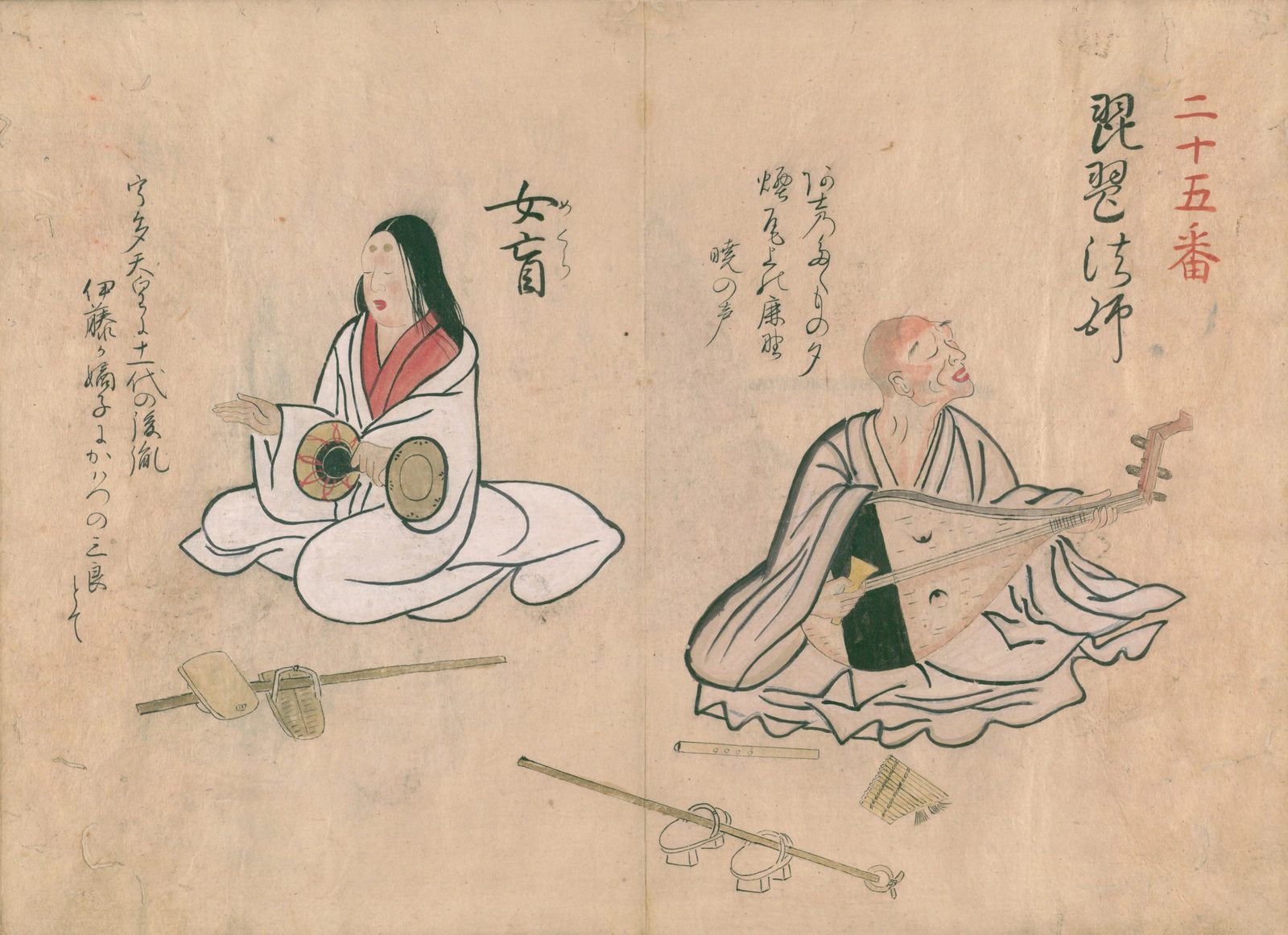
One of the people who stopped to listen was a short, fat, beardless young man in his mid-twenties, carrying a four-stringed lute slung across his shoulder. His eyes, according to every chronicler who ever met him, bulged so violently from their sockets that it was painful to hold his gaze. He had lost the sight in one of them entirely. He was "very badly served," in the surviving Jesuit phrase, by the other. On one hand, he had six fingers. His face was described, with the Portuguese restraint of the 16th century, as de muy ridiculosa fisionomia, of a very comical physiognomy. He was almost certainly illiterate. He had been born poor in a fishing village on the island of Hirado, had learned his trade by ear, and made his living shuffling from town to town chanting the Heike Monogatari and other epics of the samurai wars to audiences who paid him in rice and coppers. His name was Ryōsai. History would come to know him by the name he took at his baptism: Lourenço.
He asked Xavier questions. He asked them precisely, persistently, and with an intelligence that startled the foreigners. What exactly was this God they were preaching about? Where had He come from? Why had men sailed from the other end of the earth to tell the Japanese about Him? The missionaries answered as best they could. Ryōsai kept coming back. Then he came back with his lute, and he began to follow them.
The Jesuits of the next 40 years would regard this moment as the foundation of their mission in Japan. They were right to do so, though not quite for the reason they thought. Xavier would leave Japan by the end of 1551. The apostolic generation of European priests that followed him, Cosme de Torres, Gaspar Vilela, Luís Fróis, would each in turn rely on Ryōsai the way a stonemason relies on his hammer. It was not Xavier who planted Christianity in the soil of the warrior aristocracy. It was the half-blind minstrel who stopped to ask him questions.
The Society of Jesus eventually realized what it had. In 1563, more than a decade after that first encounter, Father Cosme de Torres formally received Ryōsai, by then known as Brother Lourenço of Hirado, as a lay brother. It was the first time in the history of the Society that a Japanese person had been admitted to the order. He would remain in it for the rest of his life. He would die on a tatami mat in Nagasaki in February 1592, aged about 66, whispering the name of Jesus.
This is his story.
The Blind Lute-Bards of 16th-Century Japan
The Profession of the Blind
In 16th-century Japan, the profession of itinerant lute-bard was, by a long and formalized tradition, reserved almost exclusively for blind or partially blind men. The biwa hōshi, literally "lute priest," though most of them were only nominally ordained, carried a four-stringed instrument derived ultimately from the Persian barbat, and they wandered the roads chanting from a repertoire of warrior epics that centered on the Heike Monogatari, the great 13th-century prose account of the war between the Taira and the Minamoto clans. They performed at temples, at roadside inns, at the gates of castles, in the courtyards of merchant houses. They were paid in food, shelter, and small coins.
The profession had a particular cultural status that cannot quite be translated into European categories. The biwa hōshi was not an entertainer in the sense that a court musician was an entertainer. He was something closer to what an ancient Greek would have recognized as a bard, a mnemonic vessel for the heroic past, a voice through which the dead warrior spoke to the living. Samurai listened to biwa hōshi not merely for pleasure but for instruction in their own identity. The violent deaths, the tragic loyalties, the doomed honor of the Taira clan came to the ears of each new generation of bushi through the unseeing eyes of these men.
What this meant, in practical terms, was that Lourenço had spent his entire working life before 1551 learning three things that would prove decisive for what came next.
He had learned to perform. A biwa hōshi did not read his text; he carried it in his memory, and he delivered it from memory with the modulation and emphasis that a recited text requires if it is to hold the attention of a shifting audience. He had trained his voice. He had trained his rhythm. He had trained his ability to read a crowd and adjust his material on the fly.
He had learned Japanese as an instrument. The language of the Heike Monogatari is a classical register, not the spoken vernacular of 16th-century Hirado. To recite it from memory, and then to improvise commentary on it, which the biwa hōshi also did, required a command of high and low Japanese simultaneously, and the ability to move between them with ease. Lourenço could speak to a peasant in the peasant's idiom and to a courtier in the courtier's, and he could do so without pausing to think about which register he was in.
And he had learned the material itself. The Heike Monogatari is a profoundly Buddhist text, suffused with the vocabulary of Pure Land theology, Tendai cosmology, and the ambient syncretism of medieval Japanese religion. A biwa hōshi could not chant it without absorbing the conceptual architecture of Japanese Buddhism, the transience of earthly things, the wheel of karma, the particular valences of kami and hotoke, the sectarian distinctions between Tendai and Shingon and Pure Land and Zen. He learned these not as a seminarian learns dogmatics but as a performer learns lines: by living inside the words until the words lived inside him.
No European missionary of Lourenço's generation, not Xavier, not Torres, not Vilela, not even the formidably learned Luís Fróis, possessed any of this. They could spend decades in Japan and still be fumbling for the correct verb ending when talking to a daimyō. Lourenço arrived at his first theological debate already fluent in the vernacular of his opponents' religion, because for years he had been paid to recite it.
The Jesuit chroniclers, being Europeans, tended to record his gifts as though they were supernatural, a miracle of grace conferred upon an unlettered pagan. It is worth pointing out that grace had a very professional foundation.
Lourenço’s Long Road to Becoming a Jesuit
The Long Apprenticeship
Lourenço did not become a Jesuit overnight. For at least 12 years after his first encounter with Xavier, he occupied an ambiguous position: a catechumen, then a lay assistant, then something resembling a full-time associate of the Society without any formal status in it.
The sources suggest he was informally received into the Jesuit residence at Funai in Bungo around 1556, which is to say he was given a bed, a share of the rice, and an expectation of reliable service. He worked as an interpreter for Cosme de Torres, Xavier's hand-picked successor. He instructed catechumens. He traveled with European priests on their provincial circuits. He was, in effect, a Jesuit in everything but name.
The delay in his formal admission is instructive. The Society of Jesus in the mid-16th century was a new, elite, and institutionally self-conscious order, proud of its standards of education and its insistence on Latin literacy. A blind, unlettered former minstrel who could not read so much as the Our Father in Portuguese was a difficult fit on paper. But he was an impossible man to do without in practice. By the early 1560s, Torres appears to have concluded that the bureaucratic obstacles were not worth the cost of losing him, and in 1563 he was formally received as a coadjutor temporal, a lay brother, a full member of the Society not bound by the vows of the priesthood. He was the first Japanese to wear the black cassock.
By then he was in his mid-thirties, and he had already delivered the performance that made him famous.
Lourenço’s Role in the Kyoto Mission
Kyoto: The Ears and the Mouth
The foundation of the Jesuit mission in the imperial capital, the story of how Padre Gaspar Vilela, Brother Lourenço, and the Japanese catechist Damião arrived in a war-shattered Kyoto in November 1559 and built a church there against the hostility of the Buddhist clergy of Mount Hiei, is told in full in the article on Vilela and the Kyoto mission. What matters to the story of Lourenço is the division of labor that emerged once they arrived.
Vilela was the priest of record. He celebrated the Mass. He baptized converts. He carried the institutional authority of Rome in his person, and when a Japanese authority needed to see a Portuguese priest in a Portuguese cassock, Vilela was the Portuguese priest who appeared.
But Vilela's Japanese was serviceable at best. The high Kyoto speech of the imperial court and the Ashikaga bakufu, with its elaborate honorific grammar and its coded allusions to classical literature, was beyond him. So, for that matter, was the middling speech of the samurai retainers who controlled access to the men who mattered. He could order rice at an inn. He could not debate cosmology with a Confucian tutor.
Lourenço could. And did. An audience before the 23-year-old Shōgun Ashikaga Yoshiteru in early 1560 produced the kinzei: a public notice that officially placed the Jesuits under shogunal protection. Fróis, writing later, described him as the orelhas e boca of the mission: the ears and the mouth. It was not flattery. It was administrative fact. Every word of Japanese that Vilela spoke to a person of consequence in Kyoto was a word Vilela had rehearsed with Lourenço first, or a word Lourenço was simply saying on Vilela's behalf. Every word of Japanese that Vilela heard from a person of consequence in Kyoto came to him through Lourenço's mediation.
What Lourenço did next was the thing that transformed the mission.
The Buddhist clergy of Kyoto, led by the great Tendai monastic complex on Mount Hiei, understood within months of Vilela's arrival that the new foreign religion was a threat to their own intellectual prestige and their own lucrative claim on the spiritual anxieties of the aristocracy. They petitioned the bakufu to expel the missionaries. They stirred up the street gangs. They lobbied the provincial warlords who drifted in and out of the capital. The kinzei restrained them, but it did not silence them, and from 1560 onward the mission lived under a constant low-grade siege of theological harassment.
Lourenço met the harassment by going on the offensive. He accepted debates. All of them. He accepted debates with Tendai scholars, with Shingon scholars, with Pure Land scholars, with Zen scholars. He accepted debates in temples, on street corners, in private audiences, and in front of crowds. He did not decline on grounds of safety when declining would have been wise. He did not decline on grounds of unfamiliarity when the topic was a Buddhist sutra he had not consulted in a decade. He went, he debated, and he usually won.
He drove himself, by every contemporary account, past the limits of his body. The Jesuit sources report that at one point during his first years in Kyoto he brought up blood from sheer exhaustion after a marathon series of disputations, the specific verb in Fróis's Portuguese is vomitou sangue, which leaves little room for interpretation. He kept going. The figure that emerges from the chronicles is not that of a polished court theologian but of a kind of intellectual shock-trooper, a man dispatched into the parts of the engagement the Europeans could not handle.
The Nara Debates of 1563
Nara, 1563
The Buddhist establishment of Kyoto, having failed to dislodge Vilela through ordinary pressure, resolved in the summer of 1563 to try something more formal. At their instigation Matsunaga Hisahide, warlord of Yamato, Chief Judge of Nara, and devout Nichiren adherent, convened a formal judicial inquisition into the foreign doctrine. The full political context is handled in the article on Vilela's Kyoto mission; what concerns us here is the bench and the accused.
Matsunaga appointed two of the most credentialed scholars in central Japan as inquisitor-judges: Yūki Yamashiro no Kami Tadamasa, an astronomer of the Kyoto-Yamato learned class, and Kiyohara Ekata, a Confucian tutor with connections to the imperial court. This was not to be a provincial disputation refereed by a local abbot. It was a formal proceeding at the highest level of Japanese intellectual prestige, convened by the civil power, with capital consequences hanging on the result.
The trigger had been a civil case. A Japanese Christian convert, a layman known as Diogo, had given Yūki such a lucid account of his faith during an earlier appearance that the judge, intellectually intrigued rather than appalled, sent Diogo back to Sakai, where the Jesuits had established a foothold, with a letter requesting that Padre Vilela and Brother Lourenço come to Nara to explain the new doctrine in person.
The Jesuit community at Sakai read the letter and concluded, reasonably, that it might well be a trap. They could not send Vilela, he was the priest, the institutional target, the man whose death would carry symbolic weight across the Japanese Church. But they could send a test.
They sent Lourenço, without a European companion. With no one to translate for, no mass to say, no diplomatic cover, and no guarantee that he would come back at all.
Lourenço faced Yūki and Kiyohara, who threw at him the hardest questions they could find. The substantive topics were the classic pressure-points between Christian metaphysics and the Japanese religious tradition: the origin of the universe, and whether it was created or eternal; the existence of a single personal Creator God prior to and distinct from the cosmos; the immortality of the human soul and its destination after death. These were precisely the questions on which a European missionary fumbling for his verbs would have been intellectually annihilated.
Lourenço was not someone fumbling for verbs. When Yūki reached for a Buddhist analogy, Lourenço recognized it, met it on its own ground, and turned it. When Kiyohara quoted a Confucian classic, Lourenço answered in the same register. When the judges pressed on the problem of how an eternal God could be said to be prior to a cosmos they had always understood as itself eternal, Lourenço gave them the schoolroom Thomistic answer, that God is not merely the first in a sequence but the ground of being itself, in Japanese phrasing that their own vocabulary could accommodate.
It was, in effect, a master-class in vernacular Catholic apologetics, delivered by an unlettered partially blind lute-player to two of the most learned Confucian-Buddhist scholars in the country, over several days of hard questioning, with his own life on the table.
When the debate ended, the two men who had been commissioned to dispose of the foreign religion, Yūki and Kiyohara, had instead professed themselves convinced. They asked to be baptized.
Lourenço returned to Sakai to report what had happened, bearing a second letter from Yūki, this time formally summoning Padre Vilela himself to Nara. After 40 days of waiting for the promised escort, Vilela went, and there both judges received the sacrament. Yūki's son was baptized as Dom Antão, and would shortly afterwards bring 73 samurai retainers of the Miyoshi clan to the font at Iimoriyama, with Lourenço himself traveling up to complete the conversion. Kiyohara entered the Church without, apparently, much further fuss. And Takayama Zusho, Takayama Tomoteru, the castellan of Sawa in Yamato, who heard of the judges' baptism and spent two days and nights hidden in Nara listening to the doctrine, was baptized as Dom Dario, sent for Lourenço, and had his entire household evangelized: his wife Maria, his three sons, his three daughters, and 150 retainers. Among the sons was an 11-year-old boy called Hikogoro, baptized as Dom Justo.
40 years later that boy would be the most celebrated Christian samurai in Japanese history. His long, extraordinary career, as a general of Nobunaga and Hideyoshi, as a tea master trained by Sen no Rikyū, as the daimyō who would forfeit his fief rather than apostatize, as the exile who died in Manila in 1615 and was beatified by the Catholic Church in 2017, began in a room at Sawa Castle where a half-blind lute player poured water on his forehead.
The inquisition of 1563 was supposed to end the Japanese Church. Instead it created the Christian samurai aristocracy of central Japan.
Lourenço Before Oda Nobunaga
Nobunaga's Court
Two years after Nara, in 1565, the shōgun Ashikaga Yoshiteru was killed in his own mansion by troops loyal to Matsunaga Hisahide, the same warlord who had commissioned the inquisition. The kinzei that had protected the missionaries died with him. The Jesuits were formally banished from the capital, and Lourenço, Vilela, and the newly arrived Luís Fróis retreated to Sakai, where they would spend the next four years in a condition of uneasy exile.
Lourenço did not spend all of those years in Sakai. He was dispatched to the Gotō Islands in January 1566 with Brother Luís de Almeida, to answer a standing request from the island lord for a missionary. Almeida fell ill and had to be evacuated. Lourenço stayed, alone, and sustained the Gotō mission single-handedly until 1568. He then moved to Bungo for a further year, where he worked among the established Christian community of Dom Francisco Ōtomo's domain.
And then, in the spring of 1569, Cosme de Torres recalled him to Kyoto on an emergency basis, because Oda Nobunaga had just walked into the city.
Nobunaga's march on the capital in 1568 had rearranged the political landscape. The warlord who emerged from the internecine warfare of the Home Provinces in that year was the most formidable figure Japan had seen in a century, and he was, from the Jesuits' point of view, a strategic opening. Matsunaga Hisahide had fallen from grace. The Nichiren establishment had lost its patron. The new hegemon had no particular ideological commitment to any Buddhist sect, and he appeared, on early information, to actively enjoy humiliating Buddhist monks. This was an audience worth seeking.
The first Jesuit audience with Nobunaga, Luís Fróis's celebrated meeting at the drawbridge of Nijō Castle in 1569, the warlord in tiger skins demanding to know why the foreigner had traveled so far to tell the Japanese about a God they had managed quite well without, is recounted at length in the article on Nobunaga and the Buddhist establishments. What concerns us here is that Lourenço was there. When Nobunaga, with apparent good humor, asked why the missionaries had no proper residence in Kyoto, it was Lourenço who answered, explaining, with the cultivated fluency of a man who knew exactly what registers of deference to use with a man of this rank, that the Buddhist clergy had engineered their eviction out of jealousy at the Jesuits' successes among the nobility.
Nobunaga liked the answer. He liked the man who gave it. And shortly afterwards, when the court Buddhist Nichijō Shōnin, one of the most virulent public opponents of the mission, demanded a formal debate in front of Nobunaga himself, the Jesuits sent Lourenço. Again.
The debate was one of the defining public moments of the Christian Century. Nichijō was a polished courtier with deep institutional backing. The disputation was held before the supreme warlord of the realm. Lourenço's victory was comprehensive enough that Nichijō left the proceedings not merely discredited but marked as a fool in the eyes of a patron whose opinion now mattered more than anyone else's in Japan. From that moment until Nobunaga's assassination in the Honnō-ji in 1582, the Kyoto mission would enjoy a 13-year golden age of political protection and high-level converts. The Azuchi Debate of 1579, at which the Jesuits watched Nobunaga dispose of the Nichiren problem once and for all, was the natural terminus of a relationship that Lourenço had opened in 1569 with a well-placed sentence in front of the hegemon.
Three times, now, with Yoshiteru in 1560, at Nara in 1563, with Nobunaga in 1569, Lourenço had walked into the most dangerous room in the country and walked out with the outcome the mission needed.
Lourenço’s Last Years
The Quiet Ending
Lourenço outlived almost everyone he had worked with. Torres died in 1570. Vilela died in Goa in 1572. Xavier had been dead since 1552. The mission's European personnel turned over steadily through the 1570s and 1580s as new arrivals stepped off the Nau do Trato and old hands died of dysentery, old age, or the accumulation of 40 monsoons endured too far from home.
He continued to work. In his fifties, then in his sixties, even more blind and slowing, Brother Lourenço went on preaching, interpreting, and catechizing. He was, by the early 1580s, the indispensable institutional memory of the mission. When Alessandro Valignano, the Italian Jesuit Visitor who arrived in 1579 and set about reforming the entire evangelical enterprise, drew up his personnel catalog of Japan, he singled out Lourenço as outstanding as a preacher in Japanese. In his treatise Principio, Valignano called him an excellent interpreter and acknowledged, with the unsentimental clarity that characterized his administration, that the European Jesuits in Japan depended on Japanese lay brothers like Lourenço to do the actual work of communicating the Gospel.
This was not a small admission. Valignano was the most intellectually formidable Jesuit superior in Asia, a man who knew exactly how much his order's prestige rested on the fiction that salvation flowed from Rome outward. To concede in print that the mission's most important preaching had been done in Japanese by a Japanese man, in vernacular idioms no European could match, was to concede something fundamental about the structure of the enterprise.
When Toyotomi Hideyoshi, in July 1587, issued his sudden midnight edict ordering the missionaries out of Japan within 20 days, Lourenço was in his early sixties. The edict was not enforced, the political and commercial machinery of the Nagasaki trade made anything like a strict expulsion impossible, but the mood of the mission changed overnight, and the older personnel began to withdraw to the relative safety of the Christian strongholds in Kyūshū. Lourenço went with them and spent his last five years in the Christian lands of Ōmura around Nagasaki, still preaching two or three times a day when he was needed and continuing the unobtrusive work of catechesis and spiritual direction that had occupied him for decades when he was not in front of a warlord.
In February 1592, after what the Jesuit chroniclers described as 40 years of grueling, indefatigable labor for the mission, Brother Lourenço of Hirado died peacefully on his tatami mat in Nagasaki. He was approximately 66 or 67 years old. The chroniclers record that his last word was the name of Jesus.
Why the Mission Depended on Japanese Preachers
The Argument the Jesuits Could Not Have Made
The testimony of Lourenço's European colleagues is unambiguous. Fróis, who worked at his elbow for years, declared that it pleased our Lord to make him the foundation, as it were, of all the Christianity in the region of Miyako, and elsewhere called him one of the most important preachers that the Society gained in Japan. Torres, who admitted him to the order, trusted him with the assignments no European Jesuit could have managed: opening the Kyoto mission, salvaging the Gotō islands, returning for the audiences with Nobunaga. Valignano, who disliked sentimentality and was famously exacting about linguistic competence, called him outstanding.
These are the men whose letters and catalogs produced the European image of the Japan mission. They were the official chroniclers, the institutional voices, the figures around whom European historiography of the Christian Century has always been built. And the thing they insisted on, in every generation, was that the survival of their project depended on a blind, unlettered, six-fingered Japanese lay brother from a fishing village on Hirado.
The familiar narrative of the Christian Century in Japan tends, almost reflexively, to treat the Europeans as the active agents and the Japanese as the field of action: Xavier arrives, Xavier preaches, Xavier baptizes, and in due course Japan responds with gratitude, with indifference, or with persecution. This narrative is not exactly wrong, the Europeans did arrive, did preach, did baptize, but it is misleading in proportion. What Lourenço's career reveals, and what his own superiors repeatedly insisted on, is that once past the first months of the mission, the evangelization of Japan was not something done to Japan by Europeans. It was something done in Japan by a partnership, in which the indispensable linguistic, cultural, and rhetorical labor was being performed by Japanese lay brothers, dōjuku catechists, and converted samurai, while the Europeans provided institutional continuity, the sacraments, and the distant papal authority that the whole structure depended on.
This was not a secret hidden from the participants. Valignano built the entire reform program of the 1580s around it, the vernacular press, the Japanese seminary, the cultural-accommodation policy, the eventual ordination of Japanese priests. He built that program on Lourenço.
Lourenço did not convert his 73 Miyoshi samurai at Iimoriyama, or his two scholar-judges at Nara, or his several thousand other converts across 40 years, through coercion. He had no coercive power of any kind. He was the blind one. He converted them by standing in front of them and speaking, in perfect Japanese, in the registers they expected, with the rhetorical craft of the biwa hōshi and the conceptual freight of a religion he had worked out, in their language, over a lifetime. They converted because they found the argument persuasive.
Sources & Further Reading
Boxer, C. R. The Christian Century in Japan, 1549–1650. University of California Press, 1951. The indispensable English-language foundation for the period. Boxer's treatment of Lourenço is brief but clear-eyed, and his framing of the mission's reliance on Japanese lay brothers and dōjuku remains the starting point for all serious discussion of indigenous agency in the Christian Century.
Charlevoix, Pierre-François-Xavier de. Histoire et Description Générale du Japon. Paris, 1736. The eighteenth-century Jesuit historian who preserved, at two centuries' remove, the most detailed physical description of Lourenço, the bulging eyes, the six fingers, the disproportionate strength. Charlevoix's account is hagiographical but draws on earlier Jesuit sources, some now lost.
Cooper, Michael, SJ. Rodrigues the Interpreter: An Early Jesuit in Japan and China. Weatherhill, 1974. Though focused on João Rodrigues, Cooper provides essential background on the role of Japanese-language competence in the mission and the dependency of European Jesuits on native collaborators.
Elison, George. Deus Destroyed: The Image of Christianity in Early Modern Japan. Harvard East Asian Monographs, 1973. The standard analytical treatment of how Japanese intellectual elites engaged with, and eventually rejected, Christian doctrine. Elison's discussion of the debate tradition is particularly valuable for understanding what Lourenço was actually doing at Nara and before Nobunaga.
Fróis, Luís, SJ. Historia de Japam. Edited by José Wicki, SJ. 5 vols. Biblioteca Nacional, Lisbon, 1976–1984. The great first-hand chronicle of the Jesuit mission, and the principal source for Lourenço's career. Fróis worked alongside him for years in Kyoto and Nagasaki, and his characterizations of the half-blind brother are the bedrock of everything written since.
Fujita, Neil S. Japan's Encounter with Christianity: The Catholic Mission in Pre-Modern Japan. Paulist Press, 1991. A concise synthesis that gives appropriate weight to Japanese Jesuits and catechists, and treats Lourenço as the central figure he was rather than as a footnote to Vilela.
Higashibaba, Ikuo. Christianity in Early Modern Japan: Kirishitan Belief and Practice. Brill, 2001. The best recent treatment of how Christian doctrine was actually received and practiced by Japanese converts, with attention to the vernacular intellectual work performed by indigenous preachers.
Moran, J. F. The Japanese and the Jesuits: Alessandro Valignano in Sixteenth-Century Japan. Routledge, 1993. Essential for the Valignano era and for the Visitor's insistence that the mission could not be run by Europeans alone. Moran quotes Valignano's personnel catalogs directly, including the notices on Lourenço.
Ross, Andrew C. A Vision Betrayed: The Jesuits in Japan and China, 1542–1742. Orbis Books, 1994. A sympathetic but analytically sharp account of the Jesuit enterprise in East Asia, with careful attention to the indigenous collaborators who made it possible.
Ruiz-de-Medina, Juan G., SJ, ed. Documentos del Japón. 2 vols. Institutum Historicum Societatis Iesu, 1990–1995. The modern critical edition of the principal Jesuit letters and reports from Japan, including Torres's, Vilela's, Fróis's, and the early personnel catalogs, the primary-source foundation for all of Lourenço's movements.
Schurhammer, Georg, SJ. Francis Xavier: His Life, His Times. Volume IV: Japan and China, 1549–1552. Translated by M. Joseph Costelloe, SJ. Jesuit Historical Institute, 1982. The definitive life of Xavier, and the most careful reconstruction of the Yamaguchi encounter of 1551 at which Lourenço first met the Jesuits.
Valignano, Alessandro, SJ. Sumario de las cosas de Japón (1583). Edited by José Luis Alvarez-Taladriz. Sophia University, Tokyo, 1954. Valignano's own survey of the state of the mission, including the famous judgments on Lourenço's preaching gifts.
Bibliotheca Lusitana. Diogo Barbosa Machado. 4 vols. Lisbon, 1741–1759. The eighteenth-century bibliographical compendium that preserves the earliest Portuguese tradition on the careers of the Jesuits in Japan, including substantial material on Lourenço and the Kyoto mission.
Monumenta Nipponica. Sophia University, Tokyo. Ongoing since 1938. The standard scholarly journal for Japanese historical studies in Western languages, containing decades of specialist articles on the Kirishitan period and the Luso-Japanese encounter.
Recent scholarship
- Kanazawa, Osamu (2026). “The Truth and Fiction of Xavier’s 1551 Meeting: As the Starting Point of Discovering Conceptual Similarities between Mahavairocana and the Prime Matter”, Journal of the Research Institute for Christian Culture, Seisen University, 34, pp. 1–24. — This 2026 journal article argues that the 1551 Yamaguchi meeting likely sparked a later theological comparison between Mahavairocana and Prime Matter, rather than producing the equivalence itself.Free full text ↗ (opens in a new tab)
Cite this page
Nanban.pt. “Brother Lourenço of Hirado: The Blind Minstrel Who Built a Church.” Last modified 7 October 2026. https://nanban.pt/articles/brother-lourenco-hirado/.
@misc{nanban-brother-lourenco-hirado,
  author = {Nanban.pt},
  title = {Brother Lourenço of Hirado: The Blind Minstrel Who Built a Church},
  year = {2026},
  url = "https://nanban.pt/articles/brother-lourenco-hirado/",
  note = {Last modified 2026-10-07}
}