The Barefoot Invasion: The Franciscan Friars in Japan
A Spanish ex-soldier who fought in the tercios, a Dominican Sinologue killed by headhunters in Formosa, and a Castilian lay brother who jumped ship in the middle of the Pacific, the story of how the Spanish mendicant orders crashed into a Japanese mission that the Portuguese Jesuits had built and the Pope had reserved for them alone.
The Barefoot Invasion recounts how the Spanish mendicant orders, chiefly the Franciscans, pushed from 1593 into a Japanese mission that the Portuguese Jesuits had built and the Pope had reserved for them alone. Its cast includes a former tercios soldier, a Dominican Sinologue killed in Formosa, and a Castilian lay brother who jumped ship in the mid-Pacific.
Juan Pobre de Zamora: The Friar Who Wrote It Down
The Man from Zamora
In the late 1570s, in a Franciscan monastery in the war-ravaged Low Countries, a Spanish veteran in a brown habit was trying to find a quiet corner in which to pray. The Netherlands was, at that particular moment, one of the noisiest places in Christendom, the Eighty Years’ War had turned the Flemish countryside into a rolling catastrophe of sieges, massacres, mutinies, and religious atrocities on a scale that made contemplative life rather difficult to sustain. The ex-soldier, who had himself fought in those campaigns as part of the Duke of Alva’s tercios, was beginning to suspect that he had swapped one battlefield for another.
His name, at that point, was Fray Juan de Zamora, after the Spanish town of his birth. He had served in one of the most celebrated military formations in Europe, the Spanish tercios, the backbone of the Habsburg war machine, the infantry that had humiliated the French at Pavia and would, in another generation, bleed themselves dry at Rocroi. He had, by his own later account, been part of an abortive scheme around 1574 to surprise and seize London in a coup de main, one of those audacious Spanish plans that periodically surfaced in the era of Elizabeth I and disappeared again without causing quite as much damage as they could have. He had, in short, lived the life of an active Catholic campaigner.
And then he had decided to stop.
The transition from tercio to Franciscan is not a smooth one. The tercios were the shock troops of a global empire; the Franciscans were the successors of a 13th-century saint who had preached poverty to the birds. The two institutions shared a theology but not a worldview. The ex-soldier spent some years in a Flemish monastery, found the experience unworkable amid the cannon-fire, and returned to Spain. By 1592 he had settled at the convent of San José in Salamanca, and his brethren, who had noticed that this particular friar took the vow of poverty with a seriousness that bordered on the terrifying, had quietly dropped the surname Zamora and rechristened him Fray Juan Pobre.
Pobre. The Poor One.
It was the kind of nickname that stuck because it was accurate. Juan Pobre would spend the rest of his life refusing ordination, refusing offices, refusing anything that might lift him above the status of a simple lay brother. He would cross the Atlantic and the Pacific multiple times on Crown business, recruit dozens of missionaries in Spain, lobby the papal curia in Rome, survive shipwrecks and executions and the personal attention of Toyotomi Hideyoshi, and King Philip III would eventually commission a portrait of him after his death. None of this would persuade him to let anyone call him anything other than the Poor One.
He was not, by any reasonable measure, a representative figure of his era. But he is the perfect lens through which to watch what happened when the Spanish mendicant orders came to Japan.
Why the Franciscans Were Barred from Japan
The Pope’s Fence
To understand what Juan Pobre and his brethren were doing in Japan at all, it helps to understand what they were not supposed to be doing there.
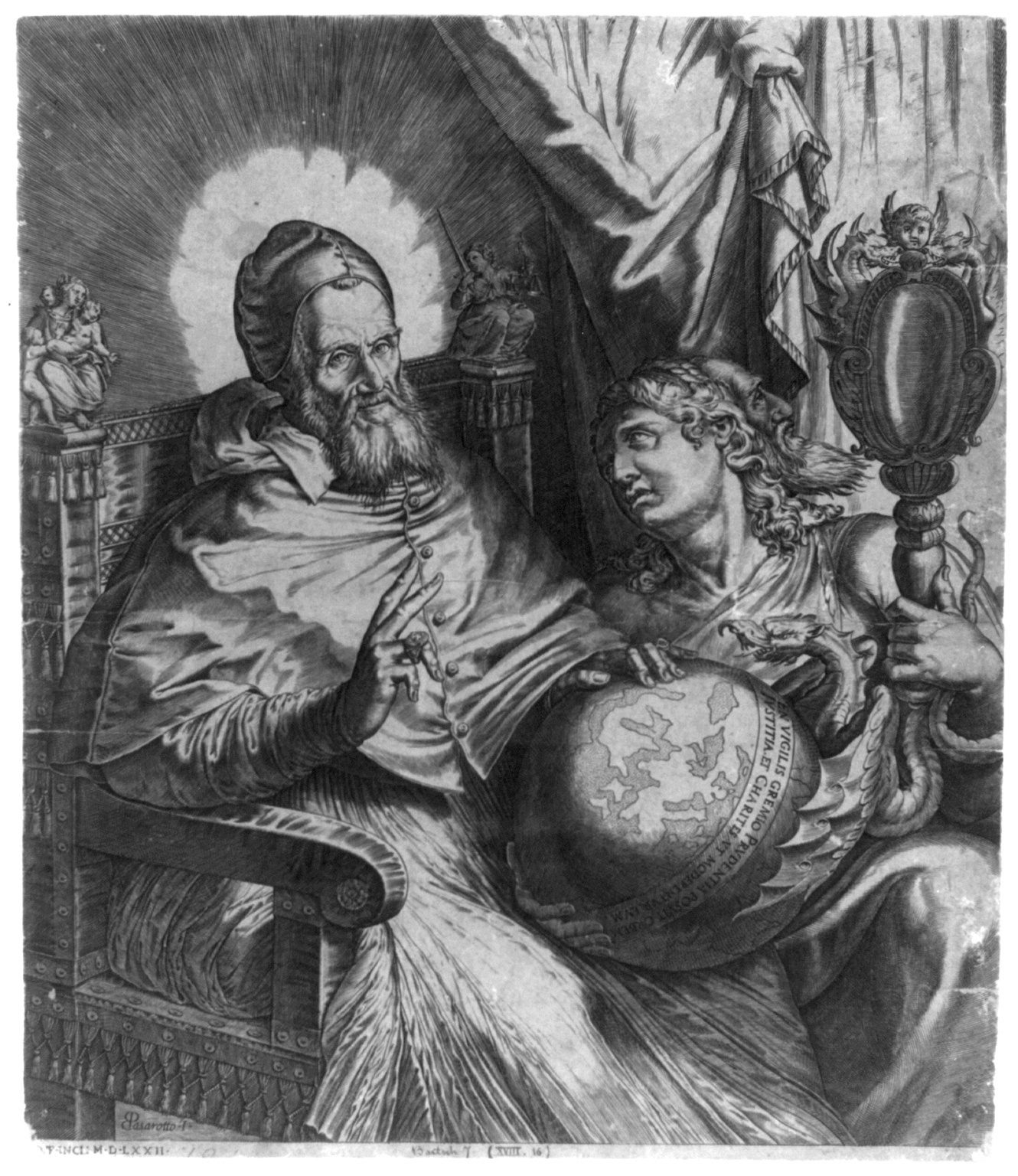
In 1585, Pope Gregory XIII had issued a brief titled Ex pastorali officio. The document was, in its way, a small masterpiece of ecclesiastical fence-building. It reserved all missionary activity in Japan to the Society of Jesus. No Franciscan, no Dominican, no Augustinian, no friar of any order other than the Jesuits could legally enter Japan to preach, administer sacraments, or establish a mission. The brief had been lobbied for by the Jesuit Visitor Alessandro Valignano, a story told in detail in the article on the Visitor himself, and it reflected a theory of mission that Valignano had spent years refining.
The theory was this: Japan was a civilization too sophisticated, too proud, too internally fragile to tolerate competing Christian sects. One order, one strategy, one voice. Drop a second European order into the mix, with different habits, different rules, different superiors, different theological emphases, and the Japanese would immediately notice the contradiction, and the whole mission would unravel.
The Jesuits, having made this argument to Rome, got the monopoly. For a while, it held.
The problem was that the world kept changing. In 1580, the Portuguese Crown had passed, via a complicated inheritance dispute involving a missing king and a dead cardinal, to Philip II of Spain. Legally, the two empires remained separate, Portugal kept its own administration, its own Church structure, its own overseas padroado, but the practical effect was that Philip now ruled both hemispheres. And Philip’s Spanish subjects, particularly the colonists in the Philippines, looked at the Jesuit monopoly on Japan, which was a Portuguese enterprise conducted through Macau, and saw a business opportunity that was being deliberately kept out of their reach.
The Philippines had been founded in the 1560s as the Spanish outpost at the western edge of the Pacific, the terminus of the Manila galleon trade. It was populated by soldiers, traders, and a small army of Spanish friars, Franciscans, Dominicans, and Augustinians, who had come to evangelize Asia and found themselves confined to the archipelago by a papal decree that made no sense to them whatsoever. Japan was right there. One could stand on the beach at Manila and point approximately in its direction. Why should the Portuguese Jesuits have it all?
The answer from Rome was: because we said so. The answer from Manila was: we’ll see about that.
And then, in 1591, an opportunity dropped from the sky.
Hideyoshi’s Letter to Manila
The Letter from the Taikō
Toyotomi Hideyoshi, having finished the business of unifying Japan and begun the rather more ambitious business of trying to conquer Korea and China, found himself in an expansive geopolitical mood. He dispatched a letter to the Spanish governor of the Philippines, Gómez Pérez Dasmariñas, demanding an oath of vassalage and threatening, with the casual menace of a man who had recently brought 300,000 soldiers to the field, to send warships against Manila if the colony refused.
The letter was delivered by an individual named Harada Magoshichirō, who styled himself as Hideyoshi’s envoy but whom Dasmariñas immediately suspected of being an unauthorized freelancer. The demand was outrageous. The threat was credible. The governor needed time.
His solution was an embassy. Specifically, it was a Dominican embassy, led by a man whose presence in Manila in that particular year was one of those quiet accidents that reshape history.
Fray Juan Cobo, sometimes rendered as Cobos in the Spanish sources, was one of the most unusual Europeans in Asia. He was a Dominican friar, which made him a member of an order largely excluded from the Japan mission by the Jesuit monopoly, but his specialism was not Japan. It was China. Cobo was a Sinologue of remarkable accomplishment: he had mastered over 3,000 Chinese characters, translated a Chinese Confucian text into Spanish (the Mingxin baojian or Beng Sim Po Cam), and was regarded in Manila as the European who best understood the civilization on the other side of the sea.
Dasmariñas needed someone who could speak to Hideyoshi with authority, who could represent the Spanish Crown with appropriate gravitas, and who could, crucially, string the negotiations out long enough to let Manila prepare its defenses. Cobo, accompanied by the captain Lope de Llano, sailed for Japan in 1592.
They landed at Satsuma in southern Kyushu in June, and from there made their way north to Hideyoshi’s forward military headquarters at Nagoya Castle in Hizen province, not the modern city of Nagoya, but the enormous staging fortress that the Taikō had built on the north-western coast of Kyushu to coordinate his invasion of Korea. It was from this castle that Hideyoshi was directing the most ambitious military operation in Japanese history, and it was here that he received the Dominican ambassador from Manila.
The meeting went, by all accounts, remarkably well. Hideyoshi, who had a taste for foreign spectacle and a soldier’s appreciation for bearing, received Cobo warmly. During the audience, the friar produced a globe and used it to explain to the Taikō the sheer geographic reach of the Spanish Empire, the Americas, the Philippines, the outposts in Africa and India, the territories that had been added through the Iberian Union.
Hideyoshi dismissed the Dominican with a cordial reply letter addressed to the governor of Manila. The mission had succeeded.
And then Juan Cobo got on a ship, and the ship sailed for Manila, and the ship never arrived.
The vessel was wrecked on the coast of Formosa, modern Taiwan, and the survivors were killed by indigenous headhunters. Cobo died somewhere on that coast, and the letter from Hideyoshi died with him. In Manila, the authorities received only a short note from Cobo. Days became weeks became months. The embassy had vanished. Hideyoshi’s reply had vanished. The whole diplomatic posture of the colony rested on a conversation that nobody in Manila could prove had occurred.
Dasmariñas did the only thing he could do. He sent another embassy.
And this one, he gave to the Franciscans.
Pedro Bautista and the Franciscan Mission in Kyoto
Bautista Goes to Kyoto
Fray Pedro Bautista Blázquez, also rendered as Baptista, was a Franciscan of the Province of San Gregorio in the Philippines, born in the small town of San Esteban in the diocese of Ávila. He had taken the habit at 22. By the time he was dispatched to Japan in 1593 he had spent 15 years in missions across New Spain and the Philippines, and he held the superiority of the Franciscans in Manila.
His delegation was small: four Franciscans, including the lay brother Gonzalo García, who had actually lived in Japan years earlier as a merchant’s servant and spoke enough Japanese to function as an interpreter. They carried the official credentials of a diplomatic embassy from the governor of the Philippines. They also, in the quiet understanding of every person involved in the expedition, carried a second and unofficial mandate: once they were in Japan, they were going to stay there. They were going to bypass Ex pastorali officio. They were going to found a Spanish Franciscan mission on ground the Pope had reserved for the Portuguese Jesuits.
The Jesuits would later accuse them of duplicity. The accusation was not baseless. But the Franciscans saw it as something closer to righteous defiance: a legalistic papal decree, issued under Jesuit lobbying, stood between suffering souls and the Gospel. The mendicants would not be bound by it.
Bautista’s reception at the Nagoya headquarters was, on the surface, encouraging. Hideyoshi received the embassy cordially. He was in the middle of financing the most expensive war Japan had ever fought, and a trading relationship with Manila, a potential silver pipeline that might bypass the Portuguese monopoly at Nagasaki, was attractive. The Taikō listened politely, accepted the gifts, and declined to authorize anything resembling a missionary presence. His 1587 edict against Christianity remained in force.
But Hideyoshi did permit the friars to travel to Kyoto. He eventually granted them the site of a former Buddhist temple. The Franciscans interpreted this grant as a license. It was not a license. It was an act of polite indifference by a ruler who had larger wars to fight. The distinction would turn out to matter.
In the capital, Bautista and his brethren established a church. They founded a monastery. They opened a leper hospital, eventually expanding to two hospitals that, between them, treated thousands of sufferers of Hansen’s disease, a population that the Buddhist clergy of the city had long neglected and that the Jesuits, for reasons of their own cultural strategy, had not prioritized. The Franciscan emphasis on ministry to the destitute, the diseased, and the socially despised was not a rhetorical flourish. It was a theology in action, and it produced concrete institutions in the middle of Kyoto that the Japanese, even those who had no interest in Christianity, could see working.
And then they made their first catastrophic error. They assumed they were safe.
Where the Jesuits, operating under a dormant but real prohibition, had spent years dressing in modified Japanese robes, holding services behind closed doors, and declining to ring church bells in public, the Franciscans did the opposite. They wore their brown Castilian habits openly. They walked the streets of Kyoto barefoot, as their rule prescribed, in full public view. They sang the Divine Office in their monastery with the doors wide open. They preached to crowds in the streets. They rang their church bells, which in Kyoto in the 1590s was a little like broadcasting your coordinates to a hostile air defense network.
The Jesuits, watching this with the frozen horror of professionals observing amateurs, warned Bautista repeatedly. He dismissed them. The Portuguese fathers were hypocrites, he said. They had sacrificed the purity of the mission to commercial convenience. They had become soft, worldly, and cowardly. Real friars preached in the open. Real friars wore their habits. Real friars accepted martyrdom if it came. They didn’t have to wait long.
The full story of the collision between the two orders, the 1596 San Felipe catastrophe, and the 1597 crucifixions is told in the article on the San Felipe Incident.
Juan Pobre Arrives in Japan
The Inspector
Juan Pobre had not been in Japan when Bautista’s mission was established. He had been in Salamanca, discovering his vocation. He volunteered for the Philippine missions in 1593, sailed via Mexico and crossed the Pacific on the Manila galleon, and arrived in Manila in 1594. Within a year, his superiors had dispatched him to Japan as a visitator, an inspector, with orders to report on the state of the Franciscan houses in Kyoto and their work among the poor.
He spent most of 1595 and the first half of 1596 in the Japanese capital, interviewing the friars, visiting the leper hospitals, and forming his opinions. Those opinions were characteristically uncompromising.
He approved of the work among the sick. He approved of the open preaching. He approved of the barefoot processions. He approved, in general, of everything that made the Kyoto Franciscans different from the Kyoto Jesuits. And he took careful, private notes on the Jesuits, because Juan Pobre had by this point developed a fixed theological conviction that the Society of Jesus was not merely a misguided rival but an active enemy of the Gospel, and he was beginning to assemble the evidence for what would later become a series of polemical writings denouncing the Portuguese order from Manila to Madrid.
His central charge was simple. The Jesuits, he insisted, were evangelizing the wrong people. They had made a deliberate strategic choice to convert ‘the great ones of the earth’, the daimyō, the samurai, the rulers, on the theory that if you converted the prince, the population would follow. Pobre thought this was both theologically deformed and factually wrong. The rich were ‘sunk and involved in vices’ beyond the reach of easy conversion. The poor, the sick, the outcast were the proper objects of missionary labor. The Jesuits had inverted the Gospel. They had chosen dignity over destitution, silk over sackcloth, the dinner tables of daimyō over the beds of lepers. They were not missionaries. They were courtiers.
This critique was, of course, a caricature of actual Jesuit practice, Alessandro Valignano’s famous accommodationist strategy was considerably more nuanced than Pobre’s polemic suggested, and the Jesuits had in fact done extensive work among ordinary Japanese Christians, especially in Kyushu. But Pobre’s fury was not a considered academic disagreement. It was the rage of a man who genuinely believed his brethren were being sabotaged by fellow Christians, and who would spend the rest of his life trying to prove it in print.
He was aboard the San Felipe, bound for Madrid with his report and still sharpening his grievances, when she ran aground on the coast of Tosa.
The San Felipe Affair and What Followed
The Escape
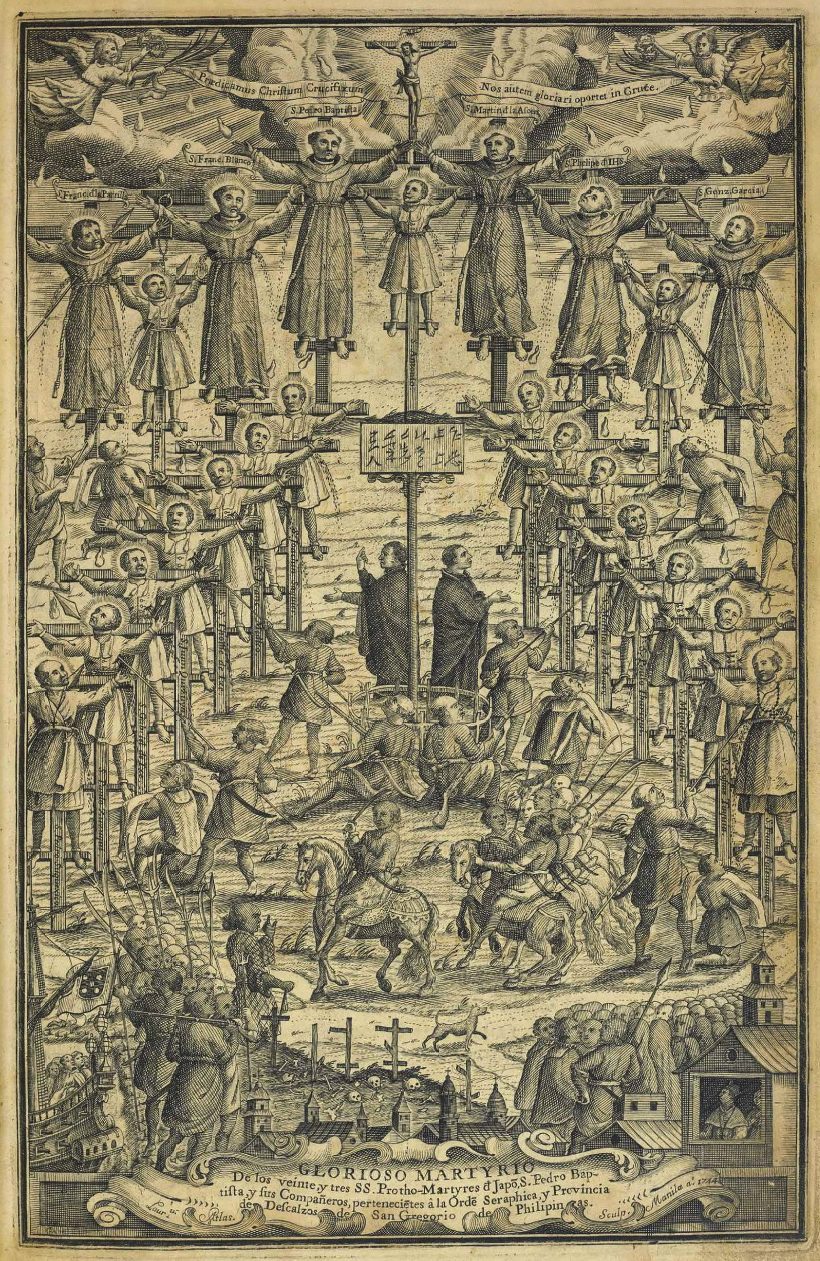
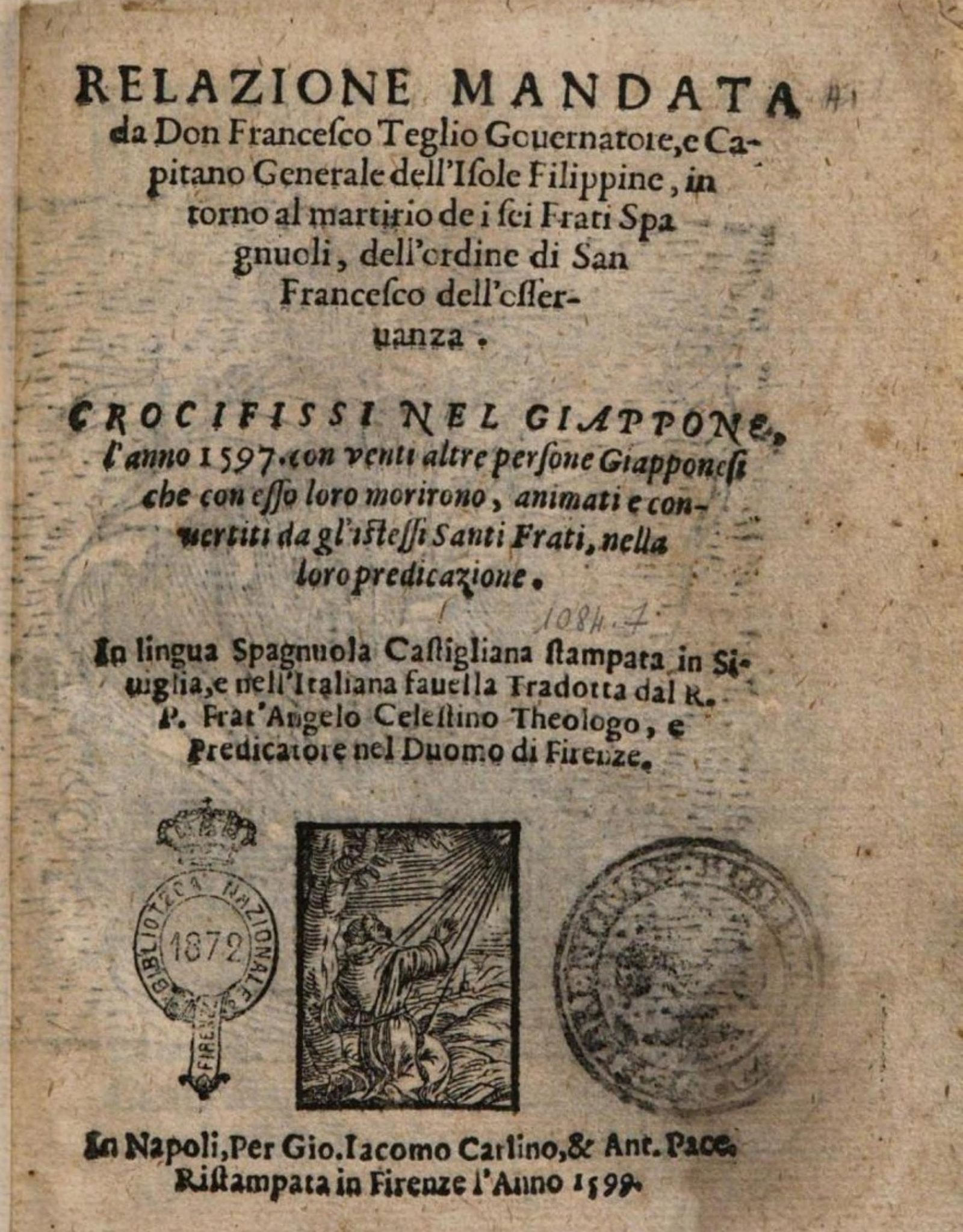
What happened after the pilot unrolled his map, and what happened to Pedro Bautista and his companions in the aftermath, is the subject of other articles on this site, chiefly the article on the San Felipe Incident and, on the wider context of the crucifixions themselves, the article on the Great Martyrdom of Nagasaki, which picks up the pattern of mass executions a quarter-century later. Pedro Bautista, Gonzalo García, and four other Franciscans were among the 26 Christians crucified on Nishizaka hill on 5 February 1597. Their deaths ended the first Franciscan mission to Japan and inaugurated the pattern of state-sponsored martyrdom that would define the next four decades.
Juan Pobre was not among them.
By a combination of timing and geography, he was not in the Franciscan houses when the arrests swept through Kyoto and Osaka, and he escaped the initial dragnet. He was, however, deported alongside the remaining Franciscans to Macau in the weeks after the crucifixions, carried out of Japan on a Portuguese vessel whose crew likely enjoyed the irony of rescuing the Spanish mendicants who had spent years denouncing them.
From Macau, Pobre made his way back to Manila, and from Manila back to Spain, and from Spain to Rome. And this is where his life takes on the quality of one of those early-modern picaresques in which the protagonist cannot seem to stop moving.
He became a procurador for his order, an official agent tasked with recruitment, fundraising, and ecclesiastical lobbying. In this role he crossed the Atlantic and the Pacific multiple times. He recruited dozens of Franciscans in Spain and accompanied them to Mexico and the Philippines. He petitioned the Spanish Crown for support of the mendicant missions in Asia. And most consequentially, he lobbied in Rome for the revocation of Ex pastorali officio, the brief that had reserved Japan to the Jesuits.
In December 1600, Pope Clement VIII issued a new brief, Onerosa pastoralis officii, which opened the Japan mission to the mendicant orders, though only by way of Lisbon and Portuguese India; in June 1608, Paul V lifted that condition. It was, in substance, a repudiation of the Jesuit monopoly that Alessandro Valignano had spent the 1570s and 1580s engineering. The fence was down. Franciscans, Dominicans, and Augustinians could now legally do what Juan Cobo and Pedro Bautista had done at their peril. Juan Pobre, the ex-soldier from Zamora with a grudge against the Society of Jesus, had won his fight.
The consequences would not be happy ones. The arrival of additional mendicant orders in Japan in the early 17th century complicated the mission’s relationship with the Tokugawa shogunate, intensified inter-order rivalries, and contributed, in ways that are disputed but difficult to deny, to the accelerating cycle of persecution that would culminate in the expulsion edicts of the 1610s and 1630s. Pobre’s victory over the Jesuits in Rome helped to produce exactly the result the Jesuits had always warned him about. But he did not live to see the worst of it. He died in Madrid in 1615 or 1616.
There is one more episode in Juan Pobre’s career that deserves to be recorded, because it captures the man better than any of his theological manifestos.
In 1602, on one of his Pacific crossings, Pobre was aboard a Manila galleon making the long transit from Acapulco back to the Philippines. The ship passed through the Ladrones Islands, what are now called the Marianas, a scattered archipelago in the western Pacific that had been claimed by Spain but where almost no Europeans had yet settled. Pobre looked at the islands, looked at his brother friars on the ship, looked at the horizon, and made a decision that appears to have startled everyone around him.
He jumped ship.
He had no authority to do this. He had no provisions, no companion but a single lay brother, Pedro de Talavera, no plan, and no language in common with the Chamorro inhabitants of the islands. He simply climbed off the galleon, waved to his departing brethren, and walked into the interior.
He spent seven months there, living among the Chamorros, picking up their language, observing their customs, writing the first detailed European account of the Marianas. And because Juan Pobre was a man who could not stop improving the world by small increments, he taught the islanders how to cultivate maize, a New World crop he had encountered in Mexico, thereby introducing to the Marianas a staple that would still be grown there four centuries later.
When the next Manila galleon passed, he flagged it down and climbed aboard. He continued his journey.
What the Franciscans Changed in Japan
The Ledger
It is tempting, in histories of the Christian century in Japan, to treat the Franciscans as a footnote, the indiscreet Spanish interlopers who got themselves crucified and complicated the Jesuits’ infinitely more sophisticated project. This is the version the Jesuits told. It is the version that, because the Jesuits were better writers, has largely survived. It is not entirely wrong. But it is not enough.
The Franciscans brought to Japan a theology that the Jesuits, for all their intellectual brilliance, had not emphasized. They insisted on the primacy of the poor, the diseased, and the socially discarded as the proper objects of Christian concern. They built hospitals in a capital where lepers died in ditches, and they treated thousands of patients there until the institutions were forcibly closed. They preached to crowds that the Jesuits, working patiently through daimyō and merchant elites, had not directly addressed. They were, in their way, a corrective to a mission that had perhaps grown too fond of courts and too distant from the kinds of Christians Francis of Assisi would have recognized.
They also made nearly every mistake the Jesuits had warned them to avoid. They mistook an absence of immediate punishment for positive approval. They paraded their habits through a capital where the ruler had explicitly banned the religion they represented. They quarreled with their fellow Catholics more bitterly than with the Buddhist clergy who opposed them. They trusted Hideyoshi at a moment when no one should have trusted Hideyoshi. When the catastrophe came, it fell first on them, and then, because the Japanese government now had a template for how to kill Christians in public, it spread to everyone else.
The ledger, three centuries later, is hard to balance. Six Franciscans died at Nishizaka on a winter morning in 1597, and their deaths became icons of the Church Universal, the Twenty-Six Martyrs of Japan, canonized by Pius IX in 1862, honored with a feast day on 5 February and a bronze monument overlooking the harbor at Nagasaki.
Sources & Further Reading
Boxer, C.R. The Christian Century in Japan, 1549–1650. University of California Press, 1951. The foundational study in English; indispensable on the Franciscan-Jesuit rivalry and the road to Nishizaka.
Cieslik, Hubert. ‘The Great Martyrdom in Edo, 1623.’ Monumenta Nipponica 10, no. 1/2 (1954): 1–44. Useful context for the continuation of the martyrdom pattern that began with the 1597 crucifixions.
Cooper, Michael. Rodrigues the Interpreter: An Early Jesuit in Japan and China. Weatherhill, 1974. Contains invaluable material on how the Jesuits perceived the arrival of the Spanish mendicants in the 1590s.
Elison, George. Deus Destroyed: The Image of Christianity in Early Modern Japan. Harvard University Press, 1973. The classic study of how the Japanese state came to understand Christianity as a political threat.
Lach, Donald F. Asia in the Making of Europe, Volume I: The Century of Discovery. University of Chicago Press, 1965. Exhaustive on the papal decrees, Iberian Union politics, and the emerging mendicant missions to East Asia.
Moran, J.F. The Japanese and the Jesuits: Alessandro Valignano in Sixteenth-Century Japan. Routledge, 1993. Essential for understanding the Jesuit monopoly that the Franciscans so determinedly broke.
Pérez, Lorenzo. Cartas y relaciones del Japón. Tres volúmenes. Madrid: G. López del Horno, 1916–1923. The fundamental Spanish-language collection of Franciscan correspondence from the Japan mission.
Ribadeneira, Marcelo de. Historia de las Islas del Archipiélago Filipino y Reinos de la Gran China, Tartaria, Cochinchina, Malaca, Siam, Cambodge y Japón (1601). Edited modern edition, Madrid: Editorial Católica, 1947. A near-contemporary Franciscan history of the mission by a participant who knew Juan Pobre personally.
Ruiz-de-Medina, Juan G. El martirologio del Japón, 1558–1873. Rome: Institutum Historicum Societatis Iesu, 1999. The definitive modern study of the Japanese martyrs, including the Franciscans of 1597.
Sola, Emilio. Historia de un desencuentro: España y Japón, 1580–1614. Alcalá de Henares: Fugaz Ediciones, 1999. On the Spanish diplomatic and missionary effort in Japan, with particular attention to the Manila–Nagasaki triangle.
Uyttenbroeck, Thomas. Early Franciscans in Japan. Missionary Bulletin Series VI, Himeji: Committee of the Apostolate, 1958. A short but authoritative institutional history of the Franciscan mission and its personnel.
Common questions
Why were the Franciscans forbidden to work in Japan?
Because a pope had reserved the country to a rival order. In 1585 Gregory XIII issued the brief Ex pastorali officio, which reserved all missionary activity in Japan to the Society of Jesus — no Franciscan, no Dominican, no Augustinian was to work there. The Spanish friars in Manila regarded this as an opportunity kept deliberately out of reach.
Read the full account →How did the Franciscans get into Japan anyway?
Through a diplomatic emergency. Hideyoshi sent a letter to the Spanish governor of the Philippines, Gómez Pérez Dasmariñas, demanding an oath of vassalage and threatening warships. Dasmariñas had to answer, and the embassy he sent in 1593 he gave to the Franciscans — which put Spanish friars in Japan as envoys rather than as missionaries.
Read the full account →Who was Pedro Bautista?
The Franciscan who led that 1593 embassy and then stayed. Fray Pedro Bautista Blázquez, of the Province of San Gregorio in the Philippines, was born at San Esteban in the diocese of Ávila and took the habit at 22; by 1593 he had spent 15 years on missions across New Spain and the Philippines. His delegation was small — four Franciscans, including the lay brother Gonzalo García.
Read the full account →What happened to the Franciscans in Japan?
They were crucified. Pedro Bautista, Gonzalo García and four other Franciscans were among the 26 Christians crucified on Nishizaka hill at Nagasaki on 5 February 1597, in the aftermath of the San Felipe affair. Their deaths ended the first Franciscan mission to Japan and began the pattern of state-sponsored martyrdom that defined the next four decades.
Read the full account →Why did the Franciscans matter if the mission failed?
Because treating them as a footnote — the indiscreet Spanish interlopers who got themselves crucified and complicated the Jesuits' more sophisticated project — misreads what happened. Their arrival broke the Jesuit monopoly, changed how the shogunate read the European presence, and produced the first mass martyrdom on Japanese soil.
Read the full account →Cite this page
Nanban.pt. “The Barefoot Invasion: The Franciscan Friars in Japan.” Last modified 25 September 2026. https://nanban.pt/articles/franciscan-friars-japan/.
@misc{nanban-franciscan-friars-japan,
  author = {Nanban.pt},
  title = {The Barefoot Invasion: The Franciscan Friars in Japan},
  year = {2026},
  url = "https://nanban.pt/articles/franciscan-friars-japan/",
  note = {Last modified 2026-09-25}
}