William Adams and the Protestant Disruption
In 1600, a dying English pilot washed ashore in Japan and quietly destroyed a 60-year Catholic monopoly. William Adams became a samurai, an advisor to the shōgun, and the man who proved that European trade could be separated from European God.
William Adams (1564 to 1620) was the English pilot who washed ashore in Japan in 1600 and quietly destroyed a 60-year Catholic monopoly on European contact. He became a samurai and an advisor to the shōgun, proving that European trade could be separated from the European God.
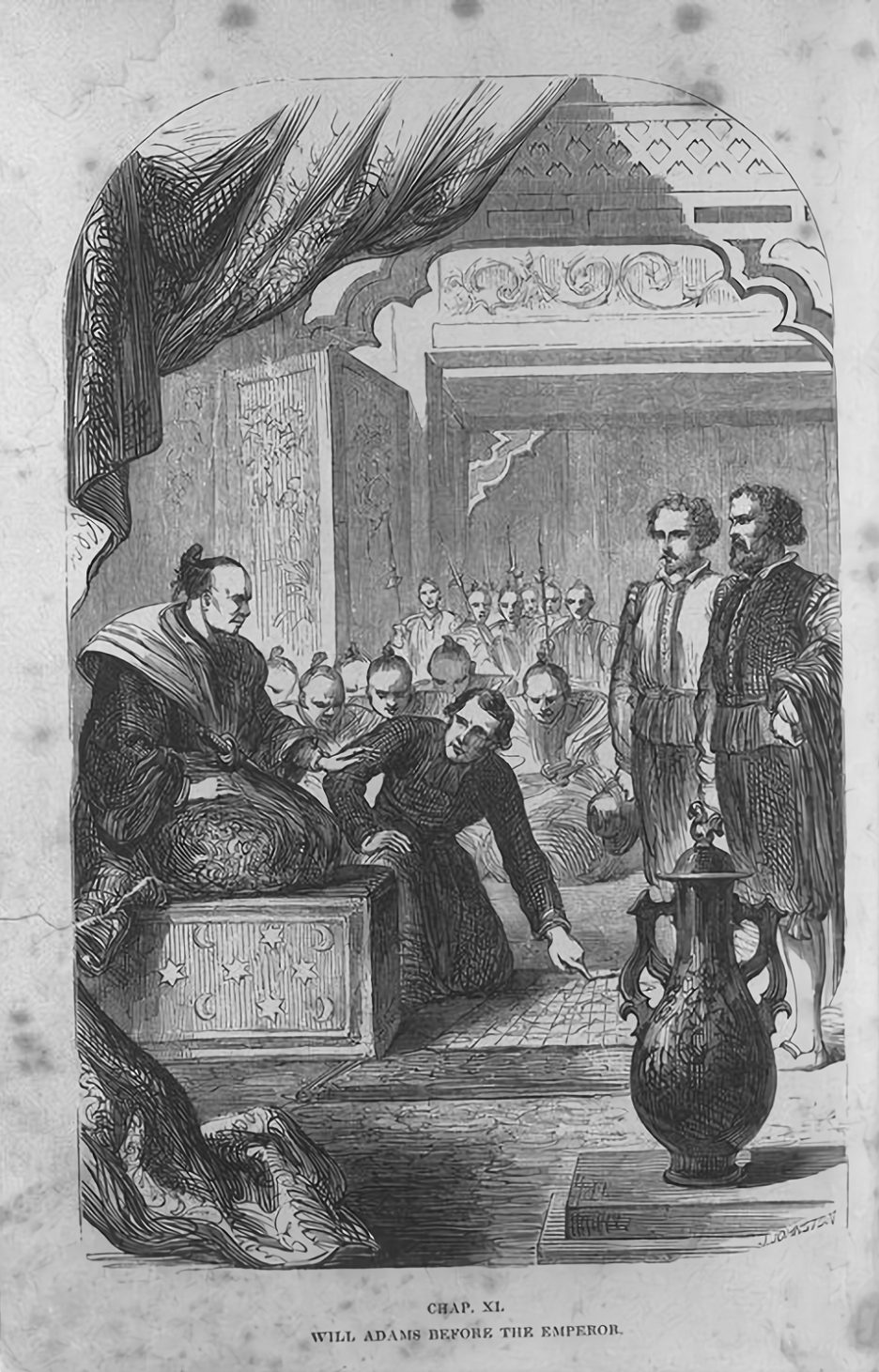
The Liefde: How William Adams Reached Japan in 1600
The Charity That Wasn’t
The ship was called the Liefde, Dutch for “Charity”, and by the time it reached Japan, there was nothing charitable about the condition of anyone aboard.
The vessel had left Rotterdam in June 1598 as part of a five-ship fleet bound for the East Indies, an expedition organized by a consortium of Dutch merchants who wanted to break the Iberian stranglehold on the spice trade. The plan was to sail south along the African coast, through the Strait of Magellan, across the Pacific, and into the markets of Southeast Asia, where Portuguese and Spanish merchants had been getting rich for the better part of a century while the Dutch watched from the wrong side of the Iberian embargo. It was an ambitious plan. It was also, in execution, one of the most catastrophic commercial voyages of the 16th century.
Of the five ships and approximately 500 men who departed Rotterdam, one ship and 24 men reached Japan. Most of the rest were killed by scurvy, starvation, hostile encounters with indigenous peoples along the South American coast, ambushes by Spanish garrisons, storms that scattered the fleet across the Pacific, and the general accumulated misery of spending two years on a wooden vessel in conditions we would consider inhumane in the 21st century. By the time the Liefde staggered within sight of the Japanese coast on April 19, 1600, her surviving crew had been reduced to hollow-eyed specters. Of the 24 men still alive, six could stand. Three more would die within days of making landfall.
The ship dropped anchor off the coast of Bungo province, modern-day Usuki, in Ōita Prefecture. The local Japanese, encountering their first Dutch vessel, fed them, gave them a house, and then looted their navigational instruments, their books, and anything else that wasn’t nailed down. The survivors, too weak to object, watched their possessions disappear and waited to see what would happen next.
What happened next was that the Jesuits arrived, and the Jesuits wanted them dead.
Why the Jesuits Wanted Adams Executed
The Interpreters Who Wanted an Execution
The Portuguese Jesuit missionaries who rushed to the scene at Bungo understood, with a clarity that their weakened visitors could not yet appreciate, exactly what the Liefde’s arrival meant. For over half a century, the Iberian powers had enjoyed an unchallenged monopoly on European trade with Japan. The Portuguese were the sole pipeline for Chinese silk; the Jesuits were the indispensable brokers who made the trade function. This arrangement had survived the 1587 edict, the San Felipe crisis, and the crucifixion of the Twenty-Six Martyrs because, at bottom, everyone needed everyone else: the Japanese needed the silk, the Portuguese needed the silver, and the Jesuits sat in the middle, translating, negotiating, and collecting souls.
A Dutch ship in Japanese waters was a crack in the foundation. A Dutch ship carrying Englishmen, Protestant Englishmen, enemies of Spain and Portugal, subjects of nations that had violently rejected the Pope, was a potential demolition charge.
The Jesuits did what institutional survival demanded: they acted as interpreters for the local authorities and translated in the most unflattering terms available. The Dutch and English were not merchants, they told the Japanese. They were pirates, sea-robbers, violent criminals. Their nations had cast off their allegiance to their lawful sovereign, the King of Spain. They had come to Asian waters not to trade but to steal. The proper course of action, the Jesuits advised, was execution. Crucifixion, ideally.
Why Ieyasu Spared and Kept Adams
The Patient Calculator
Tokugawa Ieyasu was, in the spring of 1600, the most dangerous man in Japan. He was nominally serving as one of the five regents appointed to govern during the minority of Toyotomi Hideyoshi’s young heir, and in reality maneuvering to seize supreme power for himself. Within six months he would fight the Battle of Sekigahara, destroy the western coalition, and establish the Tokugawa shogunate that would rule Japan for the next 265 years. He was 57 years old, a survivor of decades of civil war, betrayal, and political murder, and he possessed a quality that set him apart from both Nobunaga and Hideyoshi: patience. He did not react. He calculated.
When the report of a heavily armed foreign ship arrived, Ieyasu’s response was not alarm but curiosity. He ordered two of the survivors brought to him: William Adams, the ship’s English pilot-major, and Jan Joosten van Lodensteijn, a Dutch merchant. The ship’s captain, Jacob Quaeckernaeck, was too ill to travel.
Adams was a man from Gillingham, Kent, a small town on the Medway estuary in southeastern England, who had been trained in shipbuilding and navigation at the Royal Dockyard at Chatham. He had served in the English fleet against the Spanish Armada in 1588, worked as a pilot for the Barbary Company in North Africa, and joined the Rotterdam expedition as chief navigator at the age of 34. He was, by the time he was hauled before the most powerful warlord in Japan, 36 years old, recently starved, and in possession of nothing except his knowledge and his nerve.
The interviews lasted several days, stretching late into the night. Ieyasu, Adams later recalled, was “wonderfull favorable”, intensely curious, methodical in his questioning, interested in everything. He asked about Adams’s homeland, about the route the fleet had taken, about European political affairs. Adams produced a map and showed Ieyasu the Strait of Magellan, tracing the path the Liefde had followed halfway around the world. Ieyasu, who understood geography better than most European monarchs of the period, was astonished.
Then Ieyasu asked the questions that mattered. Was Adams’s country at war? Yes, Adams replied, with Spain and Portugal, but at peace with all other nations. What was his religion? Adams answered that they believed in God, who made heaven and earth. It was a carefully diplomatic formulation. The Protestants believed in God. They did not, pointedly, believe in the Pope.
Ieyasu absorbed all of this, processed it through the calculating machinery of a mind that had survived the Sengoku period, and reached a conclusion. He rejected the Jesuits’ demands for execution. The castaways had done no harm to Japan, he reasoned, and it was against justice to kill men merely because their nations were at war with Spain and Portugal. He held Adams in confinement for 41 days, not as punishment, but as a precaution while he decided what to do with him, then released him, reunited him with his crew, and compensated the survivors with 50,000 reais in silver for their stolen property.
He also confiscated the Liefde’s arsenal: 19 bronze cannons, 5,000 cannonballs, and 500 matchlocks. Whether this arsenal appeared on the field at Sekigahara five months later is a matter of scholarly debate, but the timing is suggestive.
The castaways were forbidden from leaving Japan. They were relocated to the Kantō region, near the new center of Tokugawa power. Adams and Jan Joosten were given positions as diplomatic advisors, interpreters, and, in Adams’s case, shipbuilders.
Miura Anjin: How Adams Became a Samurai
The Pilot Becomes a Lord
The transformation of William Adams from shipwrecked pilot to feudal aristocrat is one of the more remarkable social ascents in the history of European-Asian contact, and it happened because Adams possessed something that Ieyasu could not get from anyone else: an alternative perspective.
For 40 years, the only Europeans the Japanese had dealt with were Catholics, Portuguese merchants, Jesuit missionaries, and the occasional Spaniard, who presented themselves as representatives of a unified Christendom, a single global faith under a single Pope, backed by the unified power of the Iberian crowns. This was, to put it diplomatically, a curated version of the truth. It omitted the Protestant Reformation, the wars of religion tearing Europe apart, the fact that England and the Netherlands had violently rejected papal authority, and the inconvenient detail that the “unified” Iberian crowns were held together by a dynastic accident that half of Portugal resented.
Adams told Ieyasu all of this. He explained that Europe was bitterly divided between Catholic and Protestant powers. He explained that England and the Netherlands had expelled the Jesuits as agents of treason, that the same missionaries currently operating in Japan had been kicked out of half of northern Europe for stirring up rebellions against their natural princes. He explained, and this was the blade that cut deepest, that the Spanish and Portuguese strategy of empire was to send missionaries first and soldiers after; that the conversion of local populations was a prelude to political conquest; that the pattern had been repeated in the Americas, in the Philippines, and across the East Indies.
Adams was not lying. He was, however, presenting information with a rhetorical angle that happened to align perfectly with what Ieyasu already suspected. The San Felipe pilot’s boast of 1596, the Franciscan defiance, the Jesuit control of Nagasaki, the steadily growing Christian community with its loyalty to a foreign Pope, all of Ieyasu’s unease about the Catholic presence found, in Adams, an articulate, knowledgeable, and conveniently Protestant confirmation.
The Jesuits understood immediately what was happening. Their senior interpreter, João Rodrigues, had been Ieyasu’s primary source of information about the outside world. Adams supplanted him. Where Rodrigues had carefully filtered information to present Christendom as a harmonious unity, Adams tore the filter away. The Jesuit monopoly on European knowledge, maintained for half a century through linguistic skill and strategic omission, was broken in a series of late-night conversations between a warlord and a pilot.
Ieyasu rewarded Adams with the status of hatamoto, a bannerman, a direct high-ranking vassal of the shōgun. He was given the Japanese name Miura Anjin: Anjin meaning “pilot”, literally, “one who considers the compass needle”, and Miura denoting the peninsula where his new estate was located. The estate, in the village of Hemi on the Miura Peninsula, was valued at 150 to 250 koku of rice and included over 100 farms and 80 to 90 households of peasant retainers. Adams was, in every legal and social sense, a Japanese feudal lord. He had authority over his vassals. He had a townhouse in Edo, near the Nihonbashi bridge, in a neighborhood that became known as Anjin-chō, Pilot Street.
He also had a Japanese wife, a Japanese family, and an increasingly complicated relationship with his English one. He had left a wife and daughter in Gillingham. He would never see them again.
Ieyasu also commissioned Adams to build Western-style ships, Japan’s first. Working with the naval commander Mukai Shōgen and local carpenters, Adams constructed an 80-ton vessel at Itō on the Izu Peninsula, followed by a larger 120-ton galleon. The second ship was eventually lent to the Spanish for a Pacific crossing to New Spain, a diplomatic gesture that cost Ieyasu nothing and demonstrated to the Iberians that Japan was perfectly capable of building ocean-going vessels without their help.
Adams tutored the shōgun in mathematics, geometry, and world geography. He translated diplomatic correspondence. He served as the intermediary for every significant European contact that passed through Tokugawa Japan for the next two decades. He was, for all practical purposes, the foreign ministry.
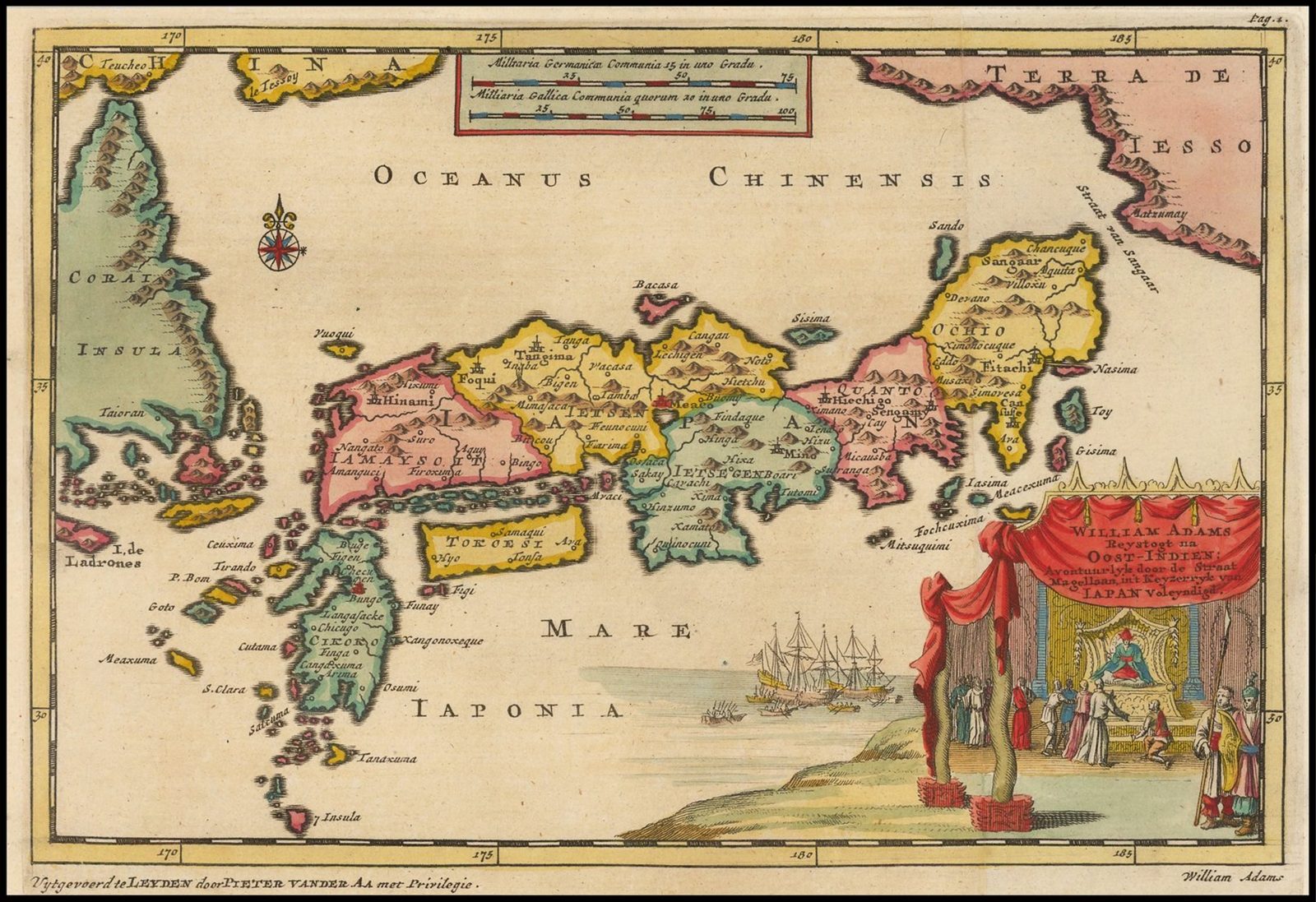
The Dutch and English Who Followed Him
The Merchants Arrive
The commercial consequences of the Liefde’s arrival took nine years to materialize, which was approximately eight years longer than the Dutch East India Company would have liked.
In 1605, Ieyasu permitted Jacob Quaeckernaeck and Melchior van Santvoort, two of the original Liefde survivors, to leave Japan and sail to the Dutch trading post at Patani, in present-day Thailand. They carried a shuin-jō, a red-seal pass, and a letter from Ieyasu officially inviting the Dutch to trade. The VOC, tangled in naval conflicts with the Spanish and Portuguese across Southeast Asia, could not spare ships immediately. It was not until July 1609 that two Dutch vessels, the Roode Leeuw met Pijlen and the Griffioen, finally anchored at Hirado.
Adams had been rehearsing the role for nine years: diplomat, translator, advocate. In the event, he narrowly missed the Dutch envoys Abraham van den Broeck and Nicolaes Puyck on their way to Ieyasu’s court at Sunpu, where, with Melchior van Santvoort as their interpreter, they weathered the predictable Portuguese accusations of piracy. But his years of advocacy had helped prepare the ground for the formal trade pass of August 24, 1609, a sweeping decree that authorized Dutch ships to land on any Japanese coast and trade without restriction. The VOC established its factory at Hirado on September 20, with Jacques Specx as the first opperhoofd. When the ships departed in October, they left behind Specx, three assistants, a boy, and a modest inventory of silk, lead, and pepper.
The factory was small. Its significance was immense. For the first time since the Portuguese had arrived in 1543, Japan had a European trading partner that came without priests.
The English followed four years later. In June 1613, Captain John Saris sailed the Clove, the first English ship to reach Japan, into Hirado harbor. Adams, delighted to see a compatriot after 13 years of exile, offered his services as guide and intermediary. He secured Saris a red-seal trading pass from Ieyasu and recommended establishing the English factory at Uraga, close to the massive Edo market and the center of Tokugawa power.
Saris ignored the advice. He distrusted Adams, suspecting the pilot had gone native, lost his English loyalties, and chose to place the factory in Hirado, where he could keep a jealous eye on the Dutch next door. It was the first in a series of decisions that would doom the English enterprise in Japan.
Adams and the English Factory at Hirado
The English Factory
There is a separate article on the history of the English factory in Hirado. In short, it was in the wrong place, traded the wrong goods, and was managed by Richard Cocks, a man more interested in opening trade with China than making the Japan trade profitable. It failed. In December 1623, the English East India Company’s Council of Defense in Batavia ordered the factory closed. It had lost between £5,000 and £10,000, a significant sum for the period, though a rounding error compared to what the VOC was investing in Asia. Cocks was recalled to England in disgrace, charged with mismanagement. He died at sea in 1624, somewhere in the Indian Ocean, on the voyage home.
The English would not trade with Japan again for over two centuries.
The Protestant Case Adams Made to Ieyasu
The Propaganda War
The Portuguese and Jesuits had spent decades constructing an image of Catholic Christendom as a unified, harmonious enterprise, one Church, one Pope, one set of monarchs working in concert to spread the faith across the globe. This image was essential to their position in Japan, because it allowed them to present the Jesuit mission as an extension of an irresistible global order. The Japanese did not need to fear Christianity, the argument ran, because Christianity was universal, benign, and backed by the mightiest powers on earth.
Adams and the Dutch and English did not need to invent counter-narratives. They simply described Europe as it actually was: a continent riven by religious wars, in which Protestant nations had expelled the Jesuits, in which Catholic missionaries had been implicated in political assassinations and colonial conquest, and in which the supposedly universal Church was, in fact, bitterly contested by half of its former flock. Cocks told Japanese officials about the Gunpowder Plot. Adams told Ieyasu about the expulsion of the Jesuits from England. The Dutch translated intercepted Portuguese correspondence and presented it to the bakufu as evidence that the Iberians were plotting Christian insurrections in Japan.
The cumulative effect was devastating. The Jesuits had spent 40 years building a monopoly on information about the outside world, carefully screening out anything that contradicted the image of a unified Christendom. The Protestants destroyed that monopoly in a few years by the simple expedient of telling a different, and largely accurate, story. The Jesuit Father Diogo de Carvalho, writing to the Pope in 1614, bitterly complained that Adams and the Protestant merchants had “poisoned” Ieyasu’s mind with “false accusations”, transforming the shōgun’s previous tolerance into lethal hostility.
The accusations were not entirely false. That was the problem.
The Portuguese did operate in countries where conversion had preceded colonization. The Jesuits had been expelled from England. Spain had used missionaries as instruments of imperial policy in the Americas and the Philippines. The pilot of the San Felipe had, in 1596, laid out the strategy on a map. The Protestants were not fabricating a conspiracy theory. They were pointing at a pattern and saying: look.
The definitive ban on Christianity followed in 1614. The expulsion of the Portuguese followed in 1639. The Protestant merchants had provided the bakufu with the intellectual framework it needed to do what it had been contemplating for decades: separate trade from faith, keep the commerce, and destroy the Church.
William Adams’ Last Years and Death
The Last Years of the Pilot
William Adams spent the final decade of his life as a man stretched between two worlds, fully belonging to neither.
He remained Ieyasu’s advisor until the shōgun’s death in 1616, after which his influence diminished. Hidetada, Ieyasu’s successor, had less use for a foreign counselor and less patience for the broad trading privileges that Adams had helped negotiate. Adams continued to serve as an intermediary, he was still the only person in Japan who could interpret between Japanese, English, and Dutch, but his political leverage was fading.
He invested in the red-seal trade, the system of licensed Japanese merchant ships that sailed to Southeast Asian ports under shogunal authorization. He dispatched vessels to Siam, Cochin-China, and Tonkin.
Adams died on May 16, 1620, at Hirado. He was 55 years old. He had spent the last 20 years of his life in Japan, had risen from castaway to samurai, had built ships for a shōgun, had brokered the entry of two European trading nations into the Japanese market, and had, more than any other individual, provided the Tokugawa government with the understanding of European politics that would shape its foreign policy for the next two and a half centuries.
He left behind two families: one in Gillingham that he had not seen since 1598, and one in Japan, a Japanese wife, whose name appears in the records as Oyuki, and two children, Joseph and Susanna, who bore English names and lived Japanese lives. His estate in Hemi passed to his son. The neighborhood of Anjin-chō in Edo kept its name.
Jan Joosten, the Dutch merchant who had been Adams’s companion since the wreck of the Liefde, died the following year, drowning when his ship capsized somewhere in the South China Sea. The Tokyo district of Yaesu, a corruption of “Jan Joosten”, preserves his name, though vanishingly few of the people who pass through Yaesu Station every day know why it is called that.
Sources & Further Reading
Boxer, C.R. The Christian Century in Japan, 1549–1650. University of California Press, 1951. The foundational account of the Jesuit mission, with detailed treatment of the Protestant disruption and its consequences for the Catholic enterprise.
Clulow, Adam. The Company and the Shogun: The Dutch Encounter with Tokugawa Japan. Columbia University Press, 2014. An essential study of the VOC’s operations in Japan and the political dynamics of the Dutch-Tokugawa relationship.
Cooper, Michael. They Came to Japan: An Anthology of European Reports on Japan, 1543–1640. University of California Press, 1965. Contains translated accounts from Adams, Saris, and Cocks, providing firsthand perspectives on the English and Dutch arrival.
Corr, William. Adams the Pilot: The Life and Times of Captain William Adams, 1564–1620. Curzon Press, 1995. The most thorough English-language biography of Adams, drawing on Japanese and European archival sources.
Farrington, Anthony. The English Factory in Japan, 1613–1623. British Library, 1991. 2 vols. The definitive documentary collection of the English East India Company’s Hirado factory, including Cocks’s diaries and correspondence.
Laver, Michael S. The Sakoku Edicts and the Politics of Tokugawa Hegemony. Cambria Press, 2011. Places the Protestant arrival within the broader framework of Tokugawa foreign policy and the development of sakoku.
Massarella, Derek. A World Elsewhere: Europe’s Encounter with Japan in the Sixteenth and Seventeenth Centuries. Yale University Press, 1990. A superb synthesis that devotes substantial attention to Adams, the English factory, and the Dutch-Portuguese rivalry.
Milton, Giles. Samurai William: The Adventurer Who Unlocked Japan. Hodder & Stoughton, 2002. A popular biography of Adams, accessible and well-researched, aimed at a general readership.
Mulder, W.Z. Hollanders in Hirado, 1597–1641. Fibula-Van Dishoeck, 1985. A detailed study of the Dutch factory at Hirado, covering the period from initial contact through the relocation to Dejima.
Nagazumi, Yōko. “Ayutthaya and Japan: Embassies and Trade in the Seventeenth Century”. In From Japan to Arabia: Ayutthaya’s Maritime Relations with Asia, edited by Kennon Breazeale. Foundation for the Promotion of Social Sciences and Humanities Textbooks Project, 1999. Essential for understanding the Southeast Asian trade networks in which Adams and the English factory participated.
Purnell, C.J. “The Log-Book of William Adams, 1614–19”. Transactions of the Japan Society of London 13 (1914–15): 156–302. A transcription of Adams’s own logbook from his final years, invaluable for understanding his commercial activities and daily life.
Screech, Timon. “The English and the Control of Christianity in the Early Edo Period”. Japan Review 24 (2012): 3–40. Examines the English role in the anti-Christian turn, including the propaganda campaign and its political context.
Totman, Conrad. Tokugawa Ieyasu: Shogun. Heian International, 1983. The standard English-language biography of Ieyasu, providing essential context for Adams’s patron and his political calculations.
Vialle, Cynthia, and Leonard Blussé. The Deshima Dagregisters: Their Original Tables of Contents. Leiden Center for the History of European Expansion, 2001–10. 13 vols. The Dutch factory’s daily registers, essential for tracing the VOC’s operations from Hirado to Dejima.
Cite this page
Nanban.pt. “William Adams and the Protestant Disruption.” Last modified 25 September 2026. https://nanban.pt/articles/william-adams-protestant-disruption/.
@misc{nanban-william-adams-protestant-disruption,
  author = {Nanban.pt},
  title = {William Adams and the Protestant Disruption},
  year = {2026},
  url = "https://nanban.pt/articles/william-adams-protestant-disruption/",
  note = {Last modified 2026-09-25}
}