Prize of War: The Dutch Captures of the Santo António
Three ships, one name, and a hundred million guilders’ worth of reasons to rethink who owned the sea. How Dutch privateering in Asian waters provoked the first international legal case in Japanese history.
The Dutch Captures of the Santo António were the seizures of three Portuguese ships, each named for the patron of lost things, by Dutch privateers between 1605 and 1618. The capture off Meshima in 1615 forced Tokugawa Ieyasu to arbitrate what became the first international legal case in Japanese history.
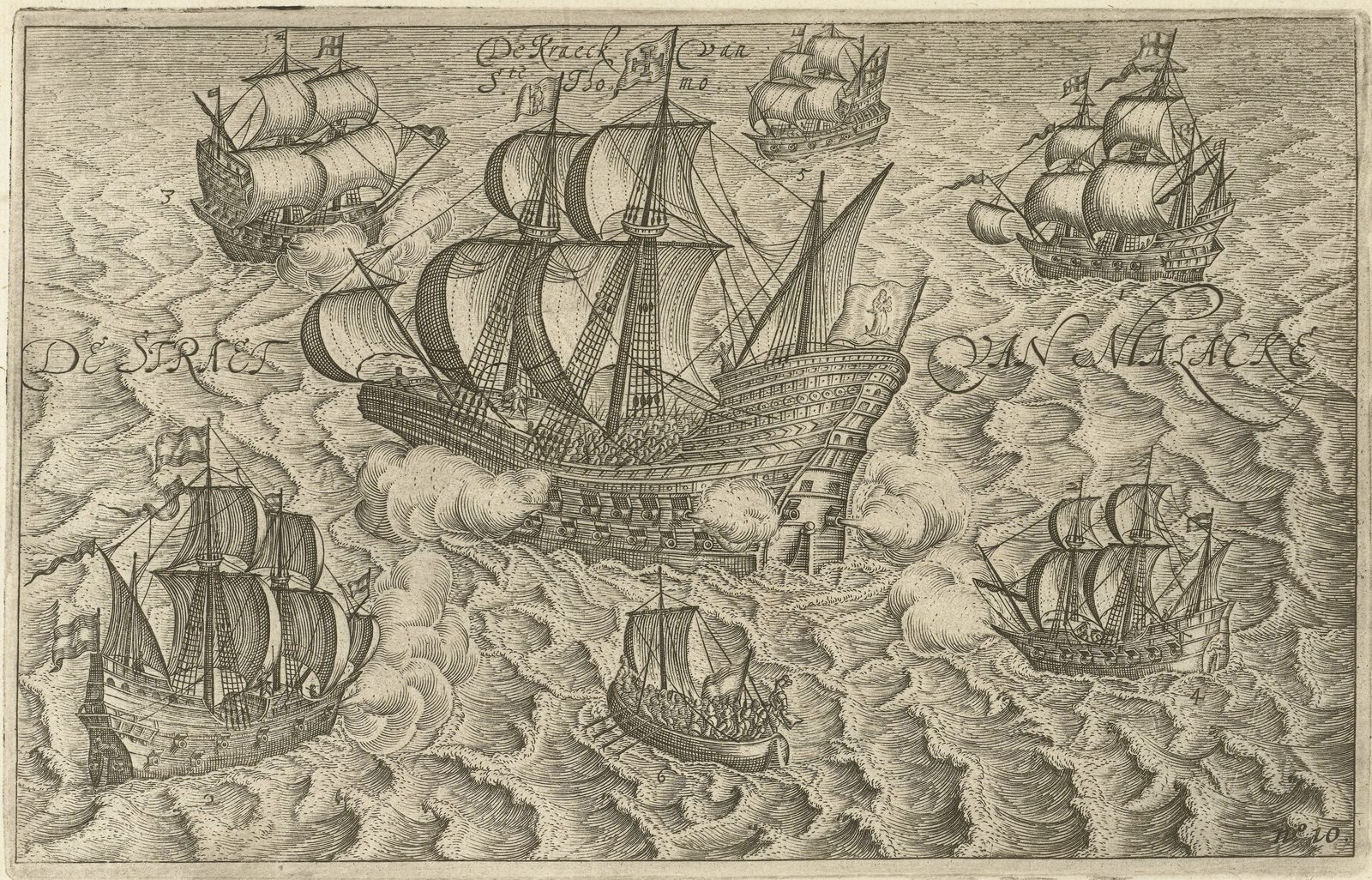
The Portuguese had a naming problem. Or rather, they had a naming habit that, over the course of the early 17th century, turned into a problem for anyone trying to keep track of which ship had been seized by which Dutchman in which harbor.
The name Santo António, Saint Anthony of Padua, patron of lost things, which is the kind of irony that writes itself, was among the most popular christenings in the Portuguese maritime fleet. Devout captains, devout shipwrights, devout wives of devout captains: everyone agreed that a vessel sailing into waters full of typhoons, pirates, and the Dutch East India Company would benefit from the intercession of a saint known for recovering what had been lost. The result was that at any given moment in the early 1600s, multiple carracks, galleons, and junks named Santo António were plying the sea lanes between Goa and Nagasaki. When the Dutch started capturing them, and they captured at least three, the archival record became a tangle of identical names, different ships, different cargoes, and very different consequences.
Two of those captures mattered enormously. The first, off the coast of the Malay Peninsula in 1605, delivered a windfall that confirmed privateering as corporate strategy. The second, in the waters off western Japan in 1615, triggered the first formal arbitration of a European dispute by the Tokugawa shogunate, produced a landmark ruling on the limits of Japanese legal protection, and drew a line in the ocean that the Dutch would spend the next two decades pretending they could not see.
But to understand either, you have to start with the ship that started everything. And that ship was not named Santo António at all.
The Prize That Changed the Rules
In February 1603, a Dutch fleet under Admiral Jacob van Heemskerck was prowling the Strait of Singapore when it encountered the Santa Catarina, a Portuguese carrack sailing from Macau to Malacca. The Santa Catarina was fat with cargo, Chinese silk, spices, Ming porcelain, and Heemskerck’s ships were armed to the teeth. The engagement was brief and its outcome decisive.
When the carrack’s hold was inventoried and its contents shipped back to Amsterdam for public auction, the total realized was staggering: over 3.3 million guilders. To put that figure in perspective, it roughly equated to the revenue of the English Crown for 1603. A single Portuguese ship, captured in a single afternoon. The porcelain alone, delicate blue-and-white bowls and plates that Dutch housewives would display in their parlors for the next century, became known as Kraakporselein, carrack porcelain, a term that ceramic scholars still use today.
The effect on the boardroom of the Vereenigde Oostindische Compagnie, the VOC, chartered just one year earlier, was transformative. Before the Santa Catarina, the Company’s directors had entertained polite fictions about coexistence with the Portuguese in Asian waters. The Dutch were newcomers. The Portuguese had been operating in the Indian Ocean and South China Sea for nearly a century. There was an argument, which some VOC directors genuinely believed, that accommodation was possible, that the ocean was large enough for two European trading empires and that armed confrontation was bad for margins.
The 3.3 million guilders obliterated that argument. Privateering was not a cost of doing business. Privateering was the business. By the end of 1603, the VOC had dispatched Admiral Steven van der Hagen with a fleet carrying explicit instructions to take the offensive and inflict as much damage as possible on Spanish and Portuguese shipping and fortifications across Asia. The defensive posture was over.
There was, however, a legal difficulty. The Santa Catarina had been seized without a declaration of war, in waters over which the Dutch had no sovereign claim, from a ship belonging to a nation with which the Dutch Republic was not formally at peace but was not formally at war either, the Portuguese Crown having been absorbed into the Spanish Monarchy since 1580, and the Spanish war with the Dutch being one of those baroque European conflicts that lurched between armistice and hostility depending on the season. The Portuguese owners of the Santa Catarina’s cargo filed legal challenges. The legitimacy of the prize was not a foregone conclusion.
The VOC’s response was to hire a 20-year-old lawyer.
The Lawyer and the Ocean
Hugo Grotius was brilliant, ambitious, and, at the time of his commission, young enough that his legal reputation was still mostly a matter of promise rather than precedent. The VOC directors asked him to write a legal defense of the Santa Catarina seizure, a brief, essentially, arguing that taking another nation’s ship and selling its cargo was not piracy but a legitimate act of war conducted by a private commercial entity.
The resulting treatise, De Jure Praedae, “Commentary on the Law of Prize and Booty”, did considerably more than defend a single seizure. Grotius constructed an entire philosophical framework for the freedom of the seas, arguing that the ocean could not be owned by any sovereign power, that the right of navigation was a natural right belonging to all nations, and that a private company acting under the authority of its government could lawfully seize the ships of an enemy state even in the absence of a formal declaration of war. One chapter of the treatise, published separately in 1609 as Mare Liberum, “The Free Sea”, became one of the foundational texts of international law.
The irony was exquisite. A legal argument commissioned to justify corporate piracy became the philosophical basis for the modern law of nations. Grotius’s ocean was free because the VOC needed it to be free. The principle of open seas, which would eventually underpin centuries of international maritime commerce, was born as a corporate legal strategy, a memo from the boardroom dressed in Latin and published as philosophy.
The Portuguese, naturally, took the opposing view. The Iberian position, articulated with varying degrees of sophistication by Spanish and Portuguese jurists, was that the Treaty of Tordesillas and subsequent papal bulls had divided the non-Christian world between Spain and Portugal, and that any incursion by Protestant powers into waters claimed under these grants was illegal. The Dutch response, that the Pope had no authority to give away oceans he did not own, to nations that could not enforce their claims, was both legally sound and commercially convenient.
The Santa Catarina precedent settled the question in the only court that mattered: the marketplace. The VOC’s shareholders received their dividends. The Dutch public received their porcelain. And every VOC captain sailing east received a clear signal: Portuguese ships were lawful prey, and the rewards for taking them were spectacular.
The Second Prize: Patani, 1605
Two years after the Santa Catarina, the system produced its next major result.
On 26 March 1605, Admiral Wybrant van Warwyck was at anchor in the harbor of Patani, a thriving trading port on the eastern coast of the Malay Peninsula, when a Portuguese carrack sailed in. The ship was the Santo António, bound from Macau to Malacca, and it had put into Patani for repairs. It was loaded with the proceeds of the Macau silk trade, the same trade that sustained the annual voyage of the Nau do Trato to Nagasaki and that generated the colossal margins described elsewhere in this series.
Van Warwyck did not attack immediately. He was a shrewd operator, and he understood that seizing a ship in a sovereign harbor required more than firepower. It required permission. The Dutch had recently established a trading factory in Patani, and Van Warwyck had been cultivating relations with the local ruler, the Queen of Patani, one of a succession of women who governed the sultanate through the late 16th and early 17th centuries. Portuguese-Patani relations, meanwhile, had soured. The Portuguese stronghold at Malacca was a commercial rival, and the Queen’s government had accumulated a list of grievances against Portuguese traders that Van Warwyck was only too happy to validate.
He secured the Queen’s explicit consent to attack the carrack in her harbor. The diplomatic cover was as important as the cannon fire. Van Warwyck was not a pirate. He was a Company officer executing a corporate mandate with the documented approval of the local sovereign, exactly the kind of legal fig leaf that Grotius’s treatise had been designed to provide.
The Santo António was taken. Its cargo, when auctioned in the Netherlands, realized 1,600,000 guilders, making it the second most valuable prize ever captured by the Dutch in Asian waters, surpassed only by the Santa Catarina itself. The name of the Portuguese captain who commanded the vessel goes unrecorded in the surviving sources, which tells its own story about whose perspective the archives preserved.
Van Warwyck’s strategy at Patani established a template that the VOC would repeat across Southeast Asia for the next four decades: identify a local ruler with grievances against the Portuguese, offer commercial and military support, secure formal authorization for attacks on Iberian shipping, and present the resulting prize as a legitimate act of sanctioned warfare rather than open-ocean robbery. It was a system that combined capitalism, diplomacy, and violence with an efficiency that the Portuguese, still operating under the older model of fortified coastal enclaves and Crown-licensed monopoly, could not match.
The 1605 capture also revealed something about the rhythm of Dutch strategy. Van Warwyck had not been at Patani by accident. He had spent the previous summer cruising the South China Sea with the specific objective of intercepting Japan-bound Portuguese carracks, the great ships of the Macau-Nagasaki route whose cargoes were worth more, per hull, than almost anything else afloat in Asian waters. He had failed to find them. The Santo António at Patani was an acceptable consolation prize at 1.6 million guilders.
The message to the VOC boardroom was clear: the Portuguese silk trade was the richest target in Asia, and every guilder spent on warships to intercept it was an investment with extraordinary returns. The hunt for the great carracks was on.
A Junk Named Santo António
A decade passed. The VOC expanded relentlessly, factories at Bantam, Hirado, the Moluccas, Ayutthaya, while the Portuguese Estado da Índia contracted under the combined pressure of Dutch aggression, overextended garrisons, and the catastrophic loss of revenue from captured ships. In 1609, Spain and the Dutch Republic signed the Twelve Years’ Truce, a formal cessation of hostilities in Europe. In theory, the truce extended to Asian waters. In practice, it extended to whatever interpretation the VOC’s local commanders found convenient.
In August 1615, the VOC yacht Jaccatra was operating in the waters west of Kyushu when it fell upon another vessel named Santo António. This ship was no carrack. It was a Portuguese junk, a hybrid vessel of the kind common in the intra-Asian coastal trade, sailing from Champa in Indochina to Japan, crewed largely by Chinese and Japanese mariners. It was smaller, humbler, and carried a cargo of ebony, tin, gold bars, and conserves rather than the silk fortunes of the Macau run.
The capture took place near Meshima, a jagged volcanic island in the Danjo Guntō chain, roughly 100 miles off the western coast of Kyushu. Meshima’s distinctive high, ragged silhouette had made it a crucial navigational landmark for every European and Japanese pilot approaching the Japanese archipelago from the south or west. If you could see Meshima, you knew where you were. The island was a signpost at the threshold of Japanese waters.
This geographical detail would prove decisive. Because the question that emerged in the weeks following the seizure was not whether the Dutch felt they had the right to capture a Portuguese vessel, the precedents of 1603 and 1605 had settled that, but whether they had the right to do so here, within sight of Japan, in waters that even the Dutch reckoned the Tokugawa shogunate’s own.
On 18 August, the Dutch brought their prize into Kochi harbor, a secondary port near the VOC factory at Hirado. The junk was renamed the Hoope, “Hope”, and the Dutch prepared to add its cargo to their accounts. They expected the matter to end there.
It did not.
The Shogun’s Court
The Portuguese merchants in Nagasaki were furious. They filed a formal protest with the Japanese authorities, arguing that the Dutch had committed piracy by seizing a ship within the territorial waters of Japan. The charge was serious, and it was unprecedented. For the first time, the global war between Catholic Iberia and Protestant Holland had intruded directly into Japanese jurisdiction. The European conflict had washed up, quite literally, on Japanese shores.
The Tokugawa Bakufu agreed to hear the case. This was itself remarkable. The retired Shogun, Tokugawa Ieyasu, still the most powerful man in Japan despite having formally ceded the title to his son Hidetada in 1605, would serve as arbiter of a dispute between two groups of foreigners whose war had nothing to do with Japan. It was, in effect, the first international legal proceeding conducted on Japanese soil.
Jacques Specx, the opperhoofd, the head, of the Dutch factory at Hirado, traveled to the Shogun’s court to present the VOC’s defense. Specx was a Company man to his fingertips: pragmatic, persuasive, and entirely untroubled by the gap between what the VOC was authorized to do under the Twelve Years’ Truce and what it was actually doing in Asian waters. His argument was straightforward. The Dutch were not pirates. They were soldiers engaged in a legitimate war. The Spanish and Portuguese had repeatedly violated the terms of the 1609 Truce by launching large-scale military attacks against Dutch positions in the Moluccas and elsewhere in Asia. In retaliation, Prince Maurice of Nassau had authorized VOC servants to seize Iberian vessels wherever they were found.
The captains of ships like the Jaccatra, Specx insisted, were not pirates. They were official military officers carrying out the orders of their sovereign prince. The distinction was important, not because anyone in the room believed it completely, but because it placed the seizure within a legal framework that even the Bakufu, with no stake in European quarrels, could evaluate on its own terms.
The Pilot’s Testimony
Into this diplomatic tangle stepped the man in Japan best placed to explain European geopolitics to a Japanese warlord: William Adams.
Adams, the English pilot who had washed ashore in 1600, survived Jesuit attempts to have him executed, and risen to become Tokugawa Ieyasu’s most trusted foreign adviser, had been navigating the treacherous space between European factions in Japan for 15 years. He spoke Japanese. He understood the Tokugawa court. And he had no love for the Portuguese or Spanish, whose missionaries had lobbied for his death when he first arrived.
Ieyasu was genuinely puzzled by the case before him. The geopolitical contradiction was baffling: how could the Iberian and Dutch powers be fighting a vicious maritime war in Asian waters while a formal truce existed between them in Europe? The concept of a peace that applied to one hemisphere but not the other, which was, in practice, exactly how the Twelve Years’ Truce operated, made no sense to a ruler accustomed to a world where a peace was a peace and a war was a war.
He turned to Adams for an explanation.
Adams’s testimony was measured, sympathetic to the Dutch, and devastatingly effective. He confirmed that the European powers had recently become friends through the mediation of the King of England and other rulers, a reference to the 1609 Truce. But he explained that the King of Spain believed himself more entitled to the Asian territories than any other Christian prince, because Spain had already established its presence in the Philippines and the Indies. Spain, Adams told Ieyasu, intended to use force to prevent all other nations from trading in the region.
Ieyasu asked why the Iberians captured Dutch men as well as goods, a question that revealed the degree to which the Shogun was engaging with the substance of the dispute rather than merely adjudicating its surface. Adams explained that the Spanish were holding hundreds of Dutch prisoners in the Philippines, and that the Dutch were therefore compelled to retaliate by seizing Iberian men and goods in return.
The testimony framed the conflict in terms that Ieyasu understood: a powerful lord (Spain) claiming exclusive rights over territory that other lords (Holland, England) disputed, and the resulting cycle of seizure and counter-seizure that followed from the failure to resolve the claim. It was, in its essentials, the logic of the Sengoku period transposed onto oceans.
The Dutch records credit Specx and Jan Joosten; the English at Hirado thought Adams’s role decisive. He was not a neutral witness, he was a Protestant Englishman with commercial ties to both the Dutch and English trading factories, but his unique position as Ieyasu’s trusted adviser gave his testimony a weight that few other Europeans in Japan could command.
The Red Seal
Before rendering a verdict, the Bakufu dispatched an envoy to interrogate the captured Portuguese mariners. The interrogation was brief, because the Bakufu needed the answer to only one question.
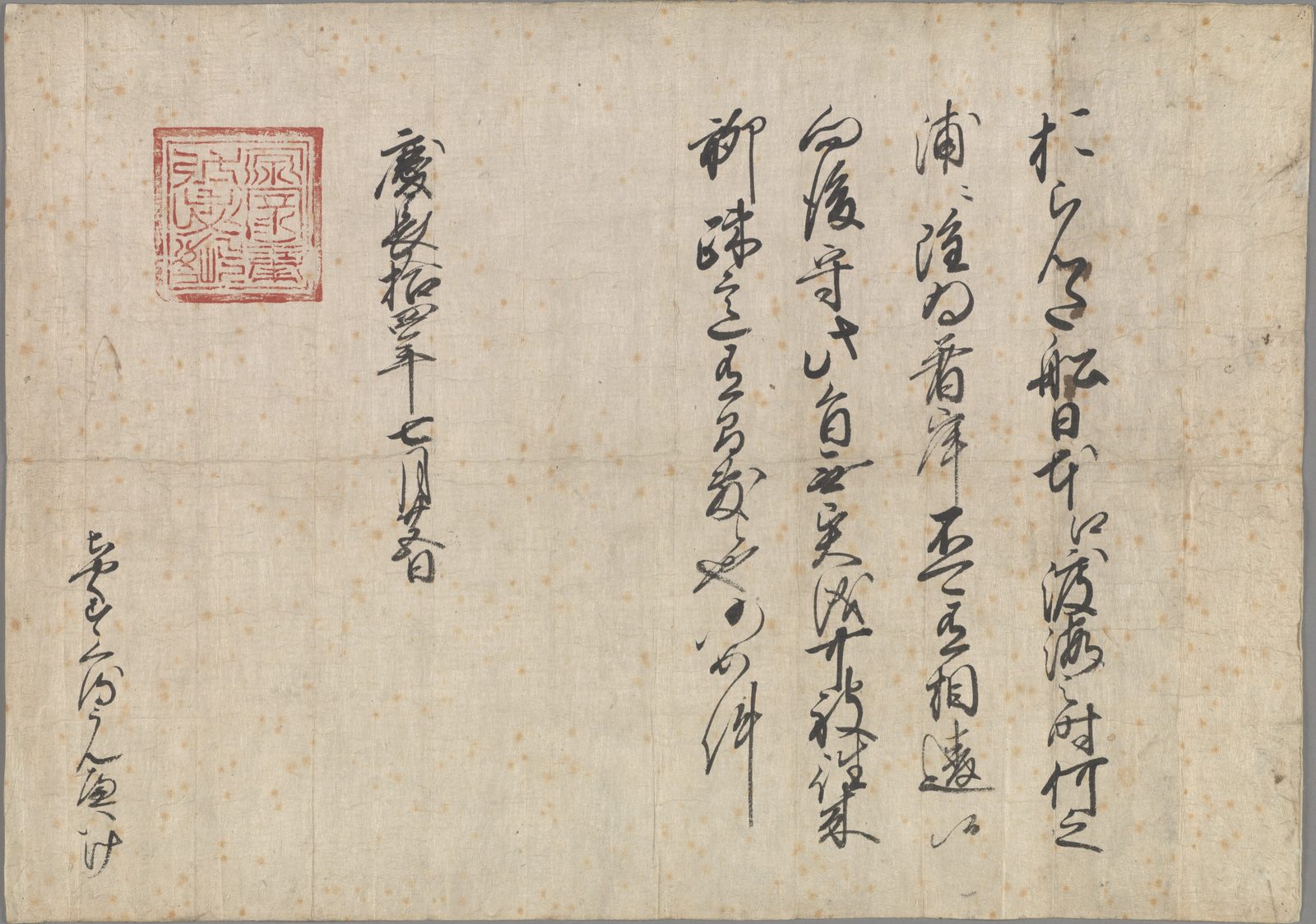
Did the Santo António carry a goshuin?
The goshuin, also known as the shuinjō, was the red-seal passport issued by the Tokugawa shogunate to authorize and protect ships engaged in foreign trade. It was, in the Japanese system, the definitive document of maritime legitimacy. A ship bearing the red seal was under the personal protection of the Shogun. To attack a shuinsen, a red-seal ship, was to attack the Shogun himself.
The Portuguese cartaz system in the Indian Ocean operated on a different principle entirely. The cartaz was a license extracted under the threat of violence: pay the Portuguese customs duties and carry their pass, or face the guns of their warships. It was a protection racket administered by a naval power. The Tokugawa goshuin, by contrast, offered genuine, formidable protection backed by an authority that every foreign trader in Japanese waters, Dutch, English, Chinese, Portuguese, and Spanish alike, recognized and feared. The VOC never willingly crossed the line drawn around red-seal ships, and the pass was so coveted that even Iberian captains sought to obtain one, recognizing that it was the most effective shield available against Dutch attacks in the waters approaching Japan.
The Portuguese mariners confessed that they did not carry a red seal.
The Bakufu immediately terminated the interview. Without a goshuin, the Santo António had no claim to Japanese protection. The question of whether Meshima was in Japanese waters, whether the Dutch were pirates or soldiers, whether the Twelve Years’ Truce applied in Asian seas, none of it mattered. The Bakufu had reduced a complex international dispute to a single binary question, and the answer was no.
The Verdict
On 26 September 1615, Tokugawa officials delivered their ruling. The Santo António and its cargo were awarded to the Dutch as a legitimate war prize. The vessel lacked a red seal. The Portuguese had no standing to invoke Japanese protection.
Ieyasu added a political coda. Persuaded by Adams’s testimony, he concluded that the Spanish had no reasonable grounds for their exclusive territorial and commercial claims in Asia. But he was careful not to endorse the Dutch position either. He declared that since this was an ongoing dispute between foreign nations, he “would not make nor meddell in the matter”, leaving it for the European rulers to resolve among themselves.
The ruling was a masterpiece of limited engagement. The Bakufu had asserted three things simultaneously: that whether Meshima lay in Japanese waters did not matter; that Japanese legal protection extended exclusively to shuinsen; and that the Tokugawa government had no interest in adjudicating European wars beyond the narrow question of whether Japanese sovereignty had been violated.
The Dutch, naturally, heard something different. They interpreted the ruling as a broad endorsement of their right to prey on Iberian shipping in the seas around Japan. If the Shogun himself had awarded them a captured Portuguese vessel, surely this meant they were free to capture more? The logic was seductive, and it was wrong. The Bakufu had not endorsed privateering as a general principle. It had ruled that a ship without a red seal was not Japan’s problem. The distinction was narrow, but the distance between the two interpretations would generate friction for years.
The Portuguese, for their part, drew their own conclusion: every ship approaching Japan needed a goshuin. The red seal, already valuable, became indispensable. And the race to secure Tokugawa patronage, the diplomatic competition between Dutch, English, Portuguese, Spanish, and Chinese traders for the Shogun’s favor and the Shogun’s stamp, intensified accordingly.
Fire on the Water
The Jaccatra herself, the Dutch yacht that had captured the Santo António off Meshima, enjoyed three more years of service after her moment of legal fame. She was employed by the VOC on the long run between Hirado and Southeast Asia, shuttling between the Dutch factory in Japan and the Company’s trading posts to the south. It was useful, unglamorous work: the bread-and-butter of intra-Asian commerce that kept the VOC’s network connected while the big fleets hunted for bigger game.
In 1618, that run turned lethal.
The Jaccatra was sailing to Japan when she encountered four Portuguese galliots commanded by Captain-Major António de Oliveira de Moraes. The galliots were smaller, faster, and more maneuverable than the Dutch yacht, and there were four of them. A running fight began. The Portuguese closed the distance, and two of the galliots managed to grapple and board the Jaccatra.
What happened next belongs to a tradition of maritime violence that both the Dutch and the Portuguese understood implicitly. The Dutch commander, whose name the sources do not record, an anonymity that lends the scene an eerie universality, realized that the ship was lost. Capture meant imprisonment, interrogation, and the confiscation of every scrap of intelligence aboard. The alternative was the one that André Pessoa had chosen in Nagasaki harbor eight years earlier when he blew up the Nossa Senhora da Graça rather than surrender to Arima Harunobu’s boarding parties. It was the option that European captains in Asian waters had come to regard not as desperate but as correct.
The Dutch commander fired the ship’s magazine. The Jaccatra erupted. The explosion killed everyone on board.
The Wider Frame
The multiple captures of vessels named Santo António were not isolated events. They were data points in a pattern, the systematic Dutch campaign to dismantle the Portuguese maritime empire in Asia by attacking its most vulnerable component: the ships.
The Portuguese Estado da Índia had been built on a network of fortified trading posts stretching from Mozambique to Macau, connected by sea lanes that were, in theory, patrolled by Portuguese warships and protected by the cartaz pass system. The theory had worked tolerably well when the Portuguese were the only European power in the Indian Ocean. It collapsed when the Dutch arrived with more ships, more capital, and a corporate structure designed from the ground up for naval warfare.
The VOC’s strategy was simple and ruthless: intercept Portuguese carracks, seize their cargoes, auction the goods in Amsterdam, and use the proceeds to finance the next round of interceptions. Every captured ship weakened the Portuguese both commercially and militarily. Every windfall strengthened the VOC’s shareholders and its war chest. The Santa Catarina in 1603, the Santo António at Patani in 1605, the Santo António off Meshima in 1615, and a third Santo António seized off Nagapattinam on the Coromandel Coast, carrying 700 merchants and passengers, a hold full of rice, and 290 bales of textiles valued at a minimum of 60,000 cruzados, were all products of the same corporate logic.
The conflict contrasted the unwieldy Portuguese empire, weighed down by sluggish bureaucracy, competing demands of national interest, fighting wars, subservient to the church, with the Dutch VOC: a well capitalized, shareholder-driven predator with only one objective: profit.
Sources & Further Reading
Boxer, C.R. The Christian Century in Japan, 1549–1650. University of California Press, 1951. The essential foundation for the entire Nanban period, with detailed treatment of Dutch-Portuguese rivalry in Japanese waters and the diplomatic consequences of maritime captures.
Grotius, Hugo. De Jure Praedae Commentarius (Commentary on the Law of Prize and Booty). Written 1604–1606; first full publication 1868. The legal treatise commissioned by the VOC to justify the Santa Catarina seizure, and the intellectual origin of modern international maritime law.
Grotius, Hugo. Mare Liberum (The Free Sea). Leiden, 1609. The separately published chapter of De Jure Praedae that became the foundational text on freedom of navigation.
Massarella, Derek. A World Elsewhere: Europe’s Encounter with Japan in the Sixteenth and Seventeenth Centuries. Yale University Press, 1990. Essential for the English and Dutch perspective on the Japan trade, including Adams’s role in the Meshima arbitration.
Clulow, Adam. The Company and the Shogun: The Dutch Encounter with Tokugawa Japan. Columbia University Press, 2014. The definitive modern account of VOC-Tokugawa relations, with extensive treatment of the goshuin system and the legal framework governing foreign trade.
Nagazumi, Yōko. Tōsen Yushutsunyū-hin Sūryō Ichiran, 1637–1833 (A Quantitative Study of Chinese Junk Trade at Nagasaki). Sōbunsha, 1987. Statistical analysis of the trade flows that the Dutch sought to capture and control.
Lach, Donald F., and Edwin J. Van Kley. Asia in the Making of Europe, Volume III: A Century of Advance. University of Chicago Press, 1993. The broadest context for the European scramble for Asian trade, including the Dutch-Portuguese naval war.
Van Veen, Ernst. Decay or Defeat? An Inquiry into the Portuguese Decline in Asia, 1580–1645. Research School CNWS, Leiden, 2000. A structural analysis of the Portuguese Estado da Índia’s collapse under Dutch pressure.
Borschberg, Peter. Hugo Grotius, the Portuguese, and Free Trade in the East Indies. NUS Press, 2011. The most thorough modern study of the Santa Catarina case, Grotius’s legal arguments, and their consequences for international law and Asian trade.
Hesselink, Reinier. The Dream of Christian Nagasaki: World Trade and the Clash of Cultures, 1560–1640. McFarland, 2016. Places the maritime captures within the broader context of Nagasaki’s transformation under competing European and Japanese interests.
Vialle, Cynthia, and Leonard Blussé, eds. The Deshima Dagregisters: Their Original Tables of Contents. Leiden Center for the History of European Expansion, 2001–10. 13 vols. The Dutch factory’s daily registers, indispensable for tracing the VOC’s operations and the aftermath of the Meshima ruling.
Souza, George Bryan. The Survival of Empire: Portuguese Trade and Society in China and the South China Sea, 1630–1754. Cambridge University Press, 1986. Traces the long-term Portuguese commercial decline that the Dutch captures accelerated.
Cite this page
Nanban.pt. “Prize of War: The Dutch Captures of the Santo António.” Last modified 25 September 2026. https://nanban.pt/articles/dutch-captures-santo-antonio/.
@misc{nanban-dutch-captures-santo-antonio,
  author = {Nanban.pt},
  title = {Prize of War: The Dutch Captures of the Santo António},
  year = {2026},
  url = "https://nanban.pt/articles/dutch-captures-santo-antonio/",
  note = {Last modified 2026-09-25}
}