Red Lion, Red Seal: The Dutch Arrival at Hirado in 1609
Two Dutch warships sailed halfway around the world to capture the richest Portuguese carrack afloat. They missed it by two days and a fog bank. What they found instead was a trade permit.
The Dutch Arrival at Hirado in 1609 saw two Dutch warships reach Japan after sailing halfway around the world to capture the richest Portuguese carrack afloat, which they missed by two days and a fog bank. Instead they secured a red-seal trade permit that would underpin two centuries of Dutch commerce in Japan.
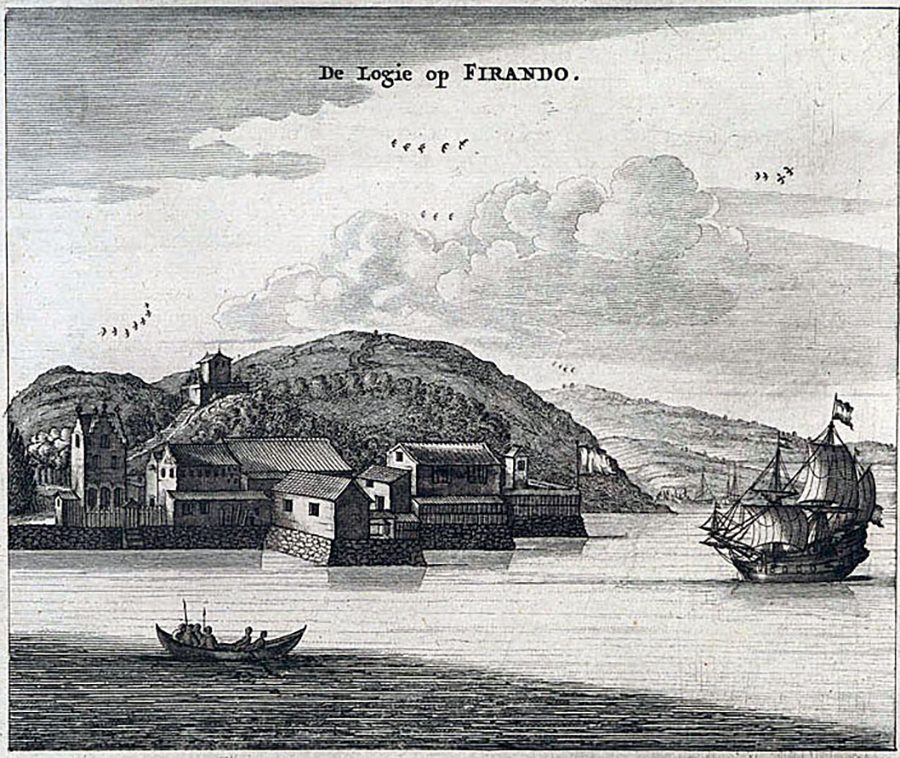
In the spring of 1609, somewhere in the gray waters of the Formosa Channel, a fog rolled in and changed the history of East Asian commerce.
On one side of that fog sat two Dutch warships, the Roode Leeuw met Pijlen and the Griffioen, Red Lion with Arrows and Griffin, cruising in wait for a Portuguese carrack whose cargo was worth more than the annual revenue of several European principalities. On the other side, invisible and oblivious, the carrack herself was slipping northward toward Nagasaki, her hold packed with enough Chinese silk to clothe the entire Japanese aristocracy twice over, her captain battling monsoon winds he had no business sailing against, her hull still groaning from a typhoon that had nearly broken her apart south of Macau.
The fog lifted. The carrack was gone. The Dutch captains checked their charts, consulted their frustration, and turned their ships toward Japan.
The Dutch Fleet That Was Sent to Asia
The Admiral’s Orders
To understand why two Dutch warships were lurking in the Formosa Channel in the first place, you have to understand what the VOC was doing in 1609.
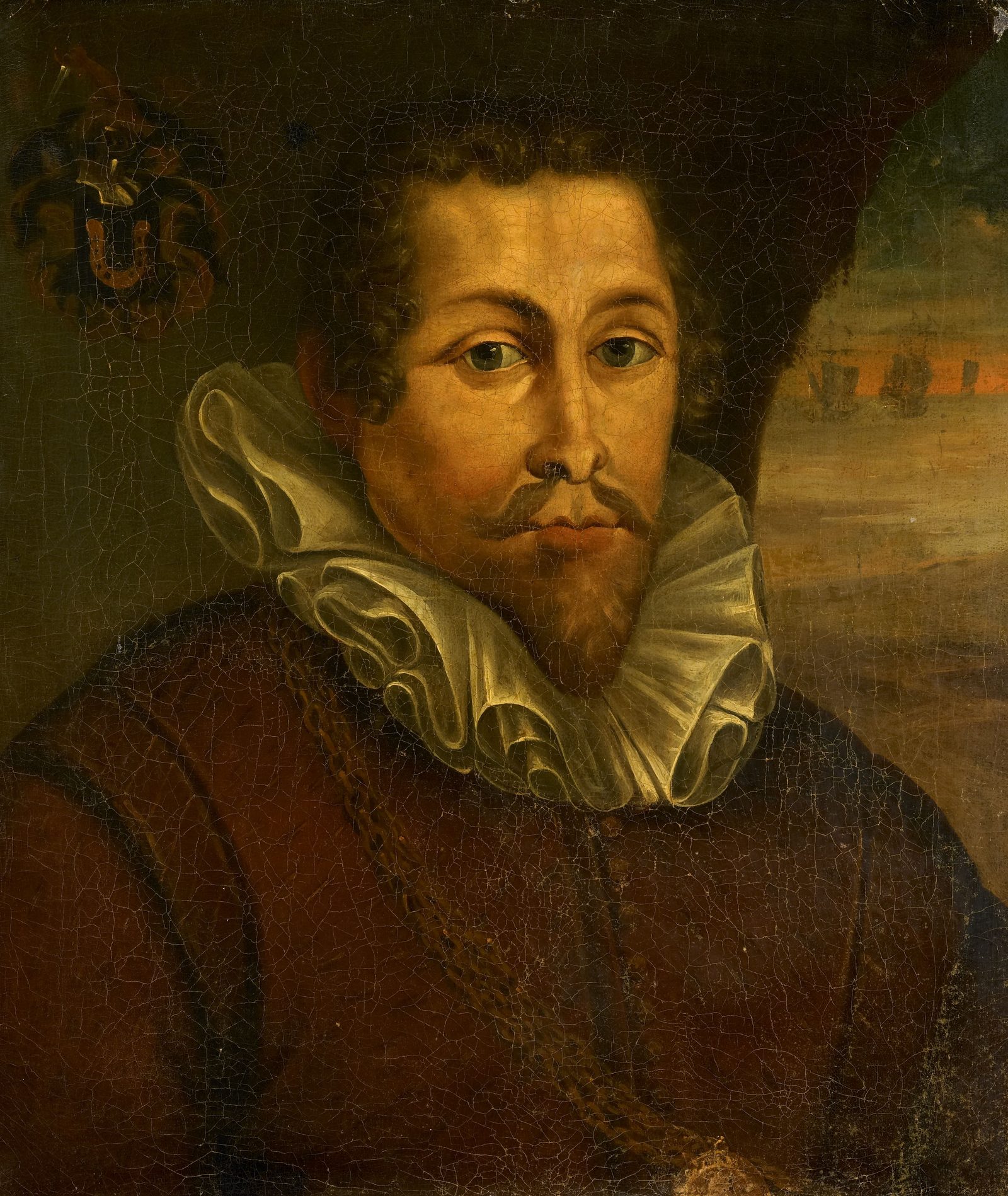
The Vereenigde Oostindische Compagnie was seven years old and already fighting on more fronts than most sovereign nations. Its directors in Amsterdam, the Heeren XVII, had dispatched a massive fleet under Admiral Pieter Willemsz Verhoeff with a set of instructions that read less like a commercial brief and more like the opening moves of a board game played by men who intended to own the board. Verhoeff was to forge an alliance with the Sultan of Johor and capture the Portuguese fortress at Malacca. He was to secure an absolute monopoly over cloves, nutmeg, and mace in the Moluccas and the Banda Islands, “by treaty or by force”, the directors specified, in case anyone mistook the Company for a charity. He was to raid Spanish shipping in the Philippines. And, should any ships prove surplus to these requirements, he was to open commercial relations with Japan.
The fleet’s trajectory through the first half of 1609 was a catalog of ambitions colliding with reality. An assault on the Portuguese fortress at Mozambique in 1608 had failed. The Sultan of Johor, who had recently concluded his own peace with Portugal, received the Dutch proposals with the diplomatic warmth of a man who had no intention of starting another war on someone else’s schedule. Verhoeff abandoned the Malacca plan and sailed for Bantam on Java, where fresh instructions from the Heeren XVII were waiting, instructions that carried a new urgency.
In Europe, Spain and the Dutch Republic were negotiating the Twelve Years’ Truce, a cessation of hostilities in the long, grinding war that had produced the VOC in the first place. The directors understood the truce’s implications with the clarity of men who had built a fortune on wartime trade privileges: any territorial freeze would lock the current map of control across Asia. Whatever the VOC held when the truce took effect, it would keep. Whatever it did not hold, it would have to negotiate for later, at a table, with lawyers, which was precisely the kind of contest the Heeren XVII preferred to avoid. The orders were unambiguous: seize the Banda Islands now. Build fortresses now. Establish facts on the ground before the diplomats in The Hague signed away the Company’s future.
Verhoeff obeyed. He sailed to the Banda archipelago with 900 men in April 1609 and began construction of Fort Nassau on the island of Neira. The Bandanese, who had been watching the Dutch arrive with a hospitality that the sources describe as calculated, invited the admiral and his escort into the forest to negotiate terms. On May 22, they killed him. Verhoeff and roughly 40 of his men were cut down in an ambush that the survivors later described as meticulously planned. The Bandanese had evidently concluded that the best moment to discuss the terms of a Dutch fortress was before it was finished. They were not wrong, but the Dutch, under the command of Simon Janszoon Hoen, completed the fort anyway and violently subdued Neira. The admiral was not coming home, but the spice islands were acquired.
Meanwhile, Vice-Admiral François Wittert’s squadron, detached for operations against the Spanish in the Philippines, sailed into a trap. The Spanish destroyed his fleet off Manila in April 1610. Wittert was killed.
The VOC’s grand fleet of 1609 was accomplishing its objectives, but it was paying for them in admirals.
The Two Ships Sent to Japan in 1609
Two Ships and a Shopping List
Before the disasters at Banda and Manila, Verhoeff had detached two ships for a mission that combined commerce and piracy in the seamless manner that was the VOC’s signature contribution to early modern business practice.
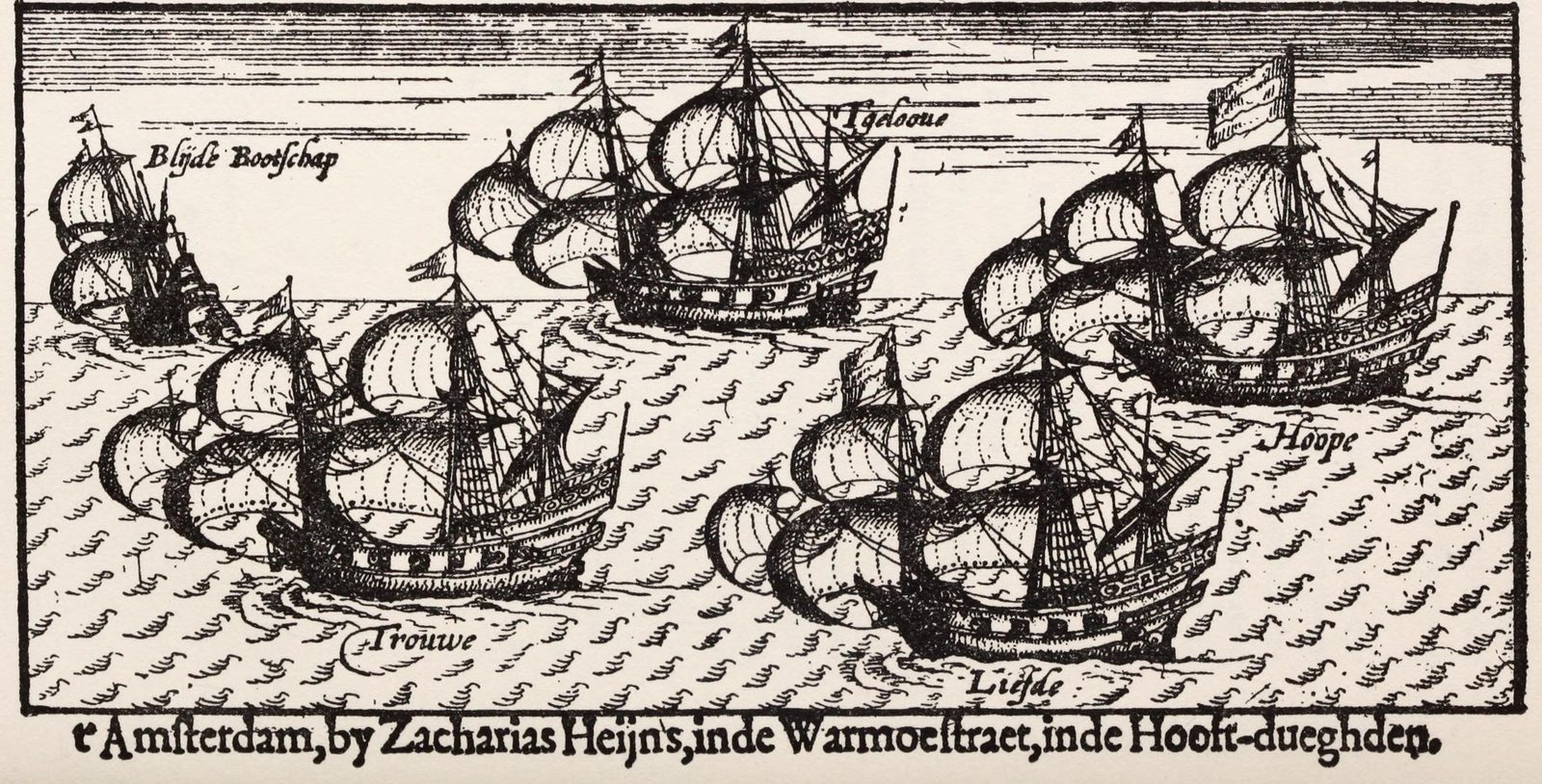
The Roode Leeuw met Pijlen and the Griffioen, under the command of Abraham van den Broeck, were given two orders. The first was to intercept and capture the Madre de Deus, the Portuguese Great Ship of Commerce on the Macau–Nagasaki route. The second, in case the carrack proved elusive, was to proceed to Japan and negotiate a trade agreement.
The mission’s priorities were clear from their sequencing. Prize-taking came first. Diplomacy was the fallback. The VOC was a corporation, and capturing a Portuguese carrack worth 1 million gold cruzados would generate returns that no trade agreement, however generous, could match in a single fiscal year. The Japan mission was important, the Heeren XVII had been eyeing Japan’s silver since the Liefde survivors first reported the islands’ staggering mineral wealth, but it was the consolation prize.
En route, Van den Broeck stopped at Patani on the Malay Peninsula and purchased a small cargo of silk, pepper, and lead. The goods were not intended for profit. They were intended as props, evidence that the Dutch were legitimate merchants should they need to present themselves at a Japanese court rather than dividing up captured Portuguese silk on their own quarterdeck. It was a prudent precaution that doubled as an insurance policy. The VOC always had a plan B.
The Portuguese Carrack the Dutch Hunted
The Richest Ship Afloat
The target was worth the effort.
The Madre de Deus, also known as the Nossa Senhora da Graça, was a colossal India-built carrack of teakwood, commanded by Captain-Major André Pessoa. She was the official nau do trato for 1609, the designated Great Ship of Commerce on the Macau–Nagasaki run, and she was carrying a fortune that made even experienced privateers pause to do the arithmetic.
No official Portuguese trading ship had sailed from Macau to Japan in 1608. The Dutch naval threat in the South China Sea had been sufficient to keep the carrack in port for an entire season, which meant that the merchants of Macau had two years’ worth of accumulated goods waiting for the Japanese market. When the Madre de Deus finally departed, she was carrying the backlog: approximately 3,000 piculs of high-quality Chinese raw silk valued at 600,000 cruzados and assorted goods that brought the total lading to something in excess of 1 million gold crowns. The Dutch factor Jacques Specx, who would shortly become very familiar with Hirado’s harbor, later claimed the ship and cargo were worth 8 million ducats, a figure that may have owed something to hindsight and the natural inflation of missed opportunities.
By any honest estimate, the Madre de Deus was one of the most valuable single vessels afloat in 1609. Her capture would have been the greatest maritime prize since Sir Walter Raleigh’s men had taken the other Madre de Deus off the Azores in 1592, a different ship with the same name, a coincidence the Portuguese naming conventions made inevitable when you recycled the Virgin Mary’s titles across every hull in the fleet.
André Pessoa knew the Dutch were waiting for him. Word had reached Macau from Malacca that enemy ships were cruising the sea lanes. Pessoa did what any captain carrying an irreplaceable cargo would do: he sailed early. The Madre de Deus departed Macau on May 10, 1609, a full six weeks before the usual sailing season, forcing her way against the monsoon winds in a calculated gamble that the Dutch would not expect a departure so far ahead of schedule.
The gamble nearly killed everyone aboard. A typhoon struck the carrack south of Macau and drove her far off course. The ship was battered, her rigging shredded, her crew exhausted. But the storm also pushed her onto a track that the Dutch had not anticipated. And then, as the Madre de Deus entered the Formosa Channel, the narrow strait where Van den Broeck’s cruisers were stationed, the fog descended.
Portuguese sources called it providential. The Dutch, had they been able to see through it, would have called it something else entirely. The carrack passed through the channel in near-zero visibility, invisible to the warships stationed barely a few leagues away. When the fog cleared, Pessoa was through. He reached Nagasaki safely.
The Roode Leeuw met Pijlen and the Griffioen arrived at Hirado in July 1609 to discover, with what must have been exquisite frustration, that the Madre de Deus had docked at Nagasaki just two days before them. A 1-million-crown prize, lost to weather. The kind of margin that keeps merchants awake for years afterward, staring at ceilings and recalculating wind speeds.
The carrack, of course, would not survive the winter. Her spectacular destruction in Nagasaki harbor in January 1610, André Pessoa’s decision to blow up his own ship rather than surrender to a Japanese assault force, would become one of the defining catastrophes of the Nanban era. But all of that lay in the future. In July 1609, the Madre de Deus was intact, her cargo was being unloaded, and the Dutch had nothing to show for months of cruising except a modest cargo of Patani silk, two well-armed warships, and a mandate to make friends.
It was time for Plan B.
Why the Dutch Landed at Hirado, Not Nagasaki
The Lord of Hirado
The port where Van den Broeck dropped anchor was not Nagasaki. It was not even close to being Nagasaki. And that was entirely the point.
Hirado was a small, wind-bitten island off the northwest coast of Kyūshū, separated from the mainland by a narrow strait. It had been a trading port for centuries, Chinese and Korean merchants had frequented its harbor long before the first Portuguese ships appeared, but by 1609, it was decidedly second-tier. The main action in foreign trade had shifted to Nagasaki decades earlier, following the Portuguese decision to concentrate their operations in the deep-water harbor that the Jesuits had helped develop into Asia’s most profitable European trading post. Hirado had been left behind, and its lord, Matsuura Takanobu, was not a man who enjoyed being left behind.
The Matsuura had a complicated history with European commerce. The Portuguese had traded at Hirado between 1550 and 1561, a period that ended badly, Christian converts had destroyed Buddhist temples, Takanobu’s great-grandfather and namesake had expelled the Jesuits, and the Portuguese had relocated their operations southward. By 1565, the elder Takanobu was sufficiently irritated to send a naval flotilla to attack the Portuguese at their new anchorage at Fukuda. He lost. The Portuguese ended up at Nagasaki. The Matsuura ended up nursing a grudge and an empty harbor.
But Matsuura was also a pragmatist. If the Portuguese would not come to Hirado, he would find someone who would. The arrival of two Dutch warships, Protestant, anti-Portuguese, and conspicuously well-armed, was precisely the kind of opportunity a marginalized daimyō dreams about. Matsuura welcomed the Dutch with an enthusiasm that went well beyond ordinary hospitality. He offered them harbor facilities, provisions, and the kind of political support that only a local lord with something to prove could provide. For Matsuura, the Dutch were not just traders. They were leverage, against Nagasaki, against the Portuguese, against his own irrelevance.
The relationship would prove durable. Hirado would remain the seat of the Dutch factory for the next 30 years, until the shogunate relocated it to Deshima in 1641. Matsuura had gambled that the future of European trade in Japan lay with the Protestants, not the Catholics. It was one of the better bets of the 17th century.
The Journey to Ieyasu at Sunpu
The Road to Sunpu
Van den Broeck and his fellow merchant, Nicolaes Puyck, understood that a warm reception from a minor daimyō was encouraging but insufficient. Trade privileges in Japan were not granted by local lords. They were granted by the man who controlled the country, and in 1609, that man was Tokugawa Ieyasu.
Ieyasu had officially retired from the position of shōgun in 1605, passing the title to his son Hidetada. The retirement was a fiction that deceived absolutely no one. Ieyasu had relocated to Sunpu Castle, present-day Shizuoka, from where he continued to exercise effective control over foreign policy, commerce, and anything else that interested him, which was nearly everything. Hidetada handled the administrative machinery of government from Edo. Ieyasu handled power.
The Dutch envoys set out for Sunpu with guides, interpreters, and a degree of cautious optimism. Their optimism was grounded in something more substantial than hope: they knew, from intelligence gathered at Patani and from the Liefde survivors who had preceded them, that Ieyasu had already expressed interest in Dutch trade. The question was not whether Ieyasu would receive them. It was what terms he would offer.
Two men ensured that the terms would be generous.
The Interpreters Who Made It Possible
The Translators
Melchior van Santvoort had been in Japan for nine years. He had arrived in 1600 as a clerk or purser aboard the Liefde, the shattered Dutch vessel whose extraordinary odyssey and the role of its English pilot, William Adams, are told elsewhere on this site. Van Santvoort had survived the voyage, survived the Jesuit lobbying campaign that nearly had the Liefde’s crew executed as pirates, and survived nine years of life in a country whose language, customs, and political dynamics he had been forced to learn from scratch.
In 1605, Ieyasu had permitted Van Santvoort and Jacob Quaeckernaeck, the Liefde’s former captain, to leave Japan. They sailed to the VOC trading post at Patani on a junk provided by Matsuura Shigenobu himself, carrying an official pass from Ieyasu and what amounted to a standing invitation: the Dutch were welcome to trade. The invitation had taken four years to act upon, the VOC had been occupied with wars, sieges, and the ongoing project of dismantling the Portuguese commercial empire across Southeast Asia, but in 1609, the Company had finally sent its ships. Van Santvoort was waiting at Hirado when they arrived. He served as the primary interpreter and guide for the envoys’ journey to Sunpu, translating not just language but protocol, the elaborate rituals of Japanese diplomatic reception that could make or break a foreign mission before the first word of business was spoken.
William Adams, the English pilot who had become Ieyasu’s most trusted foreign advisor, played a different but equally decisive role. Adams had spent nine years building a relationship with Ieyasu that went far beyond commercial intermediation. He had been granted an estate at Hemi, elevated to the rank of hatamoto, a direct vassal of the shōgun, and served as a combination of naval advisor, shipbuilder, and unofficial foreign minister. When the Liefde had first arrived, Portuguese and Spanish Jesuits had lobbied Ieyasu aggressively to execute the Protestant crew as heretics and pirates. Adams had defended himself and his crewmates through extensive personal interrogations with Ieyasu, in the process exposing the political and religious fault lines of Europe, information that fundamentally altered how Ieyasu understood the European presence in his waters.
Adams narrowly missed the initial 1609 Dutch envoys on their way to court, a logistical mishap in a country where a journey of several hundred kilometers could take weeks. But his prior advocacy had laid the groundwork so thoroughly that his physical absence barely mattered. Ieyasu already knew what the Dutch were, what they wanted, and why they were different from the Portuguese. Adams had spent nearly a decade making that case. The envoys were walking through a door that Adams had spent years building.
His direct contributions would come later. During a crucial 1611 VOC mission led by Jacques Specx, Adams served as official interpreter and chief negotiator, defending the Dutch against renewed Spanish accusations of piracy and negotiating directly with senior Tokugawa officials, including Honda Masazumi, to secure unprecedented trade privileges, including exemption from the itowappu silk-pricing system that constrained Portuguese margins. Adams’s advocacy, sustained over more than a decade, was the diplomatic infrastructure on which the entire Dutch commercial presence in Japan was built.
The Red-Seal Patent Ieyasu Granted the Dutch
The Red Seal
At Sunpu, the Portuguese threw everything they had at the Dutch.
Portuguese envoys at Ieyasu’s court denounced the newcomers as pirates, rebels against their lawful sovereign, and, the perennial favorite, heretics whose presence would bring disorder and misfortune to Japan. It was the same playbook the Jesuits had used against the Liefde’s crew in 1600, and it failed for the same reason: Ieyasu did not care about European religious quarrels, and he did not care about European political allegiances. He cared about trade, about the revenue it generated, and about maintaining leverage over every foreign power that wanted access to Japanese markets.
The Dutch presented a diplomatic letter from Prince Maurice of Nassau, the stadhouder of the Dutch Republic and a figure whose Protestant credentials were, from Ieyasu’s perspective, refreshingly uncomplicated. Ieyasu accepted the letter, received the envoys with courtesy, and granted the VOC a document that would underpin Dutch trade in Japan for the next two centuries.
The shuinjō, literally “vermilion seal document”, was a formal passport stamped with the personal red seal of the shōgun. Its purpose was to officially license and authorize commercial voyages, placing the bearer under the direct protection of the Japanese government and distinguishing legitimate, state-sanctioned merchants from wakō, the pirates and smugglers who had plagued East Asian waters for centuries. Japanese merchant vessels operating under such patents were known as shuinsen, red-seal ships, and the system had been in operation for years as Ieyasu’s mechanism for controlling and taxing overseas trade.
The patent granted to the Dutch was extraordinary in its scope. It authorized VOC ships to enter any Japanese port without restriction, to trade freely, and to establish a permanent commercial factory. Ieyasu issued it in duplicate, a standard bureaucratic practice that ensured the VOC would have a spare if one copy was lost at sea, which, given the distances involved, was not an unreasonable precaution.
The breadth of the shuinjō’s terms was a calculated political act. Ieyasu was not being generous out of fondness for the Dutch. He was building a counterweight. The Portuguese had enjoyed a near-monopoly on European trade with Japan for 60 years, and monopolies made Ieyasu nervous, because a sole supplier had leverage that a ruler with multiple trading partners did not. The Dutch arrival gave Ieyasu options. If the Portuguese became difficult, there were now Protestants in the harbor who would happily supply Chinese silk without attaching a single Jesuit to the cargo.
The shuinjō secured with the help of the stranded Liefde mariners formed the foundational legal basis for what would become a centuries-long Dutch presence in Japan. It was, in retrospect, worth considerably more than a captured carrack.
The Dutch Factory at Hirado, 1609
The Factory
Armed with Ieyasu’s patent, the Dutch formally established their trading factory at Hirado. It was not an impressive operation. When the Roode Leeuw met Pijlen and the Griffioen departed in October 1609, they left behind a skeleton staff: Jacques Specx, three assistants, a boy, and the modest cargo of silk, pepper, and lead that Van den Broeck had purchased at Patani as his diplomatic cover story.
Specx was young, ambitious, and possessed of the kind of commercial instinct that the VOC cultivated in its junior officers the way the Jesuits cultivated devotion in their novices. He would go on to become one of the central figures in Dutch–Japanese relations over the following decade, leading subsequent diplomatic missions to the Tokugawa court and overseeing the factory’s growth from a lonely trading post into a profitable node in the Company’s pan-Asian network. His subsequent 1611 mission, with Adams as his interpreter, would secure the trade exemptions that gave the Dutch a structural advantage over the Portuguese.
The Hirado factory’s early years were modest. The Dutch had silk to sell but not yet the supply chain to compete with the Portuguese nau do trato, which continued to deliver shiploads of Chinese silk from Macau to Nagasaki on an annual cycle. The VOC’s competitive advantage would develop gradually, as the Company built its trading network across Southeast Asia, eventually routing Chinese silk through its fortress on Taiwan and its headquarters at Batavia, and as the Tokugawa shogunate’s increasing hostility toward Catholicism systematically dismantled the Portuguese position.
But the shuinjō was the seed. Everything that followed, the 30 years at Hirado, the relocation to Deshima, the two centuries of Dutch monopoly over European trade with Japan, the scientific and intellectual exchange that kept a window onto Europe open during Japan’s long seclusion, grew from the document that Ieyasu stamped with his vermilion seal in the late summer of 1609, in a castle in Sunpu, on the recommendation of a shipwrecked English pilot and the testimony of two Dutch merchants who had come to steal a carrack and stayed to sign a contract.
Sources & Further Reading
Boxer, C.R. The Great Ship from Amacon: Annals of Macao and the Old Japan Trade, 1555–1640. Centro de Estudos Históricos Ultramarinos, 1959. The definitive English-language account of the Macau–Nagasaki carrack trade, with detailed coverage of the Madre de Deus and the Dutch pursuit.
Boxer, C.R. The Christian Century in Japan, 1549–1650. University of California Press, 1951. Essential context for the Portuguese–Dutch rivalry in Japan and its political consequences.
Clulow, Adam. The Company and the Shogun: The Dutch Encounter with Tokugawa Japan. Columbia University Press, 2014. The most thorough modern study of VOC–Tokugawa relations, including the 1609 trade negotiations.
Clulow, Adam. “The Art of Claiming: Possession and Resistance in Early Modern Asia.” American Historical Review 121, no. 1 (2016): 17–38. Analysis of VOC territorial strategies that contextualizes the Hirado factory.
Goodman, Grant K. Japan and the Dutch, 1600–1853. Curzon Press, 2000. A survey of the entire Dutch–Japanese relationship, with attention to its diplomatic and commercial foundations.
Laver, Michael S. The Sakoku Edicts and the Politics of Tokugawa Hegemony. Cambria Press, 2011. Important context for understanding Ieyasu’s trade policy and the red-seal system.
Massarella, Derek. A World Elsewhere: Europe’s Encounter with Japan in the Sixteenth and Seventeenth Centuries. Yale University Press, 1990. A broad comparative study that situates the Dutch arrival within the wider European competition for Japanese trade.
Milton, Giles. Samurai William: The Adventurer Who Unlocked Japan. Hodder & Stoughton, 2002. A popular account of William Adams’s life that covers the 1609 Dutch arrival from Adams’s perspective.
Nagazumi, Yōko. Tōsen yushutsunyū-hin sūryō ichiran, 1637–1833. Sōbunsha, 1987. Statistical data on Chinese junk trade volumes at Nagasaki.
Wills, John E., Jr. “Maritime Asia, 1500–1800: The Interactive Emergence of European Domination.” American Historical Review 98, no. 1 (1993): 83–105. Excellent overview of the competitive dynamics among European and Asian maritime powers.
Cite this page
Nanban.pt. “Red Lion, Red Seal: The Dutch Arrival at Hirado in 1609.” Last modified 25 September 2026. https://nanban.pt/articles/dutch-arrival-hirado-1609/.
@misc{nanban-dutch-arrival-hirado-1609,
  author = {Nanban.pt},
  title = {Red Lion, Red Seal: The Dutch Arrival at Hirado in 1609},
  year = {2026},
  url = "https://nanban.pt/articles/dutch-arrival-hirado-1609/",
  note = {Last modified 2026-09-25}
}