The Line on Nishizaka: The Twenty-Six Martyrs of Japan, 5 February 1597
A Spanish galleon broken on a sandbank in Tosa, a pilot with a world map and a careless answer, a police commissioner who quietly cut a death list from 170 names down to 15, and a winter road 900 kilometers long: the first state execution of Christians in Japanese history was an act of bookkeeping that Europe spent three centuries turning into an icon.
The Twenty-Six Martyrs of Japan were executed by lance on Nishizaka hill outside Nagasaki on 5 February 1597, on the orders of Toyotomi Hideyoshi. The group comprised six Franciscans, three Japanese Jesuits and 17 Japanese laymen including three children, and their deaths marked the first state-sanctioned mass execution of Christians in Japanese history.
The Sandbank at Urado
The Wreck of the San Felipe in Tosa, October 1596
On 19 October 1596 a Spanish galleon with no rudder and one mast fewer than she had started with came in sight of Tosa, on the southern shore of Shikoku. She was the San Felipe, Captain-General Matías de Landecho, out of Manila and bound for Acapulco with a cargo that Jesuit and Spanish accounts alike valued at a million and a half silver pesos, though the surviving goods were reckoned at 600,000 crowns, the rest having gone over the side in the storms. The era name changed eight days after she arrived, which is why the wreck sits at the seam of two calendars.
The local lord, Chōsokabe Motochika, was hospitable in the way that lords are hospitable to treasure. He insisted the galleon come into the harbor of Urado to refit, and sent 200 armed boats to tow her in. On 20 October, under tow, she was run onto a sandbank and broke her back.
Whether that was seamanship or policy, the sources do not say. Motochika took the cargo into custody and sent a courier to the capital recommending that the regent confiscate it. Under Japanese strand-law, shōri, a vessel driven ashore and everything in her belonged to the authority on whose coast she grounded. A ship had come apart on a Japanese beach, and Japanese law said the contents were Japanese.
Toyotomi Hideyoshi, taikō and de facto ruler of Japan, agreed at once. Four years of war in Korea had consumed a treasury, and the Fushimi earthquake of that same year had knocked down a good part of what the war had not already spent. A cargo worth more than 1 million pesos, lying on a beach, legally forfeit, arrived exactly when a 60-year-old ruler needed it.
On 27 October 1596 the confiscation order was issued by Mashita Nagamori, one of the five bugyō, commissioners of the central administration, and chief of police. He reached Urado on 12 November, supervised the seizure, and loaded the goods onto 150 barges for Kyoto. He also copied the ship’s navigational chart, questioned the crew about the King of Spain and his war with England, and took the African slaves aboard for Hideyoshi’s personal service.
That date matters more than anything else in the story, because everything written since about the destruction of the mission in Japan rests on a conversation that happened after it.
The Man Who Showed Him the Map
The Three Versions of the Pilot’s Answer at Urado
The ship’s pilot-major appears in the record as Francisco de Olandia and as Francisco de Landia, and the historiography has never resolved which was his actual name. During the interrogations at Urado he produced a world map and showed the commissioner how much of it belonged to the King of Spain.
Nagamori asked how one monarch had come to own so much.
Three versions of the answer survive, and each is shaped like the interest of whoever recorded it. The standard chronicle version, the one that entered every European history for 300 years, has the pilot saying that the King of Spain first sends the religious to preach and then sends the army to make war and conquest. The sworn version is milder and more damning for being milder: the navigation officer Juan Lorenzo de Silva deposed under oath that when the Japanese asked how Spain had obtained Mexico, Peru and the Philippines, a Spaniard aboard replied that the king first sent the monks of all orders to propagate the gospel, and when the people converted, the Spaniards advanced to take over the countries. A third version, in the Jesuit letters compiled by Pedro Morejón, has him simply boasting to frighten his hosts.
The Franciscans, who had every reason to defend the pilot and none to defend the commissioner, made the chronological argument first, and it has never been refuted. Fray Juan Pobre de Zamora, who was aboard the San Felipe, and Captain Landecho, who commanded her, both pointed out that the confiscation had been ordered on 27 October, weeks before Nagamori ever spoke to the pilot. The espionage narrative, on their reading, was a justification manufactured afterward by a commissioner who was also soliciting bribes, to explain to Manila why a friendly power had taken 1 million pesos off a beach.
They were almost certainly right about the sequence and almost certainly wrong to think the sequence settled anything. Crew members admitted under oath that provocative statements about the geopolitical function of missionaries had in fact been made. Whether or not the pilot said the sentence attributed to him, the idea had reached the top of the Toyotomi administration and was being handled there as a matter of national security.
The salvage was legal. The story about the friars was for Manila. What the story cost was decided in December.
The Loophole in the Gray Habit
Why the Franciscans Preached Openly Against the 1587 Edict
For nine years Japanese law had said one thing about Christianity and Japanese practice had done another.
On 24 July 1587, immediately after subduing Kyūshū, Hideyoshi had issued the Bateren Tsuihōrei, condemning Christianity as a pernicious doctrine and ordering every foreign priest out of the country within 20 days. The grounds set out the day before were the destruction of shrines and temples by converts, the forced conversion of whole domains by Christian daimyō, the Portuguese trade in Japanese men, women and children, and the suspicion that a faith owing loyalty to a foreign pontiff dissolved the bond between vassal and lord. The reasoning was coherent, the deadline was specific, and the edict was then left to sit.
Enforcing it would have been expensive. Hideyoshi wanted the raw Chinese silk and the weapons that came on the Portuguese carracks, and exempted the Portuguese merchants by name. The Jesuits were the indispensable brokers of that trade, and local governors warned in writing that if the priests were handled roughly the ships would stop coming. The Society went quiet, moved its seminaries to Arima and Amakusa, and sent home exactly three men out of more than 100.
So the mission grew under a standing sentence of death, to roughly 300,000 Christians by 1596, some 65,000 of them baptized after the edict that supposedly ended it. Everyone understood that this was an arrangement. The priests pretended to be gone, the government pretended to believe them, and the silk arrived on schedule.
Then the Franciscans walked into Kyoto and began ringing bells.
They had reached Japan in the summer of 1593 not as missionaries but as diplomats, which was the entire point. Governor Gómez Pérez Dasmariñas of the Philippines, answering a letter in which Hideyoshi demanded that Manila submit as a tributary vassal, played for time by sending an embassy headed by Fray Pedro Bautista Blázquez of the Order of Friars Minor. Entering as accredited secular ambassadors, the friars stepped over two obstacles at once: the expulsion edict, which applied to priests, and Gregory XIII’s brief Ex pastorali officio of 28 January 1585, which had declared Japan an exclusive Jesuit preserve under the Portuguese padroado. That brief was Alessandro Valignano’s project, and it held the field alone for not quite two years, because in November 1586 Sixtus V, a former Franciscan, permitted his old order to found houses throughout the East Indies.
The friars took Hideyoshi’s permission to reside at face value. They opened a convent in Osaka, built the church of Santa María in Kyoto in 1594, wore their gray habits in public, preached in the street, said Mass con voz alta, with the doors open and the bells audible, and founded hospices for lepers. The Jesuits, saying Mass behind locked doors in Japanese secular dress, warned them to be discreet, and so did the local officials. The friars believed the Jesuits had gone native to protect a monopoly. The Jesuits believed the friars were going to get everybody killed.
On 7 December 1596 Mashita Nagamori returned to Fushimi, reported on the San Felipe, and added that the barefooted friars had been openly violating the edict for three years.
Eight Days in December
The Arrests of December 1596 and the Order of Execution
Hideyoshi issued the arrest order orally that same evening. The written command went out the following day to Ishida Mitsunari, minister of criminal affairs and governor of Lower Kyoto, who appears in European sources as Gibunosci, a mangling of his title Jibu-no-shō. Armed guards surrounded the Franciscan and Jesuit residences in Kyoto and Osaka.
In Kyoto the soldiers raided the convent Pedro Bautista had founded in 1593 and the hospital beside it, taking three friars with their Japanese assistants, cooks and neophytes. In Osaka they took three more Franciscans, and then, because the house next door also contained men in religious dress and the warrant did not distinguish between orders, they arrested three Japanese from the Jesuit residence: the Jesuit brother Paulo Miki and the catechists João de Gotó and Diogo Kisai. The bugyō worked out the error soon enough, and Hideyoshi is reported to have wished the Jesuits released, but the names were on a roll by then and no official was willing to be the man who took them off.
Three men died because a search party could not tell one kind of religious habit from another.
The officials handling the operation were not enthusiasts, which turns out to be the most consequential fact in the affair. Maeda Gen’i, governor of Kyoto and minister of worship, whose two sons were close to the Jesuit Father Organtino Gnecchi-Soldo, went to Hideyoshi personally to plead for the Christians; he failed on the main point and succeeded on a smaller one, shielding several Jesuits from the dragnet. Ishida Mitsunari, no friend of Christianity and a man who would spend his last years on the losing side of a larger question, obstructed his own commission with a persistence visible in the numbers.
The original roll listed 170 people who had frequented the Franciscan churches of Kyoto and Osaka. Mitsunari cut it to 47. As Hideyoshi left Fushimi for Osaka, he cut it again, to 15 Japanese neophytes. With six Franciscans and the three misidentified Jesuits, that made 24.
Against him stood Yakuin Zensō, Hideyoshi’s physician, known in the European sources as Jacuin, who pressed steadily for execution and got it. On 29 or 30 December 1596, the sources differ by a day and the discrepancy has never been resolved, Hideyoshi issued the written sentence against the barefooted friars and their neophytes, ordering that their noses and both ears be cut off before they were paraded. The placard to be carried before them bore the date of the 20th day of the 11th moon of the first year of Keichō, which converts to 31 December 1596.
Two transcriptions of that placard survive, one made for Bishop Pedro Martins, one recorded by the Spanish merchant Bernardino de Ávila Girón, and they agree on the substance. These men had come from Luzon calling themselves ambassadors and had remained in Miyako preaching a prohibited law; they and those who had accepted it were to be crucified at Nagasaki and left raised on the crosses so that no one should remove them; and anyone who preached or practiced this law hereafter would be executed with his entire family, even if only one person offended.
It was, in the strict sense, a public notice of a change in policy. The 24 were the notice.
A Portion of the Left Ear
The Mutilation at Kyoto and the Parade Through Osaka and Sakai
On 1 January 1597 the three Jesuits and the other Osaka prisoners were moved to the public prison in Kyoto and joined the Franciscans. At daybreak on 3 January they were taken to Ichinotsuji, the Ichijō crossroads near the Kamigata bridge, where the sentence was read aloud and carried out.
Hideyoshi had ordered noses and both ears. What the executioners removed, on Ishida Mitsunari’s authority, was a portion of a single ear.
Which ear became, over the following century, a minor front in a much larger war. The Jesuit eyewitnesses and the earliest Japanese documents all specify the left lobe; the Spanish and Franciscan versions, and the Manila and European printings that followed them, say the right. Modern scholarship has settled on the left, and on the further point that the accounts which added nose amputation and eye-gouging were describing the sentence as written rather than as performed, or were selling pamphlets. The European broadsheet trade of the 1590s did not reward restraint.
24 people with their hands bound behind them and one ear partly severed were then loaded into eight ox-carts, three to a cart, and driven through Upper and Lower Kyoto, behind a placard mounted on a spear announcing in Chinese characters that they were to die for preaching an outlawed foreign religion. Between 4 and 8 January the procession was repeated through Osaka and Sakai.
The Japanese records are startling for how little they say. Five contemporary diaries register the affair, among them the Tokitsugu kyō ki, kept by a Kyoto courtier, and the Gien jugō nikki, kept by a Buddhist monk. All note the transit, the ear-cutting and the crucifixions, and none offers a word of moral or ideological comment. To the men who kept Japan’s official memory this was a police matter that had been handled, and the handling had been noted.
The mutilation was performed at a crossroads in daylight rather than quietly in a prison yard because Japanese practice reserved public execution and public shaming for crimes against the state. Ordinary criminals were killed out of sight, behind walls. The choice of venue was itself a legal statement, addressed to everyone who could read.
It would be repeated, at greater length, along 900 kilometers of winter road.
The Road from Sakai
The Winter March from Sakai to Nagasaki, January 1597
The column left Sakai on 9 January 1597 and reached the outskirts of Nagasaki on 4 February. The distance is given in the modern literature as close to 900 kilometers; Fróis offered only a round figure of his own. What the sources preserve is the weather. It was the depth of winter, the prisoners went through snow, and in places they went barefoot.
On 16 January, at Katakami in Bizen, they wrote to the Jesuit vice-provincial asking to receive the sacraments before they died. On 31 January they reached Hakata after a sea crossing from Shigajima, and on 1 February, at Karatsu in Hizen, Terazawa Hanzaburō took charge of the final stage. He was the younger brother and deputy of the governor of Nagasaki, who was in Korea, and appears in the Portuguese sources as Fonzanbrandono.
Somewhere on that road the number went from 24 to 26.
Pedro Sukejirō was a lay Jesuit helper whom Father Organtino had sent to shadow the column and pass money and food to the prisoners. The guards caught him doing it and added him to the line. Francisco Kichi was a Kyoto carpenter who had helped build the Franciscan churches and who followed the friars out of attachment, baptized eight months earlier. The escort arrested him as well. Neither man was on any list. Both were on the hill.
They were not the only ones who chose it. Among the 15 Japanese condemned in Kyoto was a man remembered only as Matthias, who appears on no arrest roll anywhere. The soldiers had come to the convent looking for a different Matthias and could not find him. This man stepped forward, offered himself in the missing man’s place, and was taken. Scholarship has never established his surname, his age, his trade or his origin. The record preserves the gesture and loses the man.
The families are easier to trace. Michael Kozaki, 46, a bow-and-arrow maker from Ise who had helped build the churches in Kyoto and Osaka, walked with his son Thomas, 14, an acolyte. From the road Thomas wrote a farewell letter to his mother, telling her not to grieve and explaining, with the precision of a boy who had learned his catechism thoroughly, that his sins would be forgiven through contrition even without a priest to absolve him. Paul Ibaraki, a former samurai turned sake brewer who lived in poverty beside the Kyoto convent, walked with his younger brother Leo Karasumaru, once a Buddhist monk and by then steward of the Franciscan hospital, and with his 12-year-old nephew Louis.
Terazawa Hanzaburō, who had a schedule to keep and a hill to prepare, spent part of the final week trying to persuade the three children to recant. He was, by the accounts of men who watched him, personally distressed, and particularly by Louis. He got nowhere.
On 4 February the column reached Sonogi, about 22 miles from Nagasaki, at noon, crossed the bay to Tokitsu, and went on to Urakami. At Sonogi the Portuguese interpreter João Rodrigues Tçuzzu and Father Francisco Pasio met the prisoners, together with Murayama Tōan, the Christian administrator of Nagasaki. Rodrigues obtained brief access, spoke with Paul Miki and with the friars, and carried between the two orders an exchange of consolation and mutual forgiveness that neither order’s headquarters would honor for 30 years. Hanzaburō let Pasio hear the final confessions of the three, receive Gotó and Kisai into the Society, and ordered every Jesuit but Pasio and Rodrigues to stay away, on the grounds that the city might rise.
The prisoners were refused entry to Nagasaki and refused Communion. They spent their last night in small boats off the coast, in February, on the water.
The Carpentry of the Thing
How the Japanese Crosses at Nishizaka Were Built
The site was chosen for crowd control. Hanzaburō expected trouble from a heavily Christian city that also contained Portuguese merchants with opinions, so he moved the execution off the common criminal ground and onto Nishizaka, written 西坂, the western slope, also called Tateyama, a hill overlooking the bay. The concession was aimed at the Portuguese, and it produced a natural amphitheater.
The crosses were prepared inside a fenced enclosure, set in a single line at intervals of three to four paces, all facing the city. They were not the Roman instrument. Each had a vertical timber and two crossbars, an upper and longer one for the arms spread wide, a lower and shorter one for the feet set apart, and midway up the post a small peg on which the condemned man sat astride, taking his own weight.
No nails were used. The martyrs were secured with iron manacles, staples and collars, hammered into the wood and closed around the neck, the wrists and the ankles, with thick cord binding the rest of the body. They were fixed to the timbers while the crosses lay flat on the ground, and then the whole line was raised together and dropped into holes dug in advance. A crucifixion of this type was not designed to kill by exposure over days but to hold a body upright, immobile and conscious, until a lance could reach it. The apparatus was a display stand.
The arrangement of the 26 along that line is the best-corroborated detail in the whole affair, which is a strange thing to say about an event on which the two orders agreed about almost nothing. Fróis, writing five weeks later, enumerated the crosses outward from the center in both directions; other traditions numbered them straight down the line from one end. The two schemes reconcile position for position without a single conflict.
At one end, on the first cross, stood Francisco Kichi, the carpenter arrested on the road. At the other end, on the 26th, stood Paul Suzuki, 49, warden of St Joseph’s hospital in Kyoto. At the center, on the 11th, stood Pedro Bautista Blázquez, 48, of San Esteban del Valle in Ávila, doctor of philosophy and theology, 15 years in Mexico and the Philippines, commissary of the Franciscans in Japan and the ambassador who had walked through the loophole in 1593. The canonization bull of 1862 styles him Bishop of Ávila, which he never was; a Roman scribe at three removes from Nagasaki had converted his birthplace into a see.
10 crosses stood to one side of him and 15 to the other, and the six Europeans and colonials occupied a single contiguous block, positions 11 to 16: Martín de la Ascensión of Vergara, barely six months in the country; Felipe de Jesús of Mexico City, 24, a passenger off the San Felipe; Gonçalo García, 40, born at Bassein in Portuguese India to a Portuguese father and an Indian mother, who spoke the best Japanese of the six; Francisco Blanco of Monterrey; and Francisco de San Miguel of La Parrilla.
The three Jesuits and the three children stood among the Japanese, down the line. Diogo Kisai, 64, doorkeeper of the Osaka residence, was on the fifth cross; Paulo Miki, 33, son of a samurai commander and the most accomplished preacher in the group, on the sixth; João de Gotó, 19, on the eighth. Louis Ibaraki, 12, was on the ninth, Anthony of Nagasaki, 13, born of a Chinese father and a Japanese mother, on the 10th, and Thomas Kozaki, 14, on the 20th, some way down the line from his father on the fourth.
Ten in the Morning
The Execution of 5 February 1597 and Who Stood Where
It was a Wednesday. The juridical examinations Bishop Pedro Martins conducted shortly afterward, collecting the sworn testimony of eyewitnesses including 22 Portuguese laymen, establish the hour at about ten in the morning. Later literary reconstructions preferred sunset, which is better lighting, and the sources that offer it are not eyewitness sources.
The crowd is harder. The earliest Jesuit reports give 4,000 to 5,000. Within a generation the figure had climbed to 30,000, and by the 19th century to 150,000, which is more people than Nagasaki contained. The growth of the number follows the growth of the cult rather than any new evidence.
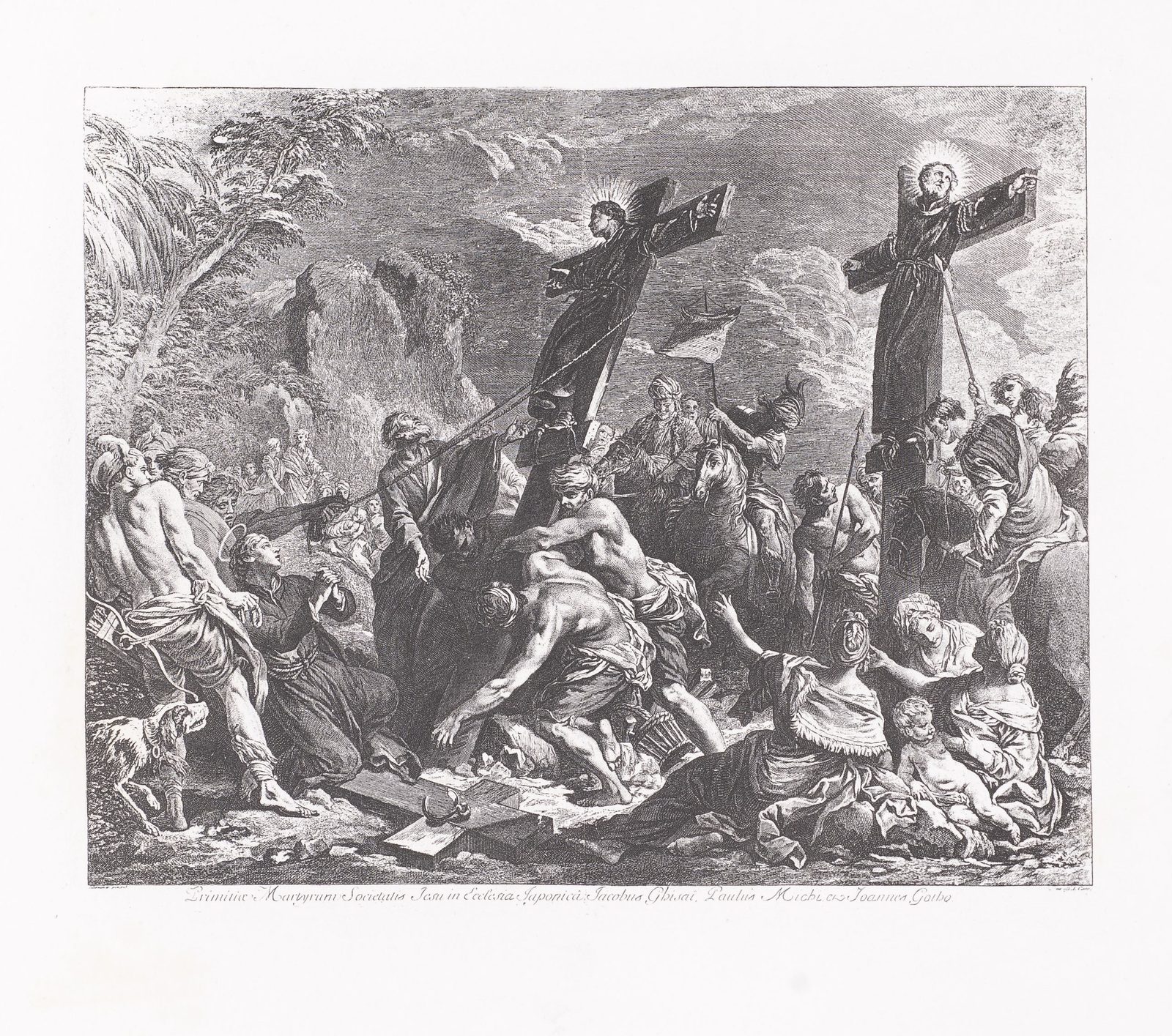
A guard of soldiers held the crowd back from the fence. Two executioners, or by some accounts two pairs, were assigned to each cross. On the command of the presiding judge they closed from both sides with long iron lances and thrust simultaneously. The lances entered at the right side of the chest, passed diagonally upward through the heart, and came out above the left shoulder. The crossed-spear method produced immediate and massive hemorrhage. It killed as quickly as the technology allowed, which was the point of it.
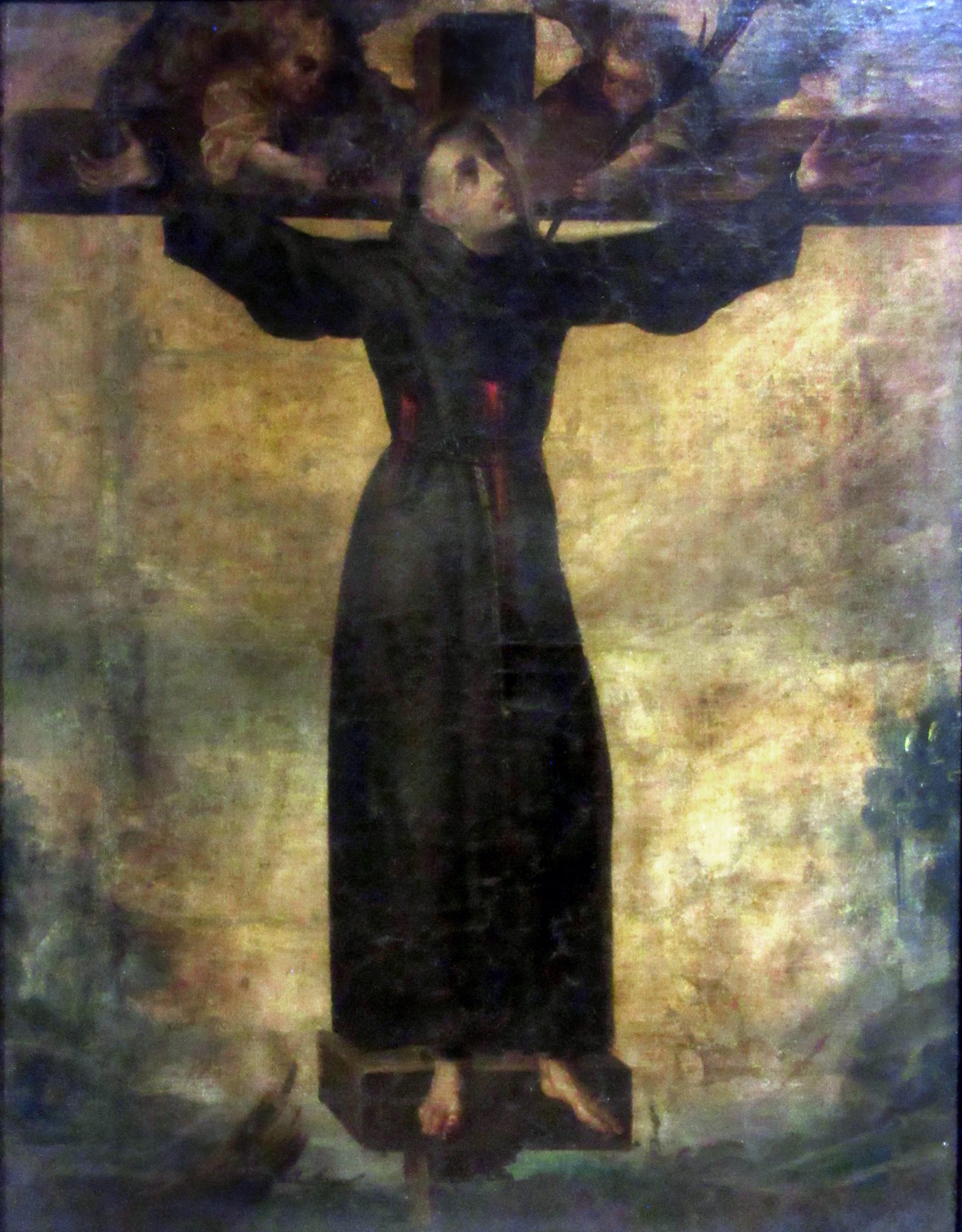
Felipe de Jesús was the first to die. He had boarded the San Felipe at Manila as a passenger going home to Mexico to be ordained, and the storm that carried the ship to Tosa carried him to Nishizaka. He became the first Mexican-born saint, which is why the largest painted cycle of the martyrdom anywhere in the world is on the walls of a Franciscan church at Cuernavaca.
Paul Miki had preached from the ox-cart during the parade and he preached from the cross, taking turns with Pedro Bautista. He declared his joy at dying for the Gospel, publicly forgave his executioners and forgave Hideyoshi by name, and called out to the Christians below to hold firm, telling them to watch closely this splendid scene for the sake of the greatest glory of the Lord in heaven. The general histories give fragments; the fuller text survives in the Jesuit archival codex JapSin 52, which is not a document most of the people who quote Paul Miki have read.
The three children sang. What they sang was Laudate pueri Dominum, the psalm that begins by calling on children to praise the Lord, which they had learned as choirboys in the houses where they served. Louis Ibaraki had laughed when they cut his ear at Ichinotsuji, according to men standing near enough to see it, and he had sung on the road, and he had turned down Terazawa Hanzaburō’s private appeals to save himself.
Pedro Bautista used his last strength to speak to João Rodrigues and Captain Francisco Paez, thanking them for being there and asking formal mutual forgiveness for the quarrels, theological and national, between the Franciscans and the Society of Jesus. Rodrigues carried the message back down the hill, where it accomplished nothing whatsoever.
Bishop Pedro Martins had been forbidden to attend. He watched the entire execution from a window of his residence, and some hours after the martyrs were dead he walked up to Tateyama and knelt in front of the crosses.
The Toothpick Trade
The Relic Trade at Nishizaka and the Church Destructions of 1597
The governors ordered the bodies left where they were. They hung on the hill for months, under a guard of five men, as a public warning, and in that respect the policy worked exactly as designed and produced precisely the opposite of the intended result.
Nagasaki’s Christians and the Portuguese merchants raided the hill repeatedly. They cut away flesh, hair and clothing; the friars’ bodies, in the phrase used by the sources, were stripped by bits. Believers came back over the following years for the hardware, prizing out the nails and the iron staples, and eventually for the crosses themselves, which were whittled into toothpicks and amulets and bartered at high prices. A relic market appeared with the pricing structure of any other commodity market and, inevitably, a counterfeit sector: the notarial record preserves the case of a merchant named Rui Pérez, caught selling fabricated bones and splinters of wood to neophytes.
To stop the remains from disappearing altogether, lay members of Nagasaki’s Confraternity of Mercy, the Misericórdia, went up the hill at night, covered what was left, and buried it beneath the execution ground. The bones were later exhumed, boxed and sent out of the country along the fault line that had defined the whole affair, the Jesuit remains to Macau and the Franciscan relics to Manila, some of the boxes lost at sea. What survived came back in 1995, gathered originally in 1598 and enshrined in the Hall of Glory at the museum on Nishizaka.
Hideyoshi, meanwhile, did what the placard had said he would. The proscription was renewed, in terms recorded as a flat declaration that there would be no more preaching of this law hereafter, and churches came down across Kyūshū. The best-documented count, from testimonies the Jesuit rectors compiled in 1598, gives 154 destroyed in the territories of Nagasaki, Arima and Ōmura, more than 130 of them burned on the orders of Terazawa Hirotaka. Other returns give 137, or 120.
The deportations were less impressive. Six men left in 1597: four surviving Nagasaki Franciscans and Bishop Martins, put aboard a Portuguese ship for Macau on 21 March, and Fray Jerónimo de Jesús, deported to Manila in October.
Only 11 Jesuits left, as a token. No fewer than 114, 43 of them priests, stayed in Japan, hidden in the territories of friendly Christian lords, and went on working.
In August 1597 the Governor of the Philippines sent Captain Luis de Navarrete Fajardo to demand the return of the cargo and the bodies of the martyrs, with a portrait of the governor and a black elephant named Don Pedro as gifts. The elephant drew crowds in Kyoto and Osaka so large that onlookers were crushed to death in them, a detail the sources record without comment because everyone involved considered it a normal hazard of public spectacle. Hideyoshi received the envoy at Osaka Castle, explained that the cargo had been taken under Japanese salvage law, which was true, and promised free trade to Spanish merchants who refrained from preaching. Navarrete died at Nagasaki on 30 November 1597, with neither the cargo nor the bodies.
The letter Hideyoshi sent back to Manila is the clearest surviving statement of what the taikō thought he had been doing. It opens on the doctrine of shinkoku, the Land of the Gods, the proposition that Japan stands under the protection of its own deities and cannot admit foreign teachings that displace them, then states the security case without ornament: he had learned that the promulgation of this religion was a part of the scheme of your country to conquer other nations. And then it makes the argument that no European correspondent ever managed to answer. If some Japanese preachers and laymen were to come from Japan to your country, he wrote, and preach the teaching of Shinto, and create disorders by leading your people astray, would you as the ruler be pleased with it? You would not be. So can you blame me for that?
Hideyoshi died at Fushimi Castle on 18 September 1598, 20 months after the executions, still fixated on the survival of his five-year-old son. A week before the end João Rodrigues was admitted to his bedside and made a last attempt to convert him, which failed. The man who won the succession struggle that followed wanted trade more than theology, at least at first, and the hidden priests came back out.
War to the Knife
The Jesuit and Franciscan Blame War and the 1627 Beatification
The blame war began before the bodies came down and ran, in James Murdoch’s phrase, to the knife.
Bishop Pedro Martins signed his deposition at Macau on 17 November 1597, and Valignano followed with an Apologia in 1598. The friars, they argued, had caused the persecution by publicly flouting a standing edict and boasting of Spanish conquests; the three Japanese Jesuits had died through a clerical error, which was true; and the executed Franciscans were political victims killed as suspected foreign agents rather than religious martyrs. That last point had a precise institutional purpose: a man killed for espionage cannot be beatified, and a beatification would hand the mendicants the standing to overturn the Jesuit monopoly.
The Society pursued that logic to its conclusion. When reports began circulating of miracles at Nishizaka, columns of fire above the crosses, bodies that would not decay, the Jesuit administration at Nagasaki opened a formal investigation into them and declared them spurious. Bishop Cerqueira certified the finding on 3 February 1599, two days short of the second anniversary.
The Franciscan case, deposed on oath at Manila and Macau by Juan Pobre, Marcelo de Ribadeneira and Diego de Guevara, was the mirror image. The Jesuits and the Portuguese merchants had slandered the Spaniards to Hideyoshi as conquistadores and pirates in order to protect the Macau silk monopoly; the pilot was blameless; and the Jesuits had obstructed the beatification, denied the imprisoned friars spiritual assistance, and blocked the dispatch of relics to the Philippines.
Both parties then took the quarrel to print, where it became one of the fastest-moving bodies of reportage in early modern Europe. News reached Macau in May 1597 and Mexico City on Sunday, 7 December 1597, 10 months later. Fróis’s manuscript of 15 March 1597 went the other way with the Carreira da Índia, producing an Italian translation at Rome in 1599, a Latin version at Mainz, a German one alongside it, and French editions at Paris and Rouen in 1600. 22 European and colonial cities issued books and broadsheets on the martyrs in the single year after the beatification.
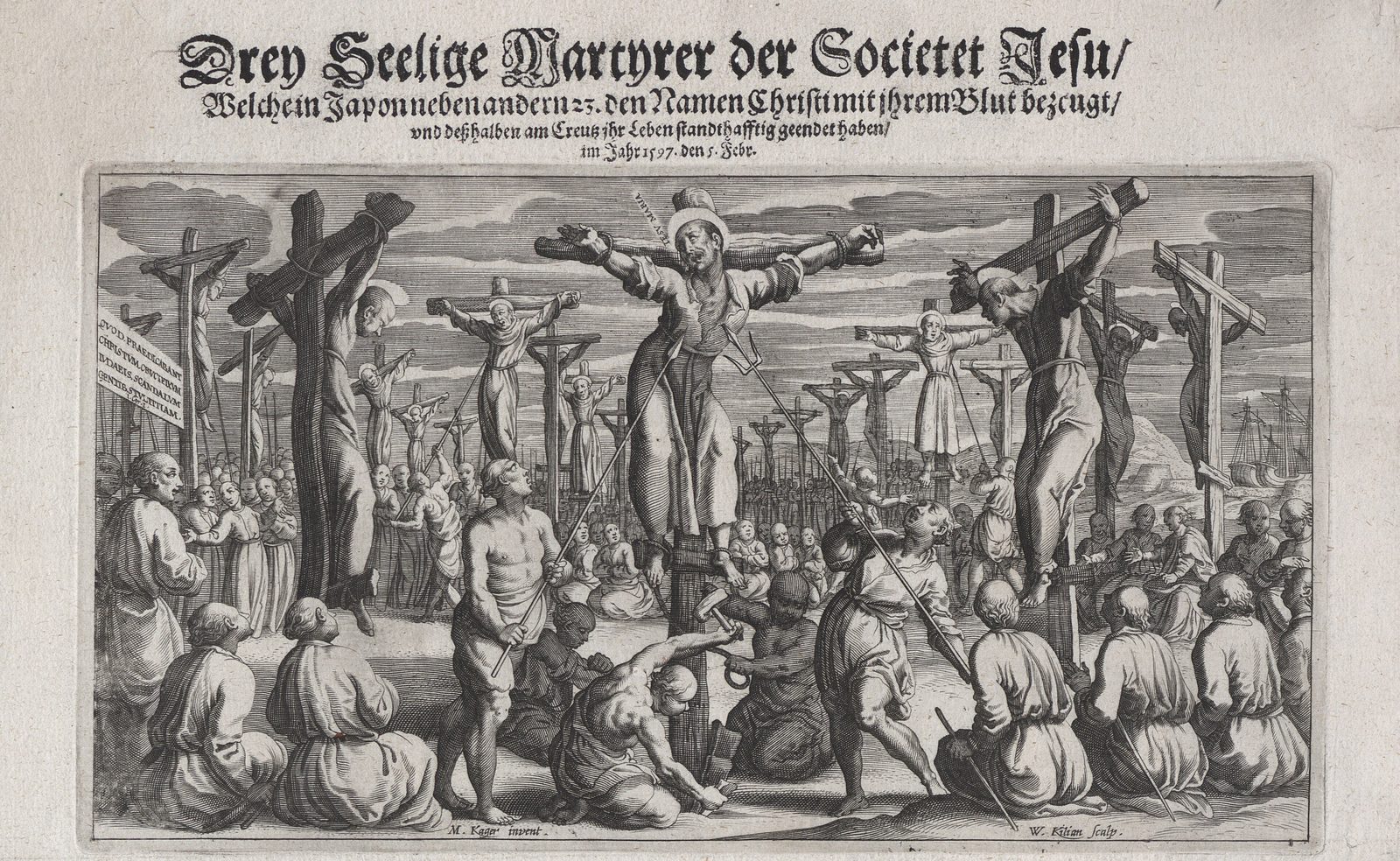
The images make the argument more efficiently than the pamphlets. The Franciscans commissioned Jacques Callot, the finest etcher in Europe, to engrave Les Martyrs du Japon, which shows 23 martyrs on 23 crosses and omits the Jesuits entirely. The Jesuits answered in 1628 with an Augsburg broadside engraved by Wolfgang Kilian, Drey Seelige Martyrer der Societet Jesu, which puts Miki, Kisai and Gotó in the foreground as heroic figures and relegates the Franciscans to the background. Neither engraving is an error. Both are arguments, executed in copper.
Rome resolved the matter with the elegance for which curial administration has always been noted. Urban VIII beatified the martyrs in two separate briefs on consecutive days: the 23 Franciscan-affiliated martyrs on 14 September 1627, and the three Jesuits on 15 September.
The Chain of Consequences
From the Twenty-Six Martyrs to the 1614 Edict and Sakoku
The decade after Hideyoshi’s death was the best the mission ever had, and it rested on a misreading. Tokugawa Ieyasu wanted foreign trade, tolerated the hidden missionaries unofficially, and let the Christians of Nagasaki practice more or less openly. Fray Jerónimo de Jesús came back in disguise in December 1598, was welcomed in Edo, and was given permission to build a church and a role as a channel toward Manila.
Something else came out of the affair, and it came out of the paperwork rather than the theology. The negotiations over what had happened at Urado, over ship security, safe-conducts and the status of vessels in distress, produced the habits that hardened into the shuinsen system, the red-seal licenses under which Japanese ships sailed to Southeast Asia for the next 40 years. A dispute about salvage taught both sides how to write a maritime guarantee.
The tolerance ended for reasons that had as little to do with theology as the executions had. In 1612 a bribery and forgery case ended with two men executed and with an investigation that showed Ieyasu how many Christians were working inside his own household. That April he banned Christianity in the shogunal domains and stripped some 700 retainers of rank. On 31 January 1614 the Zen monk Konchiin Sūden drafted the definitive edict in Shogun Hidetada’s name, using the same phrase Hideyoshi’s officials had used in 1587, a pernicious doctrine, and that November 96 missionaries out of the 149 then active were shipped out of Nagasaki with Justo Takayama Ukon.
What followed was no longer a matter of 26 people on a hill. The great martyrdom of 1622 killed 55 in a single morning on the same slope, and the persecution of 1617 to 1640 worked through the country with the patience of an administrative system that had settled on an outcome and had time. By the time the doors closed, the Church that had counted 300,000 members survived as a secret held by fishing villages.
Pius IX canonized the martyrs in St Peter’s on 8 June 1862, in the middle of the Risorgimento, with the Papal States disappearing around him and a theology of martyrdom to deploy against liberal Europe. The crowds began arriving at five in the morning; by seven there were 30,000 inside the basilica and 60,000 in the square, and artisans were being lowered from the dome on ropes to light the chandeliers. It was that ceremony, and the bull that came out of it, that turned Pedro Bautista into a bishop of Ávila, gave Anthony of Nagasaki an Indian father, and made Leo Karasumaru a Korean, an error revived in good faith in 1974 and dismantled by Hubert Cieslik and Diego Pacheco, who showed that Roman copyists had read the Portuguese Voari, meaning Owari, as Corai.
The site itself had to be found again: Bishop Bernard Petitjean placed the execution at Chausuyama and was wrong, and Bishop Urakawa Wasaburō established Nishizaka from the documents. On 9 August 1945 the atomic bomb destroyed Urakami Cathedral and killed some 8,500 local Catholics, about 60 percent of the community, and the survivors folded that into the older memory, reading their dead as an offering in the way their ancestors had read the 26.
The monument on Nishizaka went up in June 1962, for the centenary. Funakoshi Yasutake’s bronze relief shows the 26 standing side by side, each in the position he occupied on the hill, in the order Luís Fróis wrote down in Nagasaki five weeks after the event, while the bodies were still hanging above the harbor and the guards were still failing to keep the Christians away from them. The orders spent three centuries arguing about who had caused the deaths, who deserved the credit, which ear was cut, and who stood in the middle. About where each man stood, the Jesuit chronicler and the Franciscan chroniclers agreed exactly, position for position, from Francisco Kichi the carpenter at one end to Paul Suzuki the hospital warden at the other.
It is the only thing they never quarreled about, and it is the only part of the record that has survived unamended.
Sources & Further Reading
Berry, Mary Elizabeth. Hideyoshi. Harvard University Press, 1982. The standard English biography, essential for the fiscal exhaustion, the succession anxiety and the centralizing logic behind the 1596 decisions.
Boxer, C. R. The Christian Century in Japan, 1549-1650. University of California Press, 1951. Still the framing narrative for the whole episode, and the origin of the reading of the San Felipe pilot as thoughtless rather than conspiratorial.
Boxer, C. R. The Great Ship from Amacon: Annals of Macao and the Old Japan Trade, 1555-1640. Centro de Estudos Históricos Ultramarinos, 1959. Supplies the commercial machinery, Macau silk and Nagasaki silver, that explains why Hideyoshi exempted the Portuguese and why the Jesuits were worth sparing.
Cooper, Michael. Rodrigues the Interpreter: An Early Jesuit in Japan and China. Weatherhill, 1974. The fullest account of João Rodrigues Tçuzzu, including his access to the prisoners at Sonogi and his presence at the foot of the crosses.
Elison, George. Deus Destroyed: The Image of Christianity in Early Modern Japan. Harvard University Press, 1973. Reads the executions as an act of state centralization rather than religious persecution, and translates the key anti-Christian documents.
Fróis, Luís. Relatione della gloriosa morte di ventisei posti in croce ... alli 5. di febraio 1597. Luigi Zannetti, 1599. The primary Jesuit chronicle, written at Nagasaki on 15 March 1597; its enumeration of the crosses governs the modern monument.
Hesselink, Reinier H. The Dream of Christian Nagasaki: World Trade and the Clash of Cultures, 1560-1640. McFarland, 2016. Places the martyrdom inside the commercial and demographic history of Nagasaki itself, and is the basis for treating the higher crowd figures as impossible.
Juan Pobre de Zamora, Fray. Ystoria de la pérdida y descubrimiento del galeón San Phelipe. Manuscript completed at Acapulco, 1603. The eyewitness Franciscan account by a passenger of the wrecked galleon, and the source of the argument that the confiscation preceded the pilot’s interrogation.
Ribadeneira, Marcelo de. Historia de las Islas del Archipiélago y Reynos de la Gran China, Tartaria, Cochinchina, Malaca, Siam, Camboxa y Iappon. Barcelona, 1601. Written by a friar interned aboard a Portuguese carrack in Nagasaki harbor during the executions; the source behind the Cuernavaca fresco cycle.
Ruiz-de-Medina, Juan G. El Martirologio del Japón, 1558-1873. Institutum Historicum Societatis Iesu, 1999. The Jesuit archivist’s prosopography of the Japanese martyrs, and the corrective to the corrupted names and origins in the 1862 bull.
Valignano, Alessandro. Apologia en la qual se responde a diversas calumnias. Manuscript, Macau and Japan, 1598. The Society’s polemical answer to the Franciscan depositions, and the clearest statement of the case that the friars caused the persecution.
Recent scholarship
- González-Bolado, Jaime (2026). “Portraying the ‘Chosen Samurai’: The Creation of an Idealized Image of the Japanese in 16th-Century Jesuit Printed Works”, Religio: Revue pro religionistiku, 34, pp. 145–168. — This 24-page article argues that 16th-century Jesuits crafted an idealized “Chosen Samurai” image in print, partly to secure funding, while their private letters revealed a far more critical view of the Japanese people.Free full text ↗ (opens in a new tab)
Cite this page
Nanban.pt. “The Line on Nishizaka: The Twenty-Six Martyrs of Japan, 5 February 1597.” Last modified 6 October 2026. https://nanban.pt/articles/twenty-six-martyrs-1597/.
@misc{nanban-twenty-six-martyrs-1597,
  author = {Nanban.pt},
  title = {The Line on Nishizaka: The Twenty-Six Martyrs of Japan, 5 February 1597},
  year = {2026},
  url = "https://nanban.pt/articles/twenty-six-martyrs-1597/",
  note = {Last modified 2026-10-06}
}