The Tokugawa Persecution of Christians, 1617–1640: How the Shogunate Learned to Manufacture Apostates
Between the first foreign beheadings at Ōmura in 1617 and the severed heads of the Macao embassy at Nishizaka in 1640, the Tokugawa shogunate ran what may be the earliest documented case of iterative, audience-tested state violence in the modern world. They killed in public, watched the crowds, learned from the results, and rewrote the script.
Between 1617 and 1640 the Tokugawa shogunate developed its persecution of Japan's Christians by trial and error, moving from public executions at Omura, Kyoto, Nagasaki, and Edo to a bureaucratic system of forced apostasy built on the ana-tsurushi pit torture, the fumi-e image trampling, temple registration, five-household surveillance, and silver bounties. Public killing kept producing martyrs and moving crowds, so after the Great Martyrdom of 1622 the shogunate hid its executions and engineered apostates instead, ending with the beheading of 61 members of the Macao embassy in 1640.
The Officer’s Sword
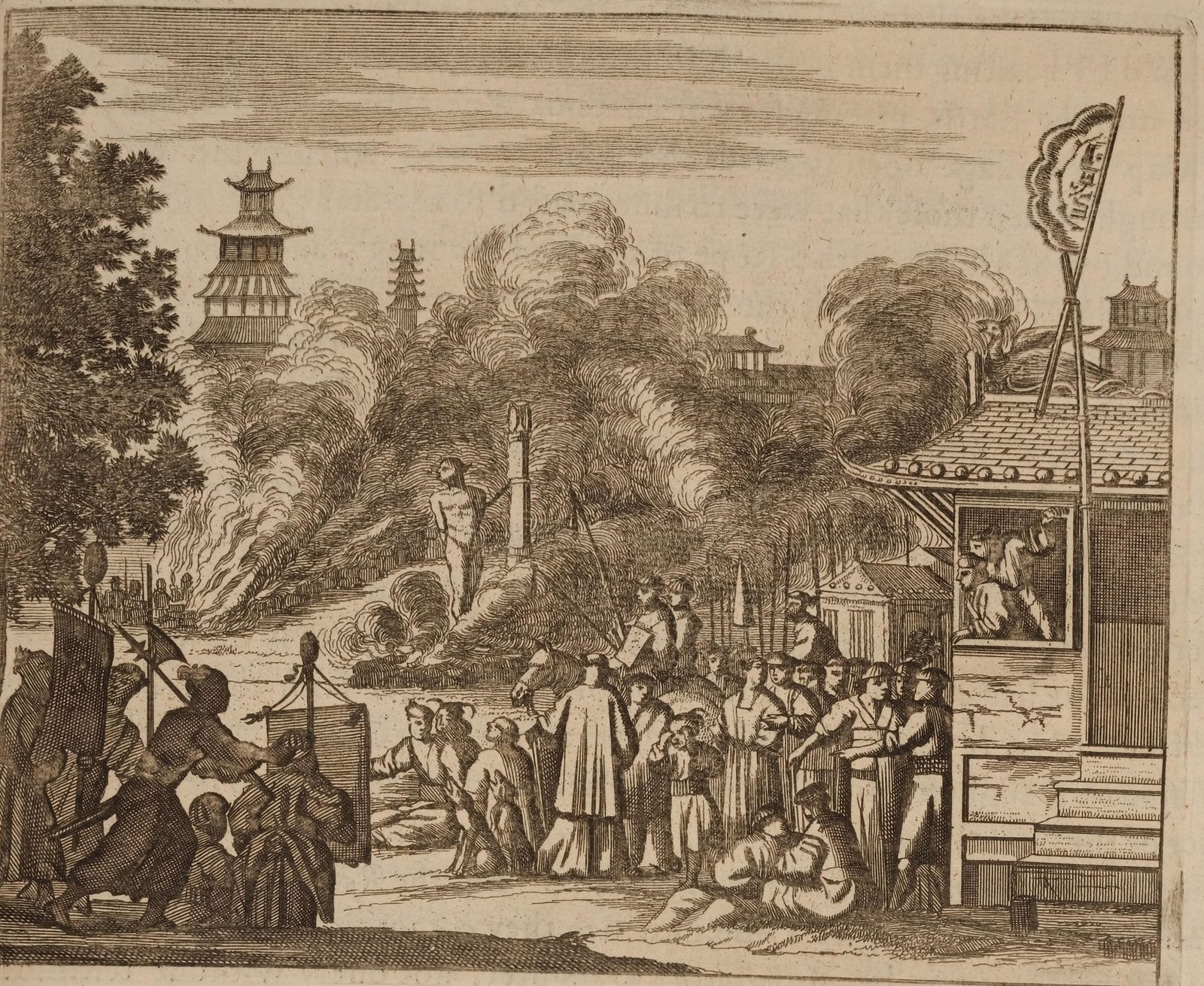
On the morning of 21 May 1617, in the Kyūshū fief of Ōmura, a high-ranking samurai stepped forward to behead two foreign priests.
This was, by the standards of 17th-century Japanese justice, deeply strange. Executions were not normally performed by high-ranking anyone. They were the work of the eta, the hereditary outcasts whose status was defined precisely by their proximity to death, blood, and the carcasses of animals. To execute a criminal while wearing a silk hakama and carrying a sword that had cost more than most peasants saw in a lifetime was polluting and unthinkable. And yet here was Ōmura Sumiyori’s senior officer, sword drawn over two kneeling Europeans, a Franciscan friar named Pedro de la Asunción and a Jesuit priest named Juan Bautista Machado de Tavora, while the lord of the domain stood by and tried not to look like a man about to commit a profoundly consequential mistake.
He was about to commit one. Sumiyori had not wanted this. Three and a half months earlier, summoned to the shogun’s New Year court, he had been savaged by Hidetada for the unforgivable offense of having allowed Catholic priests to operate openly in a domain whose lord, whose own grandfather, had been the first Christian daimyō in Japanese history. The shogun’s instruction was clear: kill the hidden priests. Sumiyori, hoping to do the bare minimum, had intended to execute one. His officers, perhaps keen to demonstrate zeal to a nervous superior, had arrested two. Sumiyori had written back to Edo requesting clarification. The reply, sealed that morning with the unambiguous vermilion of Hidetada, was a death sentence for both.
What happened next was not in the script. The bodies were gathered into coffins and buried in a shared grave, which was normal. What was not normal was the crowd. Within hours, Christians were arriving from every direction, on foot, by cart, carrying cloths and handkerchiefs that they pressed to the earth and to the wood of the coffins to soak up blood. Sick children were carried to the grave. Relics appeared. Stories circulated about the calm with which the priests had died, the prayers they had spoken, the particular way the Franciscan had made the sign of the cross just before the sword fell. Local pagans, the sources use the word without embarrassment, filed through the graveyard in admiration. And a rumor began to spread, the one piece of gossip the shogunate could least afford: that Ōmura Sumiyori himself, shaken by what he had witnessed, might return to the Catholic faith.
The Bakufu had intended to produce terror. It had produced a shrine.
This was, in 1617, a problem without precedent, because the problem itself was not yet recognized. The shogunate had treated capital punishment as a straightforward act of deterrence, and the deterrence had failed. Within weeks the Dominican Alfonso de Navarrete, Vice-Provincial of his order in Japan, and the Augustinian Hernando de San José arrived in the domain and openly launched a propaganda campaign, distributing a letter in which Navarrete declared he did not recognize the authority of the Emperor of Japan but only of the Emperor of Heaven. Ōmura now had to kill two more, and he understood, with the clarity that comes to men who have already made one catastrophic public mistake, that he could not afford to make the same one again.
The second execution, in early June 1617, was carried out on the island of Takashima, out of public view. The bodies were placed in coffins, weighted with heavy stones, rowed out to sea, and dumped. The English merchant Richard Cocks, running his quietly unprofitable factory at Hirado, recorded the news in his diary by 6 June. He did not appear to understand what he was watching. Nobody did, yet. But what had happened at Ōmura in the space of 16 days was, in essence, the entire intellectual history of the Tokugawa persecution in miniature: public ritual punishment, unanticipated response, private corrective execution. The dialectic was set. The laboratory was open. Over the next 23 years, the shogunate would run the experiment again and again, on larger and larger scales, until by the summer of 1640 it had arrived at a final equation whose solution was the display of 61 Portuguese heads on spikes at the site of a hill Nagasaki had already learned to recognize.
The Shogunate’s Problem
When Tokugawa Ieyasu summoned the Zen monk Konchiin Sūden to Edo Castle on the night of 31 January 1614 and told him to write the decree that would end Christianity in Japan, he did so in the confident knowledge that the work of extermination would be essentially clerical. The edict that Sūden produced by morning was a masterwork of political theology, a blend of Shinto nativism, Buddhist orthodoxy, and Confucian rationalism that cast Christianity as cosmologically incompatible with Japanese existence. As a tool of enforcement, it was hopelessly inadequate.
The edict ordered every foreign missionary onto a boat to Macao or Manila. The November deportations put roughly 300 people on ships, including 88 of the 115 Jesuits then operating in the country. It also produced 47 missionaries, 27 Jesuits, seven Franciscans, seven Dominicans, one Augustinian, and five priests, who simply did not get on the boats. Supported by perhaps 200 Japanese lay catechists, the dōjuku, these men vanished into a population that had numbered close to 300,000 Christians on the eve of the edict. The Bakufu had removed roughly three-quarters of the clergy and left behind virtually all of the laity. It had criminalized a religion without extinguishing it.
Ieyasu died in June 1616. His son Hidetada, now free of the retired shogun’s cautious hand, inherited the problem and began to improvise. The improvisation took three years to reach a form that could be called a policy, and that form was the discovery, by trial and error, that punishment was a communications medium, and that the Bakufu had been terrible at it.
The Merchant, the Ward, and the Slow Fire
Domingos Jorge lived in a neighborhood called Bunchi-machi, in Nagasaki. He was Portuguese, a merchant of no particular eminence, married to a Japanese Christian woman, and the father of a four-year-old boy. In December 1618, soldiers arrived at his house and took him away.
The charge was harboring. In his own home, not in some hidden chapel, not in a country retreat, Jorge had been sheltering two Jesuits: the Italian mathematician and astronomer Carlo Spinola, who had lectured in Kyōto in happier years, and the Portuguese lay brother Ambrósio Fernandes. Both were taken in the raid and sent to the jail at Suzuta, in Ōmura. Jorge, his wife, their son, and several of his irmãos in the local Catholic lay brotherhood fared no better.
What distinguished Jorge’s case was not the fact of his arrest but the fact of his burning. Portuguese merchants in Nagasaki had, until that winter, enjoyed a kind of commercial immunity. They brought the silk. The shogunate needed the silk. The equation had been understood on both sides for 60 years and had operated as an invisible shield around the foreign residents of the city, whose quiet support for the underground Church had been treated as one of those inconveniences that one tolerates in the name of profit. Jorge’s arrest, and the subsequent escalation by the Nagasaki bugyō Hasegawa Gonroku, formally extended the anti-Christian penal code to all Spaniards and Portuguese resident in the city. The shield was gone.
The authorities accompanied the arrest with a piece of street theater. In the principal square of a neighborhood called Kurusu-machi, the Ward of the Cross, so named for its Christian population, they displayed 30 bars of silver on a public platform. The silver, a notice explained, was a bounty. Any person who denounced a hidden priest, friar, or their host would collect it. The ward named for the cross had been turned into a billboard for a bounty on the people who had named it.
Jorge was executed on 18 November 1619 in a public square in Nagasaki, tied to a stake alongside a Japanese Jesuit lay brother named Leonardo Kimura. The method was what the authorities by now referred to, with the flat practicality of bureaucrats, as the slow fire. The victim was tied to the stake by a single wrist, loosely, deliberately, so that he could move. The faggots of wood were arranged in a wide ring several feet from the stake, so that the fire would burn at a distance rather than consume him directly. The logic was that a prolonged burning would produce a prolonged agony, and that the agony would cause the victim to writhe, jump, scream, and beg, in short, to disqualify his own corpse from the iconography of martyrdom by behaving, in his final moments, like a man rather than a saint.
The historian C. R. Boxer, drawing on the Jesuit relations, records that Jorge went to the stake so cheerfully that the flames held no terror for him. His wife and four-year-old son were kept in prison and executed in 1622.
The Bunchi-machi merchant had been selected as a convenient intermediate figure, not quite Portuguese enough to enjoy full diplomatic protection, not quite Japanese enough for his death to register as an ordinary execution, and his body had been selected as the medium through which a new policy would be communicated to both audiences at once. The message to the Portuguese community was that the commercial shield no longer existed. The message to the Japanese Christians was that their own neighbors were now incentivized, in literal silver bars, to report them. It was a carefully engineered piece of signaling, and it failed in precisely the way that Ōmura had failed. Christians who witnessed the execution collected cloth stained with Jorge’s blood. The four-year-old became, in the oral memory of the city, a second Holy Innocent. The silver in Kurusu-machi drew curiosity, but few denunciations.
The Dry Riverbed
Six weeks before Domingos Jorge’s burning, and 700 kilometers to the north-east, the same policy was being tested on a much larger scale.
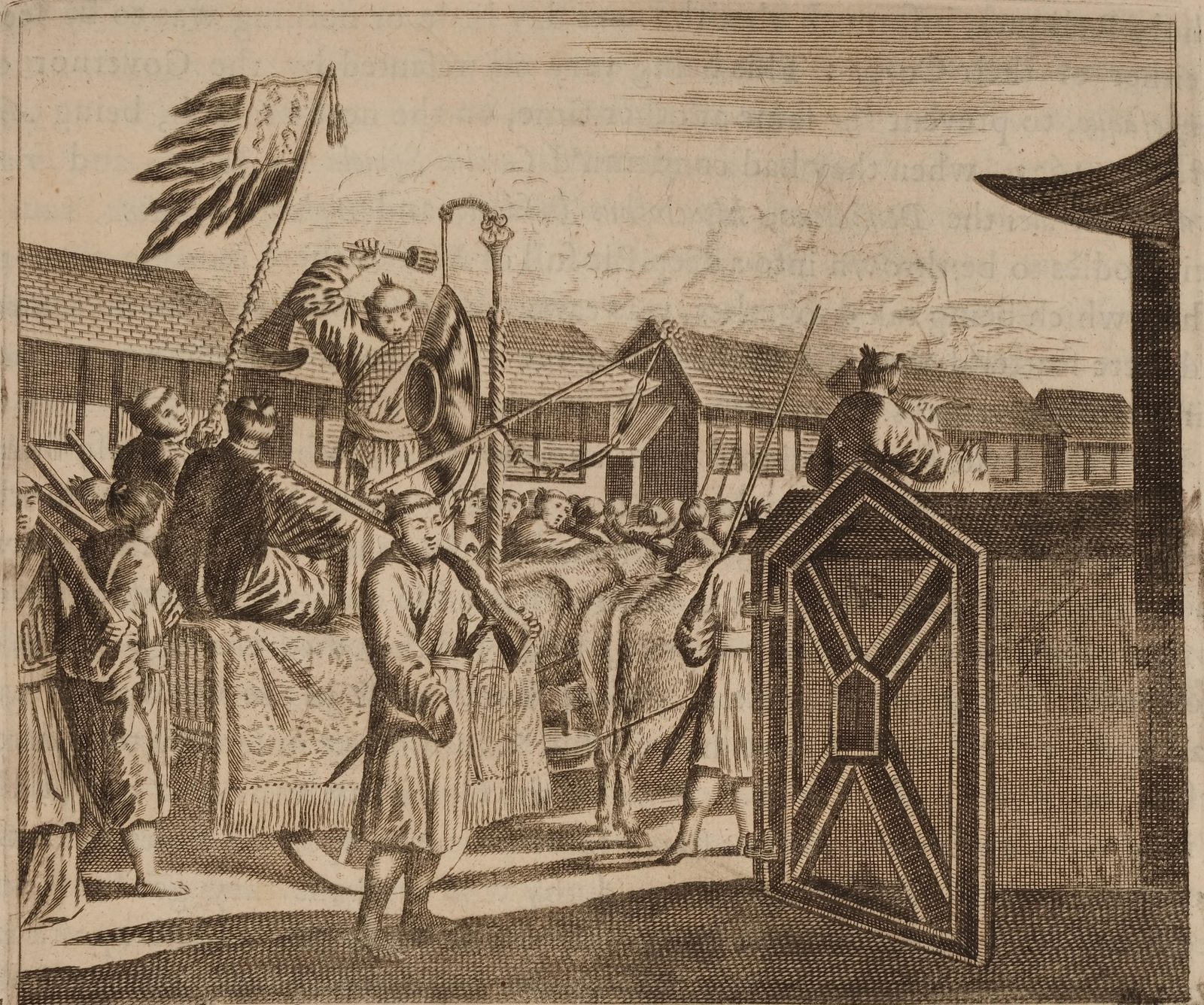
The Kamo river runs through Kyōto, the imperial capital, and for most of the year it is a modest stream, narrower than the great rivers of the east, civilized by centuries of embankment, carrying the city’s sewage and its memory in roughly equal proportion. At a place called Rokujō Gawara, the Sixth Avenue Riverbed, the Kamo’s flat stone plain had long served as the city’s open-air execution ground. On 7 October 1619, 52 Christians were burned alive there in a single afternoon.
The victims came from a specific neighborhood, a district known as Daiusu-machi, the Deus Block, or the Street of the Christians. The residents were the families of above-average samurai who had held to their faith quietly through the early phase of the persecution. 36 had been arrested in the preliminary sweep. The order that transformed the arrest into a mass execution arrived in the summer from Hidetada himself, during a visit to the capital. The shogun, informed that Kyōto’s Christian community remained active despite the 1614 edict, declared himself utterly resolute against what he called their persistent obstinacy and ordered that they all be burned.
The local shōshidai, the shogunate’s deputy in Kyōto, was a moderate man named Itakura Katsushige, who had spent the preceding years quietly shielding the capital’s Christians and who, the Jesuit relations report, would have preferred to release the prisoners rather than execute them. He did not dare. He read the order, arranged the stakes, and on 7 October watched the fires lit.
Among the 52 were 26 women and at least six children. A prominent merchant named Hashimoto Tahyoe went to the stake beside his household. Richard Cocks, the English merchant of Hirado, saw the burning and wrote in a letter of children of five and six burning in their mothers’ arms while the mothers called out Jesus receive their souls. The Jesuit priest Pedro Morejón, compiling the mission’s reports in Europe, recorded the scene in a history that circulated through the Catholic world in the years that followed. He described the fortitude of the women, ordinary townswomen, wives of minor samurai, with no theological training and no institutional support, meeting the fire as if it were a doorway.
What Morejón reported next would, in the sociology of the Japanese Church, prove more consequential than the executions themselves. From that day forward, he wrote, countless women began to step forward independently of their husbands and fathers, offering themselves to the authorities rather than concealing their faith. The Rokujō burning had been designed to terrify the Christian community into submission. What it had done instead was to widen, in a single afternoon, a breach that Kyōto’s women catechists had opened a generation before in the patriarchal structure constraining female conversion and martyrdom.
The shogunate had, in effect, just changed the demographic composition of its own enemy. The underground Church of the 1620s would be, disproportionately and defiantly, a Church of women.
The Lesson of Nishizaka
The events of 10 September 1622 on Nishizaka Hill, outside Nagasaki, are told in their own dedicated article elsewhere on this site, and the full account of the Great Martyrdom does not need to be rehearsed here. What matters for the present argument is the lesson that the Bakufu drew from it.
55 Christians were burned or beheaded on Nishizaka that day, including the Italian astronomer Carlo Spinola, the Japanese Jesuit Sebastião Kimura, the Dominican Francisco de Morales, and 30 lay followers, among them at least 13 women and seven young children. The executions were staged on the precise promontory where the Twenty-Six Martyrs had been crucified in 1597, a topographical echo that the shogunate intended and that no one present missed. The slow fire was used. The wood, wetted by rain that morning, burned reluctantly. The victims took two or three hours to die. A crowd variously estimated between 30,000 and 60,000 people, including a substantial contingent of Portuguese merchants, gathered on the hillside. As the martyrs were bound to the stakes, Carlo Spinola intoned a psalm, and the crowd took it up.
They sang the psalm. They called on Jesus and Mary. They prayed, on the hillside and in the boats on the bay beneath Nishizaka, in the ears of the shogun’s officers, with the Portuguese carracks watching from the harbor, until the clamor drowned out everything else. The most carefully orchestrated piece of state theater the Tokugawa had yet produced had been, in the judgment of its own architects, a catastrophic failure. The crowd had not been terrified. The crowd had been moved.
This was the moment, and the shogunate’s own internal shift in methodology dates, quite precisely, from the weeks after Nishizaka, at which the experiment changed direction. The inquisitors of the Bakufu had spent five years testing the hypothesis that greater scale and greater visibility would produce greater deterrence. The hypothesis had been falsified. The new hypothesis, which would govern the next 15 years of policy, was the precise inverse: that the killing must disappear, and that the apostasy must take its place.
Public executions did not stop at once; nothing in a state apparatus this large stops at once. But the direction of travel was set. After 1622, the executions would increasingly be carried out in private. The ashes would be scattered at sea to deny Christians bones to venerate. Spectators who so much as murmured a prayer at an execution site risked being cut down by the guards. And the Inquisition, soon to be presided over by a man named Inoue Masashige, would begin to prefer, over the production of martyrs, the production of apostates.
The Tōkaidō Stakes
There was one last large-scale public experiment before the new doctrine took hold.
In 1623, Tokugawa Hidetada retired from the shogunate in favor of his son Iemitsu, a retirement that was, in true Tokugawa fashion, entirely nominal, since Hidetada continued to govern as ōgosho until his death in 1632. The missionary community nevertheless allowed itself a quiet hope that the young new shogun, or at least the generational transition he represented, might bring some relaxation of the purges. They were wrong in a way that only the young Iemitsu could manage: he was more zealous than his father.
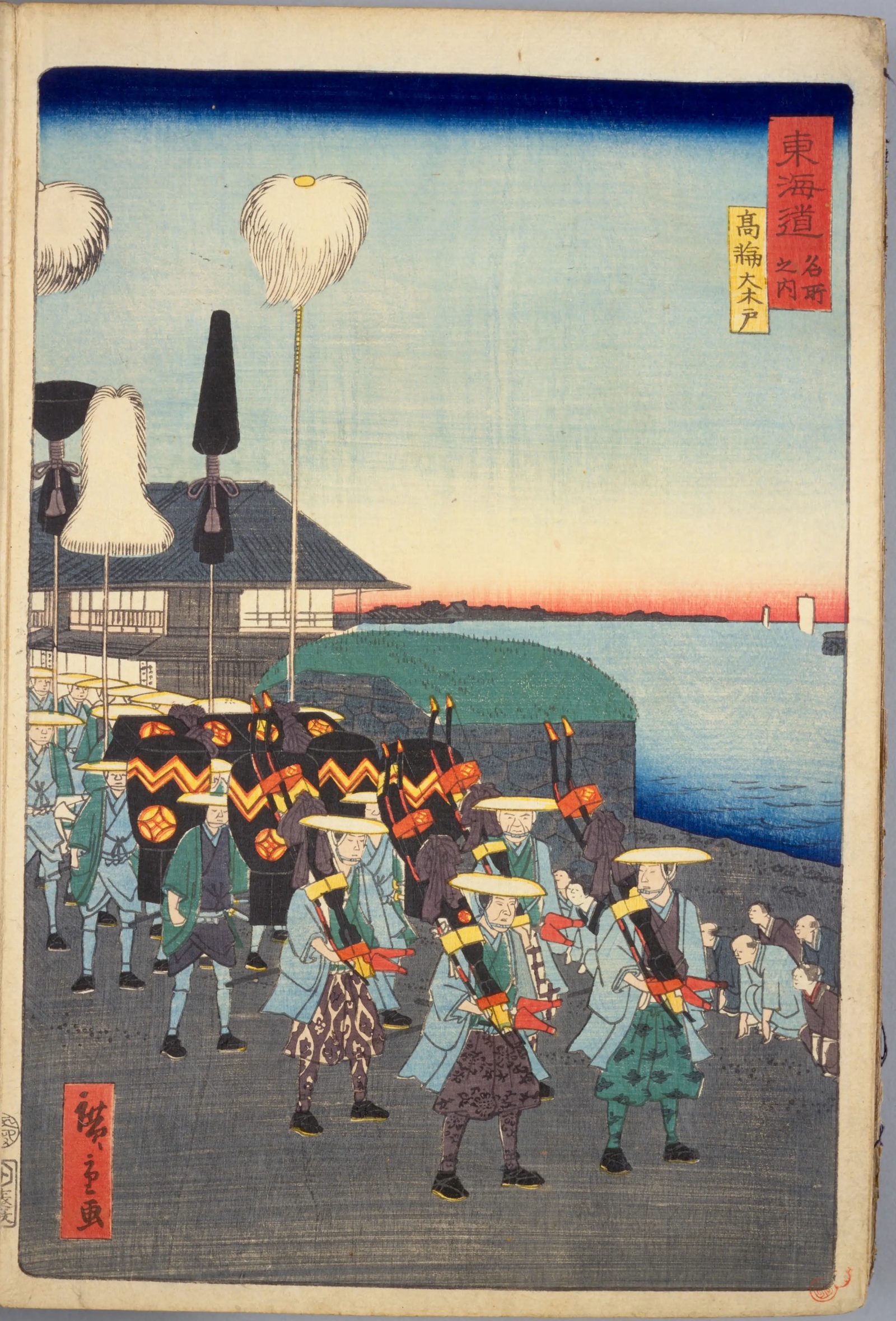
Iemitsu chose the occasion of his investiture to make his position clear. The daimyō of Japan had gathered in Edo to pay their respects, the great annual congregation of feudal power that was the ceremonial foundation of Tokugawa rule. A covert Kirishitan community had recently been exposed operating in the shogun’s own capital, and Iemitsu, the evidence suggests, made the deliberate decision to use the presence of the assembled lords as the audience for a demonstration. On 4 December 1623, on the heights of Takanawa near Edo, at a place the sources identify as Fuda-no-Tsuji, 50 Christians were burned alive.
The site was chosen for its visibility. The stakes were erected along the Tōkaidō, the great coastal highway, the busiest artery in 17th-century Japan, the road every daimyō traveled to and from Edo on the shogunate’s own compulsion. The burning was not something the lords could choose to witness or not witness. It was in their path.
Among the 50 were two European priests. The most prominent was the Sicilian Jesuit Girolamo de Angelis, a man who in 1618 had become the first European to explore the northern island of Ezo, Hokkaidō, and whose career had taken him from Sicily through the Mediterranean, and across two oceans. He went to the stake beside a Spanish Franciscan. 48 Japanese burned with them. And of the 48, 13 were not Christians at all.
The 13 were members of gonin-gumi, five-household neighborhood associations, who had failed to report the missionaries hiding in their midst. They were being burned not for what they believed but for what they had not said. Their inclusion in the execution was the Bakufu’s announcement of a new principle: the silence of a neighbor was now itself a capital crime, and the social structure that Christian communities had used to shelter their priests was about to be inverted into a structure of mutual surveillance.
The Edo authorities made no attempt to prevent de Angelis from preaching from his stake. He did. The effect on the crowd was such that two bystanders rushed forward and begged the presiding judges to allow them to join the flames. On 29 December, another 37 were executed in Edo in a follow-up operation. Together, the two winter burnings inaugurated Iemitsu’s personal reign over the persecution, a reign that would prove, by every metric the Bakufu cared about, more thorough than his father’s.
But the Fuda-no-Tsuji stakes were, even as they burned, already obsolete as policy. Iemitsu’s persecution would not, from here forward, rely on theater. It would rely on bureaucracy.
The Architecture of Suppression
What the Bakufu built between 1623 and 1640 is described in detail across several articles on this site, the dedicated piece on Iemitsu covers the psychology behind the new system, and the Sakoku article traces the sequence of edicts that closed the country. What belongs here is a summary of how the four components fit together as a single learning system.
The first component was the ana-tsurushi, the hanging in the pit. A bound victim, suspended upside-down over a hole filled with filth, with small incisions behind the ears to prevent merciful unconsciousness, could be kept alive for days while his entire circulatory system protested. The pit was not designed to kill. It was designed to produce a choice, on the victim’s own hand-signal, between continued faith and renunciation. It was the instrument that, in October 1633, broke Cristóvão Ferreira, the Jesuit Vice-Provincial, a success that would echo through the remainder of the 17th century and become, 300 years later, the central image of Shūsaku Endō’s Silence.
The second was the fumi-e, the image-trampling ritual introduced in Nagasaki in the late 1620s by the bugyō Takenaka Uneme. Suspects were required to step on a brass, metal, or wooden plaque bearing the image of Christ or the Virgin Mary. Inquisitors watched for hesitation, trembling, tears, or sweating, for the outward physical signs of an interior act of faith. The ritual produced, at the end, either a criminal or a document: the korobi kakimono, the apostate’s written oath, in which the penitent swore by both the Christian God and the native kami and buddhas that he would suffer the torments of Hell itself if he ever secretly returned to the forbidden faith. The theological judo of this oath was the Bakufu’s most imaginative stroke, it weaponized the apostate’s own theology against him, binding him to his renunciation with threats calibrated to the belief system he had just repudiated.
The third was the surveillance apparatus. The terauke system, elaborated between the mid-1630s and 1640, required every household in Japan to register annually with a local Buddhist temple. Temple priests became state agents, certifying each year that their parishioners were not Christians. The certificate was the indispensable document of Tokugawa life; without it a person could not marry, travel, inherit, or be buried. Parallel to it ran the gonin-gumi, the five-household associations that Fuda-no-Tsuji had announced, in which every family was collectively responsible for every other, and in which the discovery of a concealed priest in one household meant the execution of the entire group. The social texture that had once sheltered the underground Church was thereby inverted into the instrument of its betrayal.
The fourth was the bounty. The Bakufu erected kōsatsu, wooden notice boards, in public squares across Japan, posting a price list in silver for the denunciation of Christians: 500 silver pieces for a padre, 300 for an irmão or a relapsed apostate, 100 for a dōjuku or an ordinary believer. The sums were enough to transform the life of any peasant who collected one. The silver in Kurusu-machi square back in 1619 had been a prototype. The bounty system of the 1630s was the same policy, industrialized.
The four components worked as a single machine. The terauke produced the initial screen. The gonin-gumi produced the neighborly pressure to report. The bounty produced the financial incentive to denounce. The arrest produced the candidate for the fumi-e. The refusal to trample produced the candidate for the pit. And the pit, more often than the shogunate had dared hope in 1622, produced an apostate, a visible, living, humiliated testimony to the powerlessness of the Christian God.
Inoue Masashige, appointed first head of the Office of the Inquisition in 1640, understood the system from the inside. He was himself an apostate. He had then been put to work by the shogunate as an interrogator. His career was the system’s proof of concept: the state produced apostates, turned them into officials, and through them manufactured more apostates. This was what the Bakufu had learned since Ōmura.
The Final Demonstration
The last act of the experiment took place in the place where it had begun: on a hill above Nagasaki Bay, with Portuguese bodies as the medium and the world as the audience.
After the annihilation of the Shimabara rebels at Hara Castle in April 1638, 37,000 men, women, and children, nearly all killed over the course of a three-month siege that the shogunate had come to regard as proof that Christianity was ineradicably subversive, the final sakoku edict was issued on 4 August 1639. Portuguese ships were forbidden Japan on pain of death. Any vessel that attempted to return would be burned and its crew executed.
The Senate of Macao, facing the collapse of the city’s commercial lifeline, voted the following March to send an embassy. The story of that embassy is told in its own article: 74 men aboard a galliot, four ambassadors of distinguished age and standing, no cargo, no arguments except a plea for mercy and an offer to settle Macao’s debts to its Japanese creditors. They arrived at Nagasaki on 6 July 1640, were immediately confined to Dejima, and received the verdict from Edo in the first week of August. The ambassadors were offered their lives if they would apostatize. They refused.
On 3 or 4 August 1640, 61 members of the embassy were beheaded at Nishizaka, the same hill where Spinola and the 54 had died 18 years earlier. The heads were placed on spikes. 13 sailors were spared and returned to Macao in a small boat. They carried with them a written message from the shogunate, drafted with what can only be described as calculated blasphemy: so long as the sun warmed the earth, no Christian should be so bold as to come to Japan, and if King Philip himself, or the God of the Christians, or even the great Buddha should contravene this prohibition, they would pay for it with their heads.
What the Laboratory Proved
The architecture of persecution that the Tokugawa built between 1617 and 1640 is unusual in world history not for its cruelty, which was, on any honest comparative accounting, about average for the age, but for its speed of iteration. Contemporary European states faced with religious heterodoxy tended to respond with tools developed 200 or 300 years earlier: the Inquisition, the auto-da-fé, the public burning, the penitential procession. These were institutions with inertia. The Bakufu, by contrast, seems to have been genuinely experimentalist. The shogunate tried a method, watched the crowd, noted the results, and modified the method, often within a matter of years, sometimes within months. The progression from the public beheading at Ōmura in May 1617 to the secret decapitation off Takashima in early June 1617 is the entire feedback loop, compressed into 16 days.
What the laboratory ultimately proved is that the state could extinguish the visible Church. The 1614 population of 300,000 Christians had, by the end of the Edo period, been reduced to a remnant of perhaps 20,000 to 50,000 Kakure Kirishitan, Hidden Christians, concentrated in the mountains of Kyūshū and the islands of Gotō and Ikitsuki. The institutional Church was gone. The clergy was gone. The sacraments beyond baptism were gone. The system worked.
What the laboratory did not prove, what it could not prove, and what it was perhaps never quite honest enough to admit that it could not prove, was the claim for whose sake the entire apparatus had been built: that the interior life of the shogun’s subjects could, by sufficiently sophisticated outer discipline, be made legible to the state. When the French missionary Bernard Petitjean stepped into the newly built Ōura church in Nagasaki on 17 March 1865, and was approached by a group of peasant women who whispered, in Japanese threaded with Portuguese loanwords, that their hearts were the same as his, he was meeting the descendants of the households that had been the particular target of the Rokujō burning and the Nishizaka fires. Seven generations of terauke registration, fumi-e trampling, gonin-gumi surveillance, and bounty-board denunciation had not reached what the Tokugawa had most wanted to reach.
Sources & Further Reading
Boxer, C. R. The Christian Century in Japan, 1549–1650. University of California Press, 1951. The foundational English-language study of the entire period, with extended narrative treatment of the Ōmura, Nagasaki, Kyōto, and Edo persecutions and their place in Bakufu policy.
Boxer, C. R. The Great Ship from Amacon: Annals of Macao and the Old Japan Trade, 1555–1640. Centro de Estudos Históricos Ultramarinos, 1959. Essential for the commercial context in which Jorge, the Macao merchants, and the 1640 embassy operated.
Cieslik, Hubert. “The Great Martyrdom in Edo, 1623.” Monumenta Nipponica 10, no. 1/2 (1954): 1–44. The single most detailed English-language study of the Fuda-no-Tsuji burning and its aftermath.
Cocks, Richard. Diary of Richard Cocks, Cape-Merchant in the English Factory in Japan, 1615–1622. 2 vols. Edited by Edward Maunde Thompson. Hakluyt Society, 1883. The English merchant’s contemporary record, invaluable for the Ōmura executions of 1617.
Cooper, Michael. They Came to Japan: An Anthology of European Reports on Japan, 1543–1640. University of California Press, 1965. Collects the crucial Jesuit and Franciscan eyewitness accounts of the persecutions.
Elison, George. Deus Destroyed: The Image of Christianity in Early Modern Japan. Harvard University Press, 1973. The indispensable analytical study of the ideological framework within which the Bakufu understood and justified its violence.
Elisonas, Jurgis. “Christianity and the Daimyō.” In The Cambridge History of Japan, Volume 4: Early Modern Japan, edited by John Whitney Hall, 301–372. Cambridge University Press, 1991. The standard institutional treatment of the persecution’s geographic and political logic.
Endō, Shūsaku. Silence. Translated by William Johnston. Monumenta Nipponica, 1969. The novelistic treatment, inseparable from the Ferreira apostasy, that shaped the modern imagination of the persecution.
Hesselink, Reinier. The Dream of Christian Nagasaki: World Trade and the Clash of Cultures, 1560–1640. McFarland, 2016. Detailed treatment of the Nagasaki executions, Hasegawa Gonroku’s administration, and the commercial context of the Jorge case.
Higashibaba, Ikuo. Christianity in Early Modern Japan: Kirishitan Belief and Practice. Brill, 2001. The best treatment of lay Christian life in the communities targeted by the Rokujō and Nishizaka burnings.
Laures, Johannes. The Catholic Church in Japan: A Short History. Charles E. Tuttle, 1954. Chronologically organized survey that remains valuable for tracking the sequence of edicts and executions.
Nosco, Peter. “Secrecy and the Transmission of Tradition: Issues in the Study of the ‘Underground’ Christians.” Japanese Journal of Religious Studies 20, no. 1 (1993): 3–29. Essential for understanding what the Bakufu’s experiment did and did not succeed in extinguishing.
Turnbull, Stephen. The Kakure Kirishitan of Japan: A Study of Their Development, Beliefs and Rituals to the Present Day. Japan Library, 1998. The fullest treatment of the communities that survived the persecution and what they carried with them.
Cite this page
Nanban.pt. “The Tokugawa Persecution of Christians, 1617–1640: How the Shogunate Learned to Manufacture Apostates.” Last modified 25 September 2026. https://nanban.pt/articles/tokugawa-persecution-christians-1617-1640/.
@misc{nanban-tokugawa-persecution-christians-1617-1640,
  author = {Nanban.pt},
  title = {The Tokugawa Persecution of Christians, 1617–1640: How the Shogunate Learned to Manufacture Apostates},
  year = {2026},
  url = "https://nanban.pt/articles/tokugawa-persecution-christians-1617-1640/",
  note = {Last modified 2026-09-25}
}