The Wrong Cloth in the Wrong Town: The English East India Company at Hirado, 1613–1623
On a June afternoon in 1613, a ship called the Clove anchored in a small Kyushu harbor and a captain named John Saris stepped ashore carrying a letter from King James I, a cargo of unsold broadcloth, and a grudge against the only Englishman in Japan. 10 years later, the English would sail away in debt, in disgrace, and in tears. This is the story of what happened in between.
The English East India Company factory at Hirado (1613 to 1623) was Britain's first trading post in Japan, opened by Captain John Saris under a lavish red-seal charter from Tokugawa Ieyasu and run by the merchant Richard Cocks. It failed within a decade because the English tried to sell heavy woolen broadcloth in a silk-wearing country from a peripheral Kyushu island, were undercut by the better-financed Dutch, and lost their court patrons, closing at a heavy loss on Christmas Eve 1623.
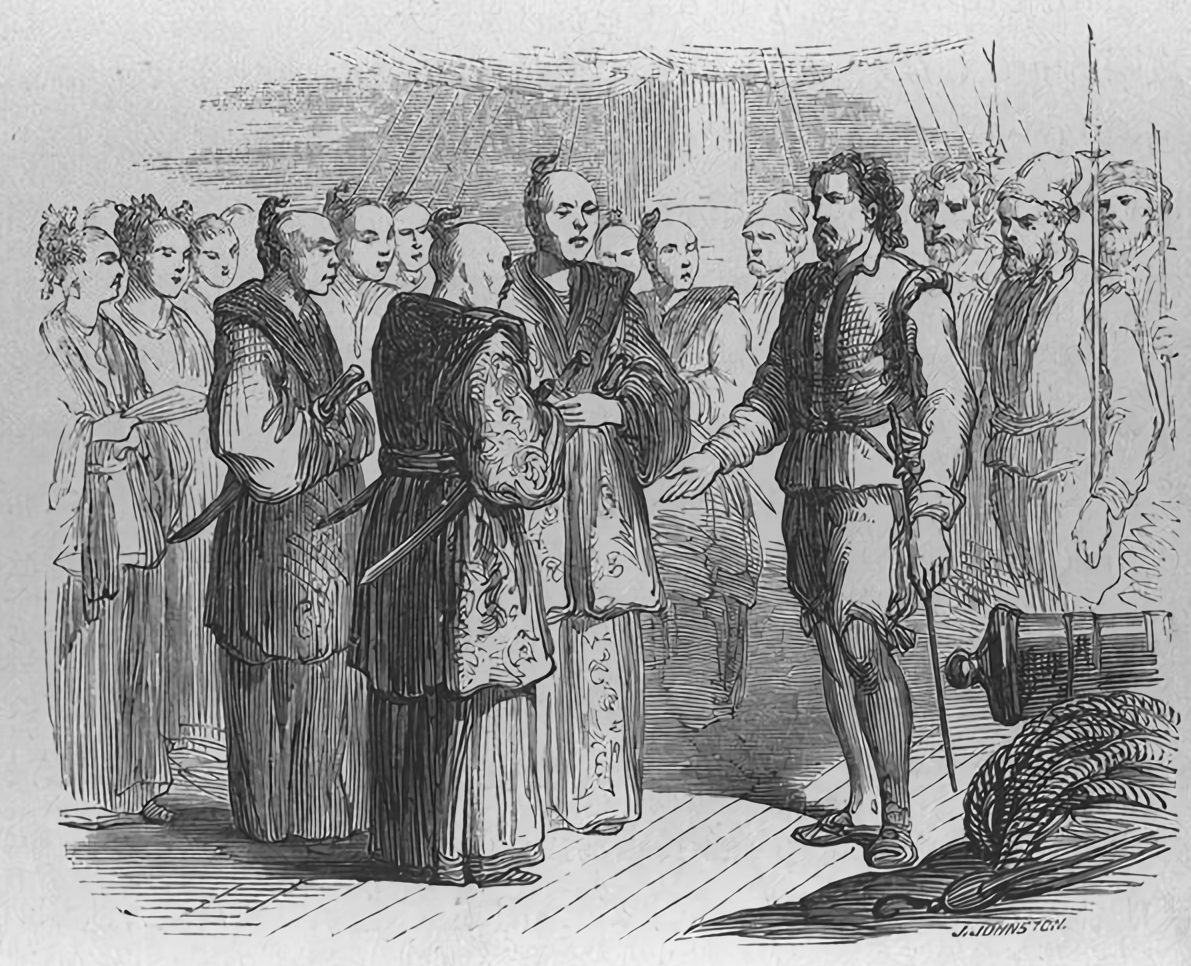
There is a particular kind of historical disaster that is worth studying not because it changed the world but because it so completely failed to. The English East India Company's decade at Hirado is one of these. It left no treaty, no colony, no durable commercial foothold. When the last Englishmen sailed out of Hirado harbor on Christmas Eve 1623, they left behind a half-demolished factory compound, uncollected debts that would never be paid, a few hundred sweet potato plants, and a tearful farewell party hosted by the townspeople who had liked them despite everything.
The English had every structural advantage it was possible to have in 1613. They threw them all away in under a year. The fault for this lies, to a remarkable degree, with a single man.
The General of the Eighth Voyage
John Saris and the Eighth Voyage to Japan
Captain John Saris was 32 years old when he took command of the Clove in the spring of 1611, and he had the particular self-regard of a man who had risen fast and was entirely sure he deserved it. He had begun as a factor at Bantam, the EIC's sweltering pepper depot on Java, where he had served for seven years and survived both the climate and the internal politics — no small achievement in a company whose early agents tended to die of dysentery or the consequences of embezzlement in roughly equal proportions. In 1610 he had returned to London with a reputation for reliability and a comfortable cushion of private trade profits. The Company offered him the command of its Eighth Voyage: three ships — the Clove, the Hector, and the Thomas — to be dispatched to Bantam, with permission to push further east than any English ship had yet gone.
The rumor in Amsterdam was that the Dutch — who had established a factory at Hirado in 1609 — were making fortunes in Japan. The EIC wanted some of it, and the Clove was instructed to attempt the voyage. Saris was appointed "General" of the expedition, a title the Company used for its senior captains that carried a distinctly military ring, and one that Saris, whose ego had its own weather system, took entirely to heart.
He sailed from the Downs in April 1611, round the Cape, across the Indian Ocean, and into Bantam by October 1612. After some three months of preparation there, he sailed north with a crew of 74 men, an elaborate set of gifts for the Japanese emperor (a title the English, like most Europeans, still confusedly applied to the shōgun), and a cargo whose composition would prove, over the following decade, to be approximately the worst possible choice of goods to bring to Japan.
The Clove rounded the Ryukyus in June 1613 and dropped anchor at Hirado on the 11th or 12th — Saris's journal is unclear — a fortified fishing town on a small island off northwestern Kyushu. The daimyo, Matsuura Takanobu, heir to a shrewd accommodating house that had been collecting foreign merchants like stamps since the 1550s, sent out boats with water, fresh fruit, and an invitation to dinner. The English had arrived.
A few weeks later a thin, weathered, middle-aged Englishman who had not met another Englishman for 13 years, arrived.
The Pilot Who Distrusted His Rescuer
Why William Adams and John Saris Fell Out
William Adams, Anjin, as he was known in Japan, had been stranded in the archipelago since April 1600, when the battered Dutch ship Liefde had drifted into Bungo harbor with most of her crew dying of scurvy. Adams had survived. Tokugawa Ieyasu had taken him into his service, granted him the status of hatamoto, given him an estate on the Miura Peninsula, and used him for 13 years as a shipwright, navigator, and unofficial advisor on European affairs. Adams had a Japanese wife, two Japanese-born children, and a fluency in the language and customs that no other European in Japan possessed.
When word reached him that an English ship had arrived at Hirado, Adams — who had been writing letters home to his Gillingham wife for more than a decade with no reliable way to send them — leaped at the chance to meet his countrymen. He made the long journey south and presented himself to Saris in late July 1613.
This should have been the best day of Saris's life. Here was a man who knew every senior figure at the shogunal court, who could interpret flawlessly, who could be expected to facilitate audiences and trade licenses. A competent captain would have embraced Adams as a godsend. Saris looked at him and saw, instead, a threat.
The specifics of the antipathy are well documented in Saris's own journal, which is not generally a document that flatters its author. Saris recorded that Adams had become "altogether Hollandized" — corrupted, in the captain's view, by too many years of association with the Dutch factors at Hirado. Saris also believed Adams had gone native, that his loyalties were divided, that he was probably on the VOC's payroll, and that he could not be trusted with English commercial secrets. Some of this may have had a grain of truth — Adams was on cordial terms with Jacques Specx, the Dutch opperhoofd, and the VOC had treated him rather better over the years than the notional representatives of his own king had managed. But the paranoia Saris developed went well beyond anything the evidence warranted.
The practical consequence was that when Adams guided Saris overland to the shogunal court at Sunpu — a long journey of some six weeks — and interpreted for him in his audience with the 70-year-old retired shōgun, and drafted, polished, and negotiated the terms of the English trading patent with the Tokugawa chancery, Saris conceded everything while convinced the whole time that he was being subtly betrayed. It is a remarkable mental feat to be simultaneously dependent on a man and contemptuous of him, but Saris managed it.
Ieyasu, for his part, was delighted to see the English. He had been hearing about them from Adams for years. He received King James's letter with ceremonial gravity, admired the telescope and the suit of armor that formed part of the gift package (the armor is still preserved in the Tokugawa shrine at Nikkō), and instructed his secretaries to draft a charter of privileges so generous it bordered on the absurd.
The Seven Articles
The 1613 Red-Seal Patent Ieyasu Gave the English
The shuinjō — the red-seal patent — that Ieyasu issued to the English East India Company in October 1613 was, by any European standard of the era, extraordinary. It ran to seven articles, each of which would have been the centerpiece of a major diplomatic treaty in a more ordinary context. Read together, they amounted to an open invitation to operate in Japan on terms that no European power had ever been granted anywhere else on earth.
The English received unrestricted free trade throughout the Japanese empire — any port, any commodity, any future voyage — in perpetuity. They received safe harbor rights: any English ship in distress could shelter in any Japanese port without permission. They received a plot of land in Edo, the political capital and by far the largest consumer market in the country, where they were expressly invited to build a residence and a trading factory. They received protection from extortion: forced sales and acts of violence against English merchants were prohibited, and redress would be provided. They received protection of their estates: if an Englishman died in Japan, his goods would be handed intact to the English captain rather than absorbed by the daimyo's treasury. And, in a provision whose significance took some time to register in London, they received extraterritorial jurisdiction — English subjects in Japan were to be tried by the "General" of the English nation, not by Japanese magistrates.
Only one article balanced the ledger in the shogunate's favor: the Tokugawa reserved the right to requisition goods from English cargoes at prices to be mutually agreed. This was a standard sovereign prerogative, though in practice the shōgun's agents haggled hard over the price.
The charter was, in short, everything a European merchant in 1613 could possibly have wanted. It was more than the Portuguese had ever received in 40 years at Nagasaki. It was better than what the Dutch had secured at Hirado four years earlier. It was a document Adams had effectively drafted, using every ounce of his influence with Ieyasu, to give his countrymen a platform from which to dominate the European trade in East Asia.
Saris took it and proceeded, with remarkable consistency, to waste it.
The Decision That Doomed Everything
Why the English Factory Was Sited at Hirado
The single most consequential decision Saris made during his months in Japan was his choice of where to locate the English factory. Ieyasu had granted permission for an establishment in Edo. Adams had strongly recommended that the English take up this option — or, failing Edo, establish themselves at Uraga, a fine natural harbor on the Miura Peninsula close to Adams's own estate, where his personal influence could be brought to bear and where English ships could access the Edo market directly.
It was excellent advice. Edo in 1613 was already one of the largest cities in the world. Its daimyo population, drawn in by the residency requirements Ieyasu had begun to impose, formed the wealthiest concentration of luxury consumers in Japan. Much of what mattered commercially in early-17th-century Japan was in the Kanto plain, not on a small island off Kyushu.
Saris ignored it. He chose Hirado.
The reasons he gave in his journal are a study in self-defeat. He did not trust Adams, so any place Adams recommended was automatically suspect. He wanted to be near the Dutch, so he could keep an eye on them. He thought Hirado's small scale would mean lower overheads, which was true only in the sense that a factory generating no revenue generates no costs worth speaking of. And he was, one suspects, simply unwilling to be seen taking advice from a man he had decided was beneath him.
The strategic effect was to condemn the English factory to a decade of struggle in the wrong town. Hirado had been chosen by the Dutch in 1609 precisely because it was peripheral — Matsuura was a minor daimyo who would treat the foreigners well because he needed them more than they needed him — but what had been a sensible compromise for the VOC, which also had direct access to Chinese goods via its Southeast Asian factories, was a catastrophe for the English, whose only hope of profitability lay in reaching the wealthy markets of Kyoto, Osaka, and Edo, which from Hirado they could reach only through distant sub-factories.
When Saris sailed away from Japan in December 1613, leaving eight English merchants in a rented Japanese house in a fishing town on the wrong side of the country, he genuinely seemed to believe he had done a fine piece of work. He returned to London in 1614 expecting praise. What he got instead was a Company investigation into his private trade — the cabinets of erotica he had tried to smuggle back for resale had been seized by the directors, who considered the matter disgraceful — and a quiet exit from Company service. He never went back to sea. He died, a reasonably prosperous Kent country gentleman, in 1643, by which time the factory he had planted had been abandoned for 20 years.
The Grocer of Coventry
Richard Cocks: The Man Left to Run the Factory
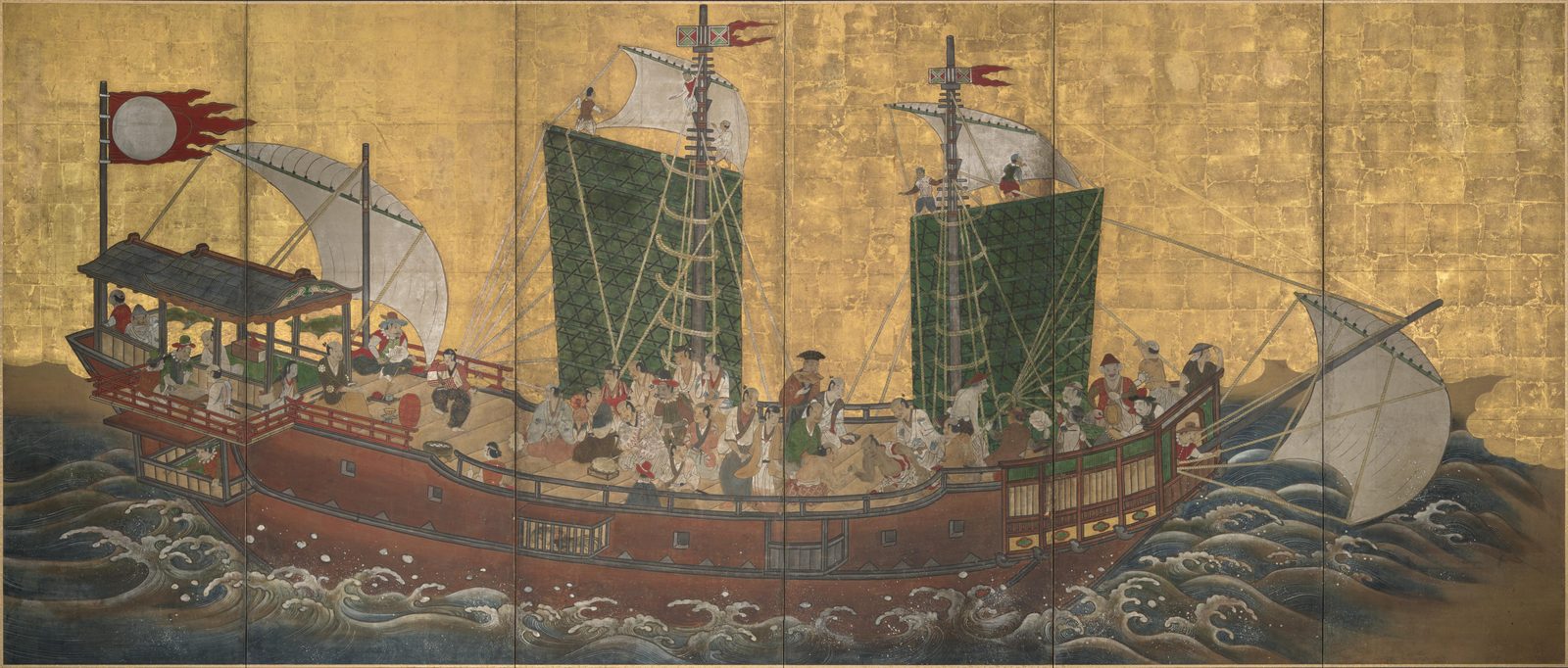
The man left to make Saris's factory work was Richard Cocks, a 50-year-old former grocer from Coventry who had spent much of his working life as a Merchant Adventurer in Bayonne, on the Franco-Spanish border, where he had run a modest import-export business and filed occasional intelligence reports for the English secretary of state. He was honest, diligent, well-intentioned, moderately conversant in French and Spanish, and entirely unprepared for what he was being asked to do.
Cocks had arrived at Hirado as Saris's second-in-command. When Saris appointed him Cape Merchant — chief factor — on the Clove's departure, he inherited a staff of eight Englishmen, three Japanese interpreters, two servants, a rented house with tatami floors and paper walls, and a strategic position that was, in commercial terms, nearly unwinnable. He proceeded to spend the next 10 years trying, with considerable personal integrity and almost no commercial judgment, to make the thing pay.
The English factory that Cocks inaugurated formally in November 1613 was a reasonably impressive physical establishment for a small Kyushu town. He progressively bought out the neighboring Japanese houses, demolished them to create firebreaks, and surrounded the compound with earth walls three feet thick — a prudent measure in a town that had burned to the waterline more than once in living memory. Inside, the English installed storage godowns, a provisions store, a small hospital for sick sailors, and a garden. In the garden, Cocks planted the first sweet potatoes ever grown in Japan — he had acquired the tubers from a Ryukyuan merchant — unwittingly inaugurating what would, two centuries later, become a staple crop of Kyushu. It is a detail of his tenure that outlived everything else he attempted.
The English merchants Cocks commanded were a reasonably able but factious group. Richard Wickham, the second-in-command, was ambitious, intelligent, and convinced that Cocks was mismanaging everything — a conviction he would air at length in letters to London that Cocks never saw until Batavia was reading them out to him in 1624. William Eaton ran the sub-factory at Osaka with genuine competence. Tempest Peacock — a name one could not reasonably invent — was sent to Cochinchina to open trade and was murdered there in 1614. William Nealson ran sub-factories at Edo and Kyoto and drank himself steadily towards an early grave. Edmund Sayers managed the office at Tsushima, probing the possibility of trade with Korea.
For his chief intermediary with the shogunal court, Cocks had Adams — now on a Company salary of £100 per annum, a contract Saris had forced him into against his will and which Saris's private instructions to Cocks ("the Remembrance," as it was known) explicitly stipulated he was not to be allowed to disburse Company money. Adams was to pilot ships and interpret documents. Political influence was to be exercised by Cocks and Wickham. It was, in retrospect, a bit like buying a racehorse and using it to pull a vegetable cart.
The Things They Could Not Sell
Why English Broadcloth Would Not Sell in Japan
The English had come to Japan to sell broadcloth.
English broadcloth was, in 1613, the staple export of the English textile industry: heavy, fulled wool cloth, produced by a network of weavers and finishers in the West Country and East Anglia, and shipped to every market England could reach. It was the single most important manufactured export the country possessed. The EIC's directors had loaded the Clove with hundreds of bolts of it on the entirely reasonable assumption that if it sold in Aleppo and Archangel and Elsinore it would sell in Japan. Broadcloth sold everywhere.
Broadcloth barely sold in Japan.
The reasons, in retrospect, were obvious. Japan is a warm, humid country. The Japanese elite dressed in silk, which was lighter, cooler, and more prestigious. They had no tradition of wearing heavy woollens and no particular desire to start doing so. The cloth the English brought was, additionally, often damaged — months in a ship's hold made worm-eaten, water-stained, or discolored bolts the norm rather than the exception — and the English had not sent a single factor who understood cloth finishing well enough to repair it.
Cocks tried everything. He sent factors to the daimyo courts with bolts as gifts. He adjusted prices downward repeatedly. He experimented with color: red cloth sold slightly better than black, though neither sold well. By the time the factory closed in 1623, much of the original 1613 cloth consignment was still in the warehouse, rotting quietly in the humid summers.
The other English imports were scarcely better received. Lead had a small market for shot. Tin sold adequately to the craftsmen of Sakai. Gunpowder and ordnance were regulated items requiring shogunal license. The goods the English acquired through their Southeast Asian "country trade" — sappanwood from Siam, deer hides from Cochinchina, ray and shark skins (prized in Japan for binding sword hilts) from Patani — moved reasonably well, but the profits were small beer compared to the prize the Company had actually come for.
That prize was raw Chinese silk.
The Silk That Never Came
The Silk-for-Silver Trade the English Could Not Enter
The entire European commercial operation in Japan — Portuguese, Dutch, and English — ran on a single fundamental arbitrage: silver out of Japan, silk into Japan. Japan was the largest producer of mined silver in the world outside the Americas. China was the largest producer of silk. The Ming emperor had banned direct trade between the two since the 16th-century Wokō depredations, and European traders filled the gap. The Portuguese had built an entire century of prosperity on this trade through their annual Nau do Trato from Macau. The Dutch were replicating it via their Southeast Asian networks. The English had nothing.
Cocks understood the problem and spent the rest of his time at Hirado trying to solve it. His chosen instrument was a Chinese merchant named Li Tan — known to the Europeans as Andrea Dittis — the powerful head of the Chinese community at Hirado, a Ming loyalist in exile who presented himself to Cocks as the man who could secure the English a Chinese trading patent. Cocks believed him.
For seven years Li Tan extracted a slow, steady stream of English silver in return for promises. Letters were being sent. Officials were being bribed. The patent was imminent. None of it produced a single bolt of Chinese silk. Whether Li Tan ever genuinely attempted anything or was simply running a long confidence trick is still debated; the evidence tilts towards the latter. When he finally died in 1625 — two years after the factory had closed — his outstanding debt to the English was booked at over 6,600 taels, roughly £1,650, an enormous sum that would never be collected.
The factory's books, meanwhile, drifted into chaos. Cocks was energetic but not methodical; his accounts had not been properly audited since 1617. The factory hemorrhaged capital while its chief factor wrote increasingly optimistic letters to London about the opportunities just around the corner. Next door, the Dutch were demolishing the English systematically.
The Neighbors Who Played to Win
How the Dutch VOC Outplayed the English at Hirado
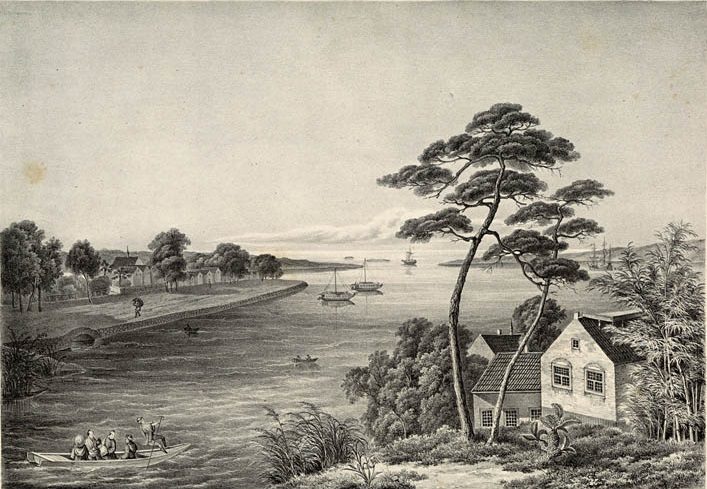
The VOC factory at Hirado was the English factory's nearest neighbor, its supposed Protestant ally, and its ruthless commercial assassin. The formal relations between the two establishments were correct. Jacques Specx hosted dinners. The English were invited. Letters were exchanged. Gifts were sent at New Year.
The Dutch also engaged, methodically and without remorse, in every form of commercial sabotage available to them. When the English tried to sell broadcloth, the VOC — with its own small stock of cloth — deliberately undercut their prices, absorbing short-term losses to destroy the market. When the English tried to buy pepper in Bantam for resale in Japan, Dutch buyers had bid the price up beyond profitability. When English factors traveled to Edo or Osaka, Dutch agents followed, sometimes visiting the same daimyo the day after an English call with improved offers on the same goods.
None of this was outside the rules of early-17th-century commerce. But the Dutch executed it with a discipline and capitalization the English could not match. The VOC in 1615 had roughly 10 times the capital reserves of the EIC, far better intelligence, tighter chains of command, and a willingness to lose money in the short term that was well beyond anything the English shareholders would tolerate. The Hirado factory was not so much outcompeted as slowly economically garrotted.
The formal climax of the competition came with the Anglo-Dutch Treaty of Defense of 1619 — signed in London, by which the two companies agreed to cease hostilities in Asia and cooperate against their common Iberian enemy. Its practical implementation in Japan was the Fleet of Defense, a joint privateering squadron based at Hirado that cruised the South China Sea between 1620 and 1622 attacking Portuguese and Spanish shipping. The fleet brought in, at its peak, some £100,000 in plunder, divided between the two factories.
It also brought in several hundred drunken sailors, who turned Hirado into what one English commander described as a "Second Sodamye" — taverns, brothels, riots, stabbings, venereal disease. It brought in the political attention of the Tokugawa shogunate, which had financial interests in the Portuguese trade the fleet was attacking and did not appreciate having its revenue stream disrupted. And in July 1621 it brought in the Shogunal Anti-Piracy Edict, which outlawed the fleet's piracy (bahan) in Japanese waters, banned the export of Japanese weapons and sailors, and hastened the dissolution of their joint operation in the summer of 1622. The dedicated article on the 1621 edict examines in detail how that legal architecture came together. Here it is enough to say that the one reliable source of profit the English had stumbled into during their entire time at Hirado was legislated out of Japanese waters in a single afternoon.
The Year Everything Died
1620: The Year the Hirado Factory Was Lost
1620 was the year the English factory's prospects passed the point of no return.
In May, William Adams died at Hirado. He was 56, in declining health for several years. He was buried at Hirado, though tradition holds that a memorial was later erected at his Hemi estate. His will divided his property between his English wife and daughter in Gillingham and his Japanese son Joseph — who inherited the Anjin title — and daughter Susanna.
Adams had been the single most valuable asset the English East India Company possessed in Asia. He was the only European whom the Tokugawa shogunate treated as a trusted intermediary. He had drafted the Seven Articles. He had spoken for the English at three audiences with Ieyasu. He had piloted the Company's junk, the Sea Adventure, on country-trade voyages to Siam and the Ryukyus. He had managed, year after year, to secure the renewal of the English trading patents despite the factory's chronic inability to pay its bills. With Adams gone, the English had no one. Joseph inherited his father's Japanese status but not his access to the court.
The worst of it was that Ieyasu himself had died four years earlier, in 1616, stripping the English of their most senior patron. His son Hidetada was less interested in European trade and increasingly preoccupied with the suppression of Christianity. Within months of his father's death, Hidetada curtailed the English free-trade privileges: the seven articles of 1613 were quietly restricted, and English commerce was henceforth confined to Hirado and Nagasaki. The subfactories at Edo, Osaka, Sakai, and Kyoto were ordered closed. The Company's links to the wealthy interior markets — already tenuous — were severed altogether.
By 1620, then, the English factory possessed: no access to the Chinese silk market, no permission to trade outside two Kyushu ports, no high-level advocate at the shogunal court, no commercially viable imports, and an increasingly chaotic financial position.
In 1622, the Anglo-Dutch alliance that had sustained the Fleet of Defense collapsed — the English had never supplied their stipulated share of ships and men, and the Dutch tired of carrying them. In early 1623 came the Amboyna Massacre — a VOC judicial execution of 10 English merchants and nine Japanese mercenaries in the Spice Islands on disputed charges of conspiracy, an atrocity that would poison Anglo-Dutch relations for a generation.
The decision to close Hirado, which Batavia had first ordered in 1622, was, in the circumstances, inevitable.
The Bull Sails Home
1623: The English Abandon Japan
On 25 April 1623, the English Council of Defense at Batavia formally resolved to dissolve the Hirado factory. Captain Joseph Cockram was dispatched on the ship Bull with orders to bring the English merchants away, collect what debts could be collected, liquidate what assets could be liquidated, and shut the establishment down.
Cockram arrived in the summer of 1623 and found a factory in what he called "deplorable confusion." The account books had not been properly reconciled in six years. Uncollected debts amounted to over 12,000 taels, most of them owed by Li Tan and not recoverable. The warehouse contained a quantity of unsold broadcloth so large that Cockram — who had some background in the cloth trade — concluded most of it would have to be written off. Several of the junior factors had died in the preceding years; others had run up personal debts the Company would now have to settle.
Cockram and Cocks did what they could. They sold off the factory buildings and what remained of the warehouse stock for whatever the local merchants would pay. They entrusted a power of attorney to the Dutch chief factor Cornelis van Neijenroode to collect the outstanding Japanese and Chinese debts on the Company's behalf — a courteous gesture that both sides knew was essentially theater. Letters of thanks were written to Matsuura Takanobu, to the bugyō of Nagasaki, and to the surviving senior officials at Edo, expressing the English hope that they might one day return.
On 23 December 1623, a farewell party was held in the half-emptied factory compound. The townspeople of Hirado came, and so did the Dutch. By the accounts of both Cockram and Van Neijenroode, there was considerable drinking and considerable weeping. Whatever else the English had failed to do over their 10 years in Japan, they had been, as individuals, liked. The jurebasso interpreters who had worked with them for a decade wept openly. Matsuura Takanobu — whose domain had been cheerfully hosting foreigners for 70 years — gave a short speech expressing regret. The Bull sailed the next day, Christmas Eve.
It took nearly six weeks to reach Batavia. Cocks spent most of the voyage in his cabin.
The Inquest
The Inquest at Batavia: Blaming Richard Cocks
What happened to Cocks at Batavia is painful to read. The EIC presidency, under its president Thomas Brockedon, was a hard-minded institution whose job was to identify commercial failures and assign blame. Cocks, on arrival in late January 1624, was summoned before an inquest and subjected to a comprehensive review of his management — conducted, with considerable energy, by his former subordinates.
The charges were fourfold. He had failed to manage his accounts since 1617. He had disobeyed Batavia's order to come away the year before. He had left behind uncollectable debts of over 12,000 taels. And — a charge that must have stung a man whose self-image was that of a diligent merchant — he had brought back a consignment of "trash and lumber" rather than valuable cargo.
Cocks had few defenders. Wickham, who had spent years criticizing him in private letters, had died in 1618; it was Cockram and the surviving factors who now testified against him. The presidency considered sending Cocks back to England as a prisoner to face formal charges, but concluded — on grounds that read as more contemptuous than merciful — that his "old age, physical weakness, and testy and wayward disposition" made such treatment likely to shorten his life beyond what the offense warranted. They settled for seizing his personal estate, valued at some £300, and sending him home as a free but disgraced passenger.
Cocks boarded the Ann Royal for England in February 1624. He was 61 years old, broken in health, bankrupted, and publicly blamed for an enterprise whose failure had been overdetermined by structural factors he had never had the power to remedy. He did not see England again.
On 27 March 1624, somewhere in the Indian Ocean, Richard Cocks died. He was buried at sea, wrapped in canvas, and sent over the side to the sound of a ship's ordnance discharge — the standard honors for a senior merchant of the Company. The log of the Ann Royal recorded the event in a single line. The latitude is not noted.
Ledgers of a Failure
What the Hirado Factory Cost the East India Company
The total losses to the EIC's investors across the decade are estimated at between £1,700 and £10,000 — a range whose width reflects the state of Cocks's books rather than any real uncertainty about the factory's performance. The factory had, in round terms, never been profitable in any year of its existence. The £100,000 in plunder generated by the Fleet of Defense, which had briefly made Hirado look like a going concern on paper, had been split with the Dutch and largely absorbed by the costs of the privateering operation itself. The silver the English had hoped would flow out of Japan had instead flowed the other way — London to Hirado to Li Tan and then nowhere.
The strategic lesson was clearer than the financial one. Commercial privileges, however generous, cannot overcome fundamental competitive disadvantages. The English had entered Japan with the best charter any European power had ever been granted, and they had lost because they were selling the wrong goods in the wrong town through the wrong middleman, while being systematically undercut by better-capitalized neighbors. Nothing in the Seven Articles could have fixed any of that.
The English did not return to Japan in any significant commercial capacity for more than 200 years. When they finally did — in the 1850s, as the Tokugawa isolation began to fray around the edges — they came as outsiders, without the advantages their predecessors had thrown away. The door that Ieyasu had held open for them in 1613 had long since closed.
What survived was the memory, and a few sweet potato plants. Matsuura Takanobu's domain continued to grow them. So did his neighbors. By the 18th century, the sweet potato — satsuma-imo, named after the Kyushu province where it had spread most widely — had become a staple famine-relief crop across southern Japan, credited with saving tens of thousands of lives in the crop failures of the 1730s. Cocks, whose books had never balanced and whose factory had never paid, had inadvertently introduced a plant that would feed more Japanese over the following two centuries than the entire Chinese silk trade had ever clothed.
It is not the legacy he would have chosen.
Sources & Further Reading
Farrington, Anthony. The English Factory in Japan, 1613–1623. 2 vols. British Library, 1991. The definitive documentary collection: transcribed versions of Cocks's diary, the factory's outgoing and incoming correspondence, and the Saris journal, with scholarly apparatus. Every subsequent study of the EIC in Japan draws from this foundation.
Massarella, Derek. A World Elsewhere: Europe's Encounter with Japan in the Sixteenth and Seventeenth Centuries. Yale University Press, 1990. The indispensable narrative history, with extensive and judicious treatment of the English factory alongside its Portuguese and Dutch counterparts.
Cooper, Michael. They Came to Japan: An Anthology of European Reports on Japan, 1543–1640. University of California Press, 1965. Contains substantial translated excerpts from Saris and Cocks, giving direct access to the factory's authorial voices.
Corr, William. Adams the Pilot: The Life and Times of Captain William Adams, 1564–1620. Curzon Press, 1995. The standard English-language biography of Adams, with detailed treatment of his tangled and mutually frustrating relationship with the English factory.
Milton, Giles. Samurai William: The Adventurer Who Unlocked Japan. Hodder & Stoughton, 2002. A popular narrative, accessible and vivid, covering Adams's career and the EIC venture at Hirado; draws heavily on Farrington and Massarella but brings the human drama forward.
Clulow, Adam. The Company and the Shogun: The Dutch Encounter with Tokugawa Japan. Columbia University Press, 2014. Essential for the VOC context — the neighbors who quietly destroyed the English at Hirado — and for understanding Tokugawa diplomatic protocol.
Clulow, Adam. "Commemorating Failure: The Four Hundredth Anniversary of England's Trading Outpost in Japan." Monumenta Nipponica, 68:2 (2013). A reflective scholarly essay published on the quatercentenary of the Clove's arrival, assessing historiographical legacies.
Satow, Ernest (ed.). The Voyage of Captain John Saris to Japan, 1613. Hakluyt Society, 1900. The first modern edition of Saris's journal, still valuable for the introduction's period context.
Thompson, Edward Maunde (ed.). The Diary of Richard Cocks, Cape-Merchant in the English Factory in Japan, 1615–1622. 2 vols. Hakluyt Society, 1883. Cocks's day-to-day diary, covering most of his tenure — a document of remarkable candor and administrative disorder in roughly equal measure.
Turnbull, Stephen. The Kakure Kirishitan of Japan: A Study of Their Development, Beliefs and Rituals to the Present Day. Routledge, 1998. Useful background on the Kyushu religious and political context in which the English factory operated.
Boxer, C. R. The Christian Century in Japan, 1549–1650. University of California Press, 1951. The foundational survey of European activity in Japan, with a substantial chapter on the English factory placing it in the broader imperial context.
Nachod, Oskar. Die Beziehungen der Niederländischen Ostindischen Kompagnie zu Japan im siebzehnten Jahrhundert. Leipzig, 1897. The classic German study of the VOC in Japan, still a reference work for the competitive commercial dynamics at Hirado.
Cite this page
Nanban.pt. “The Wrong Cloth in the Wrong Town: The English East India Company at Hirado, 1613–1623.” Last modified 25 September 2026. https://nanban.pt/articles/english-east-india-company-hirado/.
@misc{nanban-english-east-india-company-hirado,
  author = {Nanban.pt},
  title = {The Wrong Cloth in the Wrong Town: The English East India Company at Hirado, 1613–1623},
  year = {2026},
  url = "https://nanban.pt/articles/english-east-india-company-hirado/",
  note = {Last modified 2026-09-25}
}