The Paper War: How the Catholic Mission to Japan Tore Itself Apart
Before the Tokugawa destroyed the Church in Japan, the Church in Japan spent 40 years trying to destroy itself, in protocols, papal briefs, excommunication orders, prison letters, and public manifestos written on the very day its authors were marched onto the deportation ships.
The Catholic mission to Japan was split from 1585 to 1614 by a rivalry between the Portuguese Jesuits, who held a papal monopoly under the bull Ex pastorali officio, and the Spanish mendicant orders (Franciscans, Dominicans, and Augustinians) that broke it, a quarrel rooted in opposed missionary methods and the imperial competition between Portugal and Castile. It escalated through episcopal excommunications, printed polemics, and an open schism on the Nagasaki waterfront during the 1614 expulsion, leaving the Church unable to resist the Tokugawa persecution with a single voice.
The Nagasaki Waterfront Quarrel of 1614
The View from the Docks
On an autumn day in 1614, in the port of Nagasaki, a curious scene unfolded on the wooden piers where the deportation ships to Macau and Manila were being loaded.
88 Jesuits were being put aboard alongside several dozen Franciscans, Dominicans, and Augustinians, seven Japanese diocesan priests, and a crowd of prominent lay leaders including the great Christian daimyō Takayama Ukon. The Tokugawa shogunate, acting on the edict drafted by Konchiin Sūden the previous January, had finally decided to rid the country of its bateren problem by the simple expedient of putting them on boats and pointing the boats away from Japan. The foreign priests, who had in many cases spent decades in the country and who had seen this moment coming for years, were reflecting on how it could come to this. They were writing manifestos denouncing each other.
The Jesuit Provincial Valentim Carvalho, who had been designated administrator of the vacant bishopric of Funai on the death of Bishop Luis Cerqueira the previous February, was circulating a document asserting his ecclesiastical authority over the other orders. The Franciscan commissary Diego de Chinchón was circulating a document asserting that Carvalho was an unlawful intruder who possessed no such authority at all. Japanese diocesan priests, who had been ordained by the late Cerqueira and who resented being treated as auxiliaries to a Society of Jesus that had, in their view, never really wanted them to be priests in the first place, were signing Chinchón's document and adding their names to an open ecclesiastical rebellion. The Jesuits were responding with threats of excommunication. The friars were responding with threats of counter-excommunication. The whole operation was being conducted in full view of the Nagasaki bugyō's officers, who had come to the docks expecting to preside over an expulsion and found themselves refereeing a schism.
The Tokugawa officers are not recorded as having made any comment. They did not need to. Everything they had been told about European disunity, nationalistic rancor, the structural inability of the Christians to speak with a single voice, was being confirmed on the waterfront by the Christians themselves.
The Papal Monopoly That Gave Japan to the Jesuits
The Fence and the Fence-Jumpers
To understand how the Catholic mission to Japan reached the point of waterfront manifestos, it is necessary to go back to the beginning of the mission.
Ex pastorali officio, a papal bull issued by Pope Gregory XIII on 28 January 1585, was a short document with a surgical purpose: it reserved all missionary activity in Japan, under pain of excommunication, to the Society of Jesus. No Franciscan, no Dominican, no Augustinian, no friar of any description was to enter the archipelago in any pastoral capacity. The Jesuits alone were to preach the Gospel there. The Jesuits alone were to administer the sacraments. The Jesuits alone were to shape, by whatever strategy they chose, the Japanese Church.
The brief had been lobbied for by Alessandro Valignano, the Jesuit Visitor whose accommodation strategy had given the mission its institutional character. His argument was straightforward. Japan, he wrote in his 1583 Sumario, was a civilization too proud and too internally fragile to tolerate the sight of competing Christian sects. Introduce a second European order, different habits, different rules, different superiors, different theological emphases, and the Japanese would immediately notice the contradiction. The whole enterprise would unravel. He had, moreover, seen exactly how this played out in Portuguese India, where the public feuding between the Jesuits and the mendicants had disfigured the Goa mission for decades. He did not want the same thing in Japan. He got his brief.
The fence held for 22 months, give or take.
The problem was that in September 1580, nearly five years before Ex pastorali officio was issued, the Portuguese crown had passed by inheritance to Philip II of Spain. The Union of the Crowns had not formally merged the two empires, Portugal kept its own administration, its own Church structure, its own overseas padroado, but it had lowered the political barrier that had previously kept the Spanish Philippines out of Portuguese Asia. In Manila, the Spanish Franciscans, Dominicans, and Augustinians looked at the Jesuit monopoly on Japan, pointed out that Japan was almost visible from the northern tip of Luzon, and concluded that the Portuguese Jesuits were standing on a mountain of silk and souls they had no intention of sharing.
The friars found a loophole. In November 1586, Pope Sixtus V, a former Franciscan, issued a bull titled Dum ad uberes fructus, authorizing the Order of Friars Minor to found missions "throughout the East Indies." The Jesuits maintained that this general grant did not override the specific Japanese monopoly. The Franciscans, combining the new brief with whatever diplomatic cover they could improvise, ignored the Jesuit objection entirely.
The story of how they got in, Juan Pobre's accidental landfall at Hirado in 1584, the Dominican Juan Cobo's doomed 1592 embassy, and the decisive 1593 arrival of Pedro Bautista's Franciscans under Spanish diplomatic cover, is the subject of its own article on this site. What matters here is what the friars did once they were inside the country. They built a church in Kyoto. They built a leper hospital. They walked through the capital in their brown habits, ringing church bells, chanting in the streets, conducting processions, and doing every single thing that Toyotomi Hideyoshi's 1587 edict had specifically forbidden any Christian missionary from doing in Japan.
The Jesuits, who had spent the six years since 1587 keeping their heads down, saying Mass behind closed doors, and generally behaving like men who understood that their continued presence depended on not provoking a hegemon with a documented temper, watched this performance with the stunned disbelief of people who knew what would come next.
They wrote to Rome. They wrote to Goa. They wrote to Lisbon and Madrid. The friars, the Jesuits argued, were cultural illiterates with no Japanese beyond tourist phrases. They had been tolerated by Hideyoshi only because he had received them as ambassadors, a category that in the Japanese diplomatic system conferred a temporary inviolability which did not, emphatically, extend to proselytizing. By publicly flouting the 1587 edict, the Franciscans were not being brave. They were being stupid. And the stupidity was not theirs alone to pay for: it threatened the 300,000 Japanese converts who would bear the brunt of Hideyoshi's reaction whenever it came.
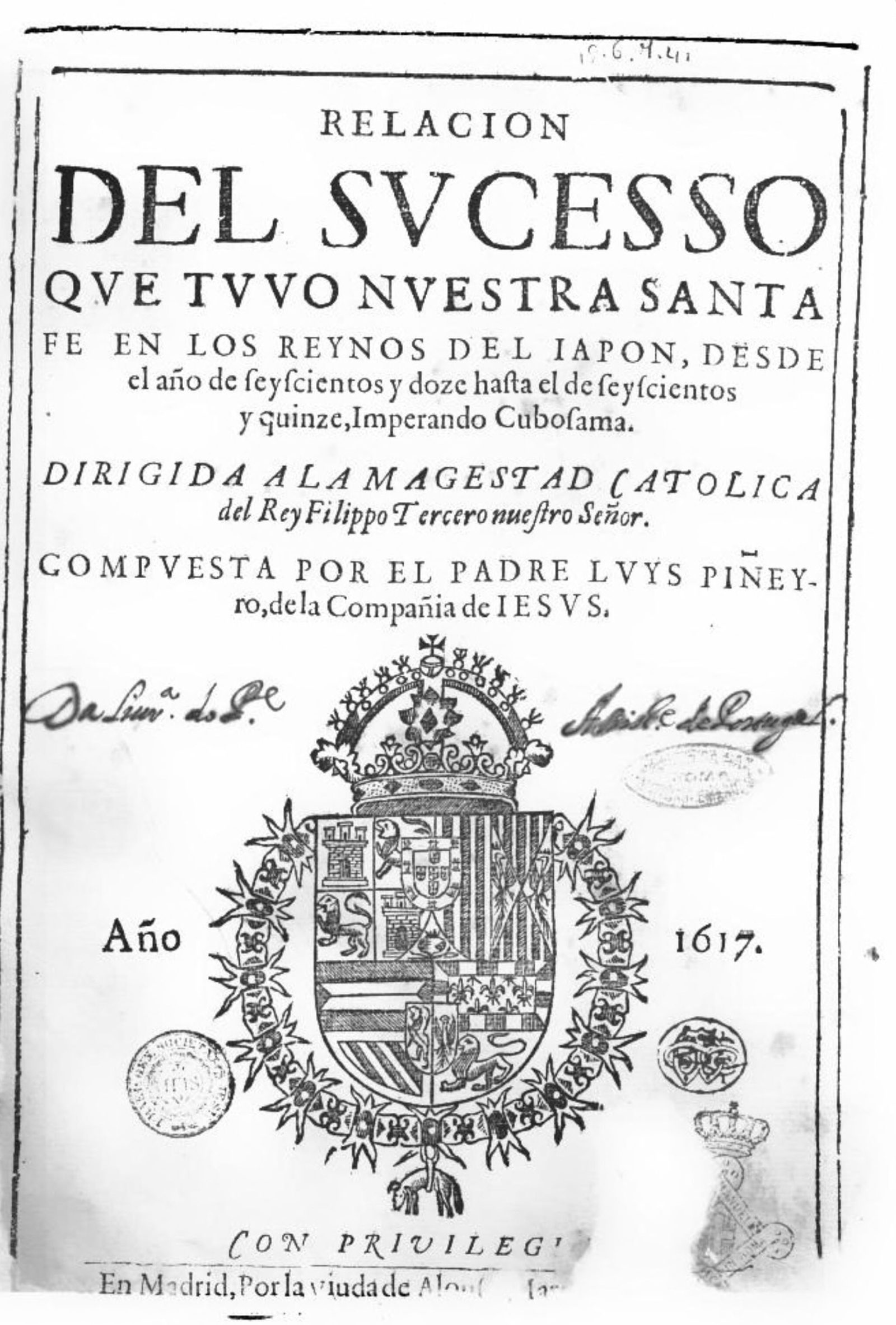
The Franciscans replied in kind. The Jesuits, they wrote to Manila and to Spain, were cowards. They were mercantile hypocrites whose involvement in the Macau–Nagasaki silk trade had corrupted their apostolate. They dressed like Buddhist abbots and feasted behind closed doors while the poor went untended. They had forgotten, if they had ever understood, that real missionaries proclaimed the Gospel openly and accepted martyrdom if it came. Veteran Jesuits such as Organtino Gnecchi-Soldo and the interpreter João Rodrigues Tçuzzu produced counter-polemics accusing the friars of "plebeian hubris." Both sets of accusations were copied, bound, shipped, and circulated throughout Catholic Europe, where they were read by cardinals and crown ministers with the same appetite that contemporary Protestants read them for confirmation that the papist enterprise was a sham.
The arguments were, in their own terms, not entirely wrong. The Jesuits were entangled in the silk trade. The Franciscans were endangering the entire Christian community. The two positions were not reconcilable, because they flowed from two fundamentally incompatible theories of what a missionary was supposed to do.
Two Missionary Methods: Accommodation Against Poverty
Two Theologies in One Harbor
The Jesuit method, formalized by Valignano and enforced after his 1581 replacement of Francisco Cabral, was one of cultural accommodation and elite conversion. The Society targeted the daimyō and the samurai class, on the theory that the masses would follow their lords. Jesuits learned Japanese to near-fluency, adopted Japanese etiquette and diet, and financed the mission through a direct commercial stake in the Chinese silk trade. They kept their numbers small, concentrated, and disciplined. They did not preach in the streets. When Hideyoshi's 1587 edict arrived, they retreated into the residences of their daimyō patrons and waited the hegemon's displeasure out.
The Franciscan method was its near-inverse on every axis. The friars defined themselves by evangelical poverty and refused, as a matter of principle, to modify their appearance to Japanese sensibilities. They built plain churches and hospitals in the poorest neighborhoods. They ministered to lepers. They preached in the streets. They celebrated Mass con voz alta, at full volume, in the heart of a capital where the hegemon had forbidden the practice of Christianity half a decade earlier. They accepted, as part of the theological package, the possibility that public ministry would produce public martyrdom, and regarded that possibility as a feature rather than a bug.
Each side looked at the other's method and saw not a tactical disagreement but a betrayal of the Gospel. The Jesuits regarded Franciscan practice as a theology of suicide, a romantic fantasy of primitive Christianity imposed upon a country whose elites would read it as political provocation. The Franciscans regarded Jesuit practice as a theology of appeasement, a worldly compromise with secular power. Both readings contained real substance. Neither could be reconciled with the other.
The theology was doctrinal. The fuel was national. The Jesuits in Japan were overwhelmingly Portuguese; the mendicants who entered after 1593 were overwhelmingly Spanish, arriving from the Spanish Philippines under Spanish superiors. The rivalry between the orders was thus also, and perhaps principally, a proxy war between two imperial administrations sharing a single monarch, Philip II, then Philip III, who sided with his Portuguese subjects until he gave way to his Spanish ones. By 1596, the disagreement had reached its first institutional crisis.
Bishop Pedro Martins and the Attempt to Enforce the Bull
The Bishop Who Tried to Enforce the Papal Bull
In August 1596, a new figure stepped off a Portuguese ship in Nagasaki harbor: Pedro Martins, a Portuguese Jesuit newly consecrated as the first resident bishop of the diocese of Funai. Funai had been erected as a full diocese only in 1588, and its first bishop, Sebastião de Morais, had died en route to his see without ever seeing it. Martins was the first bishop actually to take up residence. He arrived with the full sacramental and jurisdictional authority of a Catholic diocesan, and with a specific commission from Rome to restore order to the situation that had spiraled out of control while the see was vacant.
He was, in his own mind, clear about what that meant. On his first days in the city, Martins summoned the Franciscans. He produced Ex pastorali officio. He informed the friars that he was exercising his episcopal authority to enforce the brief. They were to leave Japan. They were to leave immediately. And until they had left, he was forbidding all Portuguese merchants and all Japanese Christians from attending Franciscan churches, receiving sacraments at Franciscan hands, or giving Franciscan houses alms of any kind. Anyone violating these prohibitions would incur formal ecclesiastical censure.
The friars refused to obey.
They did not merely ignore Martins's orders. They challenged his jurisdiction to issue them. The bishop, they argued, had misunderstood the applicable papal documents. Ex pastorali officio had been superseded, or at least complicated, by Sixtus V's Dum ad uberes fructus. The friars were in Japan under Spanish ambassadorial cover, which placed them outside the ordinary operation of the bishop's missionary jurisdiction. Martins was, in effect, trying to act as the agent of a Portuguese-Jesuit monopoly, and the monopoly itself was in canonical dispute. The friars would respect the bishop as a bishop. They would not obey him as an enforcer of a brief they regarded as legally voided.
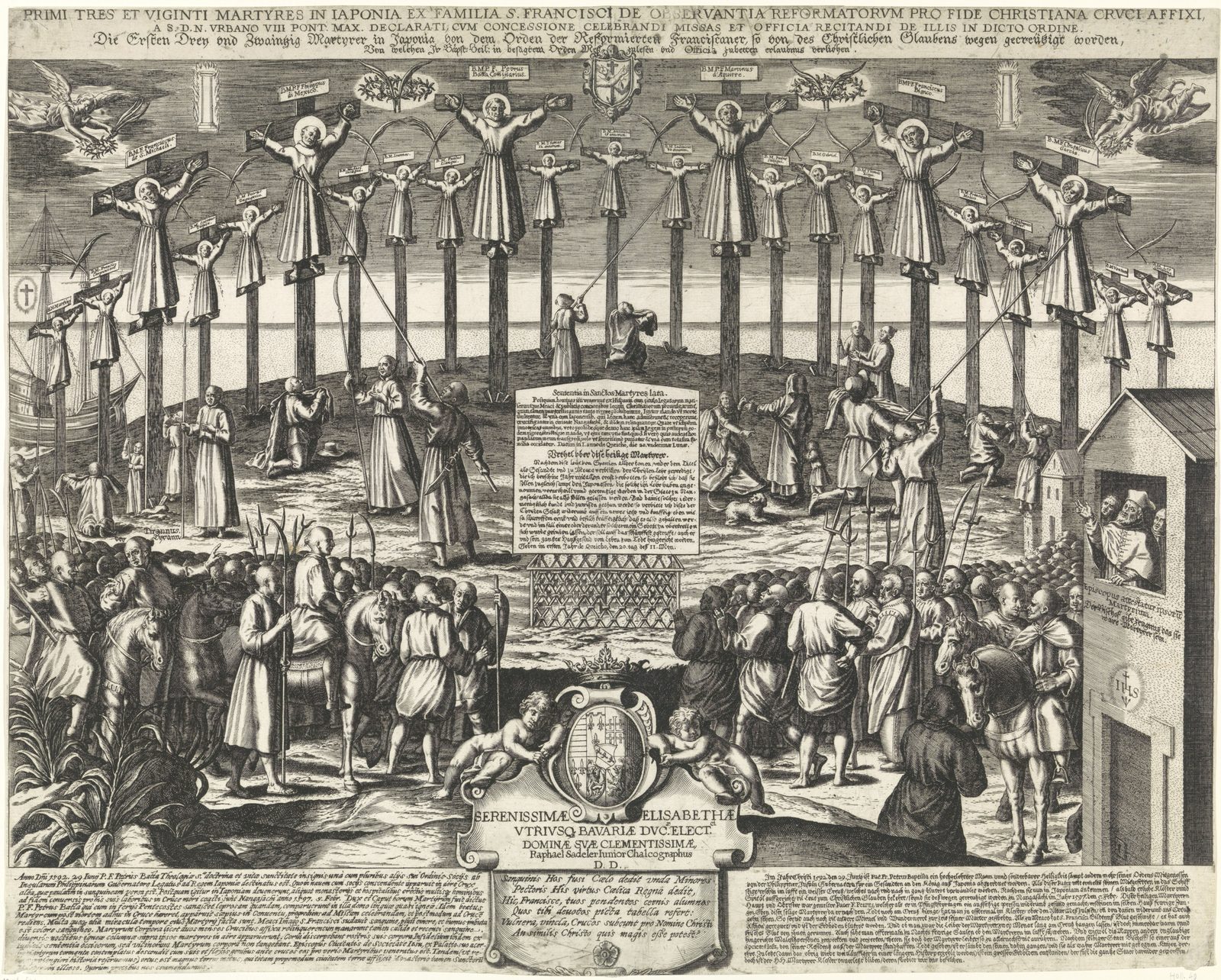
The standoff, had it remained a purely ecclesiastical matter, might have dragged on indefinitely. It did not. In October 1596, the Spanish galleon San Felipe wrecked on the coast of Shikoku, the pilot made catastrophic boasts about missionaries as a fifth column for Spanish conquest, and on 5 February 1597, 26 men were crucified on the hill of Nishizaka. Six were Franciscans. Three were Japanese Jesuits, including Paulo Miki, arrested essentially by mistake through his work at the Franciscan leper hospital in Kyoto. 17 were Japanese laymen, almost all of them affiliated with the Franciscan ministry.
The mendicants blamed the Jesuits for slandering them to the authorities. The Jesuits blamed the mendicants for provoking the catastrophe. The accusations, developed over the previous three years in European correspondence, now acquired a new and terrible concreteness. Each side held the other responsible for the deaths of specific men whose names and faces were known, and each side said so in writing that was collected, shipped, and read in the same European chanceries that had spent the previous decade being told the mission was a model of unified purpose.
Bishop Pedro Martins, whose enforcement attempt had coincided with the entire disaster, was back in Macau by 1597. He did not return.
How Clement VIII Broke the Jesuit Monopoly in 1600
The Broken Monopoly
In December 1600, Pope Clement VIII, a man whose diplomatic calendar was by this point substantially occupied with finding compromise formulae for disputes Clement VIII had personally played no part in creating, issued a bull titled Onerosa pastoralis officii. It formally opened the Japanese mission field to the mendicant orders.
The brief contained one crucial face-saving concession to Lisbon: the friars could enter Japan, but only via Lisbon, Goa, and Macau, and only under the Portuguese flag. The routing requirement was a transparent attempt to preserve the padroado real, to acknowledge, at least symbolically, that Japan remained a Portuguese ecclesiastical sphere even as it opened up to Spanish orders. The friars ignored it. Ships continued to leave Manila for Nagasaki carrying mendicant personnel. In 1602, the first Dominicans arrived officially from the Philippines, settling in the Shimazu domain of Satsuma. The first Augustinians arrived the same year, based themselves in Bungo. In 1608, Pope Paul V issued a further bull, Sedis Apostolicae, which lifted the routing restriction altogether. The Jesuit monopoly was finished, canonically and practically. The architecture Valignano had spent a decade building was a ruin.
It was into this ruin that Luis Cerqueira, who arrived as second bishop of Funai in August 1598, spent his 16-year episcopate trying to build something habitable. Cerqueira was himself a Portuguese Jesuit, but he understood, as the short-tempered Pedro Martins had not, that the monopoly was lost and the future was pluralist. His strategy was to use the authority of the bishopric to build an institutional framework within which Jesuits, mendicants, and Japanese diocesan clergy could coexist. He ordained seven Japanese priests, the first native diocesan clergy in Japanese history. He convened conferences of the religious orders. He refereed disputes over sacramental jurisdiction. When Clement VIII's 1600 compromise brief required the mendicants to travel via Lisbon, he published it and quietly ordered the Spanish friars to leave; they refused, and he did not enforce. When Paul V's 1608 Sedis Apostolicae made the argument moot, he absorbed the defeat and moved on.
A document survives from 23 September 1598, barely a month after his arrival, a formal protocol drawn up by the ecclesiastical notary Mattheus de Cours, signed by Cerqueira, Valignano, Vice-Provincial Pero Gómez, and others. It complains about the Manila friars who had entered Japan without papal authorization and affirms the bishop's authority to deport them. It is the voice of an institution trying to reassert a fence that had already been jumped. Cerqueira did not stop the rivalry, nobody could have, but he contained it, translated it into paperwork, and kept it from producing further public catastrophes.
Then, in February 1614, he died.
The Open Schism After the Okamoto Daihachi Scandal
The Waterfront Schism
The moment was, diplomatically, the worst possible. The Okamoto Daihachi scandal of 1612 had exposed a nest of Christian corruption in Ieyasu's own administration. The preliminary anti-Christian decrees had been issued in the shogunal domains. The definitive edict had just been issued from Edo Castle. Every European in Nagasaki who could read the political weather knew that expulsion was coming.
At this moment, the Jesuit Provincial Valentim Carvalho was designated administrator of the vacant bishopric. The appointment was legally correct, provisional administration during an episcopal vacancy was the standard canonical procedure, but it was politically ruinous. The mendicant orders, who had spent the previous two decades resisting every Jesuit assertion of jurisdictional authority, read Carvalho's designation as a Jesuit attempt to use the bishop's death to reimpose something like the old monopoly under emergency cover. The Franciscan commissary Diego de Chinchón, flanked by Dominican and Augustinian colleagues and supported by most of the seven Japanese diocesan priests whom Cerqueira had ordained, publicly repudiated Carvalho's authority.
The feud was conducted, as their feuds were always conducted, on paper. Both sides produced manifestos. Both sides produced counter-manifestos. Both sides accused the other of trying to sabotage the Japanese Church at the precise moment it needed unity most. And both sides kept producing this material right through the autumn of 1614, as the ships arrived in Nagasaki harbor and the deportation was carried out.
Approximately 47 ecclesiastics defied the edict and went underground to sustain the Japanese flock: 27 Jesuits, seven Franciscans, seven Dominicans, one Augustinian, and five Japanese diocesan priests. The rest were put on ships. The schism went with them. Carvalho reached Macau and continued to issue pronouncements; Chinchón reached Manila and continued to issue counter-pronouncements. The Japanese Church, now driven into hiding and bleeding missionaries at a rate of several dozen a year to Tokugawa torture chambers, was being administered on paper by two rival ecclesiastical governments writing past each other across the South China Sea.
Murayama Tōan, the Catholic daikan of Nagasaki from 1602 to 1616, offers a measure of how far the domestic Japanese Church had absorbed the European rivalry. Initially a loyal Jesuit supporter, Murayama developed an intense animosity towards the Society, and particularly towards João Rodrigues Tçuzzu, his commercial rival in the silk trade, and actively sponsored the Dominican and Franciscan houses in Nagasaki as a counterweight. He was, in effect, a Japanese Catholic layman using the inter-order rivalry as a tool of local factional politics. The shogunate, when it moved against him, executed him without distinguishing which order he had supported. To the Tokugawa, the distinctions were irrelevant.
How the Quarrel Reached Rome in the 1620s
The Dominican Who Moved the Fight to Europe
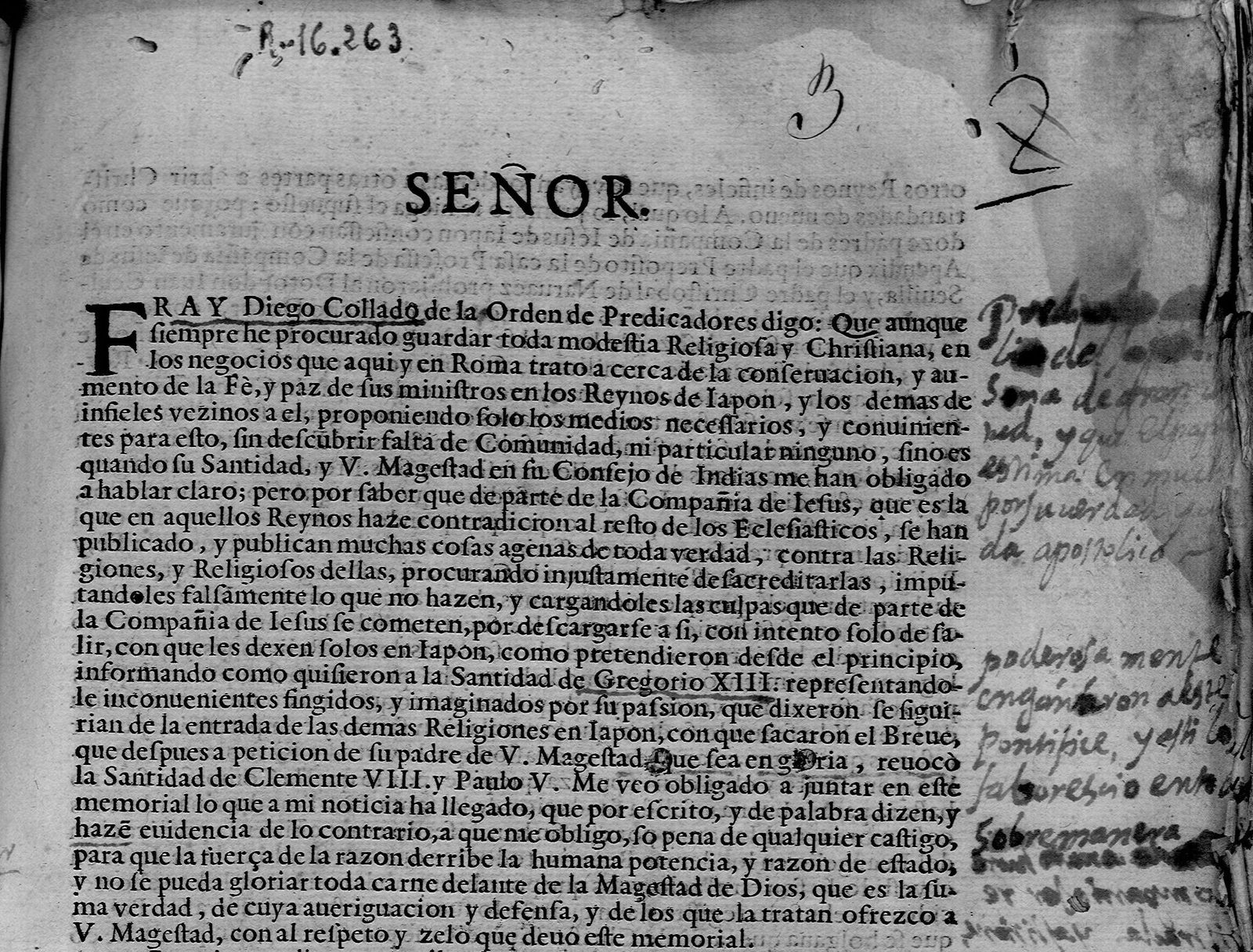
A visitor arriving in Rome in the mid-1620s might have encountered, in the corridors near the offices of the newly established Congregation for the Propagation of the Faith, a Spanish Dominican in his late thirties carrying a leather satchel stuffed with documents. His name was Diego Collado. He had spent 1619 to 1622 ministering clandestinely in Japan. He had been present at the Great Martyrdom of Nagasaki on 10 September 1622, when 55 Christians were burned or beheaded on Nishizaka hill. He had then left the country with a precisely defined political mission: to destroy what remained of Jesuit authority over the Japanese Church from within the ecclesiastical institutions of Catholic Europe.
Collado's campaign was a masterpiece of institutional warfare.
He carried with him, in his satchel, the rulebooks of Jesuit confraternities in Japan, affidavits signed by Japanese lay leaders of the Dominican Cofradías del Rosário, and a lengthy letter written in 1624 from a Japanese prison cell by the Franciscan Luis Sotelo, whose earlier career as the diplomatic architect of the Keichō Embassy was a separate saga, indicting the Society of Jesus for "political arrogance" and "mercantile greed" and laying the entire Tokugawa persecution at the Jesuits' feet. Sotelo would be burned alive at Ōmura in August 1624, making him a conveniently unimpeachable source: you could not cross-examine a martyr.
Collado used the documents with an operator's precision. He lobbied Pope Urban VIII for the appointment of four separate bishops for the four religious orders in Japan, formally ending the unified diocesan structure Cerqueira had tried to maintain. He lobbied Propaganda Fide, the new Roman congregation established in 1622 specifically to coordinate mission work worldwide, to strip Japan of padroado oversight and reassign it to direct Roman supervision, a move that would have broken the administrative link with Lisbon and Macau entirely. He produced print pamphlets in Spanish and Latin accusing the Jesuits of sabotaging the mendicant mission and of protecting their own personnel by leaving the mendicants to face the worst of the Tokugawa torture chambers.
The Jesuits counter-lobbied, with comparable intensity, through Vice-Provincial Sebastião Vieira, who reached Europe in the late 1620s, produced counter-documents and counter-pamphlets, and successfully defended the Society's record. The net result of the campaign, after a decade of argument, was inconclusive: Propaganda Fide took a more active role in Japanese affairs, but the four-bishoprics plan was quietly shelved.
By the time the pamphlets had finished circulating there was no Japanese Church left above ground to administer. The Shimabara Rebellion had been crushed, the 1640 Macau Embassy had lost 61 heads, and Sakoku had closed the archipelago to Portuguese shipping. The visible Church in Japan was gone. The paperwork quarrel about who should have been administering it was, by that point, an argument about the furniture of a house that had been burned to the ground.
Collado himself died in 1641, reportedly by shipwreck on the South China coast, returning to Asia with a fresh cargo of grievances and ecclesiastical plans. His legacy, in the longer term, was not the reforms he had failed to achieve but the archive he had produced: the Dominican case against the Jesuits in Japan, preserved in the files of Propaganda Fide, was one of the central evidentiary bases for every subsequent historical reassessment of the Society's conduct in East Asia, down to the Suppression of the Jesuits in 1773. He lost his fight. He won the historical record.
What the Rivalry Cost the Mission
The Laboratory Next Door
It is worth pausing to note, while the Europeans are busy destroying each other in protocols, how the story looked from the other side of the room.
The Tokugawa shogunate had been told repeatedly, by advisors ranging from the Zen monk Konchiin Sūden to the English pilot William Adams, that the Christian mission was a unified apparatus of Iberian imperialism, a disciplined institutional force whose clerical arm prepared native populations for conversion while its commercial and military arms prepared the political groundwork for conquest. The shogunate had a theory, and the theory called for a unified enemy.
What the shogunate encountered in practice was, by any reasonable observation, not unified at all. Between 1596 and 1614 alone, Tokugawa observers could have collected a thick dossier of examples of the Catholic mission acting like several different organizations with incompatible strategies and open contempt for one another. The Franciscans denouncing the Jesuits in printed memorials. The Jesuits denouncing the Franciscans in counter-memorials. Bishop Martins ordering excommunications that the friars openly defied. The Dominicans and Augustinians slipping in through diplomatic side-doors. Murayama Tōan weaponizing the feud for his own ends. The whole spectacle was available for inspection throughout the period when Ieyasu and his advisors were making their decisions about what to do with the Church.
The remarkable thing is that the Tokugawa, confronted with abundant evidence that the enemy was disunified, chose to treat the enemy as unified anyway. The 1614 Expulsion Edict makes no distinction between Jesuits and mendicants. The persecution apparatus developed under Inoue Masashige made no distinction.
This is the quietly terrible conclusion that emerges from the paper trail: the European rivalry did not cause the Tokugawa to destroy the Church. The Tokugawa had political and ideological reasons of their own, entirely independent of anything the Jesuits and the Franciscans were saying about each other, to destroy it. What the rivalry destroyed was the Catholic capacity to resist the destruction, to present a coherent front to Japanese authorities, to lobby unified responses, to make the persecution politically expensive to the Bakufu. There was never a unified Catholic voice for the Tokugawa to be forced to listen to, because the Catholics had spent 40 years making sure no such voice could exist.
Sources & Further Reading
Boxer, C. R. The Christian Century in Japan, 1549–1650. University of California Press, 1951. The foundational English-language synthesis, with extensive treatment of the inter-order rivalry drawn from Jesuit, Franciscan, and Dominican sources.
Cieslik, Hubert. "The Great Martyrdom in Edo 1623: Its Causes, Course, Consequences." Monumenta Nipponica 10, no. 1/2 (1954): 1–44. Essential for the period between the 1614 expulsion and Iemitsu's accession.
Elison, George. Deus Destroyed: The Image of Christianity in Early Modern Japan. Harvard University Press, 1973. Analyzes the ideological framework of the Tokugawa persecution and includes substantial discussion of how the shogunate read, and misread, the Catholic mission.
Hesselink, Reinier H. The Dream of Christian Nagasaki: World Trade and the Clash of Cultures, 1560–1640. McFarland, 2016. Detailed treatment of Bishop Cerqueira's episcopate, the 1598 Protocol, and the schism of 1614 in the immediate Nagasaki context.
Higashibaba, Ikuo. Christianity in Early Modern Japan: Kirishitan Belief and Practice. Brill, 2001. Indispensable for understanding the lay confraternities and Japanese diocesan clergy whose institutional resilience survived the rivalry that helped destroy the Church above them.
Moran, J. F. The Japanese and the Jesuits: Alessandro Valignano in Sixteenth-Century Japan. Routledge, 1993. The standard study of Valignano's mission strategy and of the ideological case for Ex pastorali officio.
Paramore, Kiri. Ideology and Christianity in Japan. Routledge, 2009. Situates the inter-order polemics within the broader Tokugawa anti-Christian discourse that eventually absorbed them.
Pérez, Lorenzo. Cartas y relaciones del Japón. 3 vols. G. López del Horno, 1916–1923. The fundamental Spanish-language collection of Franciscan correspondence from the Japan mission, containing much of the anti-Jesuit polemical material that fueled the rivalry.
Ruiz-de-Medina, Juan G. El martirologio del Japón, 1558–1873. Institutum Historicum Societatis Iesu, 1999. Comprehensive martyrology covering all four orders and the Japanese diocesan clergy.
Schütte, Josef Franz. Valignano's Mission Principles for Japan. Institute of Jesuit Sources, 1980–1985. The definitive study of the Jesuit mission strategy that Ex pastorali officio was designed to protect.
Sola, Emilio. Historia de un desencuentro: España y Japón, 1580–1614. Fugaz Ediciones, 1999. Treats the Manila–Nagasaki diplomatic triangle and its consequences for the mendicant missions.
Turnbull, Stephen. The Kakure Kirishitan of Japan: A Study of Their Development, Beliefs and Rituals to the Present Day. Japan Library, 1998. The essential study of the underground Church that inherited the surviving fragments of both Jesuit and mendicant practice.
Üçerler, M. Antoni J., S.J. The Samurai and the Cross: The Jesuit Enterprise in Early Modern Japan. Oxford University Press, 2022. The most recent major reassessment of the Society's strategy, including substantial treatment of the disputes with the mendicants.
Cite this page
Nanban.pt. “The Paper War: How the Catholic Mission to Japan Tore Itself Apart.” Last modified 25 September 2026. https://nanban.pt/articles/catholic-mission-rivalry/.
@misc{nanban-catholic-mission-rivalry,
  author = {Nanban.pt},
  title = {The Paper War: How the Catholic Mission to Japan Tore Itself Apart},
  year = {2026},
  url = "https://nanban.pt/articles/catholic-mission-rivalry/",
  note = {Last modified 2026-09-25}
}