Jan Huyghen van Linschoten: The Spy Who Sank an Empire
A Dutch clerk in Portuguese Goa spent five years copying classified sailing charts and cataloging colonial rot. The book he published when he got home broke the Iberian monopoly on the East and launched the fleets that would eventually replace Portugal in Japan.
Jan Huyghen van Linschoten (c. 1563 to 1611) was a Dutch clerk who served the Archbishop of Goa from 1583 to 1589 and secretly copied the roteiros, the classified Portuguese sailing directions for the routes to India, Malacca, Macau and Nagasaki. His Itinerario, published in Amsterdam in 1595 and 1596, put those state secrets into print, and within months the first Dutch fleet sailed for the East Indies, breaking the Iberian monopoly that had sustained the Portuguese trade with Japan.
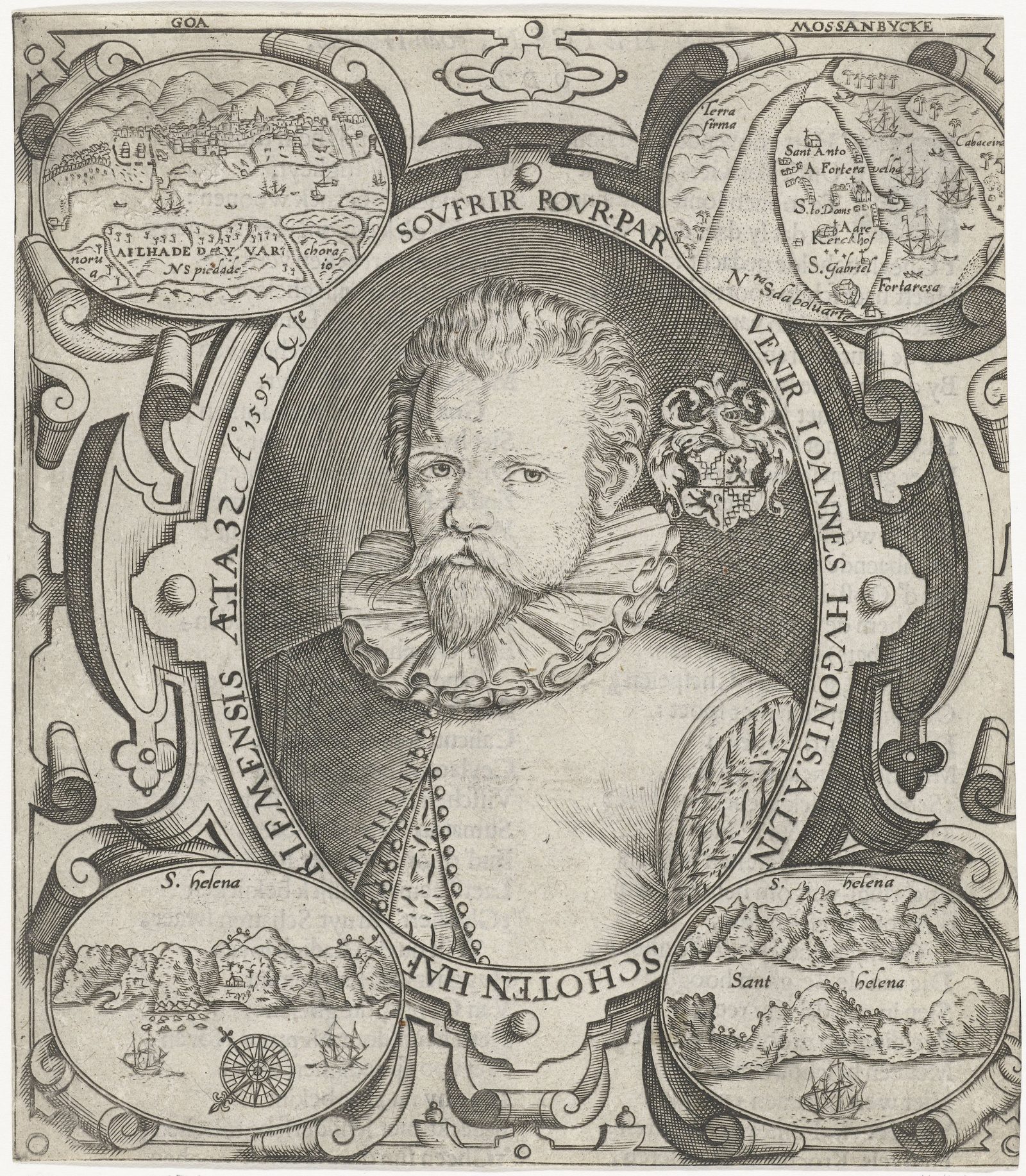
The Boy from Enkhuizen
Who Was Jan Huyghen van Linschoten? Birth and Boyhood in Holland
The Portuguese Empire's most devastating security breach began with a boy who read too many books.
Jan Huyghen van Linschoten — "John, son of Hugh," named after the village of Linschoten in the province of Utrecht — was born around 1563 in Haarlem, into a Roman Catholic family with modest commercial ties to the Iberian world. His parents, Huych Joosten and Maertgen Hendrics, had come from the nearby town of Schoonhoven, and their son's early childhood was shaped by the single most defining experience of the 16th-century Low Countries: war.
The Eighty Years' War between the Dutch and their Spanish overlords swallowed Haarlem whole. The Spaniards were driven from Holland in 1572, recaptured the city after a brutal siege in 1573, and left behind a population that had learned what happened when you were on the losing side of a religious conflict. Linschoten's father — "old Hugh" — did what any sensible man with a family would do: he packed up and moved to Enkhuizen, a seaport on the Zuider Zee that had declared early for the rebel cause.
Enkhuizen was a town built on salt herring and the sea. Its harbor bristled with masts. Its merchants traded across the Baltic and the North Sea. For a boy with an appetite for stories about distant lands. Linschoten later recalled that from a young age he took no small delight in reading histories and accounts of strange adventures, and that the stories had kindled in him a desire to see the world that no amount of parental caution could extinguish. He had firm opinions about the alternative. There was, he wrote, no time more wasted than when a young fellow hangs about his mother's kitchen, neither knowing what poverty is, nor luxury, nor what is found in the world — an ignorance which was often the cause of a man's ruin.
The Road to Lisbon
How a Dutch Catholic Reached Lisbon and the India Fleet, 1580–1583
Two of Linschoten's brothers had already left for Spain before 1576, chasing the merchant opportunities that the Iberian world offered to anyone with nerve and connections, regardless of which side of the religious divide they stood on. The fact that the Linschoten family was Catholic helped — it meant they could operate in Spanish and Portuguese territories without the theological complications that would have tripped up a Calvinist — but the real currency was commercial ambition, and the brothers had it in abundance.
John followed them. He traveled first to Seville, the great silver clearing house of the Spanish Atlantic, and then to Lisbon, where he arrived in September 1580 and stayed until 1583. Lisbon in the 1580s was the undisputed capital of the maritime world. Every year, the Carreira da Índia — the great India fleet — departed from the Tagus estuary bound for Goa, carrying soldiers, missionaries, and merchants toward a colonial empire that stretched from Mozambique to Macau. Every year, those ships came back loaded with pepper, cinnamon, silk, and the accumulated profits of a monopoly that had been running, essentially unchallenged by any Northern European power, for the better part of a century.
For a young Dutchman with sharp eyes and a capacious memory, Lisbon was an education. The wharves reeked of spice and ambition. The Casa da Índia — the royal warehouse complex — processed the incoming cargoes. The streets hummed with intelligence about prices, routes, and the thousand small disasters that afflicted every fleet. And everywhere, if you knew where to look, were the cracks in the façade: the ships that came back half-empty, the officials who whispered about corruption in Goa, the ruinous overextension of a tiny kingdom trying to hold an empire that spanned three oceans with a population smaller than that of a single major German city.
Linschoten looked. Linschoten listened. And in 1583, his brother secured him the position that would change the history of European expansion.
The Archbishop's Clerk
Why the Archbishop of Goa Hired Linschoten as His Clerk in 1583
The position was clerk to Don Frey Vicente de Fonseca, the newly appointed Archbishop of Goa — which is to say, the Archbishop of all the Indies, the most senior Catholic prelate east of Rome, the man responsible for the spiritual governance of every Portuguese colonial possession from East Africa to Japan.
Fonseca was a Dominican monk from a noble house who had seen more of life's extremes than most men of the cloth. He had served as chaplain to the young King Sebastian of Portugal and accompanied the king on the catastrophic invasion of Morocco in 1578 — the Battle of Alcácer-Quibir, where Sebastian was killed (or vanished; the Portuguese would spend the next century debating which), the cream of Portuguese nobility was slaughtered, and Fonseca himself was captured and held prisoner until a ransom was paid. His survival earned him the favor of Philip II of Spain, who had absorbed the Portuguese crown in 1580 and now needed loyal men to administer an empire that was suddenly his responsibility.
Fonseca did not want the job. He dreaded the voyage to India — months of scurvy, storms, and the very real possibility of never arriving — and initially refused the appointment. Philip persuaded him by promising to recall him to a better position in Portugal within four or five years.
For Linschoten, the appointment was providential. As the Archbishop's personal clerk, he would have access to ecclesiastical correspondence from every corner of the Portuguese East. He would sit at the center of an intelligence network that connected Goa to Macau, Macau to Nagasaki, Nagasaki to the Jesuit missions scattered across the Japanese archipelago. He would handle documents that most Portuguese officials, let alone foreign merchants, would never see. He would be trusted, because he was Catholic, because he was the Archbishop's man, and because nobody in the Portuguese colonial administration had yet developed the institutional paranoia necessary to suspect that a quiet Dutch clerk might be taking very careful notes.
The fleet departed Lisbon on 8 April 1583. They touched at Mozambique on 5 August, took on provisions, and entered the river of Goa on 21 September. Archbishop Fonseca was brought into town with great triumph and installed in his palace. Linschoten unpacked his bags, sharpened his quill, and began the most consequential espionage operation of the 16th century.
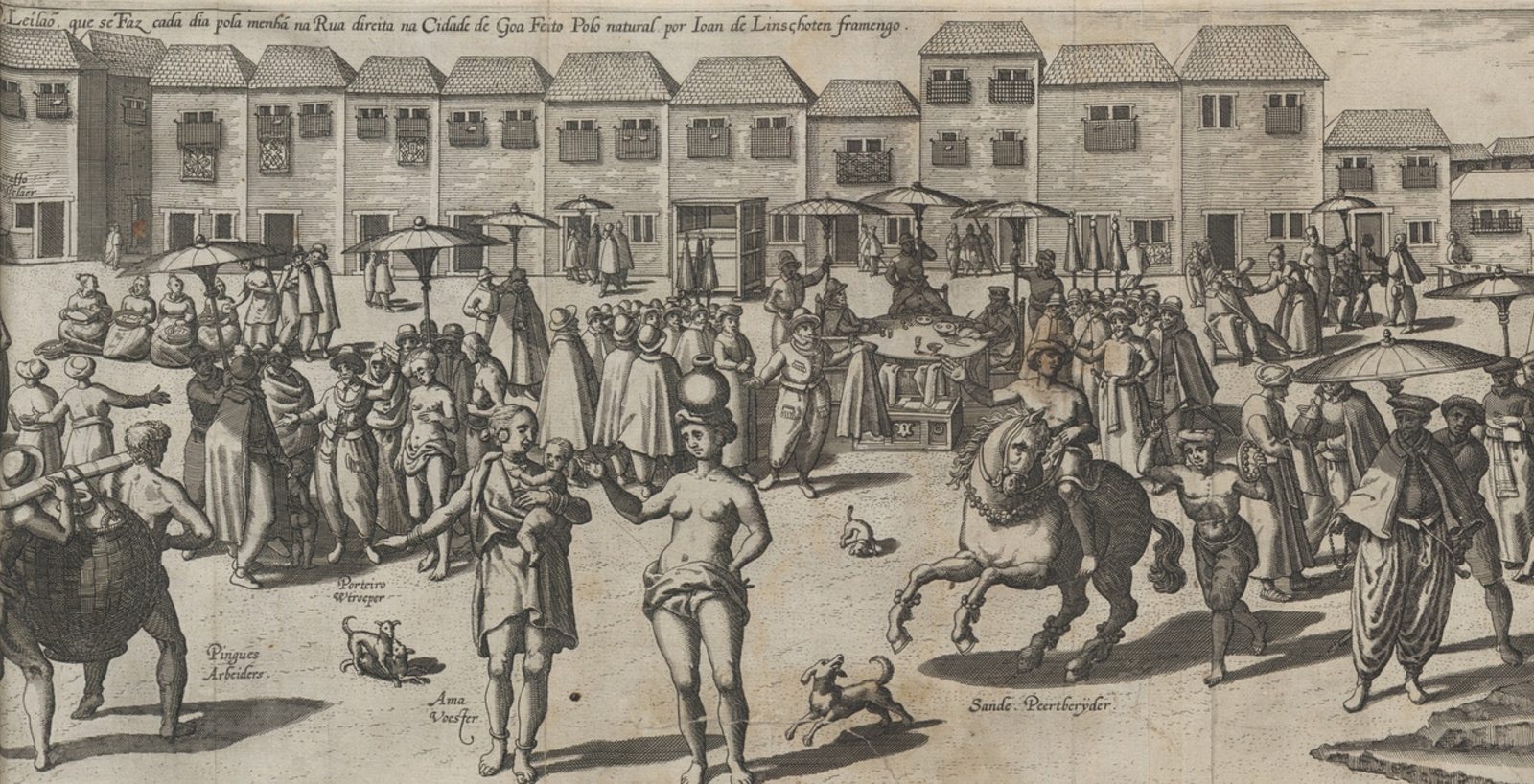
Five Years in the Heart of the Machine
What Linschoten Saw in Goa: Corruption in the Estado da Índia
Goa in the 1580s was the capital of everything Portugal claimed to control east of the Cape of Good Hope — and a living catalog of everything it could not. The city was cosmopolitan in a way that few European cities could match: Indians, Moors, Jews, Armenians, Gujaratis, Banyans, and Brahmins jostled alongside Portuguese fidalgos, Jesuit missionaries, Dominican friars, soldiers of fortune, and merchants from every corner of the Indian Ocean world. Linschoten recorded it all with the dispassionate eye of a man who understood that information was more valuable than spice.
He observed that Goa operated on a principle of pragmatic religious tolerance that would have scandalized the Inquisitors back in Lisbon. Non-Christians were permitted to live and trade freely in the city, provided they conducted their religious observances behind closed doors. The public sphere was Catholic. The commercial sphere was whatever it needed to be. This was the fundamental operating logic of the Portuguese Empire — faith at the front door, profit at the back — and Linschoten grasped it immediately.
He was equally sharp-eyed about the empire's structural rot. Portuguese officials, he documented, treated their royal appointments as personal commercial fiefdoms. He used the fortress of Hormuz in the Persian Gulf as a case study: its captaincy was one of the most lucrative posts in the Indies, not because of any legitimate administrative function, but because the captain could enforce an illegal monopoly on all trade passing through the strait. No man could buy or sell, load or unload any goods before the Captain had sold, shipped, freighted, and sent off his own. The King of Portugal explicitly forbade the practice. The captains, operating thousands of miles from any effective oversight, ignored the prohibition with the serene confidence of men who knew that by the time any complaint reached Lisbon, they would be rich and retired.
This was not an isolated case. Linschoten documented a pattern of systematic corruption that permeated the entire Estado da Índia — from the viceroys who arrived poor and left wealthy, to the customs officials who skimmed cargoes, to the military commanders who traded when they should have been patrolling. The empire was not merely corrupt; it was structurally dependent on corruption, because the Crown could not afford to pay its officials adequate salaries and instead compensated them with opportunities for graft. The system functioned as long as no external competitor appeared to exploit the resulting inefficiencies.
The Intelligence on Japan
What Linschoten Learned About Japan, Silk and Japanese Silver
Linschoten never sailed further east than Goa. He never set foot in Macau, never watched the Nau do Trato drop anchor in Nagasaki harbor, never climbed the terraced hills of a Japanese port city. Everything he knew about the Far East, he learned secondhand — from Jesuit correspondence that passed through the Archbishop's office, from classified Portuguese nautical documents, and from the testimony of merchants and sailors who returned to Goa with tales of a market so profitable it bordered on the fantastical.
His most valuable informant was a fellow Dutchman: Dirck Gerritsz, a gunner from Enkhuizen who had sailed twice to Japan aboard Portuguese vessels. Gerritsz had made the round trip from Macau to Nagasaki on the great ship Santa Cruz in 1585–86, and he carried in his head — and, critically, in his logbook — the exact sailing directions for the most profitable commercial route in the Portuguese Empire. The two Enkhuizen men found each other in Goa, as compatriots abroad tend to do, and Gerritsz shared everything: courses, depths, shoals, anchorages, the timing of the monsoon winds, the landmarks that guided the Nau do Trato through the treacherous approaches to the Japanese coast.
Linschoten also gathered intelligence from the Jesuit accounts that flowed through the Archbishop's correspondence network. The Society of Jesus maintained an extraordinarily detailed communications system — annual letters, special reports, financial accounts — that tracked every aspect of the mission in Japan, from the number of converts in each domain to the political allegiances of the local daimyō to the precise quantities of silk being exchanged for silver. For the Archbishop's clerk, reading this material was part of his job. Cataloging it for future Dutch use was his private initiative.
The picture that emerged was extraordinary. Japan, Linschoten learned, was a group of large islands whose inhabitants were wealthy, sophisticated, and desperately hungry for Chinese silk — a commodity that the Portuguese, exploiting the Ming dynasty's trade embargo against Japan, supplied in exchange for Japanese silver at margins that would have made a Venetian banker weep with envy. The Captain-Major who held the monopoly on the annual Japan voyage could expect a clear profit of 150,000 to 200,000 ducats — a sum so large that it represented a meaningful fraction of the Portuguese Crown's annual revenue from the entire Eastern empire. The Macau–Nagasaki run was, quite simply, the most profitable trade route on Earth, and the Portuguese had been running it for decades without any European competition whatsoever.
Linschoten noted the details with the precision of a man who was assembling a prospectus. He recorded the three types of silk the Portuguese carried — the finest being white Nanking silk — along with local currencies, conversion rates, and the specific commodities available in Japanese markets. He was not merely observing. He was building a business case.
The Theft of the Century
What Were the Roteiros and How Did Linschoten Steal Them?
The most devastating thing Linschoten stole was not intelligence about Japan. It was the means to get there.
The Portuguese had maintained their monopoly on the Eastern trade for nearly a century not primarily through military force — they lacked the manpower for that — but through information control. The roteiros, the classified sailing directions that guided Portuguese ships from Lisbon to Goa, from Goa to Malacca, from Malacca to Macau, from Macau to Nagasaki, were state secrets guarded with an intensity that modern intelligence agencies would recognize. These were not vague descriptions of distant shores. They were precise navigational manuals: all the courses, havens, islands, depths, shallows, sands, the times of the year when the winds blow, with the true tokens and knowledge of the tides and the weather. They were the keys to the empire, and the Portuguese understood perfectly well that the moment those keys fell into the wrong hands, the monopoly was finished.
Linschoten copied them. Methodically, over the course of his five years in Goa, he transcribed roteiro after roteiro — Portuguese and Spanish sailing directions covering the routes from the Arabian Sea to the Chinese coast. He obtained the exact rutters for the Macau–Nagasaki round trip as sailed by the Santa Cruz, courtesy of Dirck Gerritsz. He compiled approach routes for the primary Japanese anchorages: Kuchinotsu and Fukuda in southwest Kyushu, the alternative return courses from Hirado to Macau. He supplemented these with exhaustive notes on ocean depths, shoals, tidal patterns, and monsoon timing.
The scale of the theft was breathtaking. In a single, sustained act of espionage, a Dutch clerk operating under the cover of an Archbishop's household assembled the complete navigational infrastructure that Northern European fleets would need to reach, and trade with, every major market in maritime Asia. The Portuguese had spent a century building this knowledge, expedition by expedition, shipwreck by shipwreck, dead reckoning by dead reckoning. Linschoten took it in five years with a pen and a good memory.
He also arrived at a conclusion that was arguably more dangerous than the stolen charts themselves: the Portuguese Empire was an illusion. The vast swathes of territory it claimed on its maps — the spice islands of the Indonesian archipelago, the trading ports of Southeast Asia, the sea lanes between India and China — were, in many cases, not under any meaningful Portuguese military or political control. The garrisons were understaffed. The fortresses were undermaintained. Entire regions that appeared on Portuguese maps as imperial possessions were, in reality, independent polities where European merchants could trade freely if they simply showed up. In Java, Linschoten noted, European merchants might well traffic without any hindrance, for the Portuguese did not actually go there.
This was the intelligence that mattered most. The roteiros told the Dutch how to get to Asia. The assessment of Portuguese weakness told them they could survive when they arrived.
The Long Way Home
Linschoten's Return from Goa to Enkhuizen, 1589–1592
Archbishop Fonseca died at sea in 1587, on the voyage home to Portugal, and with him went Linschoten's institutional cover. The news reached Goa only in September 1588, and the clerk stayed on just a few months more — there were affairs to settle, debts to collect, and, one suspects, a few final documents to copy — before departing from Cochin on 20 January 1589, aboard a vessel that also carried his friend Dirck Gerritsz.
The voyage home became an adventure in its own right. The fleet touched at St. Helena to take on provisions, and there Linschoten encountered Gerrit van Afhuysen, an Antwerp merchant returning from a 14-month stay in Malacca. Afhuysen was a goldmine of commercial intelligence about the Far East, and Linschoten interviewed him with the thoroughness of a man who understood that every scrap of information had value. He also found time to sketch the coastlines of St. Helena and Ascension Island — because that was the kind of man he was: a compulsive documenter, incapable of letting geography pass unrecorded.
The fleet reached the Azores on 22 July 1589, but the presence of English privateering squadrons in the waters around Terceira made the approach hazardous. The ships anchored uneasily, and on 4 August, a tempest caused the vessel from Malacca to founder. The ship went down carrying a fortune in Eastern cargo, and Afhuysen — who had a commercial interest in the wreckage — persuaded Linschoten to remain on Terceira and help organize the salvage operation using divers.
Linschoten agreed, and what was supposed to be a brief layover became a two-year sojourn. The local governor took a liking to the well-traveled Dutchman and gave him the run of the island, including a horse — a mark of considerable favor. Linschoten used the time productively. He wrote a full description of the Azores. He documented the English privateering expeditions that prowled the waters. And he was present when the English commander Sir Richard Grenville, aboard the Revenge, fought his famous last battle against a Spanish fleet off Flores in August 1591 — a spectacle of doomed naval heroism that Linschoten recorded for posterity.
He finally reached Lisbon on 2 January 1592 and arrived home in Enkhuizen on 3 September of the same year, after an absence of nearly 13 years. He found his mother, brother, and sister in good health. His father had died shortly after his departure.
Linschoten was 29 years old. He had in his possession the most comprehensive collection of Portuguese imperial intelligence ever assembled by a foreign national. Now he had to decide what to do with it.
The Book That Launched a Thousand Ships
What Is the Itinerario? Linschoten's 1596 Book and Its Four Parts
What he did was write. For three years, Linschoten compiled his vast collection of notes, observations, maps, stolen navigational data, and commercial intelligence into a work of such scope and practical utility that it would reshape the geopolitics of the Eastern hemisphere. The result was the Itinerario: Voyage ofte Schipvaert van Jan Huygen van Linschoten naer Oost ofte Portugaels Indien, published in Amsterdam between 1595 and 1596.
The book was enormous in every sense. It was divided into four major treatises that collectively functioned as an encyclopedic trader's manual, an ethnographic survey, and a navigational guide — the kind of book that a nation would need if it wanted to send its own ships to Asia and not rely on Portuguese goodwill to do so.
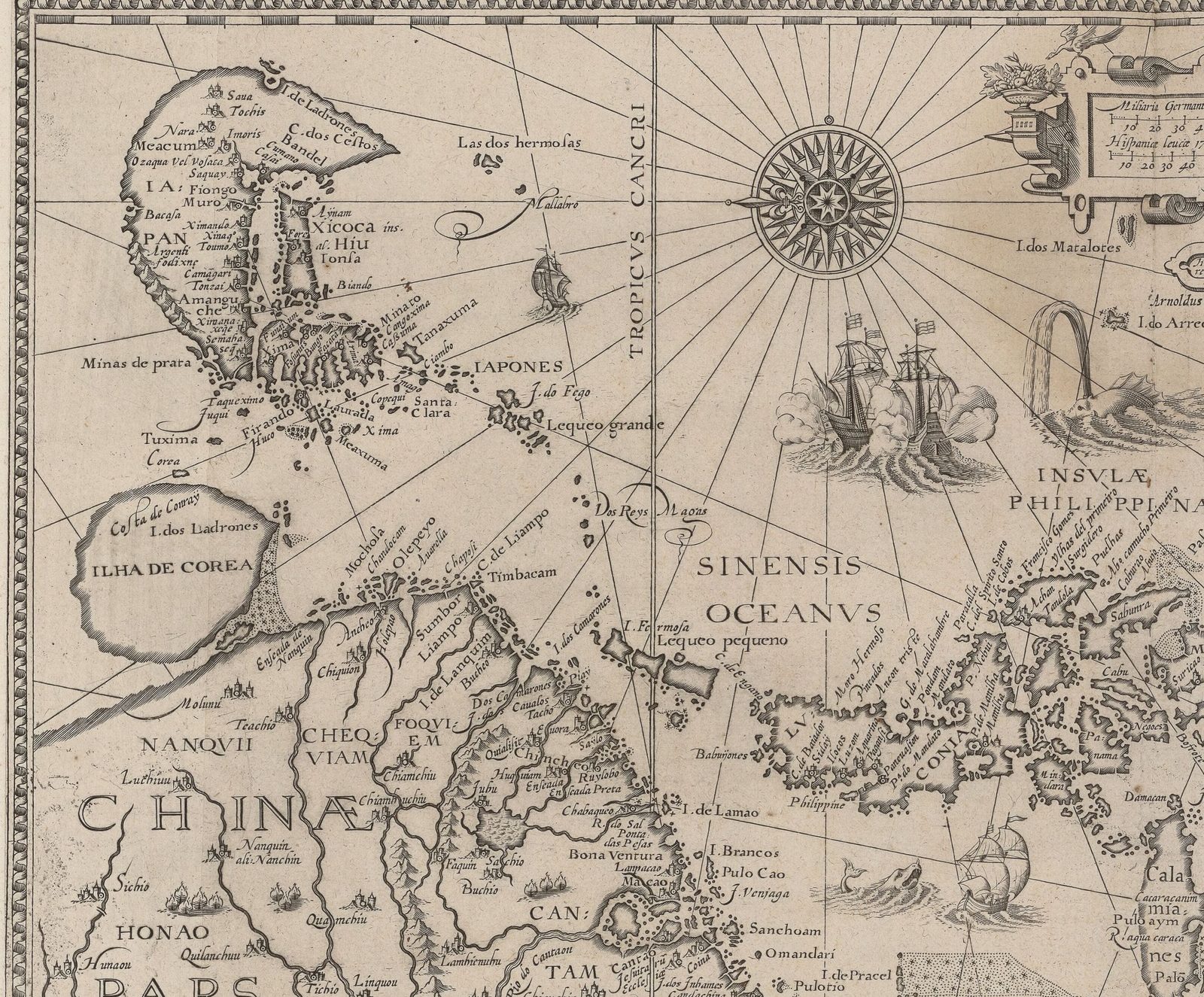
The first treatise was Linschoten's personal account of his voyage and his five years in Goa: a vivid, deeply observed portrait of the Portuguese colonial world, its peoples, customs, religions, governments, and — always, relentlessly — its commercial opportunities. The second treatise, which was considered so urgent that it was actually printed first, as a separate volume, in 1595, contained the stolen roteiros: the classified sea routes and navigational guides that the Portuguese had guarded as state secrets for a century. Dozens of folio pages were dedicated specifically to the China and Japan coasts. The first treatise also provided meticulous commercial intelligence on Asian commodities — pepper, nutmeg, mace, camphor, silk — with details on sources, prices, and the specific currencies and weights used in each market. It also covered the regions Linschoten had never visited — China, Japan, Southeast Asia — drawing on his interviews with merchants and sailors and on the Jesuit correspondence he had read in Goa. The third treatise described the coasts of Africa and the Americas, compiled from earlier writers with the help of the physician Bernard Paludanus, and a fourth summarized the domains and revenues of the King of Spain.
The Itinerario also contained something that purely textual descriptions could not convey: maps. Detailed, engraved maps of the sea routes, the coastlines, the harbors — visual intelligence that transformed abstract sailing directions into something a navigator could actually use. The large maps were not Linschoten's own work: his publisher, Cornelis Claesz, had them made by the van Langren brothers from Portuguese and Spanish charts obtained with the help of the cartographer Petrus Plancius, while Linschoten himself drew the harbor plans. But the data was Portuguese, and the combination of text and image made the Itinerario a weapon of extraordinary precision.
The impact was immediate. Richard Hakluyt, the great English geographer who had spent years lobbying the English Crown to challenge the Iberian monopoly, recognized the Itinerario instantly for what it was: a blueprint for breaking into the Eastern trade. At Hakluyt's urging, an English translation was published in 1598 — John Huighen Van Linschoten his Discours of Voyages into ye Easte and West Indies — and subsequent translations into French, Latin, and German turned it into a pan-European sensation.
The Fleets That Followed
How the Itinerario Launched the VOC and the East India Company, 1595–1602
The Itinerario did not merely describe the possibility of Northern European trade in Asia. It provided a specific, actionable strategy. Linschoten had identified Java as the critical vulnerability: a major source of spices that was not under Portuguese military control and where, he assured his readers, European merchants could traffic without any hindrance. The advice was precise, commercially reasoned, and, as a choice of target, devastatingly correct, even though Portuguese merchants were in fact already trading at Bantam.
In April 1595 — within months of the navigational volume's publication — the first Dutch fleet bound for the East Indies set sail under the command of Cornelis de Houtman. The expedition targeted the Strait of Sunda and Java, exactly as Linschoten had recommended, deliberately avoiding Portuguese strongholds. The Reys-gheschrift — the navigational directory extracted from the Itinerario — was already printed and carried aboard. Houtman's voyage was far from smooth: he lost men to disease, fought with local rulers, and returned with a cargo that barely covered costs. But he returned. He had proven that Dutch ships could reach the Indies, trade, and come home. Within two years, 65 Dutch ships were heading for Asia. By 1602, the competing Dutch trading companies had merged into the Vereenigde Oost-Indische Compagnie — the VOC, the Dutch East India Company — which would become the largest and most powerful commercial enterprise the world had yet seen.
The English followed the same script. Hakluyt incorporated Linschoten's material into his own Principal Navigations and used the intelligence to lobby Queen Elizabeth, demonstrating that English fleets could reach the Indies by targeting regions beyond the Iberian powers' effective control. When the English East India Company was formed in 1600, its directors used the Itinerario as a primary planning document. The book was considered so reliable that it was issued to Company commanders as standard navigational equipment. Captain John Saris, commanding the Eighth Voyage in 1613, was given a copy by the EIC directors and recorded in his journal that he found Linschoten's rutters perfectly accurate when navigating his ship, the Clove, along the Japanese coast — nearly two decades after the information had been published, and three decades after Dirck Gerritsz had originally sailed the route.
The Jesuits, watching from their missions in Japan, had their own views on Linschoten's commentary. His Itinerario had included a scathing attack on what he characterized as the rapacious greed of the Society of Jesus, not only in Japan but across the Indies. He had noted the Tenshō embassy — the visit of the young Japanese Christian nobles to Europe — but used the occasion to question the Jesuits' motives rather than celebrate their achievement. This anti-Jesuit stance likely reflected the institutional sympathies of his employer: Archbishop Fonseca was a Dominican, and the rivalry between the Dominicans and the Jesuits in Asia was a low-grade ecclesiastical war that colored every piece of intelligence that passed through Goa. Linschoten absorbed his patron's prejudices along with his patron's paperwork.
The Ice and the Silence
Linschoten's Arctic Voyages and His Death in 1611
Linschoten had one more adventure left in him. In 1594, he joined an expedition to find a Northeast Passage to Asia over the top of Russia — a shorter route that would avoid both the Portuguese-controlled Cape route and the Spanish-controlled Strait of Magellan. He sailed as supercargo of the Enkhuizen ship, alongside the navigator Willem Barentsz, and the fleet of three ships, from Middelburg, Enkhuizen and Amsterdam, sailed from Texel with the same mixture of commercial optimism and geographical ignorance that characterized most 16th-century polar expeditions.
The ice stopped them. Barentsz reached the coast of Novaya Zemlya before the ice forced him back; Linschoten's ships reached the Kara Sea and came home convinced the passage was open. A second expedition in 1595, with Linschoten now one of its two Chief Commissioners, fared no better. Linschoten's journals of these voyages — illustrated with maps and engravings of the indigenous peoples of Northern Russia — were published and added to his growing reputation as a chronicler of the world's edges. But the Northeast Passage remained frozen shut, and the strategic significance of the attempt faded as the success of the Houtman voyage proved that the southern route via the Cape worked perfectly well.
After 1595, Linschoten took no further part in maritime expeditions. He settled permanently in Enkhuizen, was appointed treasurer to the town, and spent his remaining years in the quiet, respectable pursuits of a provincial Dutch intellectual. He collaborated with the physician Bernard Paludanus and the cartographer Lucas Jansz Waghenaer. He translated Josef de Acosta's Historia natural y moral de las Indias into Dutch. In 1609, he translated a Spanish royal letter regarding the expulsion of the Moriscos. These were the activities of a man who had seen the world and was now content to process it from the safety of a study.
His financial situation, however, was not what a man who had reshaped European geopolitics might have expected. Linschoten petitioned the States-General for a pension, arguing, not unreasonably, that his intelligence had directly enabled the Dutch trading empire in Asia. The government disagreed. The publication patents for his books, they decided, were sufficient remuneration. The man who had stolen the keys to the Eastern trade was told, in effect, that his royalties should cover it.
Jan Huyghen van Linschoten died on 8 February 1611, in Enkhuizen, at the age of 48. He left behind no great fortune. He left behind the book that made fortunes possible.
The Shadow Over the Nanban Century
How Linschoten Ended the Portuguese Monopoly in Japan
The story of the Nanban period is, at its core, a story about monopoly — who held it, who exploited it, who broke it. For nearly 60 years, the Portuguese had the Eastern trade to themselves. The Nau do Trato sailed its annual circuit between Macau and Nagasaki, the Jesuits built their missions under the commercial umbrella of the silk trade, and the entire structure depended on a single, fragile assumption: that no other European power possessed the navigational knowledge to challenge it.
Linschoten destroyed that assumption. The roteiros he stole and published gave the Dutch and the English the technical means to reach Asia. The commercial intelligence he compiled gave them the economic incentive. And the devastating portrait he painted of Portuguese colonial weakness — the corruption, the overstretched garrisons, the vast territories claimed on maps but controlled by no one — gave them the confidence that the Portuguese would not be able to stop them.
The consequences, for Japan, were transformative. The arrival of Dutch and English merchants in the first decade of the 17th century shattered the Catholic monopoly on European contact — a monopoly on which the entire Jesuit mission depended. William Adams, the English pilot who washed ashore in 1600 aboard a ship guided by Dutch navigational intelligence derived from Linschoten's work, demonstrated to Tokugawa Ieyasu that European trade could be separated from European religion. The Dutch, who established their factory at Hirado in 1609, proved it commercially. The Portuguese, who could not — or would not — make that separation, were eventually expelled. The sakoku edicts that closed Japan to most European contact were, in a very real sense, the downstream consequence of a Dutch clerk's five years of patient note-taking in a Portuguese archbishop's office.
Linschoten never saw the VOC grow into the commercial colossus that his intelligence had midwifed into existence. He never collected the pension he felt he deserved. He was buried in Enkhuizen. His Itinerario survived. It was reprinted, translated, copied, and carried aboard ships for decades after its author's death. It sat on the shelves of VOC directors in Amsterdam and EIC merchants in London. It is one of the most consequential publications in the history of European expansion.
Sources & Further Reading
Linschoten, Jan Huyghen van. Itinerario: Voyage ofte Schipvaert van Jan Huygen van Linschoten naer Oost ofte Portugaels Indien. Amsterdam, 1596. Edited by H. Kern and published by the Linschoten-Vereeniging, 's-Gravenhage: Martinus Nijhoff, 1910–39. 5 vols. The critical scholarly edition of the original Dutch text, with extensive annotation.
Linschoten, Jan Huyghen van. John Huighen Van Linschoten his Discours of Voyages into ye Easte and West Indies. Translated by William Phillip. London, 1598. Its first book reprinted by the Hakluyt Society, 1885. The first English translation, produced at the urging of Richard Hakluyt.
Burnell, A.C. and P.A. Tiele (eds.). The Voyage of John Huyghen van Linschoten to the East Indies. Hakluyt Society, First Series, vols. 70–71. London, 1885. The standard English-language scholarly edition with extensive editorial notes.
Parry, J.H. The Age of Reconnaissance: Discovery, Exploration and Settlement, 1450–1650. Weidenfeld & Nicolson, 1963. Places Linschoten's intelligence coup within the broader context of European maritime expansion.
Boxer, C.R. The Portuguese Seaborne Empire, 1415–1825. Hutchinson, 1969. Essential for understanding the structural weaknesses in the Portuguese colonial system that Linschoten documented and exploited.
Subrahmanyam, Sanjay. The Portuguese Empire in Asia, 1500–1700: A Political and Economic History. Longman, 1993. A comprehensive reassessment of the Estado da Índia that confirms many of Linschoten's observations about corruption and overextension.
Wichmann, A. Dirck Gerritsz: Ein Beitrag zur Entdeckungsgeschichte des 16ten und 17ten Jahrhunderts. A study of Linschoten's key informant, the Enkhuizen gunner who provided the sailing directions for the Macau–Nagasaki route.
Lach, Donald F. Asia in the Making of Europe. University of Chicago Press, 1965–93. 3 vols. The monumental survey of European knowledge of Asia, with detailed treatment of the Itinerario's role in disseminating intelligence about Japan and China.
Massarella, Derek. A World Elsewhere: Europe's Encounter with Japan in the Sixteenth and Seventeenth Centuries. Yale University Press, 1990. Traces the direct line from Linschoten's published intelligence to the English and Dutch voyages to Japan.
Boxer, C.R. The Christian Century in Japan, 1549–1650. University of California Press, 1951. The standard account of the Jesuit mission, with valuable context on the Protestant disruption that Linschoten's publications enabled.
Hakluyt, Richard. The Principal Navigations, Voyages, Traffiques and Discoveries of the English Nation. London, 1598–1600. Contains material derived from Linschoten and documents the English reception of his intelligence.
Israel, Jonathan. Dutch Primacy in World Trade, 1585–1740. Clarendon Press, 1989. The definitive economic history of the Dutch trading empire, with analysis of how the Itinerario catalyzed the VOC's expansion into Asia.
Cite this page
Nanban.pt. “Jan Huyghen van Linschoten: The Spy Who Sank an Empire.” Last modified 25 September 2026. https://nanban.pt/articles/jan-huyghen-van-linschoten/.
@misc{nanban-jan-huyghen-van-linschoten,
  author = {Nanban.pt},
  title = {Jan Huyghen van Linschoten: The Spy Who Sank an Empire},
  year = {2026},
  url = "https://nanban.pt/articles/jan-huyghen-van-linschoten/",
  note = {Last modified 2026-09-25}
}