A License from the Council: The First 'Sakoku' Decree of 1633 and Nagasaki's New Magistrates
In the spring of 1633 Tokugawa Iemitsu's senior councilors handed Nagasaki's two new magistrates a code of instructions that still let licensed Japanese ships sail and allowed some emigrants to return under conditions. The harsher text often quoted under that year turns out to belong to 1635.
The first 'sakoku' edict was the code of instructions, conventionally counted as 17 articles, that the Tokugawa senior council (rōjū) issued on the 28th day of the second month of Kan'ei 10 (6 April 1633) to Nagasaki's two new magistrates, Imamura Masanaga and Soga Hisasuke. It still let Japanese ships sail abroad with the council's hōsho as well as the vermilion seal and let some emigrants return under conditions, while the harsher text often quoted under 1633, which bans all voyages and makes every return from residence abroad a capital offense, is the code of 1635.
Instructions for Two Bannermen
The Rōjū's 17-Article Order of April 1633 to Two Nagasaki Magistrates
On the 28th day of the second month of Kan'ei 10 (6 April 1633), the senior council of the Tokugawa shogunate, the rōjū (老中), issued a set of written instructions to two men about to take charge of Nagasaki. Imamura Masanaga, known as Denshirō, and Soga Hisasuke, known as Matazaemon, were hatamoto (旗本), bannermen in the shogun's direct service rather than daimyō with domains of their own. They were going to Nagasaki as its bugyō (奉行), or magistrates, and the instructions told them what they were to permit, what they were to forbid and what they were to refer back to Edo.
The document is conventionally counted as 17 articles, and historians have placed it first in a series of five maritime orders issued in the Kan'ei era, in 1633, 1634, 1635, 1636 and 1639. Together those orders are known as the "sakoku edicts," after a word meaning "closed country" that none of their authors used. In form, the first of them was a working brief for two officials. It covered Japanese shipping abroad, the hunt for Catholic priests and the mechanics of the Nagasaki silk market, and it treated all three as matters of administration in a single port city that happened to carry most of Japan's dealings with the Portuguese.
Some basic facts about the document are often misreported. The councilors who set their names to it are four in one early copy and five in others: Doi Toshikatsu, Sakai Tadakatsu, Nagai Naomasa and Naitō Tadashige, with Inaba Masakatsu in some versions. A different five-name list that circulates in modern summaries comes from the text of 1635, and it cannot simply be carried back two years. What can be described with some security is the content, and the contrast between that content and the far harsher order of 1635. That contrast has often been blurred, partly because a widely reproduced "1633" text is not from 1633 at all.
The shogun on whose behalf the council acted was Tokugawa Iemitsu. Just over a year earlier, his father's death had left Iemitsu to govern without a retired shogun above him.
A Shogun Without a Father
Tokugawa Iemitsu's Sole Rule After 1632 and Why Nagasaki Mattered to Edo
Iemitsu had held the title of shogun since 1623, but for nearly a decade his father Hidetada, who had retired from the office, kept hold of real authority from his residence in Edo Castle. Hidetada died on the 24th day of the first month of Kan'ei 9 (1632). Iemitsu, then in his late twenties, was left to govern alone, and the years that followed were marked by his efforts to show that he could. The site's portrait of Iemitsu, the shogun born to rule, follows his character and reign in detail; here only the moves that bear on the 1633 order need recalling.
He acted against potential rivals within his own house and among the great lords. His younger brother Tokugawa Tadanaga, who held a domain assessed at about 550,000 koku, was dispossessed and ordered to take his own life, the death falling at the turn of 1633 and 1634. In 1632 the shogunate confiscated the Kumamoto domain of Katō Tadahiro, assessed at about 520,000 koku. Neither case had anything to do with foreign trade, but together they showed that the new regime was prepared to remove even the largest holdings.
Accounts of these years describe foreign trade and coastal defense as matters reserved to the council. In practice that meant Nagasaki, the port where the Portuguese carracks and galliots from Macao arrived, where many Chinese junks unloaded, and where much of the remaining Christian underground had its contacts. Nagasaki had been land held directly by the shogunate since the early years of the century, administered through a magistrate and through the merchant families who served as its deputies and elders. Ownership of the port was settled; what remained open in 1632 and 1633 was how closely Edo could watch the men it sent there, and how far it could control the ships that left from there for the rest of Asia.
Both questions had recently become pressing. In 1628, Japanese ships abroad had been caught up in two incidents that embarrassed the shogunate, and the magistrate then in charge of Nagasaki was turning his office into a private business.
A Burned Ship at Ayutthaya, a Hostage at Taiwan
The 1628 Ayutthaya and Taiwan Incidents and the Hōsho Licenses Added in 1631
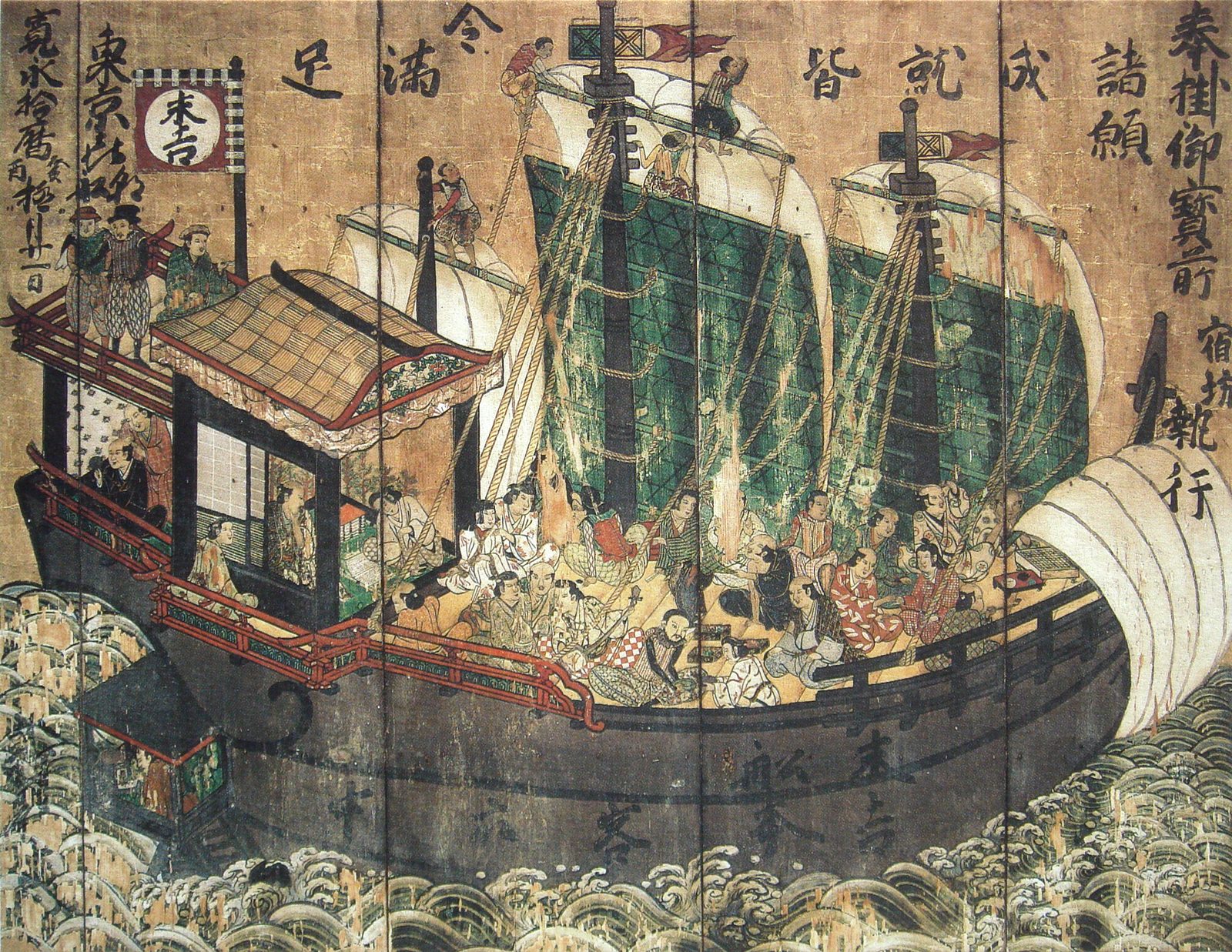
In May 1628 a Spanish squadron sent from Manila under Juan de Alcaraso entered the Chao Phraya River below Ayutthaya, the Siamese capital, and burned a ship belonging to Takagi Sakuemon, one of the town elders of Nagasaki. It was a licensed vessel, sailing under a shuinjō (朱印状), a pass bearing the shogun's vermilion seal. The Spaniards took 42 prisoners and carried off the seal pass itself. The shogunate answered by embargoing the Portuguese ships then lying at Nagasaki, Portugal then being under the same crown as Spain. The episode is told in full in the site's account of the 1628 Ayutthaya incident.
The same year produced a second crisis at Taiwan. Pieter Nuyts, governor of the Dutch East India Company's settlement there, tried to tax Japanese ships trading on the island and detained Japanese junks. Hamada Yahei, a captain sailing for the Nagasaki merchant house of Suetsugu Heizō, responded by seizing Nuyts himself and holding him hostage. The Dutch trade at Hirado was stopped from 1628 until 1632, when the Company's headquarters at Batavia handed Nuyts over to the Japanese; he was kept in custody at Hirado until 1636.
The two incidents had something in common. In each, a Japanese ship carrying the shogun's vermilion seal had been attacked, obstructed or put at risk by a European power in waters the shogunate did not control. The seal pass, which had been the basis of Japan's licensed overseas trade since the first years of the century, could identify a ship as legitimate; it could not protect it. The site's account of the red-seal system describes how that licensing worked. On one count, some 356 vermilion-seal licenses were issued between 1604 and 1635. That is a count of licenses rather than of voyages completed or of distinct ships, and the destinations it records ran from Luzon and Taiwan to Cochinchina, Cambodia, Siam and Patani.
From 1631 the shogunate added a second document. A ship going abroad now needed, besides the vermilion seal, a letter of authorization from the senior council, a hōsho (奉書). Ships licensed in this way were called hōshosen (奉書船). The hōshosen voyages of the early 1630s were concentrated in a small circle of privileged houses; the names associated with them include the Chaya, Suetsugu, Sueyoshi, Suminokura and Hirano families. The 1633 instructions built directly on this two-document system and wrote the council's letter into the code as the condition for any Japanese voyage abroad.
The Magistrate Who Wrote His Own Passes
Takenaka Shigeyoshi's Private Passes and His Replacement by Two Magistrates in 1633
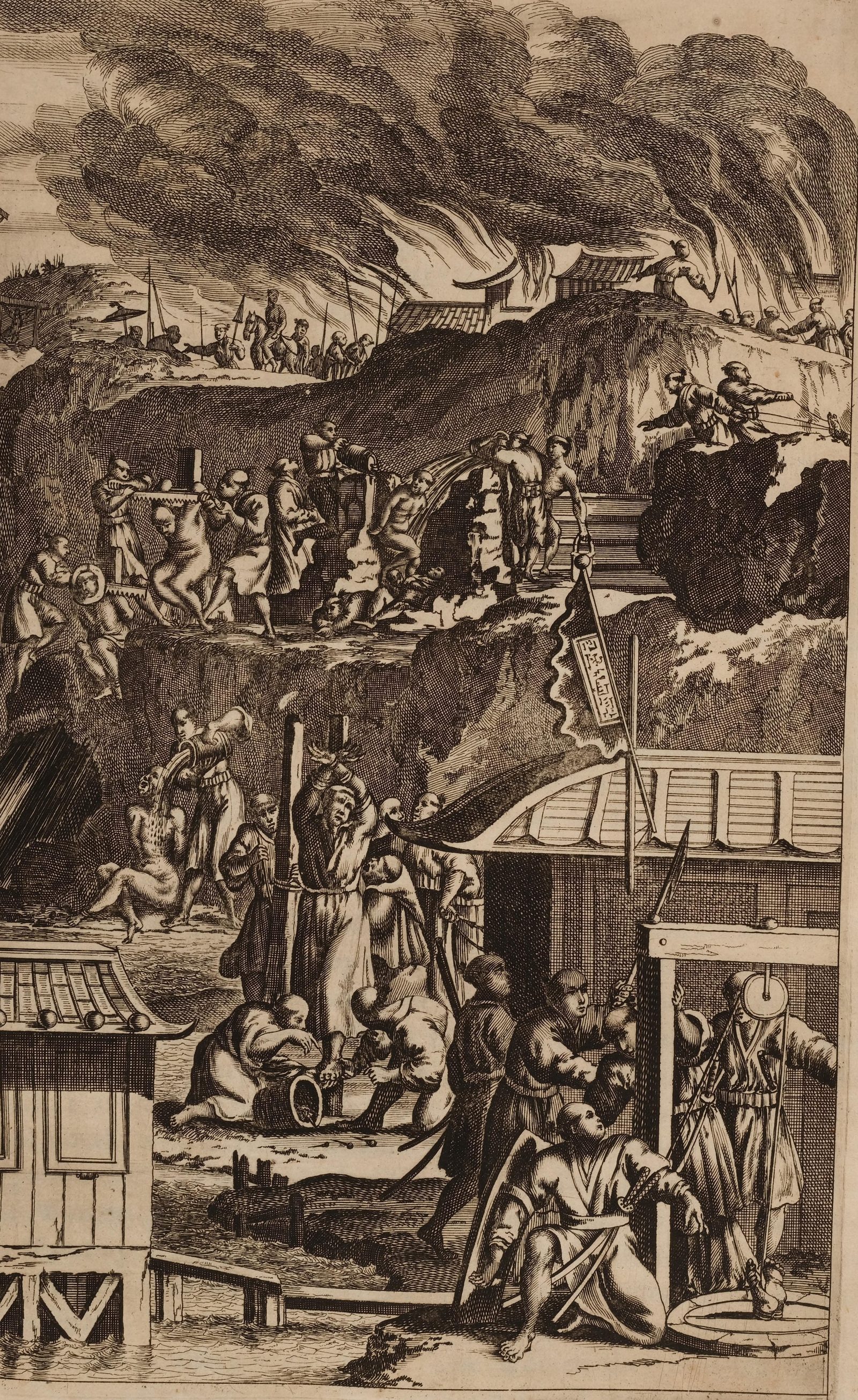
Takenaka Shigeyoshi, lord of Funai in Bungo, had been magistrate of Nagasaki since 1629. He was a shogunal appointee, and he governed the port on the shogunate's behalf. His record there, as Boxer describes it, combined two things the council might in other circumstances have kept apart. He was notorious for his treatment of Christians, torturing Christians at the hot springs of Unzen. He was also, on the same account, using his office for private gain: issuing passes for voyages on his own authority and taking part in illicit trade.
Boxer adds that he was accused of squeezing the Chinese traders, that many of the junks from Tonkin sailed on licenses he had issued, and that he traded illegally to Manila, once in a junk supplied by Jerónimo de Macedo de Carvalho, a former captain-major of the Macao voyage whose friendship counted against him at his fall. Later summaries add a private levy of about 13 percent on Chinese goods and passes for Siam and Taiwan, which have not been confirmed. A shogunal magistrate had been issuing his own licenses at the moment when the shogunate was trying to make licenses a matter for the council alone.
Takenaka was removed in 1633. Boxer describes the change as the replacement of one official by two, and he discusses how the new pair stood in relation to the existing daikan (代官), the deputy who administered the shogunate's lands around the city. This was the reorganization that brought Imamura and Soga to Nagasaki with the council's written instructions. It is sometimes described as the moment when Nagasaki passed from the hands of local lords into those of Edo, but Takenaka was already Edo's man. What changed in 1633 was the degree of supervision. Instead of a single daimyō-magistrate with his own domain and his own interests in Kyūshū, the shogunate sent two bannermen dependent on its favor, and each new pair of magistrates would in future receive its own written code. Rômulo da Silva Ehalt's study of the end of the Japanese slave trade and Ronald Toby's work on the period both describe this practice of issuing the instructions afresh to each pair.
Takenaka's own end came in 1634. He was ordered to take his own life; later accounts say that his son died with him, give the date as the 22nd day of the second month of Kan'ei 11, and add that his fief in Bungo was confiscated.
Licenses, Searches and Silver for Informers
What the 1633 Edict Said on Licensed Voyages, Returnees and Informers
The instructions of 1633 opened with Japanese shipping. No Japanese ship was to go abroad unless it carried the council's hōsho as well as the vermilion seal. Any Japanese who secretly boarded a ship to leave the country was to be put to death. On this point the first edict was already severe; the death penalty for unlicensed departure did not wait for 1635.
The clause on Japanese living abroad is the one most often misreported. Those who had settled overseas and then returned were to be executed. A proviso followed for those who came back within five years, and modern summaries often compress it into a simple rule: back within five years, spared; longer, executed. The text as reproduced by the Japanese historian Okumiyama Chikaji attaches conditions to that proviso concerning the circumstances of the return, and it also forbids the returnee from going abroad again. It was therefore a limited allowance hedged with conditions, and it closed the door behind anyone who used it. The 1633 code left a possibility of return that the 1635 code removed.
The next group of provisions concerned Christianity. The magistrates were to investigate Christians, kirishitan (切支丹). Anyone who informed on a priest, a bateren (伴天連, from the Portuguese padre), was to receive 100 pieces of silver, with lesser rewards for other informants according to the value of what they revealed. All ships entering the port were to be searched for priests. The higher rewards of 200 to 300 pieces of silver that some accounts attach to the first edict belong to a later stage, when the reward was raised in 1636.
A further clause dealt with foreign ships whose business required a decision. These were to be reported to Edo, and while the answer was awaited the ships were to be guarded by the domain of Ōmura, the daimyō house whose territory surrounded Nagasaki. The arrangement put the burden of the guard on a neighboring lord while reserving the decision itself to the council in Edo.
Read together, these clauses did not close Japan. They assumed that Japanese ships would continue to sail, under license, that some Japanese abroad would come home, and that Portuguese and Chinese ships would keep arriving at Nagasaki. What they did was place each of those movements under a rule written in Edo and enforced by two officials who answered to Edo.
The Price of Silk
How the 1633 Code Regulated the Itowappu Silk Trade at Nagasaki
Most of the remaining instructions concerned the Nagasaki market, and they show how much of the shogunate's attention to the port was commercial. The central mechanism was the itowappu (糸割符), known to the Portuguese as the pancada. Under it, the raw silk brought by foreign ships was priced as a single lot before other trading began, and the silk was then allocated among the licensed merchants of the Five Cities: Kyoto, Sakai, Nagasaki, Edo and Osaka. Only after the silk price had been fixed could other goods be bought and sold.
Around that core the instructions set out a series of rules. No single buyer was to take a whole cargo. Retainers were not to buy directly from foreign ships. Lists of the cargoes were to be sent to Edo, but sales could proceed without waiting for a reply, a practical concession given the distance between Nagasaki and the capital. Payment was to be made within 20 days, a provision that Okumiyama's reproduction of the text attaches as a proviso to the clause on pricing, not as a separate article. Foreign ships were to leave by the 20th day of the ninth month, and those that had arrived late were allowed 50 days. Goods left unsold were not to be deposited with Japanese for safekeeping until the following season.
Two further provisions show how easily the 1633 text is confused with later versions. The merchants of the Five Cities had to arrive at Nagasaki by a set day of the seventh month or lose their share of the silk. Okumiyama reports that the earlier text gave the 20th day of that month, and that the deadline was brought forward to the fifth day in Kan'ei 12. Later summaries that give the fifth day for 1633 have taken the reading of 1635. Okumiyama also includes in his Kan'ei 10 version a provision about the pricing of silk at Satsuma and Hirado, the other places where foreign silk could come ashore, which was amended in later years.
The silk rules were not new inventions. The itowappu had existed since the early years of the century, and the 1633 code restated and regulated it. Boxer's annal for 1633 shows the arrangement being applied to silk brought by the Dutch as well as the Portuguese, which suggests that the shogunate meant the system to cover foreign silk whatever ship carried it. The effect was to let the merchants of the Five Cities, under shogunal oversight, set the price of the most valuable import before the foreign sellers could test the market.
Nagasaki Under the New Rules
The 1633 and 1634 Seasons: Silk Prices, the Santo António and the Jesuits in the Pit
The first season under the new magistrates shows the code in operation. Boxer's annal for 1633 describes two large vessels newly sent from Macao that year, at a time when Lopo Sarmento de Carvalho, captain-major of the previous season's voyage, was still in Japan. Ships wintering at Nagasaki and new arrivals from Macao were separate movements, and summaries that merge them produce fleets that never sailed together. In his discussion of the arrival of Imamura and Soga, Boxer records the price of silk falling heavily at one time, as Japanese and Chinese junks brought in large quantities from Tonkin and Fujian; the Portuguese at first refused the pancada price, and the new magistrates forced them to accept it, at prices ranging from 280 to 170 taels per picul, the standard Chinese weight of roughly 60 kilograms, according to quality.
The fall came at a bad time for Macao. The city had borrowed heavily from Japanese lenders to finance the voyages, and its dependence on the annual return from Nagasaki left it exposed to any change in the terms of trade. The Portuguese entered the period of the Kan'ei edicts as debtors in a market whose prices were set by their creditors' government.
The following season is sometimes run together with this one. On 1 August 1634 Lopo Sarmento de Carvalho left Macao with five galliots. Three were driven back, one was captured, and only the Santo António reached Nagasaki. It was this 1634 voyage that carried home 490 chests of silver, and Boxer describes it as profitable; his account of that year also notes that silk prices rose as Japanese shipping abroad was restricted. The figure of 490 chests, sometimes cited as the meager return of 1633, belongs to the next year and to a voyage that did well. The course of that season and the measures issued in Kan'ei 11 are followed in the site's article on the decree of 1634.
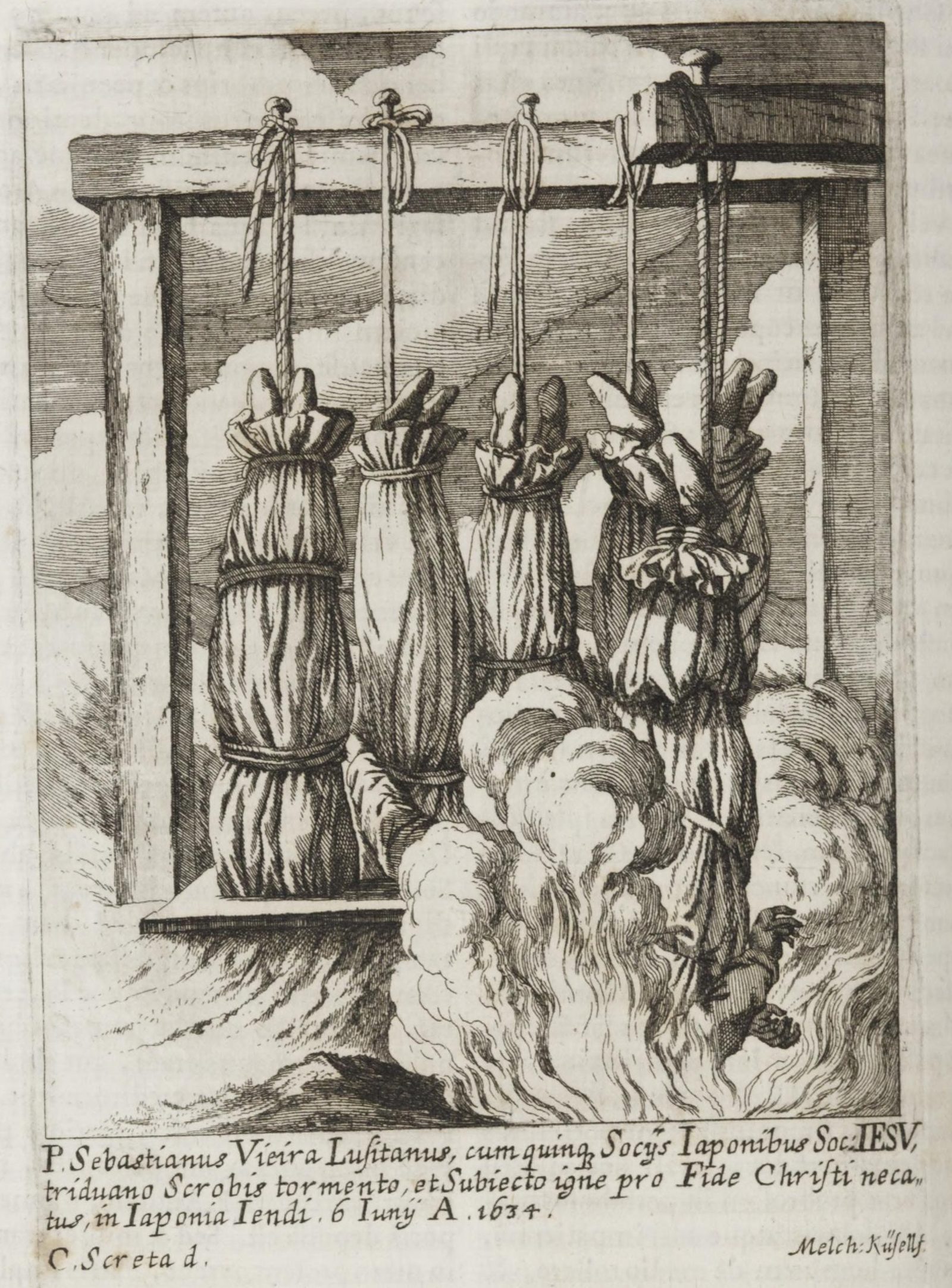
The clauses on Christianity were enforced with severity in the same months. The best-known case is that of Cristóvão Ferreira, the Jesuit vice-provincial and head of the Society's remaining mission in Japan. He was arrested in 1633 and, after torture in the pit, renounced his faith. The days usually given are 24 September for the arrest and 18 October for the ordeal in the pit, though the date of the arrest is less firmly attested than that of the ordeal. The method was ana-tsurushi (穴吊し): the prisoner was hung upside down in a pit, bound and bled through a small cut so that he would remain conscious for longer. Ferreira gave the sign of apostasy after some hours. He lived on under the Japanese name Sawano Chūan, and the anti-Christian tract Kengiroku (顕偽録), dated 1636, is associated with his name. His career is followed in the site's biography of Cristóvão Ferreira.
Among those hung in the pit on the same day was Nakaura Julião, a Japanese Jesuit who as a boy had traveled to Rome with the Tenshō embassy half a century earlier. He did not renounce his faith and died in the pit in 1633; the date usually given for his death is 21 October, some days after he was first suspended. The persecution continued into the next year. Sebastião Vieira, another senior Jesuit, died in Edo in 1634, after the pit.
A Text Dated in the 12th Year
Why the Dutch Diary's 'Edict of 1633' Is Really the Kan'ei 12 Code of 1635
One of the texts most readily available to readers of European languages as "the edict of 1633" comes from the diaries of the heads of the Dutch East India Company's factory in Japan. In the published edition of those diaries, a Dutch translation of a 17-article code appears in the first volume, on pages 298 to 300. It reads as a clear and harsh document: no Japanese ship to go abroad; any Japanese who had lived abroad for a long time and returned to be put to death; searches for priests; the silk rules for the Five Cities. Some compilations have repeated it under 1633, and from there it has passed into a number of modern accounts of the first edict.
The text itself says otherwise. Its date line reads "Het 12 jaer van Quaniae," the 12th year of Kan'ei, which is 1635. Its addressees are Sengoku Yamato-no-kami and Sakakibara Hida-no-kami, that is, Sengoku Hisataka and Sakakibara Motonao, magistrates of Nagasaki after Imamura and Soga had left. The Dutch chief Nicolaes Couckebacker copied it into the diary under December 1635. The Japanese historian Kōda Shigetomo identified it in 1932 with the instructions of the 28th day of the fifth month of Kan'ei 12, a date Yanai Kenji also gives, which places them firmly in the summer of 1635. The signing titles in the Dutch text also belong to that year, which is one reason the five-name list so often attached to the 1633 order cannot be trusted for it.
Once the Dutch text is restored to 1635, the difference between the two codes becomes plain. In the 1635 version, the council's license no longer opens a way abroad: no Japanese ship is to sail at all. The five-year proviso for returnees has gone, and anyone who has lived abroad and comes back faces death. Ehalt's account of the codes states the change in the same terms: in 1633 only government-licensed ships could go abroad and residents abroad could, under conditions, return; by 1635 the licensed-ship system had been suspended and departure or return had become capital without exception. Read as a 1633 document, the Dutch text makes the first edict look like a total ban on Japanese voyages and returns two years before the shogunate actually decreed one.
The misdating should not be generalized beyond what has been shown. The Dutch diary entry is clearly dated and clearly addressed, and its transfer to 1633 in later compilations is an error that can be traced. That does not mean every Japanese transcription of the Kan'ei codes in the standard compilations is similarly misdated; some may be, and some are reported to present composite texts with later addressees, but each needs to be judged edition by edition. The point that can safely be drawn is narrower: a code that was reissued to each new pair of magistrates survives in several versions, and the date and addressees on each copy are the first things to read.
From Licensed Ships to None
From 1633 to 1639: How the 1635 Code Ended Licensed Voyages and the Return Proviso
The documents of the next six years can be set against the first edict to show what it did and did not do. In Kan'ei 11 (1634) a new pair of magistrates, Sakakibara Motonao and Kamio Motokatsu, took over at Nagasaki; Toby associates them with the orders of that year. The orders given to the new pair on the 28th day of the fifth month of Kan'ei 11 (23 June 1634) repeated the code of 1633 in substance; a copy dated the 28th day of the second month, which Yanai reports to be identical with the 1633 text, is probably the earlier text with its year changed. Licensed voyages and the conditional return proviso remained. In the same year the shogunate posted a separate three-article notice in classical Chinese for foreign, presumably Chinese, readers, and ordered the building of the artificial island of Dejima, to which the Portuguese would be moved in 1636.
The decisive change came on the 28th day of the fifth month of Kan'ei 12, in the summer of 1635. The instructions to Sengoku and Sakakibara removed the hōsho exception, so that no Japanese ship could go abroad, and removed the five-year proviso, so that return from residence abroad became a capital offense in all cases. The death penalty itself was not new; the exceptions to it were what disappeared. The 1635 text kept the silk rules, now with the fifth day of the seventh month as the merchants' deadline and with Hirado silk to follow the Nagasaki price. Chinese junks were concentrated at Nagasaki under a separate order of the same year, but foreign shipping as a whole was not confined there: the Dutch continued to trade at Hirado until 1641.
In 1636 two clauses on Portuguese-Japanese families were added, bringing the code to 19 articles, and the reward for informing on a priest was raised; the deportations to Macao that followed are described in the article on the fourth decree and the deportation of Nagasaki's children. After the Shimabara rising, the order of Kan'ei 16 (1639) expelled the Portuguese altogether.
Against that sequence, the 1633 order appears as the opening of a tightening that took six years, with each stage building on the administrative machinery of the one before. Its own provisions were those of a regime that still expected Japanese ships to sail and some Japanese abroad to return. For the Japanese communities in Manila, Ayutthaya, Hội An and Phnom Penh, the 1633 rules already barred return to those who had been away long; the 1635 code ended the licensed sailings that connected them to Japan and withdrew the remaining allowance for return.
A Word Coined in 1801
Maritime Prohibitions, Not a Closed Country: How Historians Read the 1633 Order
None of the men who drafted or received the 1633 instructions would have recognized the label now attached to them. The word sakoku (鎖国), "closed country," was coined in 1801 by the former Nagasaki interpreter Shizuki Tadao, who used it in translating an essay by Engelbert Kaempfer, the German physician who had served with the Dutch at Dejima in the 1690s. It became current in official language only around the middle of the 19th century. 17th-century officials thought in terms closer to the kaikin (海禁), or maritime prohibitions, of Ming China and Joseon Korea: restrictions on who could go to sea, with whom they could trade, and through which ports.
The grouping of five Kan'ei orders as the "sakoku edicts" is likewise a convention of later historians. Contemporaries did not issue them as a single program under that name, and as the documents themselves show, they were instructions, notices and orders of different kinds, addressed to different people and issued in response to changing circumstances. The label has the further disadvantage of suggesting that Japan ceased to have foreign relations. Toby's work on Tokugawa diplomacy, and Arano Yasunori's model of the "four gateways", place the measures within a broader diplomatic order in which the shogunate went on dealing with the outside world through several channels: the Dutch and Chinese at Nagasaki, Korea through the Sō house of Tsushima, the Ryukyu kingdom through Satsuma, and the Ainu through Matsumae. On that reading the edicts reorganized foreign contact around the shogunate's authority rather than ending it.
Interpretations of the 1633 order in particular have stressed its domestic purposes. In these readings it served to restrict the independent overseas trade of regional lords and favored merchants, to place the silk market under shogunal control, to break the Christian underground and to keep Japan out of conflicts abroad of the kind that had flared at Ayutthaya and Taiwan. Several of those aims can be read in the text itself, though the weight to be given to each is a matter of interpretation. The order's insistence on the council's license, its requirement that difficult cases go to Edo and its replacement of a single compromised magistrate with two dependent officials all point toward control from the center. Ehalt's account of the codes makes the further point that the tightening was gradual: the first edict still assumed licensed Japanese shipping and returning emigrants.
The document that opened the sequence is still often misread. Its signatories differ by one name between the early copies, and its provisions on the Five Cities deadline and on the Satsuma and Hirado silk price are still routinely confused with those of 1635. Its contents can be described with reasonable confidence: licensed Japanese voyages permitted, a conditional route home for some emigrants, rewards for informers, searches of ships and a regulated silk market. Its wording survives in the same compilations as the Kan'ei 12 text that Couckebacker copied into his diary, the text so often read in its place.
Sources & Further Reading
Arano, Yasunori. "Foreign Relations in Early Modern Japan: Exploding the Myth of National Seclusion." nippon.com, 18 January 2013. The author's own account of his model of the "four portals" (yottsu no kuchi), first set out in 1978: Nagasaki, Tsushima, Satsuma and Matsumae, through which the shogunate conducted its foreign relations.
Boxer, C. R. The Great Ship from Amacon: Annals of Macao and the Old Japan Trade, 1555–1640. Lisbon: Centro de Estudos Históricos Ultramarinos, 1959. The annals for 1633 and 1634 supply Takenaka's misconduct and replacement by two magistrates, the silk-price fall under Imamura and Soga, the application of the silk arrangement to Dutch imports, and the separate 1634 voyage of the Santo António with its 490 chests of silver.
Ehalt, Rômulo da Silva. "Suspicion and Repression: Ming China, Tokugawa Japan, and the End of the Japanese-European Slave Trade (1614–1635)." In Slavery and Bondage in Asia, 1550–1850: Towards a Global History of Coerced Labour, edited by Kate Ekama, Lisa Hellman and Matthias van Rossum, 213–230. Berlin: De Gruyter, 2022. Sets the 17-article code of 1633 against the order of 1635 and notes that each new pair of Nagasaki magistrates received new laws (pp. 226–227). Open access.
Hayashi, Akira, Miyazaki Seishin, et al., eds. Tsūkō ichiran (通航一覧), vol. 4. Tokyo: Kokusho Kankōkai, 1912–1913; reprint, Tokyo: Taizansha, 1940. In book 170 (pp. 468–469), copies the 1633 order with five signatories from three compilations; the editors identify them as Doi Toshikatsu, Sakai Tadakatsu, Nagai Naomasa, Inaba Masakatsu and Naitō Tadashige, all senior councilors.
Historiographical Institute, University of Tokyo, ed. Diaries Kept by the Heads of the Dutch Factory in Japan. Original Texts, vol. 1. Tokyo: University of Tokyo, 1974. The Dutch translation of the seventeen-article code on pages 298–300, dated Kan'ei 12 and addressed to Sengoku and Sakakibara, is the text long misattributed to 1633.
Kōda, Shigetomo. "Iwayuru Kan'ei sakokurei ni tsukite" (所謂寛永鎖國令につきて). Shakai Keizai Shigaku 1, no. 4 (1932): 803–812. Identifies the Dutch text in the factory diary with the Kan'ei 12 code and gives its date, the 28th day of the fifth month (p. 804).
Laver, Michael S. The Sakoku Edicts and the Politics of Tokugawa Hegemony. Amherst, NY: Cambria Press, 2011. Recommended as further reading on the full sequence of Kan'ei edicts as instruments of Tokugawa political control; it is not the source of specific claims in this article.
Okumiyama, Chikaji. "Bakuhan taisei kakuritsu katei to sakoku seisaku" (幕藩体制確立過程と鎖国政策). Kokushikan Daigaku Seikei Ronsō 54 (1985): 37–57. Reproduces the 17 articles of the 1633 order (pp. 49–50) and compares them with the codes of 1635 and 1636 (pp. 51–53).
Shihōshō (Ministry of Justice), ed. Tokugawa kinreikō (徳川禁令考), vol. 6. Revised 2nd ed. Tokyo: Shihōshō, 1895. Prints the 1633 order from the Gotōke reijō with four signatories (pp. 565–567), and the Kan'ei 12 code that the Dutch text translates (pp. 568–570).
Toby, Ronald P. "Reopening the Question of Sakoku: Diplomacy in the Legitimation of the Tokugawa Bakufu." Journal of Japanese Studies 3, no. 2 (1977): 323–363. The article that places the maritime measures within a continuing diplomatic order.
Toby, Ronald P. State and Diplomacy in Early Modern Japan: Asia in the Development of the Tokugawa Bakufu. Princeton: Princeton University Press, 1984. The book-length development of the argument that the shogunate reorganized, rather than ended, its foreign relations through Nagasaki, Tsushima and Satsuma. It identifies Sakakibara and Kamio as the magistrates who issued the orders of 1634 (p. 71).
Yanai, Kenji. "Sakoku to Hirado shōnindan" (鎖國と平戸商人團). Shien 66 (1955): 29–43. Dates the code sent to Sakakibara and Sengoku to the 28th day of the fifth month of Kan'ei 12 (p. 38).
Yanai, Kenji. "Kan'ei sakoku ni tsuite no ichi kōsatsu" (寛永鎖国についての一考察). Kyūshū Bunkashi Kenkyūjo Kiyō 13 (1968): 65–76. Reports that the version dated the 28th day of the second month of Kan'ei 11 is identical in content with the 1633 text (p. 75, n. 10).
Cite this page
Nanban.pt. “A License from the Council: The First 'Sakoku' Decree of 1633 and Nagasaki's New Magistrates.” Last modified 25 October 2026. https://nanban.pt/articles/1633-first-sakoku-decree/.
@misc{nanban-1633-first-sakoku-decree,
  author = {Nanban.pt},
  title = {A License from the Council: The First 'Sakoku' Decree of 1633 and Nagasaki's New Magistrates},
  year = {2026},
  url = "https://nanban.pt/articles/1633-first-sakoku-decree/",
  note = {Last modified 2026-10-25}
}