Three Articles in Chinese: Nagasaki's Orders of 1634 and the "Second Sakoku Decree"
The "second sakoku decree" of 1634 was several documents rather than one: a recopied maritime code for new Nagasaki magistrates, a three-article warning posted in Japanese and in Chinese, and an order to build the island that became Dejima. Folded into one decree, they make a single law that no surviving document contains.
The 'second sakoku decree' of 1634 was not a single law but three documents: the 17-article Nagasaki code of 1633, repeated in substance in orders of 23 June 1634 to the new magistrates Sakakibara Motonao and Kamio Motokatsu; a three-article public notice in Japanese and classical Chinese, dated the fifth month of Kan'ei 11, against carrying Jesuits to Japan, taking Japanese weapons abroad and Japanese travel other than on the licensed ships; and an order to build the island that became Dejima. Licensed Japanese voyages still sailed in 1634; the code of 1635 ended them and made every return from residence abroad a capital offense.
A Board on the Mainmast
What Was the 'Second Sakoku Decree' of 1634? Three Documents, Not One Law
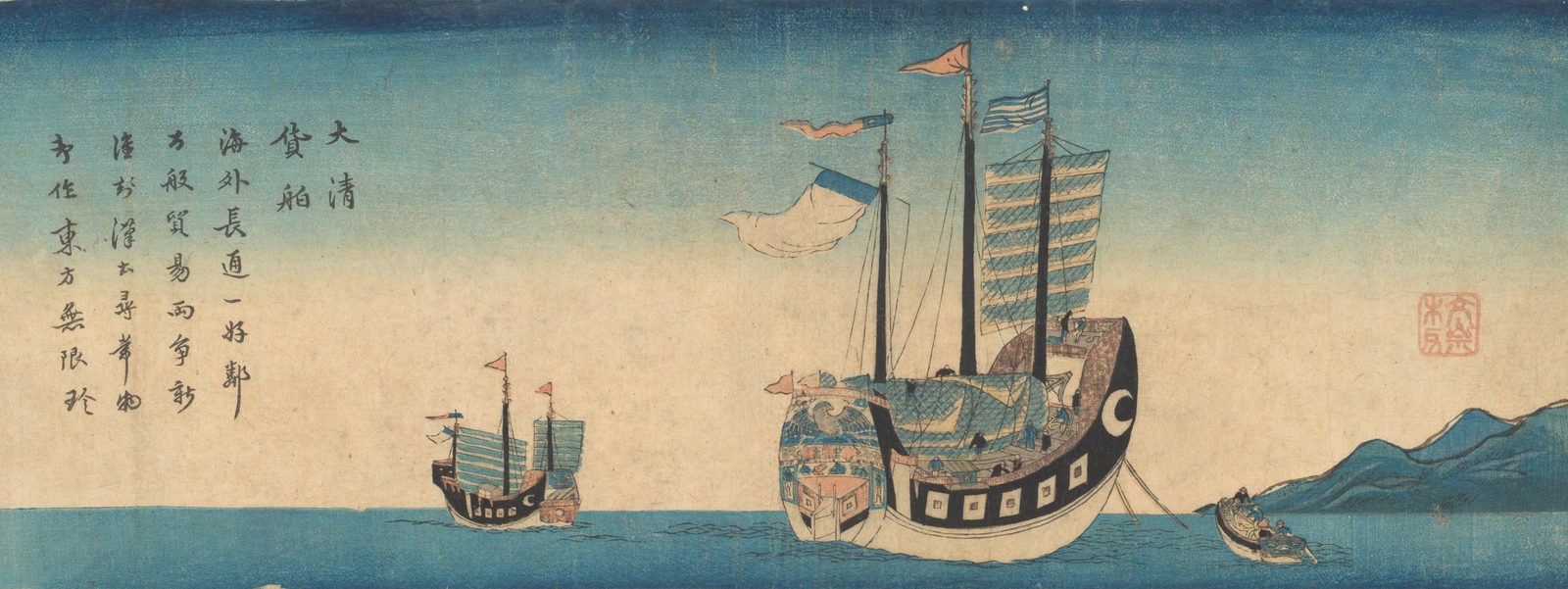
As the Japanese historian Ishii Nozomu describes the procedure of later decades, a Chinese junk entering Nagasaki was met by the port's Chinese interpreters, the tō-tsūji (唐通事). By the middle of the 17th century they brought a wooden board aboard and had the ship's writer read its text to the crew; by the early 18th they hung it on the junk's main mast and had the purser read it aloud. The text was in classical Chinese, kanbun (漢文), and from 1675 it was headed as an admonition to the shipmasters, passengers, helmsmen and crews who had come from China. The board of 1634 set out three prohibitions. Members of the Society of Jesus were not to be carried to Japan. Japanese weapons were not to be carried abroad. Japanese were not to cross to foreign countries beyond the number authorized for the licensed ships, and foreigners who had settled in Japan were to be treated in the same way. Anyone who broke these rules would be severely punished. Its Chinese text is dated to the fifth month of Kan'ei 11, the year 1634; a Japanese version, headed as the notice board of Nagasaki harbor, bears the 28th day of that month and the signature of the magistrates.
Its form set the board apart from the codes of 1633 and 1635, which were instructions from the senior councilors, the rōjū (老中), to the magistrates who governed Nagasaki and which reached the merchants and sailors they regulated only through those officials. Its Chinese version spoke to foreigners directly, in their own written language.
It is also one of three quite different things that appear under the heading of the "second sakoku decree." The others are a version of the 17-article code first issued to Nagasaki's magistrates in 1633, bearing a date in 1634, and an order to build the artificial island in Nagasaki harbor that became Dejima. The code was addressed to officials, and the board says nothing about silk prices, informers' rewards or an island. Folding the three into one decree produces a single law that no surviving document contains.
Five Edicts by Later Count
1634 in the Count of Five Sakoku Edicts: Why the Second Has No Single Text
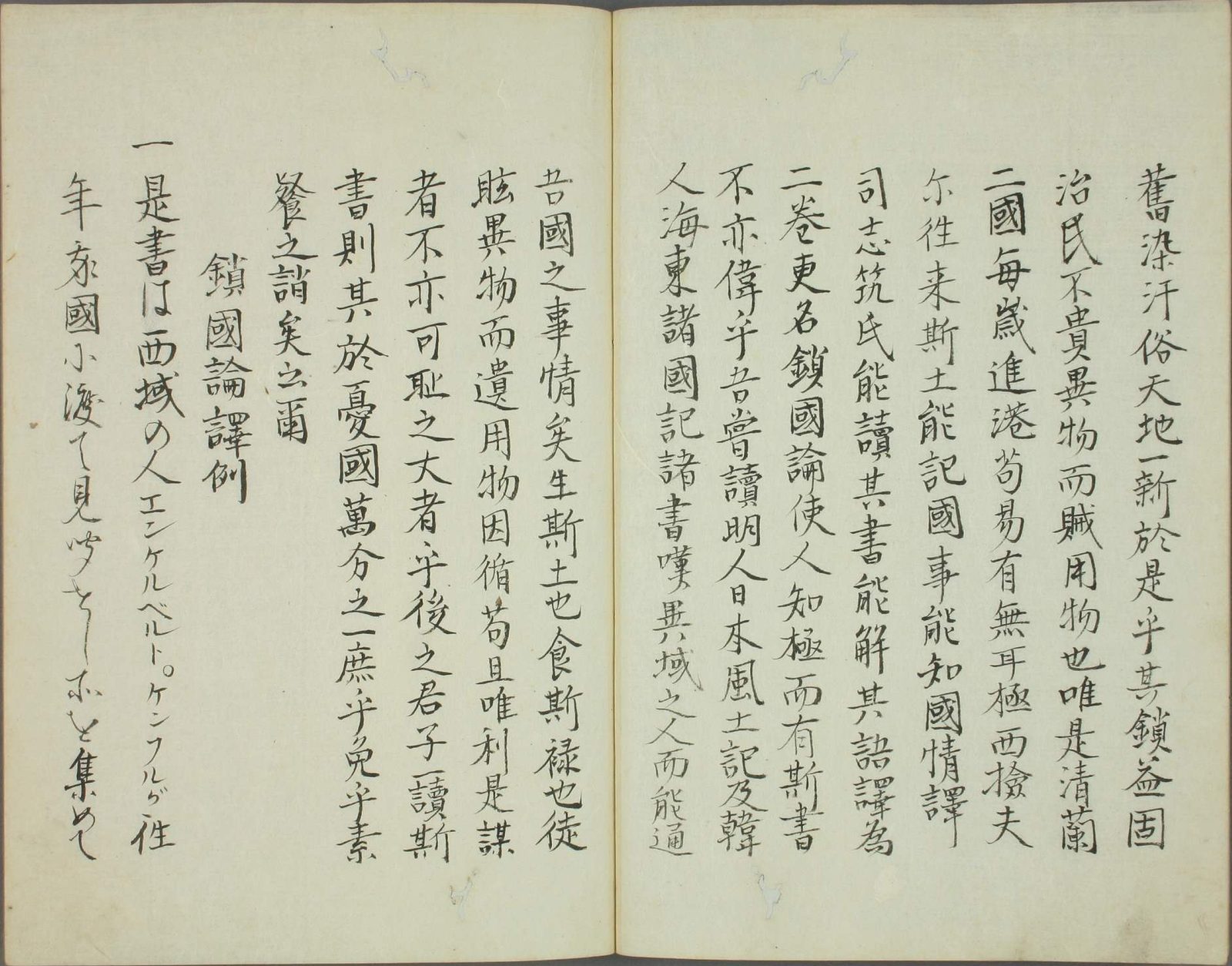
The word sakoku (鎖国), "closed country," was not used by the men who drafted these orders. It was coined in 1801 by the former Nagasaki interpreter Shizuki Tadao, translating part of Engelbert Kaempfer's account of Japan. The grouping of five "sakoku edicts," dated 1633, 1634, 1635, 1636 and 1639, is a convention of later historians; the shogunate did not issue them as a numbered program under that name. Officials of the 17th century thought in terms closer to the maritime prohibitions, kaikin (海禁), of Ming China and Joseon Korea, and those prohibitions operated alongside a working set of foreign relations. Ronald Toby, in his 1977 article reopening the question of sakoku, and Arano Yasunori, with his model of the "four gateways", placed the measures within a broader diplomatic order in which the Dutch and the Chinese went on trading at Japanese ports, Korea dealt with Japan through Tsushima, the Ryukyu kingdom through Satsuma and the Ainu through Matsumae. The broader story of the five edicts is told in Japan's closed doors.
The numbering creates its own expectation. The first and third decrees each correspond to an identifiable text. The first is the code of 17 articles dated the 28th day of the second month of Kan'ei 10 (6 April 1633), addressed to the magistrates Imamura Masanaga and Soga Hisasuke. The third is the revised code of the 28th day of the fifth month of Kan'ei 12, which survives in Japanese and in a Dutch translation addressed to Sengoku Hisataka and Sakakibara Motonao. The fourth, of 1636, added two clauses on mixed Portuguese and Japanese families and brought the code to 19 articles. A reader who looks for a matching document for 1634 finds instead a recopied text, a public notice in another language and a construction order. General surveys tend to give 1634 a "second edict" of its own, with provisions that tightened controls between the first and third.
The Shogun's Year in Nagasaki
Iemitsu in 1634, the Fall of Takenaka and the New Nagasaki Magistrates Sakakibara and Kamio
Tokugawa Iemitsu had ruled alone since the death of his father Hidetada in 1632. In 1634 he traveled from Edo to Kyoto with an enormous following, the subject of Iemitsu's own story; a total of 307,000 men is often given for it. At Nijō castle in Kyoto he received an embassy from the Ryukyu kingdom. Toby names Matsudaira Nobutsuna as Iemitsu's own man in foreign affairs at the level of the rōjū.
Nagasaki had been governed for years by shogunal magistrates, bugyō (奉行). From 1629 the office was held by Takenaka Shigeyoshi, lord of Funai in Bungo. Boxer gives a broadly supported account of his misconduct: he issued private passes for overseas voyages, traded illicitly on his own account and had Christians tortured at Unzen. He was removed in 1633, and Edo replaced him with two hatamoto (旗本), direct vassals of the shogun, who held the office as a pair: Imamura Masanaga, known as Denshirō, and Soga Hisasuke, known as Matazaemon. Takenaka had himself been a shogunal appointee, so the reform did not bring Nagasaki under Edo for the first time. It changed the personnel, introduced paired magistrates and tightened Edo's supervision of an office it already controlled. Takenaka's end is commonly dated to the 22nd day of the second month of Kan'ei 11, when he and his son are reported to have been ordered to take their own lives.
Imamura and Soga did not hold the office for long. In Toby's account, the Nagasaki team associated with the orders of 1634 was Sakakibara Motonao, Hida-no-kami, and Kamio Motokatsu.
17 Articles, Recopied
Did the 1634 Code Differ from 1633? Licensed Ships, Priest Searches and the Silk Rules
Among the texts of the Kan'ei maritime code is one dated the 28th day of the second month of Kan'ei 11, the same month and day as the code of 1633, one year later. In Yanai Kenji's comparison of the texts, this version is identical with the 1633 text, and it is probably the earlier text with its year changed by a copyist. The code was also issued again, formally, to the new magistrates: the orders given to Sakakibara and Kamio on the 28th day of the fifth month of Kan'ei 11 (23 June 1634) repeated the code of 1633 in substance. Rômulo Ehalt describes the practice of giving each new pair of magistrates its own copy of the general instructions, and Toby notes that the pair of 1634 issued theirs immediately after their appointment; the substance of the rules did not change.
That substance was the 1633 code. Its travel rules allowed Japanese ships abroad only if they carried a license from the senior councilors, a hōsho (奉書), in addition to the shogun's vermilion seal; ships sailing on such a license were the hōshosen (奉書船). Leaving the country secretly was punishable by death. Japanese who had lived abroad and came back were to be executed, with a proviso for those who returned within five years. The proviso carried conditions and barred the returnee from leaving again, so it did not amount to an automatic right of return. The magistrates were to investigate Christians, to pay 100 pieces of silver to anyone who informed on a priest, with lesser rewards according to merit, and to search every incoming ship for priests. Foreign ships whose business required a decision were to be reported to Edo and guarded meanwhile by the Ōmura domain.
The rest of the code regulated trade. No single buyer could take a whole cargo, retainers were not to buy directly from foreign ships, and cargo lists were to be sent to Edo without waiting for a reply before business began. Raw silk was priced first under the itowappu (糸割符), the bulk-purchase arrangement the Portuguese called the pancada, and allocated among the merchants of the Five Cities of Kyoto, Sakai, Nagasaki, Edo and Osaka; other goods could be traded only after the silk price had been set. A proviso required payment within 20 days. Foreign ships were to leave by the 20th day of the ninth month, with ships that arrived late allowed 50 days, and unsold goods could not be left in Japanese keeping. The Five Cities merchants had to arrive by a set day of the seventh month, which Okumiyama Chikaji's comparison of the texts gives as the 20th in the earlier version, later advanced to the fifth in Kan'ei 12.
The code also contained a provision on silk pricing at Satsuma and Hirado, and its history is easily tangled. Okumiyama includes it in the Kan'ei 10 text, so a rule of this kind existed from 1633. Boxer's annal for that year already describes the silk-price arrangement being applied to Dutch imports, which is a matter of enforcement rather than wording. The provision was amended later; by Kan'ei 12, in the version the Dutch translated, silk at Hirado was to follow the Nagasaki price and other goods were to wait until that price was fixed. Some accounts credit the measures of 1634 with extending the Nagasaki price to Hirado for the first time. The earlier text does not support a first introduction in 1634.
The 1634 code is sometimes said to have gone further, explicitly forbidding magistrates to issue private passes of the kind Takenaka had issued, or requiring every license to bear the signatures of all five senior councilors. In the form attributed to 1634, the code repeated what the magistrates of 1633 had already been told.
Three Articles in Chinese
What the 1634 Notice in Chinese Forbade: Jesuits, Japanese Weapons, Travel Outside Licensed Ships
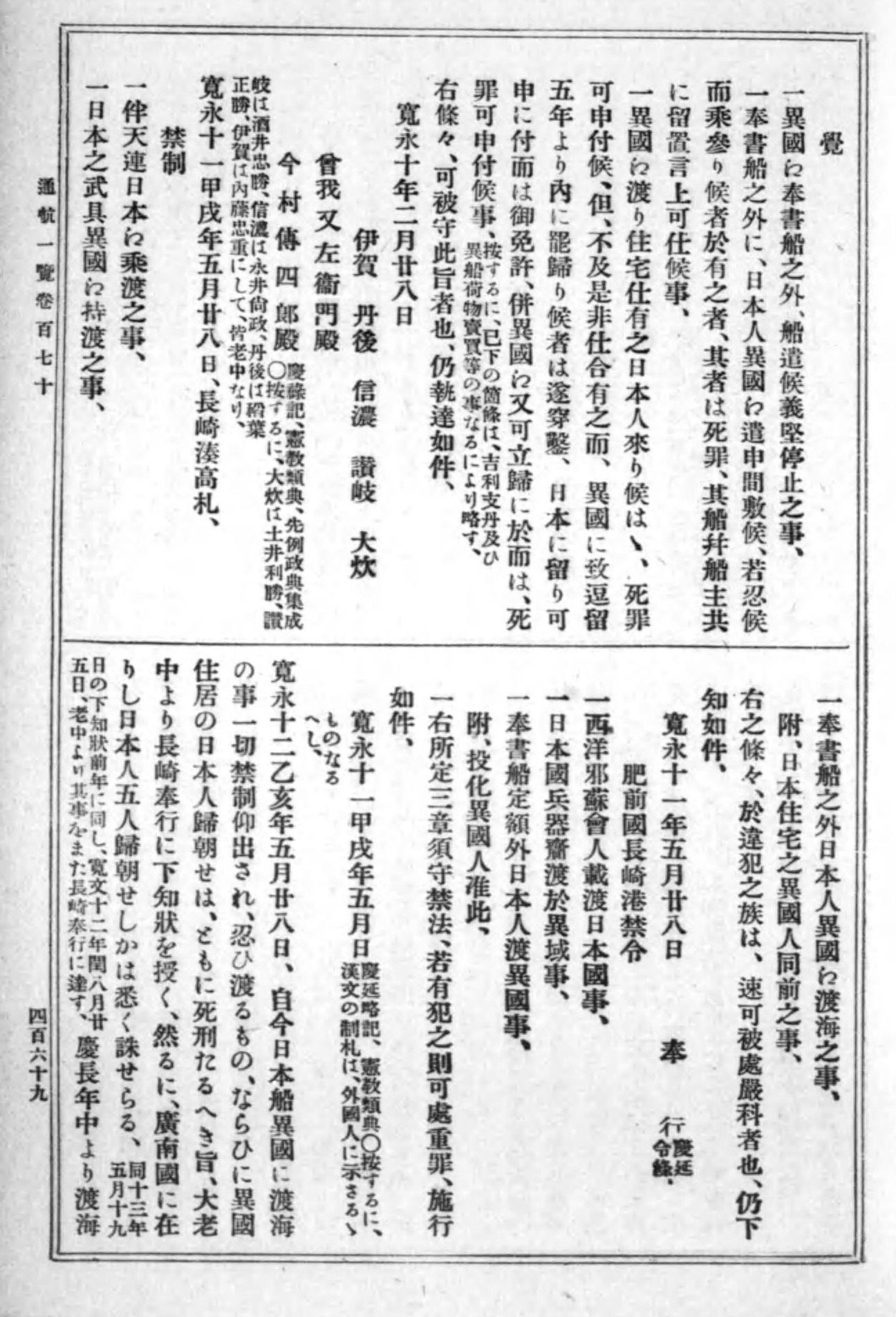
The board of 1634 belonged to a different category of document. It was a public notice, a kōsatsu (高札), meant to be displayed, and it addressed people who were not Tokugawa subjects. Its text survives in transcription in Tsūkō ichiran (通航一覧), the shogunate's 19th-century compilation of documents on foreign relations, and it is quoted by Ishii. Tsūkō ichiran files it under the 28th day of the fifth month of Kan'ei 11.
The first article forbade carrying members of the Society of Jesus from the West to Japan. The second forbade carrying Japanese weapons to foreign lands, and here the board extended an older rule. On the 22nd day of the fifth month of Genna 7 (1621), the shogunate had banned the export of swords, daggers and other weapons and the taking of purchased men and women abroad, in the order discussed in the 1621 edict against Dutch and English piracy. Toby, citing the compilation Tokugawa kinreikō, notes that in 1634 the prohibition was broadened to cover any transport of Japanese weapons to foreign countries. The earlier rule had targeted export and the traffic in people; the new wording reached any carriage of Japanese arms out of the country.
The third article is the hardest to translate. It forbade Japanese to cross to foreign countries outside the 定額 (teigaku) of the licensed ships. The phrase is often rendered "fixed quota," which suggests a limit on the number of vessels. The Japanese board of the same day says simply "other than on hōsho ships," which points to the licensed ships themselves. Either reading presupposes that licensed voyages were still sailing in 1634, which agrees with the code in its 1634 version. A rider applied the same rule to foreigners who had become naturalized or settled in Japan. Read literally, it meant that a foreigner settled in Japan, a Chinese resident of Nagasaki for example, who left outside the authorized number was to be handled like a Japanese; the board itself does not spell out how such cases were to be judged.
The board closed by telling its readers to observe the three articles and warning that offenders would be severely punished. It gave no reasons. Read beside the code, it covered ground that the magistrates' instructions reached only indirectly: the code told officials to search ships for priests and to punish Japanese who left without license, while the board told the men who sailed the ships what they were not to carry and whom they were not to take away.
A Dead Man's Signature
Who Issued the 1634 Orders and Notice, and Which Nagasaki Magistrates Received Them
The transcription of the board in Tsūkō ichiran follows directly on the code of 1633, and the page is easily misread. Just above the board stand that code's addressees, Imamura and Soga, and above them its five senior councilors, given by their court titles; the editors identify one of them as Inaba Masakatsu, who had died earlier in Kan'ei 11, before the fifth month in which the board is dated. Read straight down, the page seems to put a dead man's name on the notice of 1634. The board itself carries no councilor's name: its Japanese version is signed by the magistrates and its Chinese version by no one.
The magistrates who received the measures of 1634 are on record. The orders of the 28th day of the fifth month of Kan'ei 11 went from six senior councilors, Sakai Tadayo, Doi Toshikatsu, Sakai Tadakatsu, Matsudaira Nobutsuna, Abe Tadaaki and Hotta Masamori, to Sakakibara and Kamio, appointed 10 days earlier, and Toby associates the year's orders with the same pair. A third name sometimes placed among the magistrates of 1634, Baba Toshishige, belongs to a later stage. Toby's discussion does not include him, and he is attested as magistrate, with the newly appointed Ōkōchi Masakatsu as his colleague, in the Dutch factory's diary in early 1639; Ishii has him in post in Kan'ei 19 (1642). The next firm point after 1634 is the code of Kan'ei 12, which the Dutch translation addresses to Sengoku Hisataka, Yamato-no-kami, and Sakakibara, Hida-no-kami. Sengoku, then a censor (metsuke), was sent to Nagasaki with Sakakibara on the 20th day of the fifth month of Kan'ei 12, eight days before the code was dated.
Laid side by side, the evidence for 1634 consists of a code identical in substance to its predecessor, a notice in Japanese and in Chinese that names no councilor, and a pair of new magistrates who received the code on a recorded day. As the texts stand, the "second decree" is a reissue and a public notice rather than a new law between the codes of 1633 and 1635 on either side of it.
Ground for an Island
The 1634 Order to Build Dejima and the Move of the Portuguese There in 1636
The third measure of 1634 left something more durable than a text. In that year the shogunate ordered the construction of an artificial island in Nagasaki harbor to confine the Portuguese. The work was carried out by about 25 Nagasaki merchants, among them Suetsugu Heizō II and Takagi Sakuemon, who built it at their own expense, the shogunate paying only for the wall, gate and bridge. The Portuguese were moved onto the island in 1636.
The move took place in the year of the fourth decree, the subject of the 1636 deportations, which dealt with the mixed Portuguese and Japanese families of Nagasaki. No record gives the island's cost, and the figures for its rent and its size differ from source to source, so they are left aside here. Its later history, from Portuguese quarters to Dutch factory, is told in the Dejima article.
What the order shows about 1634 is limited but definite. In the same year that the magistrates received their copy of the code and the Chinese junks their board, the shogunate decided that the Portuguese, who still came every year from Macao, would in future live on ground built for that purpose and separated from the town.
Five Galliots and One Arrival
Lopo Sarmento's 1634 Voyage and What the 1635 Code Changed for Licensed Ships
The Portuguese trade carried on through all of this. According to Boxer's annals, Lopo Sarmento de Carvalho left Macao on 1 August 1634 with five galliots, the smaller vessels that had replaced the single great carrack of the Macao–Nagasaki voyage. Three were forced back, one was captured, and only the Santo António reached Nagasaki. That one ship carried 490 chests of silver back to Macao, and Boxer judged the voyage profitable. His account of the year connects a rise in silk prices to the restriction of Japanese shipping.
The licensed Japanese voyages still sailing in 1634 did not survive the next revision. The code of the 28th day of the fifth month of Kan'ei 12 removed the hōsho exception, so that no Japanese ship was to go abroad, and removed the five-year proviso, so that any return from residence abroad became a capital offense. Death had already been the penalty for secret departure in 1633; what changed in 1635 was the disappearance of the lawful exceptions. Under a separate order of Kan'ei 12, whose exact date is uncertain, Chinese junks were concentrated at Nagasaki. Foreign shipping as a whole was not confined there: the 1635 code itself regulated silk landed at Hirado, where the Dutch factory remained.
The Portuguese were moved onto the island in 1636 and expelled from Japan in 1639. The Dutch factory stayed at Hirado until 1641, when it was transferred to Nagasaki and onto the island that the town's merchants had begun building, under the order of 1634, for the Portuguese.
Sources & Further Reading
Arano, Yasunori. "Foreign Relations in Early Modern Japan: Exploding the Myth of National Seclusion." nippon.com, 18 January 2013. The author's own account of his model of the "four portals" (yottsu no kuchi), first set out in 1978: Nagasaki, Tsushima, Satsuma and Matsumae, through which the shogunate conducted its foreign relations.
Boxer, C. R. The Great Ship from Amacon: Annals of Macao and the Old Japan Trade, 1555–1640. Lisbon: Centro de Estudos Históricos Ultramarinos, 1959. The annals supply Takenaka Shigeyoshi's misconduct and replacement, the application of the silk-price arrangement to Dutch imports in 1633, and the 1634 voyage of Lopo Sarmento de Carvalho, with its five galliots, single arrival and rising silk prices.
Ehalt, Rômulo da Silva. "Suspicion and Repression: Ming China, Tokugawa Japan, and the End of the Japanese-European Slave Trade (1614–1635)." In Slavery and Bondage in Asia, 1550–1850: Towards a Global History of Coerced Labour, edited by Kate Ekama, Lisa Hellman and Matthias van Rossum, 213–230. Berlin: De Gruyter, 2022. Sets the 17-article code of 1633 against the order of 1635 and notes that each new pair of Nagasaki magistrates received new laws (pp. 226–227). Open access.
Hayashi, Akira, Miyazaki Seishin, et al., eds. Tsūkō ichiran (通航一覧), vol. 4. Tokyo: Kokusho Kankōkai, 1912–1913; reprint, Tokyo: Taizansha, 1940. In book 170 (p. 469), prints the board of 1634 in Japanese, dated the 28th day of the fifth month of Kan'ei 11 and issued by the magistrates, and in classical Chinese, dated the fifth month; in book 154 (p. 256), records the orders of the same day from six senior councilors to Sakakibara and Kamio.
Historiographical Institute, University of Tokyo, ed. Diaries Kept by the Heads of the Dutch Factory in Japan. Original Texts, vols. 1 and 4. Tokyo: University of Tokyo, 1974–1981. The Dutch translation of the Kan'ei 12 code in volume 1 fixes the 1635 addressees and the Hirado silk clause against which the 1634 measures are compared, and volume 4 attests Baba Toshishige and Ōkōchi Masakatsu as magistrates in 1639.
Ishii, Nozomu (いしゐのぞむ). "Kunkai Nanban shūrui bō" (訓解南蠻醜類榜). Junshin Jinbun Kenkyū 20 (2014): 194–218. Edits and annotates the anti-Christian boards shown to Chinese crews at Nagasaki, among them the three-article notice of 1634, and documents how such boards were later read aboard the junks.
Kōda, Shigetomo. "Iwayuru Kan'ei sakokurei ni tsukite" (所謂寛永鎖國令につきて). Shakai Keizai Shigaku 1, no. 4 (1932): 803–812. Dates the order of 1634 to the 28th day of the fifth month of Kan'ei 11 and finds it the same text as that of 1633 (p. 811).
Okumiyama, Chikaji. "Bakuhan taisei kakuritsu katei to sakoku seisaku" (幕藩体制確立過程と鎖国政策). Kokushikan Daigaku Seikei Ronsō 54 (1985): 37–57. Reproduces the 17 articles of the 1633 order (pp. 49–50) and compares them with the codes of 1635 and 1636 (pp. 51–53).
Toby, Ronald P. "Reopening the Question of Sakoku: Diplomacy in the Legitimation of the Tokugawa Bakufu." Journal of Japanese Studies 3, no. 2 (1977): 323–363. The article that places the maritime measures within a continuing diplomatic order.
Toby, Ronald P. State and Diplomacy in Early Modern Japan: Asia in the Development of the Tokugawa Bakufu. Princeton: Princeton University Press, 1984. The book-length development of the argument that the shogunate reorganized, rather than ended, its foreign relations through Nagasaki, Tsushima and Satsuma. It identifies Sakakibara and Kamio as the magistrates who issued the orders of 1634 and Matsudaira Nobutsuna's place in foreign policy (p. 71), and records Iemitsu's reception of the Ryukyuan embassy at Nijō in 1634 (p. 64) and the broadened weapons prohibition of 1634 (p. 123).
Yanai, Kenji. "Kan'ei sakoku ni tsuite no ichi kōsatsu" (寛永鎖国についての一考察). Kyūshū Bunkashi Kenkyūjo Kiyō 13 (1968): 65–76. Reports that the version dated the 28th day of the second month of Kan'ei 11 is identical in content with the 1633 text (p. 75, n. 10).
Cite this page
Nanban.pt. “Three Articles in Chinese: Nagasaki's Orders of 1634 and the "Second Sakoku Decree".” Last modified 25 October 2026. https://nanban.pt/articles/1634-second-sakoku-decree/.
@misc{nanban-1634-second-sakoku-decree,
  author = {Nanban.pt},
  title = {Three Articles in Chinese: Nagasaki's Orders of 1634 and the "Second Sakoku Decree"},
  year = {2026},
  url = "https://nanban.pt/articles/1634-second-sakoku-decree/",
  note = {Last modified 2026-10-25}
}