The Governor in the Surf: Rodrigo de Vivero, the San Francisco, and Spain's Best Offer to Japan, 1609–1610
A 1,000-ton galleon breaking up on a Kazusa beach, 300 Spaniards fed for 37 days at the expense of a Satsuma lord, an English pilot arriving overland with the shogun's red seal, and a draft treaty that offered Japan the secret of Mexican silver in exchange for the expulsion of the Dutch: for 10 months in 1609 and 1610 Spain came closer to owning Japan's foreign trade than it ever would again, and the man who arranged it had arrived by accident, soaking wet, with nothing left to trade but himself.
Rodrigo de Vivero y Velasco was a Spanish colonial governor whose galleon San Francisco wrecked at Iwawada, modern Onjuku in Chiba Prefecture, on 30 September 1609 while returning from Manila to Acapulco. Tokugawa Ieyasu set aside Japanese salvage law, received him at Sunpu in November 1609, agreed draft terms in February 1610 granting Spanish trading rights and, by Vivero's account, missionary rights, and lent him the Japanese-built ship San Buena Ventura to sail home in August 1610, but Spain never ratified the terms and relations were severed in 1624.
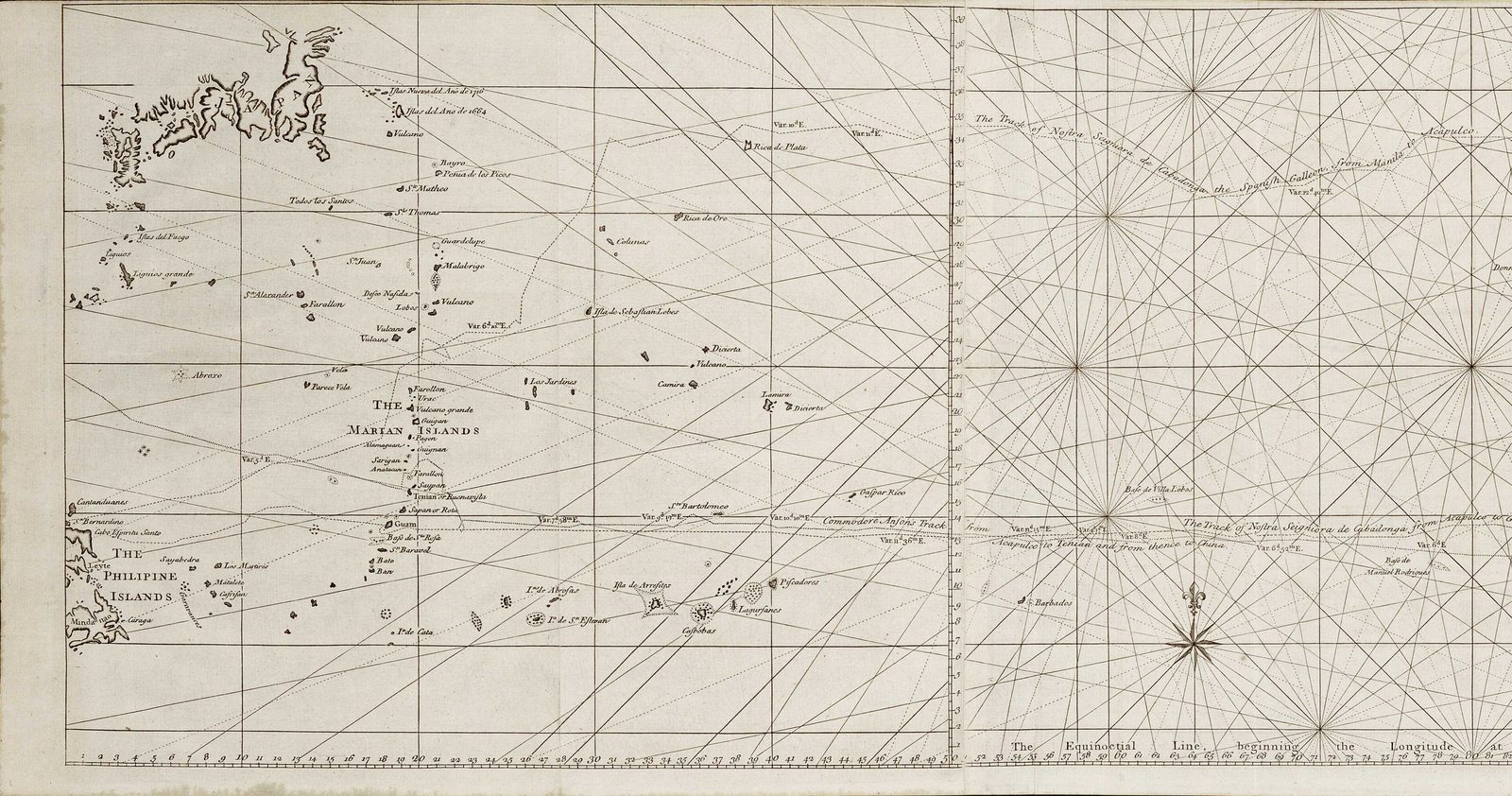
The Beach at Iwawada
The San Francisco Wreck at Onjuku, 30 September 1609
On the night of 30 September 1609 a 1,000-ton galleon came ashore on the Pacific side of the Bōsō Peninsula, at a fishing village called Iwawada in the province of Kazusa, a place that appears in the Spanish records as Yu Banda and on modern maps as Onjuku, in Chiba Prefecture. She had been dismasted days earlier, not by the storm but by her own crew, because a ship rolling that hard with that much weight aloft was a ship about to open her seams. She had lost her bearings entirely. Nobody aboard knew what country they were looking at.
She was the San Francisco, the capitana, flagship of a three-vessel convoy that had cleared Cavite near Manila on 25 July bound for Acapulco with silk and silver aboard. A typhoon had scattered that convoy weeks before. The San Antonio ran for open water and made it across the Pacific. The Santa Ana crawled into a harbor in Bungo on the far side of Japan and stayed there. The San Francisco drew the third option.
Aboard her was Don Rodrigo de Vivero y Velasco, until five months earlier the interim Governor-General of the Philippines, now the senior surviving officer of a total loss on a foreign beach in a kingdom with a specific and unforgiving legal doctrine about foreign ships that ran aground.
What followed over the next 10 months was the closest thing to a Spanish-Japanese alliance either country ever came to signing: a draft treaty, a negotiation over silver refining technology, a shipload of Japanese merchants sailing east across the Pacific, and a set of demands about the Dutch that would have redrawn the map of Asian trade.
The Uncle in Mexico City
Who Was Rodrigo de Vivero, Governor of the Philippines?
Rodrigo de Vivero y Velasco was born in New Spain in 1564, though one reading of the sources, the one that has him dying at the ripe age of 81, would push that back to around 1555. Sent to Spain as a small child, he served as a young man in the 1581 campaign that annexed the Portuguese Crown to Philip II, which placed him personally on one side of the Iberian rivalry that would define everything he later attempted in Asia, and then spent a dozen years in posts in Mexico.
The single most important fact about his career was his uncle. Luis de Velasco the Younger was twice Viceroy of New Spain, once Viceroy of Peru, and from 1611 President of the Council of the Indies, one of perhaps four men in the Spanish world who could make a career happen by writing a letter. Vivero's correspondence calls him his uncle, though parts of the wider literature give the relationship as cousin or simply kinsman. The precise degree matters less than the direction of the favor, which flowed one way and reliably.
That patronage produced the Manila appointment. Vivero arrived in June 1608 to fill the vacancy left by the death of Governor Pedro de Acuña in 1606, and governed for about 10 months before Juan de Silva relieved him in April 1609.
He inherited a wreck of a different kind. On 18 August 1608 he ordered the treasury to draw up the colony's annual accounts. Revenue from gold tenths, customs and tributes: 120,561 pesos. Ordinary expenditure on military pay, salaries and shipyards: 255,578 pesos. A structural deficit of 135,017 pesos, the colony spending twice what it took in. Manila existed to be the western terminus of the galleon route. It was a toll booth with a garrison.
And then there was the matter of the 200 Japanese.
Manila held a Japanese community the Spanish authorities found difficult, which in the vocabulary of colonial administration meant that its members were armed, litigious and unwilling to be moved. In 1606 an attempt by the Audiencia to expel them had escalated to the edge of street fighting. Vivero, arriving two years later, found 200 Japanese held in prison without any cause anyone could articulate to him. He released them, had them clothed and fed, and provided vessels to send them home.
It was, by the standards of the Spanish empire, an unremarkable act of administrative tidiness. It also turned out to be the most valuable thing he ever did.
The Long Way Home
Why Manila Galleons Sailed Past Japan: the Tornaviaje Route
To understand why a Manila galleon ended up on a beach in Kazusa, you have to understand that the route home did not go where the route out came from. The trade winds blow reliably east to west in the tropics, which makes the Acapulco to Manila run a downhill sail of two to three months. Getting back is the problem, and for 40 years after Magellan nobody could do it at all; ships that tried to beat east against the trades ran out of food and water and died. The solution, worked out by the Augustinian friar and navigator Andrés de Urdaneta in 1565, was to stop fighting the wind and go find a different one. Sail north out of the Philippines, hard north, past Formosa and along the Japanese archipelago to the latitude of the westerlies, somewhere between 35 and 42 degrees, then turn right and let the wind and the great warm current running northeast off Japan carry you 4,000 miles to the California coast, then coast south to Acapulco. The tornaviaje, the return voyage, took four to seven months and killed crews by the dozen from scurvy, and it made the eastern seaboard of Japan the shoulder that every homeward galleon had to round.
Which put Japan directly upwind of the richest shipping lane on earth, and meant that any galleon meeting bad weather at the turn met it off the Japanese coast, in September, in typhoon season.
The economics justified the risk. The galleons carried Chinese silk east and American silver west, and both directions paid, because silver was worth roughly twice as much in China as in Europe, and that arbitrage was the entire business model of the Pacific. Freight ran at 40 Castilian ducados per tonelada, and a lading was routinely worth a million and a half silver pesos. The San Francisco's cargo is given at over 2 million pesos of merchandise in one source and 600,000 crowns in another, figures not remotely reconcilable, one of which has probably wandered over from the paperwork of a different wreck.
She was 1,000 tons, very large for the period and consistently recorded as such, and carried 350 crew and passengers according to the primary records, a figure that does not survive contact with the casualty lists.
She left Cavite on 25 July, which was late. The convoy was caught and scattered somewhere in the western Pacific. And on the last night of September, at a latitude her officers recorded as 35 degrees and five minutes north, or possibly 35 degrees and 50 minutes, the sources give both, the San Francisco came ashore in the dark on the eastern flank of a country whose ruler was at that exact moment reconsidering his entire foreign policy.
The Law That Was Not Applied
Japanese Salvage Law and Why Ieyasu Waived It in 1609
How many people died at Iwawada is not known, and the reason is instructive. The standard Spanish colonial records say 30 drowned. William Adams, writing in October 1611, says 36 out of a complement of 350. Vivero's diary says 50. The letters that went back to Manila say 136 lost. The survivor counts run at 300 including Vivero, at 317 in modern reckonings, and at 340 to 350 in Adams's accounts.
None of those pairs adds up. 136 dead plus 300 survivors gives a company of 436; 50 dead plus 317 survivors gives 367; Adams's 36 out of 350 leaves 314 alive, not the 340 to 350 he is elsewhere credited with. Modern scholarship favors Adams, a navigator with a meticulous habit of dates and no stake in the number, and treats the 136 as an early Manila estimate by officials whose task was to explain to the Crown how they had lost a flagship.
What is certain is that most of the ship's company got off, onto a beach where under local law they had just forfeited everything they owned. Japanese salvage custom at the beginning of the 17th century was simple and total: a vessel driven ashore was a windfall, and her cargo passed to the lord of the place or to the central authority. It had been applied nine years earlier to the Dutch ship Liefde, whose guns went straight into Tokugawa Ieyasu's arsenal, and more alarmingly in October 1596 to the galleon San Felipe, disabled by the same kind of typhoon on the same Manila run, whose cargo of between 1.3 and 1.5 million silver pesos Chōsokabe Motochika seized at Urado in Tosa. Her pilot-major, trying to frighten the officials into restitution, pointed at a world map and explained that his king acquired territory by sending missionaries first and soldiers afterward, and within four months 26 Christians had been crucified at Nagasaki. Vivero was wrecked in the one country on earth where the Spanish reputation rested on a boast made on a beach exactly like this one.
Honda Tadatomo, the daimyō of Ōtaki, took the Spaniards into custody. Iwawada lay in his domain, described in the Spanish records as 10 leagues from Ōtaki and 40 from Yedo, which on the four-kilometer league Vivero used would give 40 and 160 kilometers against true distances of roughly 12 and 70. The leagues in these documents are not measurements. They are impressions of effort. Honda and the villagers fed, clothed and housed several hundred foreigners, and then the state began to move: on 5 October the lord of Satsuma, resident in Edo as the shogunate required of the great outside lords, came with 300 retainers to meet Vivero, and thereafter carried the cost of maintaining the survivors for 37 days.
Then came the decision that made the episode significant. Ieyasu, retired to Sunpu since 1605 but still running foreign policy in fact if not in title, waived the salvage law and ordered the recovered cargo returned, for a reason that was specific and personal: Vivero had freed 200 Japanese subjects imprisoned in Manila without cause, and the obligation was to be discharged.
There is a wrinkle. When the San Francisco broke up, only three boxes of silver and a few packages of silk were actually salvaged, so that Ieyasu gave back everything recovered and almost nothing had been recovered, and both statements in the sources are true at once. That does not make the gesture cheap. In a legal order where confiscation was automatic, setting the rule aside in public, for a named foreigner, was a diplomatic instrument that cost nothing. It told the Spanish that Japan could be dealt with. It told the Portuguese at Nagasaki, watching very carefully indeed, that their monopoly was not a law of nature. And it told the Dutch, who had planted their factory at Hirado that same autumn, that the field had acquired another player.
Ieyasu then sent for the one man in Japan who could handle the logistics, and he was not Japanese, and he was not Catholic, and he was not friendly.
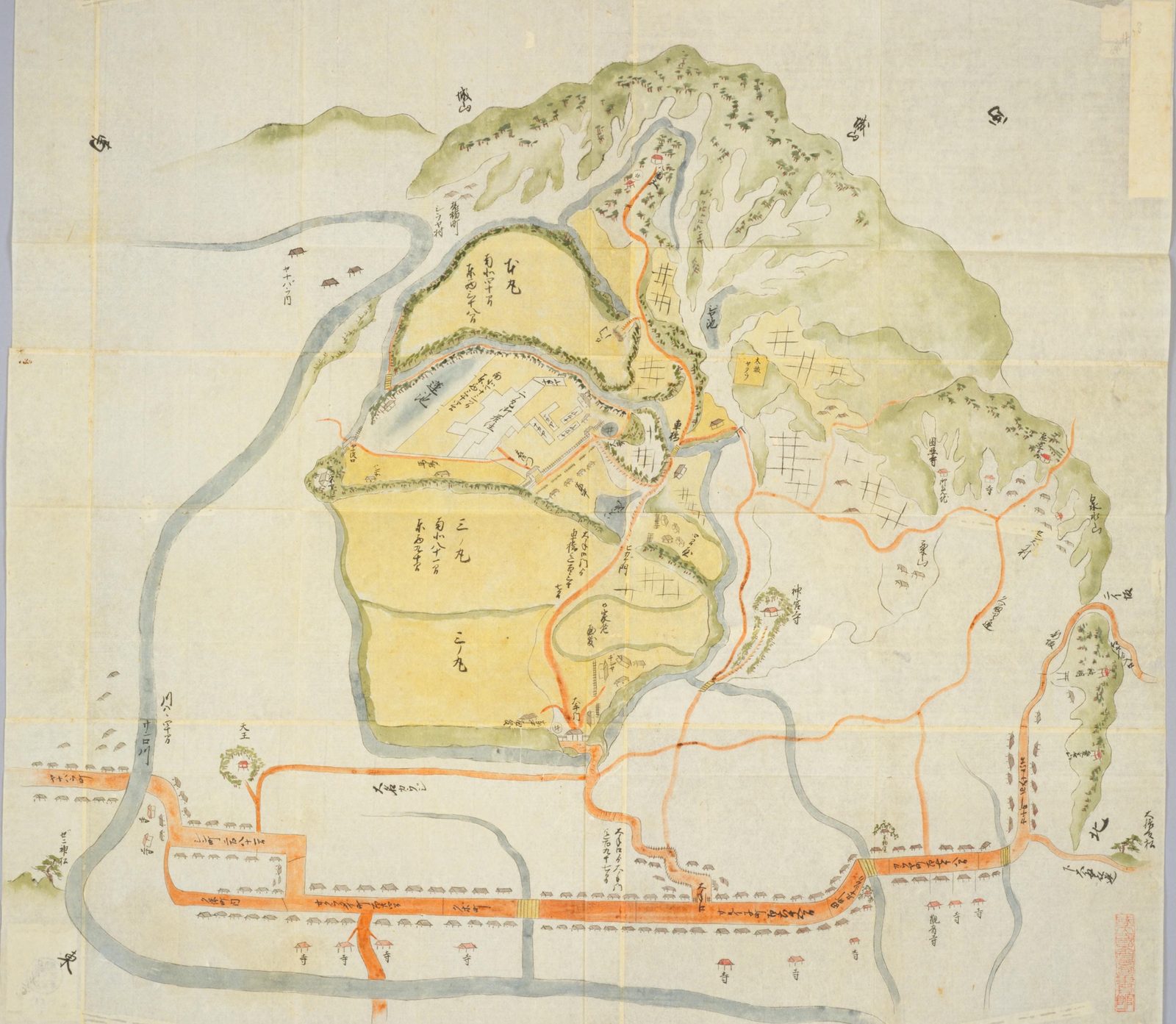
The Pilot with the Red Seal
How William Adams and a Shuinjō Pass Freed the Spaniards
William Adams had been in Japan nine years, having arrived on the Liefde as pilot-major of a Dutch expedition that left Rotterdam with five ships and 500 men and reached Japan with one ship and 24 men, most of whom could no longer stand. He had since been given land, a Japanese name, the status of a retainer, and the ear of the most powerful man in Asia. He was also, by conviction if no longer by nationality, at war with Spain. His arrival had already cost the Jesuits and the Iberians more than they understood at the time.
Ieyasu sent him to Iwawada with a shuinjō, a red-seal pass, the vermilion-stamped document that functioned in Tokugawa Japan as passport, safe conduct and standing order to every official between the bearer and his destination. It secured Vivero's release, authorized overland travel to Edo and Sunpu, and entitled the party to free lodging and meals at every post station on the Tōkaidō, the great trunk road down the eastern seaboard: the Japanese state paying to move a foreign delegation across its own territory at a moment when it was still deciding what a foreign delegation was.
The sources say Adams reached the wreck site 48 days after the grounding, which would put him there around 17 November. That cannot be right as stated, because Vivero met the lord of Satsuma in Edo on 5 October and left Edo for Suruga on 15 November. Either the count runs from something other than the wreck, or the Edo sequence is misdated, or the number is corrupt, and nothing in the surviving material resolves it. What is not in doubt is that Adams was the instrument by which the Spanish party was extracted, and that he spent the following months as interpreter, guide and fixer to an embassy whose entire diplomatic program was directed against his own country's allies.
He appears to have performed the job scrupulously. He also appears to have spent the same months telling Ieyasu, in private and in fluent Japanese, exactly what Spanish friendship had historically cost the countries that accepted it.
It is tempting to read Adams's assistance as an early instance of Anglo-Spanish cooperation in Asia. It was nothing of the kind. Adams in 1609 was a private retainer of Tokugawa Ieyasu acting on his lord's instructions, and the English East India Company would not reach Japan until 1613. There was no European bloc in Japan. There were individual Europeans, each of whom belonged to somebody, and the somebody in Adams's case wore a kimono and lived at Sunpu.
Four Feet from the Shogun
Vivero's Audience with Tokugawa Hidetada at Edo, November 1609
They took him to Edo Castle, where Vivero recorded more than 20,000 people employed, and walked him through a sequence of anterooms and past two heavily guarded ironbound doors into a chamber paneled in wood and carpeted in velvet.
Tokugawa Hidetada was 30. He sat on a velvet cushion in a kimono, his hair bound with silk ribbons, his sword through his sash. He was the reigning shogun, his father having resigned the title four years earlier precisely to demonstrate that the office was hereditary and the dynasty permanent, and he had almost no independent authority over anything that mattered.
Vivero did not prostrate himself. That was the entire diplomatic content of the audience. Spanish protocol held that the representative of Philip III did not put his face on the floor in front of anyone, Japanese protocol held that everyone did, and the impasse was resolved by giving Vivero a matching cushion and seating him on it about four feet from the shogun of Japan, an arrangement that satisfied nobody's rulebook and both men's dignity.
Hidetada welcomed him warmly, expressed sorrow at the loss of the galleon, and then explained, in substance, that he could not decide anything, since foreign policy remained with his father at Sunpu. What he could offer was safe conduct, lodging and meals down the Tōkaidō, which he did, and the interview ended.
The dutiful son would in time become the architect of a persecution that made his father's cautions look indulgent. In November 1609 he was a 30-year-old man in a velvet-carpeted room being scrupulously polite to a shipwrecked foreigner, while everyone present knew the decision lay 100 kilometers to the southwest.
Vivero left Edo on 15 November and reached Suruga on 20 November, five days for something over 170 kilometers, brisk traveling for a foreign party with baggage, and a fair indication of the condition of the road.
The road impressed him more than the castles. The Tōkaidō ran through a nearly continuous ribbon of houses and cultivated land, with very little open country along it, and each league was marked by two mounds on either side of the highway, each topped with two trees. These were the ichirizuka, the one-ri markers the Tokugawa had begun planting along the trunk roads in 1604: a state-built distance-measuring system with living signposts, in a country a European of 1609 would have called remote.
At Suruga he was met by Ieyasu's secretaries under Honda Masazumi, who appears in the Spanish documents as Kosuke-no-Suke Dono, lodged comfortably, presented with 12 silk kimonos, and supplied with fresh fruit daily.
Then they came for him with 200 musketeers.
The Tray of Gold
Vivero at Sunpu Castle: Meeting Tokugawa Ieyasu, 27 November 1609
On 27 November 1609 Vivero was carried to Sunpu Castle in a palanquin escorted by 200 matchlock men, with 30 guards marching alongside. The party crossed three drawbridges, each with its own corps of guards, and inside the second ironbound gate a further 200 matchlock men stood drawn up. Vivero, who had seen Edo 12 days earlier, judged Sunpu the equal of the shogun's own castle in luxury and considerably its superior in security.
The old man received him seated on a velvet cushion in a heavily embroidered silk kimono. The sources give his age as 67, which is his age by Japanese reckoning, in which a person is one at birth; by Western count Ieyasu was 66 that month. Vivero was seated on a blue velvet cushion six feet away, two feet farther than from the reigning shogun, which is either a coincidence or the most delicate piece of protocol in the entire episode.
The interpreters were the Franciscans Fray Alonso Muñoz and Fray Juan Bautista Porro, so that every word exchanged between the retired shogun of Japan and the former governor of the Philippines passed through two members of the mendicant order the Portuguese Jesuits had spent a decade describing to the Japanese authorities as the advance guard of an invasion. Vivero's gifts had been laid out on low tables over the tatami before he entered, in the Japanese manner, and the following day Ieyasu reciprocated with a dozen kimonos and four swords.
During the audience itself a high-ranking daimyō was introduced. He prostrated himself at the threshold, kissed the ground, advanced, and presented Ieyasu with a tray of gold pieces that Vivero valued at 100,000 ducats.
The staging was not accidental. Vivero was watching a lord who ruled a province deliver a fortune, on his knees, to a man formally retired from office, in front of a foreign witness specifically invited to be present. Every element of that scene was legible to a Spanish aristocrat, and all of it said the same thing: this ruler does not need what you are selling. Which is why the offer Vivero made the next morning had to be extraordinary.
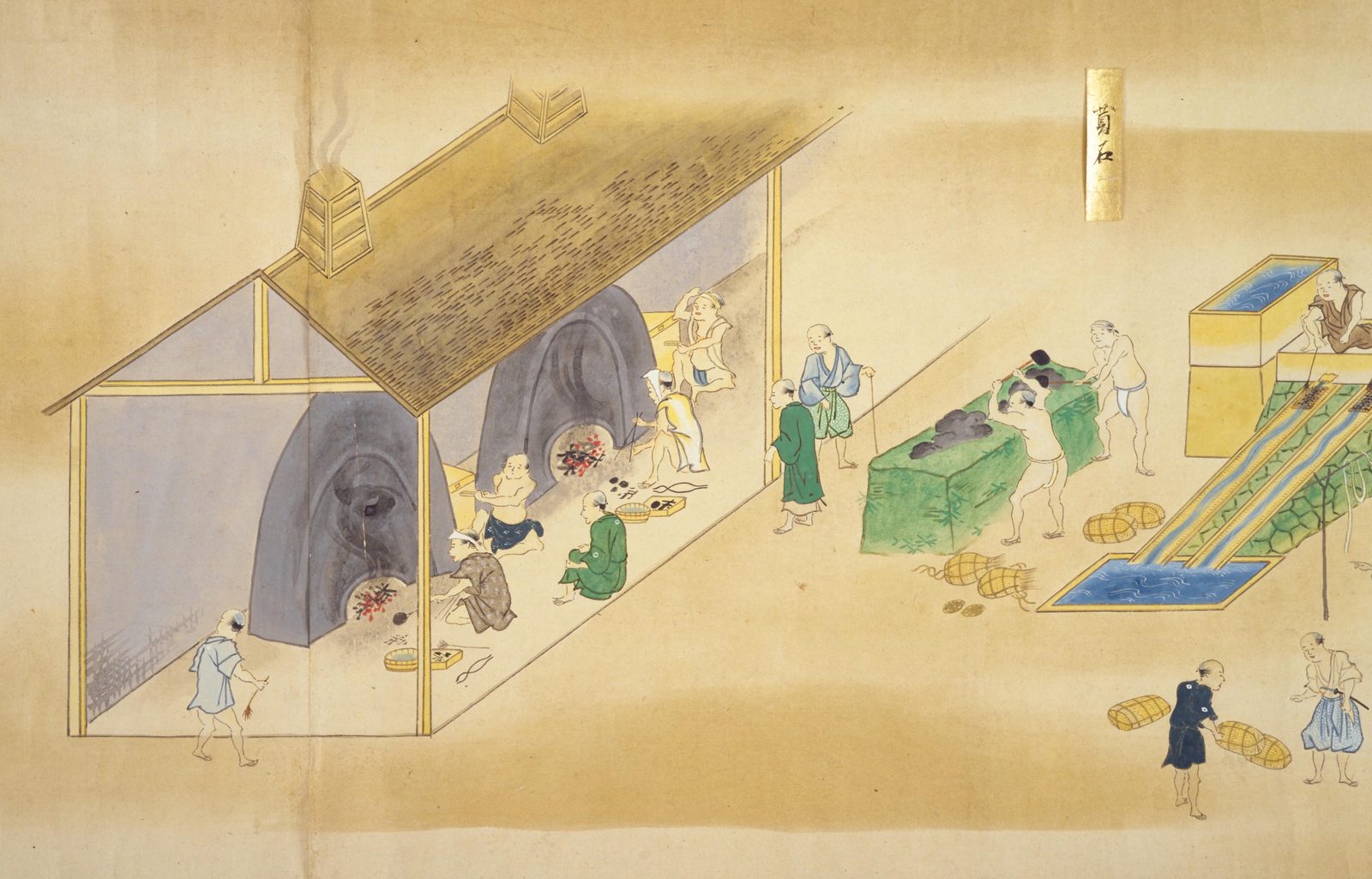
Mercury and the Men Who Knew It
The Silver Deal: Mexican Patio Amalgamation Versus Japanese Haifuki-hō
On 28 November Vivero sat down with Honda Masazumi and put three requests on the table. Freedom for Spanish missionaries to preach in Japan. An alliance between Spain and Japan. And the expulsion of the Dutch.
On 29 November Honda returned with Ieyasu's response, which granted the first, said nothing useful about the second, ignored the third, and attached a counter-demand: Spanish silver miners, sent to Japan, to improve Japanese extraction. Vivero declined to commit without royal consent. That counter-demand was the real subject of the negotiation.
Japan in 1609 was one of the largest silver producers on earth, running perhaps a third of world output from Iwami, Ikuno and Sado, and had refined it since 1533 by haifuki-hō, the ash-blowing method, a cupellation in which lead-bearing ore is melted in a hearth of bone ash and blasted with air so that the lead oxidizes, soaks into the ash, and leaves the silver behind. It works very well on rich ore, and not at all economically on poor, because every ton of low-grade rock still has to be smelted, smelting takes fuel, and Japan's mining districts were already stripping their hillsides.
The Spanish had something else. In the Mexican silver districts, since the 1550s, they had used the patio process, mercury amalgamation. Crushed ore was spread across a paved courtyard, mixed with salt, with magistral, a roasted copper pyrite that supplied the chemistry, and with liquid mercury, then trodden for weeks by mules or barefoot laborers until the mercury had gathered the silver into an amalgam, which was washed out, pressed and heated so the mercury distilled off for reuse. It needed almost no fuel. It worked on ore too poor to smelt. It was why Potosí and Zacatecas produced on the scale they did, and it was, in the most literal sense, the technology that funded the Habsburg monarchy.
Ieyasu wanted it, and Vivero offered to ask Philip III to send the experts who possessed it.
The terms are recorded twice, differently. One account has 50 Spanish experts and the yield split evenly, half to the miners and the Crown, half between the two governments. The better-sourced version has 100 to 200 experts, half the extracted silver to the miners and the remaining half split again, a quarter to the King of Spain and a quarter to Ieyasu. Under either arrangement the Japanese ruler would have handed a foreign power a controlling interest in the output of his own mountains.
And there was a rider that has attracted a great deal of scholarly attention. The mining camps were to have their own priests and their own legal jurisdiction, a clause that read literally would have scattered Spanish enclaves with resident clergy and extraterritorial standing across the interior of a country that had already executed 26 Christians for less. One line of scholarship reads that as exactly what it looks like, a blueprint for dispersing missionaries under commercial cover, aiming at a Christian rising on Ieyasu's death. Another reads it as ordinary boilerplate of Spanish colonial mining law, transplanted without much thought by a man who could not imagine a mining camp organized any other way.
Both readings can be right about the text. Only one can be right about the intention, and the intention died with the man.
Two Enemies in One House
The Capitulaciones of 1609–1610: What Spain Asked and What Japan Granted
On 20 December 1609, at Fushimi, Vivero handed Honda Masazumi the Capitulaciones, a draft set of preliminary articles.
He asked for a safe port in the Kantō, specifically Uraga, with warehouses, astilleros, shipyards and a permanent Spanish settlement, and for free access to Japanese ports for all Spanish shipping out of Manila and New Spain. He asked for a resident ambassador holding full jurisdiction over all Spaniards and Christian subjects in Japan, which is to say extraterritoriality, two and a half centuries before anyone extracted it by gunboat. He asked for exemption from the pancada, the ito wappu system under which a guild of licensed merchants fixed one price for the entire imported raw silk cargo before any of it could be sold, a mechanism designed to stop the Portuguese setting their own prices, and one that had worked.
And he asked for the immediate expulsion of every Dutch trader in Japan, as rebels and thieves. Two enemies, the draft observed, cannot live in the same house.
Honda Masazumi delivered the Japanese answer on 2 February 1610.
They granted a port of Spanish choosing, with sites to build on. They granted permission for Spanish ships to winter, refit and build vessels in Japan with Japanese materials and labor at standard prices. They granted free sale of merchandise with no forced price controls, conceding the pancada point outright. They granted reception and honor at court to an accredited ambassador. And, by Vivero's account, they put in writing that the friars of the mendicant orders would be permitted to reside anywhere in Japan they desired.
What the document did not contain was the silver. The profit split, the mining experts and the shipbuilding program were omitted entirely, not refused, simply absent, and the omission was deliberate: those details, the ones closest to Ieyasu's own interest, were to be negotiated orally in Spain rather than committed to a paper the Portuguese would be reading within the year.
On the Dutch the answer was flat. Ieyasu had granted them safe conduct, their factory at Hirado dated from that same autumn, and his honor bound him to protect anyone who came to trade peacefully. Japan, he added, was a free country, open to all foreign merchants, and the private wars of European princes were no business of his.
It is one of the more remarkable sentences in the diplomatic record of the period, delivered by the founder of a regime that would within 30 years narrow the country's foreign contact to a few tightly controlled channels, and it was sincere. Ieyasu did not want fewer Europeans. He wanted more of them, competing, so that no single one could set a price. The Dutch had arrived at Hirado that July with precisely the pitch he had been waiting to hear, trade without religion, and he was not about to expel them at the request of a man whose ship was firewood on a Kazusa beach.
There was a final clause, and it killed the whole thing. Vivero's terms bound him to obtain ratification from Philip III within two years, so that everything he had signed was provisional, informal, and dependent on a court 16,000 kilometers and 18 months away.
The Ship That Was Meant to Be Sold
The San Buena Ventura: the Japanese-Built Ship That Sailed to Mexico
Vivero now had a treaty draft, no ship, and a problem, since the Santa Ana, still sheltering in Bungo, he judged unseaworthy and refused to risk.
So Ieyasu gave him one.
The San Buena Ventura was the second Western-style vessel built in Japan, constructed in 1607 at Itō on the Izu Peninsula by Japanese shipwrights under William Adams's supervision, after Ieyasu had been impressed enough by Adams's first 80-ton effort to order a larger one. She displaced 120 tons in some of Adams's logs and 170 in others, a discrepancy in the builder's own paperwork that says something about how these figures were arrived at, and she had been serving as a shogunal coastal patrol vessel.
The terms were extraordinary. Ieyasu lent 4,000 ducats, recorded elsewhere as pesos and elsewhere again as taels of silver, to fit her out, and canceled a 4,000-peso debt Vivero personally owed the Royal Treasury, a private favor with nothing to do with statecraft. Under the agreement signed with Honda Masazumi, Vivero was to sell the ship on arrival in New Spain and use the proceeds to buy Mexican goods for a return voyage to Japan.
That clause is the whole policy in miniature. Ieyasu was not making a gift. He was making an export, on consignment, with a Japanese-built hull as the trade good and a Spanish grandee as the supercargo, opening a Japan to Mexico route that bypassed Macao, Manila and the Portuguese silk monopoly in a single voyage.
She sailed from Uraga on 1 August 1610 with 80 crew and passengers, including trained Japanese seamen, because Ieyasu intended his men to learn the tornaviaje. She carried Fray Alonso Muñoz as envoy to Spain with Ieyasu's proposals and state letters for Philip III and the Viceroy of New Spain, and 23 Japanese merchants and tradesmen, some accounts say 22, headed by Tanaka Shōsuke, with Ryūsei, an elite vermilion dealer of Kyoto, among them.
She made Matanchén, in Nayarit on the Mexican coast, on 27 October 1610. Tanaka Shōsuke was baptized there as Francisco de Velasco, taking the family name of Vivero's viceregal uncle, which tells you who arranged the ceremony. The ship was sold to the colonial authorities as instructed and promptly drafted into the Manila Galleon fleet, carrying soldiers, armaments and treasury funds on the Acapulco run, so that a vessel built by Japanese carpenters under an English pilot for a retired Japanese shogun spent her working life as a Spanish naval transport. 17 of the merchants went home the following year, and the Nahua chronicler Chimalpáhin records that between three and six stayed on to trade.
In Manila, when the terms became known, the colonial authorities wrote to the King in formal protest. Teaching the Japanese deep-draft European shipbuilding and open-ocean navigation, they argued, would destroy Spain's Pacific monopoly and end with a Japanese fleet in Manila Bay, which was Acuña's old line: instructing the Japanese in navigation would be equivalent to handing them the weapons they needed to destroy the Philippines.
What a Boast Was Worth
Did Vivero's Silk Offer Doom the Madre de Deus in 1610?
There was one more conversation, and it mattered most. At some point during the audiences Ieyasu asked Vivero directly whether Spanish ships could supply Japan with Chinese raw silk. Vivero answered that Manila could supply three times the volume the Portuguese did.
In early January 1610, while he was still in the country, Ieyasu ordered the destruction of the Portuguese carrack Nossa Senhora da Graça, the Madre de Deus, in Nagasaki harbor, over an affair of a brawl in Macao and a set of retracted affidavits. Her captain-major, André Pessoa, refused to surrender to a besieging force of samurai on a floating tower, went below with a torch, and blew up the ship, the richest cargo ever brought to Japan, and himself.
The only thing that had ever protected the Portuguese position in Japan was that Japan could not get Chinese silk any other way: Chinese ships could not legally come, Japanese ships were unwelcome in Chinese ports, and Macao sat in the gap and charged accordingly. Burning the annual carrack meant burning the year's silk supply, unless somebody else brought it.
A powerful line of scholarship, running back to Boxer, holds that Vivero's boast is precisely what decided Ieyasu: he had a replacement supplier standing in his own audience chamber promising triple volume, and with that assurance the Madre de Deus became expendable. Against this, others point out that the Spanish negotiation was too unstable to support any such confidence, a dialogue of the deaf between two states with incompatible ideas of what sovereignty and treaty even meant, conducted through Franciscan interpreters and provisional upon a ratification that never came. Ieyasu had reasons of his own to destroy that ship, and they had to do with his red seal being dishonored, not with silk futures.
Vivero's own account is the least reliable document in the pile. He claims Ieyasu's secretary told him the attack was justified despite his intercession on Pessoa's behalf, which positions him as the gallant Christian gentleman pleading for a rival Catholic power. Juan Cevicós, captain of the San Francisco and in a position to know, testified that Vivero's under-the-table Manila silk negotiations were the principal cause of the whole business.
One of those two men was writing for the Council of the Indies. The other was not.
The Closing Door
Why the Spanish Treaty Failed: Vizcaíno to the 1624 Expulsion
Everything Vivero built came apart within four years, and each stage of the collapse was performed by a Spaniard.
Sebastián Vizcaíno sailed from Acapulco in March 1611 to repay the 4,000 ducats, return the Japanese merchants, and hunt for the fabled islands of Rica de Oro y Plata. He came ashore at Uraga under the royal standard of Castile with arquebusiers and trumpets, presented his credentials to Hidetada at Edo before calling on Ieyasu at Sunpu, thereby insulting the only man whose opinion counted, demanded the expulsion of the Dutch and the right to burn Dutch shipping in Japanese harbors, and asked permission to survey and sound the Japanese coast, at which point Adams explained to Ieyasu that in Europe a request to chart another state's harbors was espionage and the customary prelude to invasion. Vizcaíno was no ignorant skipper, whatever the Jesuit tradition made of him, but a commissioned Royal Ambassador incapable of imagining that Japanese protocol applied to him.
Then Date Masamune of Sendai, seeing an opening, sent his vassal Hasekura Tsunenaga to Madrid and Rome with the Franciscan Luis Sotelo, an embassy that spent seven years learning that Spain had lost interest.
Meanwhile the ground shifted under all of it. The Okamoto Daihachi bribery scandal of 1612 showed Ieyasu how many of his own administrators and household had been baptized, in January 1614 the Zen monk Ishin Sūden drafted the statement expelling the bateren, the fathers, and that November 88 clergy were shipped out of Nagasaki. The missionary freedom that had been Spain's non-negotiable condition, and that, on Vivero's word, Honda Masazumi had put in writing on 2 February 1610, had lasted four years and nine months.
In 1624, under Iemitsu, Spain was formally expelled: her vessels banned from Japanese harbors on pain of burning, Japanese subjects forbidden to sail to the Philippines on pain of death, an embassy from Manila refused an audience and ordered out. The machinery that ended the Spanish relationship was sitting ready when the Portuguese were expelled 15 years later.
Vivero returned to Spain to report, then to New Spain, and the record of his middle years is thin. He was appointed Captain-General of the forces of New Spain in 1636 and died in 1636, a coincidence suspicious enough that one of the two dates is probably wrong. He left two documents written for the King in 1610 and the early 1630s, the Relación, a narrative of the wreck and the road and the audiences, and the Avisos y proyectos, a program for Spanish strategy in the Pacific. The Relación is where the 12 kimonos and the tray of gold survive, and where his judgment collapses, because he put the population of Kyoto at 1,500,000 including 50,000 Buddhist priests, Osaka at nearly 1 million, Edo at 150,000 and Sunpu at 100,000, figures other editions render as 700,000 and 600,000 for the last two, and none of which anybody should believe. He praised Edo as a city of great beauty and planning, with a paved causeway down the main street and stone well-heads set every 50 paces against fire, and he walked through the Sanjūsangendō, which his text calls the temple of the 2,600 idols, and which holds 1,001. Read one way that is an intelligence report with a fondness for large numbers; read another it is a criollo aristocrat holding a country of order, strict law and clean streets up as a mirror to the court that had sent him to Manila and forgotten him there. He admired Japan considerably more than he admired Madrid, and said so in a document addressed to the King of Spain.
The 200 prisoners he released in Manila bought him a hearing with the most powerful man in Asia, a canceled debt, a ship, and a treaty nobody ratified. It was the best return anyone ever got on an act of administrative decency in the Nanban century, and it still came to nothing, because what Ieyasu wanted was silver technology and a second silk supplier, and what Spain insisted on selling was priests. The terms on the table in February 1610 were the only ones either side ever nearly reached, and both governments spent the following decade proving they had never understood what the other had agreed to.
Sources & Further Reading
Boxer, C. R. The Affair of the "Madre de Deus": A Chapter in the History of the Portuguese in Japan. Kegan Paul, 1929. The detailed reconstruction of the Macao brawl, the retracted affidavits and the January 1610 destruction that ran in parallel with Vivero's negotiations at Sunpu.
Boxer, C. R. Fidalgos in the Far East, 1550–1770. Martinus Nijhoff, 1948. Supplies the Macao side of the story, the structure of the silk monopoly Vivero proposed to break, and the commercial stakes of the Nagasaki trade.
Boxer, C. R. The Christian Century in Japan, 1549–1650. University of California Press, 1951. Still the essential frame for the period, and the source of the argument that Vivero's boast about Manila silk is what decided Ieyasu to destroy the Madre de Deus.
Cooper, Michael. Rodrigues the Interpreter: An Early Jesuit in Japan and China. Weatherhill, 1974. Indispensable on the mechanics of the Portuguese silk trade, the pancada price-fixing system, and Jesuit access to the Tokugawa court in exactly these years.
Elison, George. Deus Destroyed: The Image of Christianity in Early Modern Japan. Harvard University Press, 1973. Provides the text and context of Ishin Sūden's 1614 expulsion statement and the intellectual case the shogunate built against the missions Vivero had come to protect.
Massarella, Derek. A World Elsewhere: Europe's Encounter with Japan in the Sixteenth and Seventeenth Centuries. Yale University Press, 1990. The corrective on European institutional presence in Japan, and on why Adams's involvement with the San Buena Ventura was Tokugawa service rather than Anglo-Spanish cooperation.
Mathes, W. Michael. A Quarter Century of Trans-Pacific Diplomacy: New Spain and Japan, 1592–1617. Historical Conservation Society, 1977. The archival backbone for the chronology of the wreck, the Vizcaíno embassy and the Mexican end of the correspondence, though its geography and its Manila casualty figures both need checking.
Murdoch, James. A History of Japan, Volume II: During the Century of Early Foreign Intercourse, 1542–1651. Kobe: Office of the “Chronicle”, 1903. The long English narrative that first carried the Vivero episode to a wide readership, complete with the durable misnaming of Vizcaíno that later scholarship had to unpick.
Rowley, G. G. An Imperial Concubine's Tale: Scandal, Shipwreck, and Salvation in Seventeenth-Century Japan. Columbia University Press, 2013. On a different shipwreck of October 1609, and the best available picture of how coastal Japanese communities actually treated wrecks and their cargoes.
Schurz, William Lytle. The Manila Galleon. E. P. Dutton, 1939. The classic account of the route, the tornaviaje, the freight rates and the cargo values that put the San Francisco off the Bōsō Peninsula in September in the first place.
Vivero y Velasco, Rodrigo de. Relación de lo que le sucedió volviendo de Gobernador y Capitán General de las Filipinas, with Avisos y proyectos. British Library, Additional MS 18287 (eighteenth-century copy), 1610 and early 1630s. The eyewitness source for the audiences, the Tōkaidō, the twelve kimonos, the tray of gold and the population figures nobody should believe.
Cite this page
Nanban.pt. “The Governor in the Surf: Rodrigo de Vivero, the San Francisco, and Spain's Best Offer to Japan, 1609–1610.” Last modified 25 September 2026. https://nanban.pt/articles/rodrigo-de-vivero-1609/.
@misc{nanban-rodrigo-de-vivero-1609,
  author = {Nanban.pt},
  title = {The Governor in the Surf: Rodrigo de Vivero, the San Francisco, and Spain's Best Offer to Japan, 1609–1610},
  year = {2026},
  url = "https://nanban.pt/articles/rodrigo-de-vivero-1609/",
  note = {Last modified 2026-09-25}
}