The 1623 Expulsion Order: When Japan Decided the Iberians Could Trade, but Not Live
The 1614 edict had banned a religion. The 1639 edict would banish a people. In between, a quieter decree dismantled the fabric of daily life that had made Portuguese Nagasaki possible, ending permanent residency, criminalizing European dress, and tearing Eurasian families apart ship by ship.
The 1623 Expulsion Order was a cluster of Tokugawa decrees, issued in the first months of Tokugawa Iemitsu's shogunate and enforced through 1624, that ended permanent Iberian residency in Japan, banned European dress, expelled the South Asian servants and all Spaniards, and forced departing Portuguese to leave their Japanese wives and daughters behind. It dismantled the mixed community of Christian Nagasaki and prepared the ground for the final expulsion of the Portuguese in 1639.
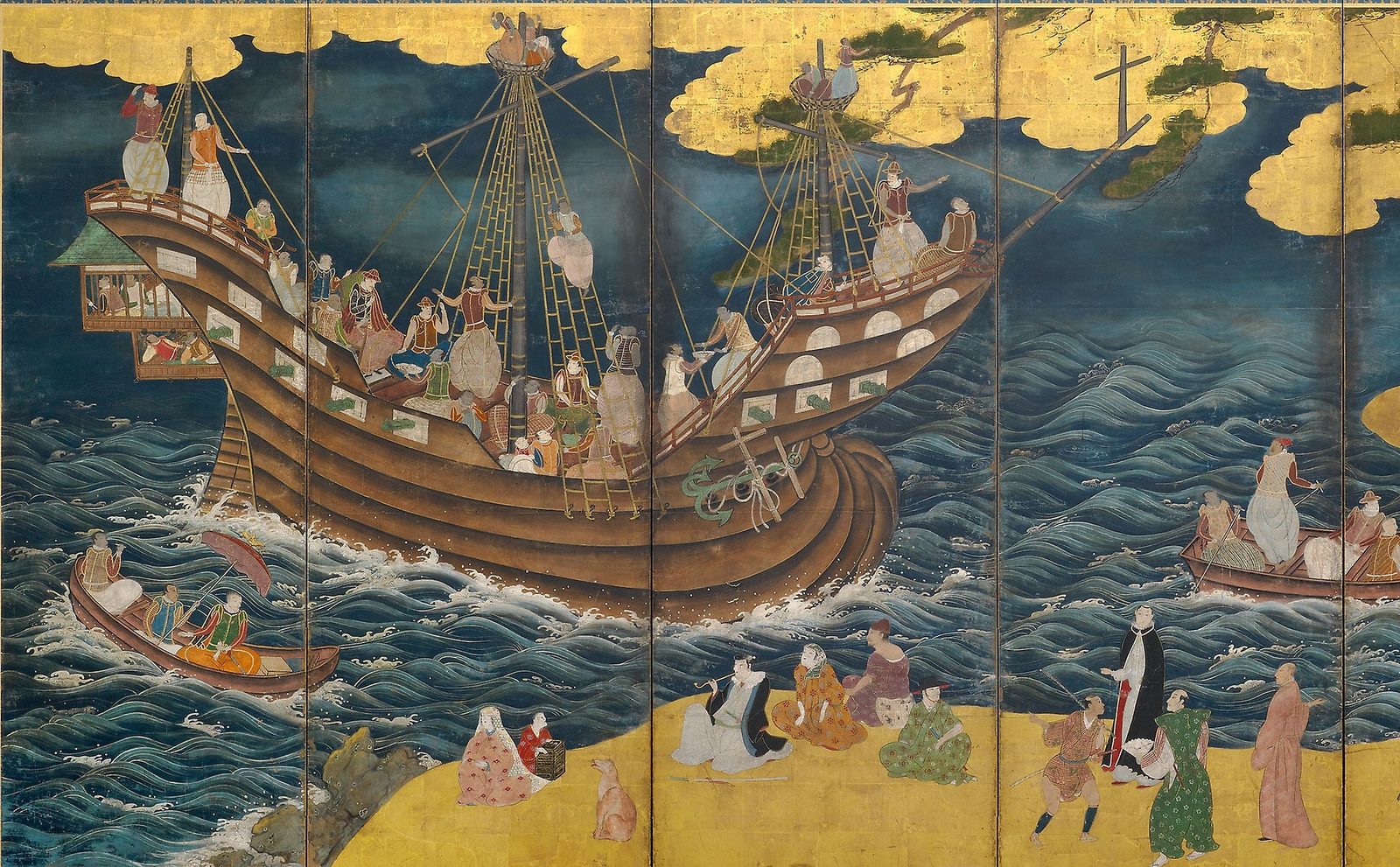
The Order in Between
History tends to remember the dramatic edicts, the bans, the burnings, the sweeping decrees that close chapters. Japan’s anti-Christian century offers two of them. The 1614 Expulsion Edict, drafted in a single night by the Zen monk Konchiin Sūden, criminalized Christianity across the archipelago. The 1639 sakoku edict, issued by Iemitsu in the aftermath of Shimabara, expelled the Portuguese forever. Between those two bookends lies a quieter, stranger, more revealing document, the 1623 expulsion order, that is rarely named and almost never remembered, but which accomplished something neither of its more famous siblings could have managed on its own.
It did not, technically, bar the Portuguese from Japan. What it did was more surgical. It dismantled the architecture of everyday life that had made a Portuguese community possible in Nagasaki for half a century. It stripped the Iberians of their right to reside permanently in Japan, converting them from residents into visitors. It forbade them to lodge with Christian families, forbade them to wear their own clothes, forbade them to employ their own servants, and, most consequentially, forbade them to keep their daughters when they left.
If the 1614 edict had ended the Christian mission, the 1623 order ended the Christian community. And it did so by targeting not belief, not preaching, not doctrine, but the domestic infrastructure of a lived world: houses, clothes, households, marriages, children. It was an extraordinary piece of legislation, and it was issued by a man who, at the moment it was promulgated, had been shogun for less than six months.
A New Shogun and an Old Problem
Tokugawa Iemitsu received the office of shogun from his father Hidetada in the summer of 1623. He was 19 years old. He had never won a battle, as the article on his reign traces in detail, and he had inherited a country that was, by every external measure, entirely pacified. Sekigahara was a quarter-century in the past. Osaka Castle had fallen eight years earlier. The daimyō had been brought to heel. The trade routes were humming. Silver was flowing out of the Iwami mines in quantities that made the Tokugawa bakufu the wealthiest government in Asia.
And yet Iemitsu, and the father who continued to rule from behind the curtain as Ōgosho, believed, with a conviction that bordered on the theological, that Japan was in mortal danger.
The danger was Christianity. Not Christianity as a religion; the Tokugawa had long since stopped engaging with it on those terms. Christianity as a network. As a web of loyalties, obligations, and communications that ran from the peasant communities of Kyushu to the Jesuit headquarters in Macao, and from there to Rome, Madrid, and points beyond. A Japanese Christian, in the shogunate’s evolving analysis, was not simply a person holding unorthodox beliefs. He was a node in a foreign command structure. He received instructions from priests who took orders from bishops who answered to a pope who might, at any moment, declare his temporal master a heretic and absolve his subjects of their allegiance.
This was not, in 1623, a theoretical concern. The Tokugawa had reasons, specific, documented, recent reasons, to believe that the threat was real and accelerating.
The Priests in the Junk
On 22 July 1620, off the coast of Taiwan, the English frigate Elizabeth intercepted a Japanese-flagged junk belonging to a Nagasaki merchant named Hirayama Jōchin. The Elizabeth was part of the Anglo-Dutch “Fleet of Defense,” a joint Protestant privateering venture whose principal enterprise was harassing Iberian shipping in East Asian waters, a venture whose fuller story is told in the article on the VOC’s Japan strategy. Hirayama was carrying a legitimate cargo. His papers were in order. His crew, however, included two passengers in Japanese dress who could not quite explain themselves.
One was a Flemish-born Dominican named Luis Flores. The other was an Augustinian friar from Spain named Pedro de Zúñiga. Both had been smuggled aboard at Manila. Both were bound, illegally, for the underground Christian mission in Japan.
The English and Dutch captors were delighted. They had been telling the shogunate for years that the Iberians were systematically smuggling priests into the country in defiance of the 1614 edict, and that the Portuguese galliots and Japanese merchant junks bound for Macao and Manila were essentially a clandestine ecclesiastical ferry service. Now, at last, they had proof. They delivered the priests, the captain, and the captured vessel to the authorities at Hirado, where the English and Dutch factories watched the Japanese response unfold with barely concealed satisfaction.
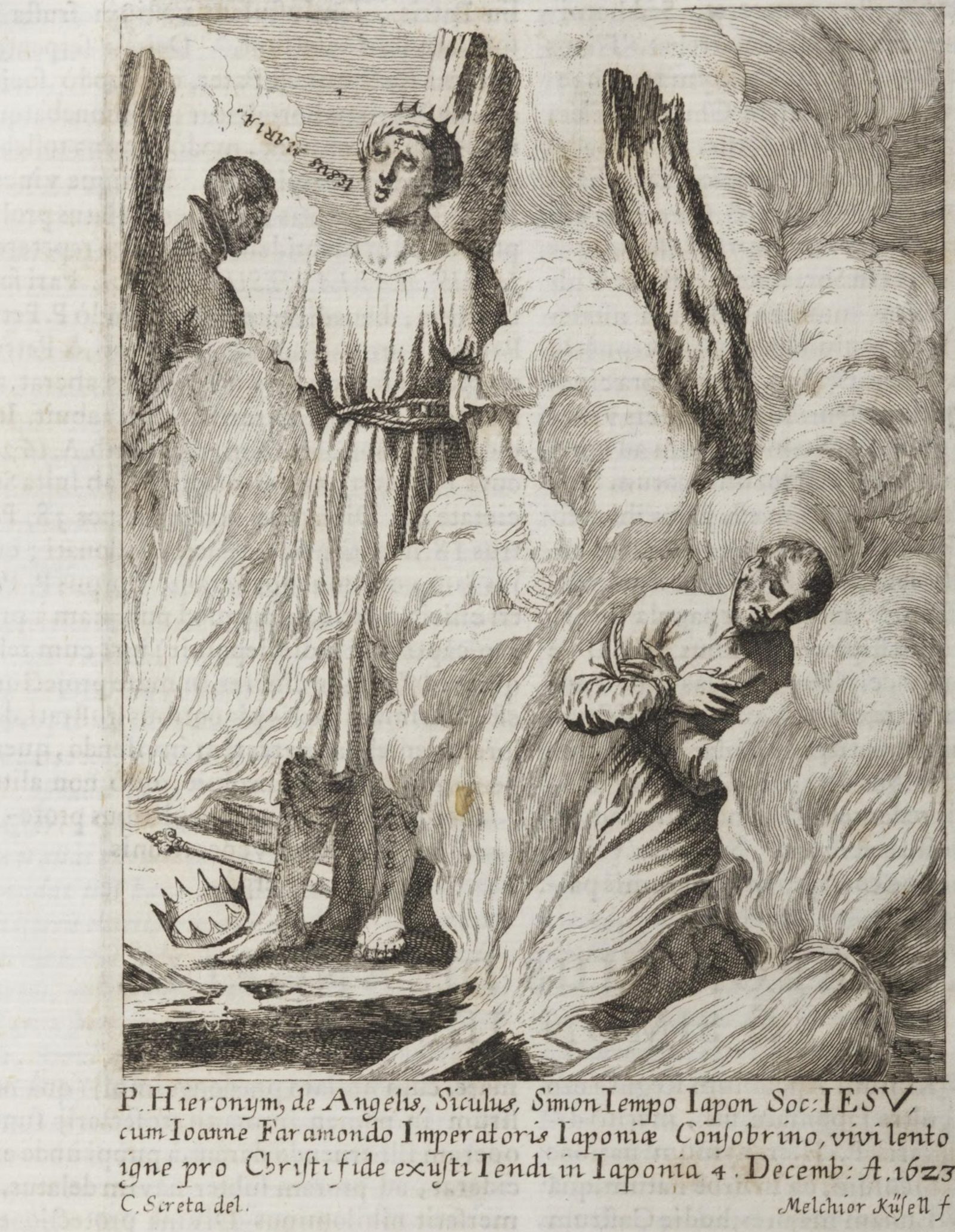
The response took two years. Japanese legal procedure under the Tokugawa was not swift; it was also not merciful. In the summer of 1622, Zúñiga, Flores, and Captain Hirayama were tied to stakes on the execution ground at Nagasaki and, over the course of several hours, roasted alive at a distance calculated to prolong their suffering. The 12 crewmen who had sailed with them were beheaded. Their severed heads were displayed on spikes along the road. The magistrate of Nagasaki, Hasegawa Gonroku, was censured for having failed to detect the smuggling in the first place.
The lesson the shogunate drew from this was not that the priests had been exceptional cases. It was that the priests were everywhere, that the merchants were knowingly carrying them, and that the 1614 edict, which had assumed missionaries could be separated from merchants, had failed on a fundamental conceptual level. The two were not separable. They had never been separable. As long as Iberian ships sailed to Nagasaki and Iberian residents lived there, priests would continue to arrive.
Three weeks after the Zúñiga and Flores executions, on 10 September 1622, the shogunate staged what became known as the Great Martyrdom of Nagasaki: 55 Christians, 25 burned, 30 beheaded, on Nishizaka hill, in full view of a crowd of 30,000. It was the single most violent act of the persecution to date.
The Report and the Discovery
Two other events, less spectacular but strategically decisive, pushed the Tokugawa toward their 1623 resolution.
The first was the return of Ibi Masayoshi. Ibi was a Japanese subject who had been dispatched to Europe some years earlier, accounts differ on the exact date and sponsor, but the likeliest patron is Hidetada himself, with a specific mission: to study the political mechanics of Christianity as practiced in Catholic Europe. Not its theology, which the shogunate considered beneath serious attention, but its organization. How did the Spanish Crown manage its relationship with Rome? What was the legal authority of a Jesuit provincial? How were missionary efforts financed? What was the chain of command?
Ibi returned around 1622, after seven years abroad, and was summoned to Edo Castle. He delivered his findings to Hidetada over three consecutive days and nights, a marathon briefing that the shogun reportedly refused to adjourn, taking meals and sleep at the dais while his envoy talked. By the time it was over, Hidetada had concluded something that his father Ieyasu had only intuited: that Christianity, as a political instrument, was not merely dangerous to Japan but was designed to be dangerous to polities like Japan. The shogunate resolved to renew the interdicts “with unprecedented severity.” What that severity would look like was still being drafted when the second event occurred.
In the autumn of 1623, officials in Edo discovered a hidden Christian community operating inside the shogun’s own capital. There were priests, two of them, Jesuit and Franciscan, living clandestinely among Japanese converts within walking distance of Edo Castle. The proscribed religion was not merely still alive in Kyushu, where it had taken root generations earlier; it had infiltrated the seat of Tokugawa power itself.
The shogunate’s response, now that Iemitsu had formally taken office that summer, was of a kind and magnitude that his father’s administration had contemplated but never quite authorized. The first move was the Great Edo Martyrdom of December 1623, 50 Christians burned at the stake on the Tōkaidō highway at Takanawa, deliberately staged on the busiest road entering the city during the season when every daimyō in Japan was traveling to or from Edo. The location was not accidental. Neither was the second executed group, a few weeks later, of 37 people, many of whom were not Christians at all but merely neighbors who had failed to inform on believers, including, notoriously, a member of Iemitsu’s own bodyguard.
These were the public acts of the new reign. The private act, the administrative order that accompanied them, issued in 1623 and progressively enforced across 1624, was the expulsion of the Iberian community as a social fact.
The Provisions
The 1623 order was not a single document so much as a cluster of decrees promulgated through the Nagasaki bugyō and transmitted verbally and in writing to the Portuguese and Spanish residents over the course of several months. Its provisions, taken together, amounted to a systematic unmaking of the Iberian settlement that had been growing in Nagasaki since the 1570s.
End of permanent residency. The Portuguese lost the right to live in Japan. They could visit for trade, but only during the trading season, arriving with the galliots in summer, departing for Macao by November or December. A handful would remain over the winter as the rearguard of each season’s commerce, often including the Captain-Major himself, who was required to travel to Edo in spring to pay obeisance to the shogun before returning to Macao with the next monsoon. These overwinterers were kept under surveillance so intense that contemporary Dutch observers described their conditions as indistinguishable from imprisonment.
Lodging with non-Christians. During their trading stays in Nagasaki, visiting Portuguese were forbidden to lodge with Christian households. The measure was aimed not merely at preventing the merchants from sheltering priests, though it did that, but at severing the affective and social bonds that had grown up over three generations of intermarriage, godparenthood, business partnership, and shared worship. A Portuguese merchant who had spent every summer since boyhood staying with his wife’s Christian family would now be required to lodge with strangers, often strangers specifically chosen for their hostility to the Church.
Expulsion of servants. The Portuguese had brought large numbers of South Asian servants and sailors, Goans, Malabaris, men and women described in Japanese records simply as “Indians”, to Nagasaki over the decades. These were now ordered to leave with the next galliot. A community that had functioned as a cosmopolitan diaspora, with its own languages and its own networks of obligation, was reduced to the Europeans themselves.
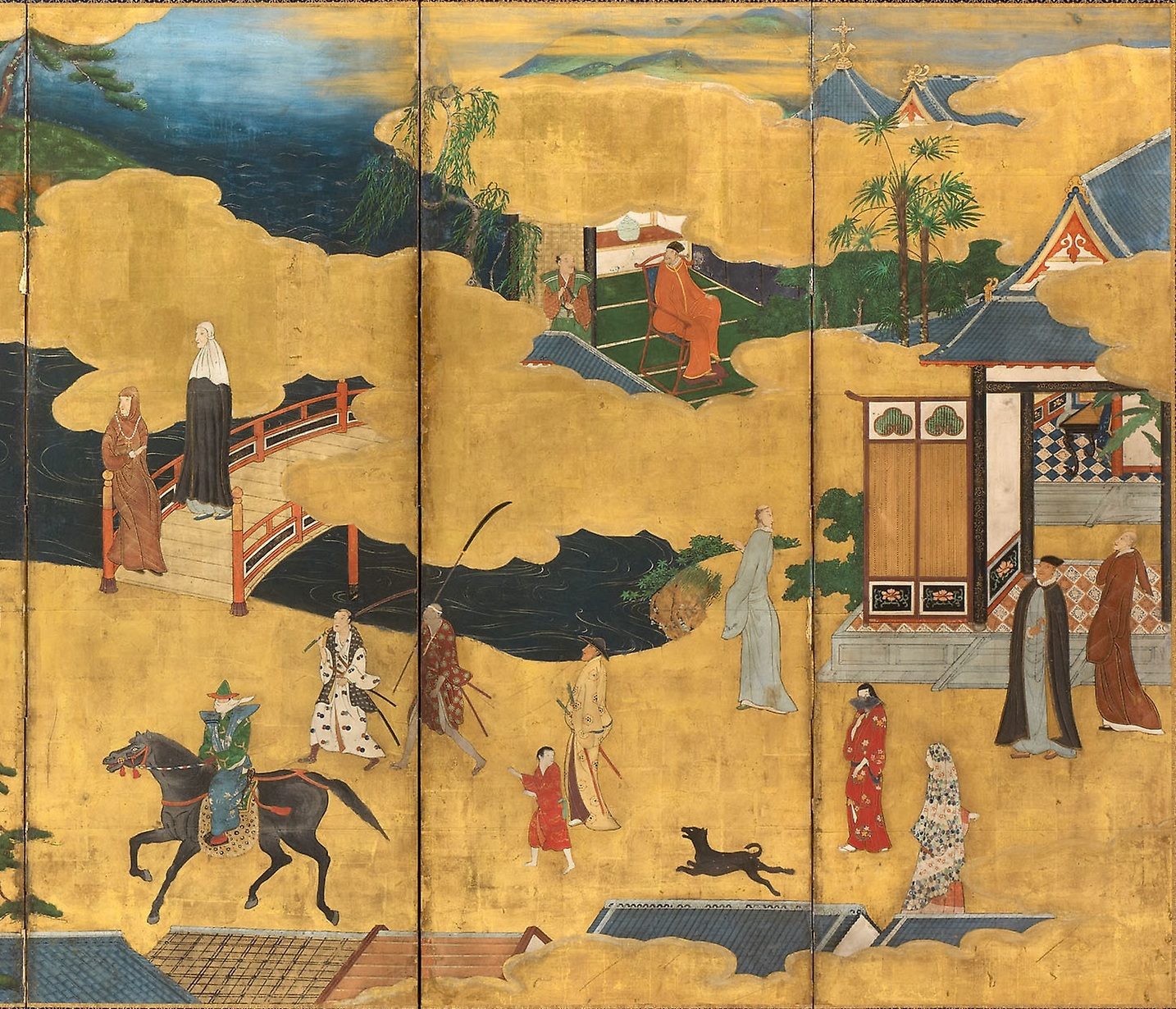
The clothing ban. Nobody, Portuguese, Spanish, Japanese, Chinese, Korean, was to wear European dress in Nagasaki. The reasoning was specific and, in its way, elegant: any missionary attempting to hide in Japanese society would have to discard his cassock and adopt Japanese clothes, but the habit of wearing European garments was sufficiently ingrained among Iberian residents, their mixed-race children, and their Japanese associates that a foreign priest could pass simply by dressing as they dressed. Making European clothing illegal meant that anyone still wearing it was either a visitor under direct surveillance or a fugitive. The measure also had a deeper cultural logic: it stripped from the Iberian community one of the most visible markers of its distinct identity. A Portuguese merchant stepping off his galliot in Nagasaki in 1625 would find that his own jerkin and breeches identified him as a problem.
The maritime prohibition. Japanese-flagged ships sailing overseas were forbidden to employ Portuguese pilots. This had been common, sometimes obligatory practice for Japanese shipping bound for Southeast Asia, where Portuguese navigational expertise was the closest thing to a reliable guarantee of safe passage. The prohibition cut another thread in the web of maritime cooperation that had tied the two commercial worlds together.
And finally, the provision that produced the loudest lamentations:
The separation of families. European men married to Japanese women, a category that by 1623 encompassed hundreds of households in Nagasaki, accumulated over three generations of settlement, were required to leave their wives and daughters behind when they departed. They could take their sons. They could not take the women who had borne those sons, or the daughters those women had also borne. A Dutch observer at Hirado, watching the first wave of departures in 1624, recorded that the rigorous edict produced “a great and pitiful outcry between those husbands and wives or fathers and children who were thus forced to separate one from another.” The grief was so audible it carried across the harbor.
The logic of the provision was, in the shogunate’s terms, perfectly coherent. Mixed-race sons could be exiled to Macao because they were, in the Tokugawa legal imagination, essentially Portuguese, carriers of the foreign bloodline, legitimate subjects of the foreign father’s jurisdiction, removable without violence to Japanese interests. Mixed-race daughters and their Japanese mothers were Japanese subjects, and Japanese subjects did not leave Japan with foreigners. The fact that this logic meant fathers might never see their daughters again, and husbands might never see their wives again, was not considered a relevant objection.
It would take another 13 years, and the full ideological intensification of Iemitsu’s mature reign, before the shogunate reversed itself on this point and decided that the daughters too would have to go. That story belongs to the end of this article.
The 1624 Enforcement and the Spanish Expulsion
The 1623 order was announced in outline. It was executed in detail over the following year.
In 1624, soldiers of the Nagasaki bugyō began a systematic inspection of every house in the city known to be inhabited by Europeans. They entered, they counted, they recorded the names of every occupant, and they added to their lists the names of any Japanese, Koreans, or Chinese they found dressed in European fashion. Each affected individual was issued a specific deadline by which he, and, in the case of the South Asian servants, she, had to leave Japan.
The departures were supervised at the quayside with the thoroughness of a customs inspection. The authorities were particularly concerned that no Japanese woman or servant be smuggled out of the country with the deportees, and every ship bound for Macao or Manila was searched before it was permitted to sail. Husbands attempting to conceal wives in cargo holds were discovered. Fathers attempting to conceal daughters in crates of silk were discovered. The inspections were not always gentle. But they were always thorough.
1624 also marked a second, parallel, and even more sweeping expulsion: that of the Spanish. The Spanish had always been the junior Iberian presence in Japan, arriving later and never matching the Portuguese in commercial importance. But their Franciscan missionaries, operating out of Manila under the protection of the Spanish Crown, had been disproportionately zealous in smuggling priests into the archipelago, and the Zúñiga and Flores case had implicated Spanish authorities as directly as Portuguese. The shogunate’s response was to cut the knot entirely. In 1624, all Spanish residents were expelled, all Spanish ships were banned from Japanese ports, and all diplomatic contact with the governor of Manila was terminated. The decision was unilateral, non-negotiable, and final. No Spanish vessel would trade at Nagasaki again.
The Portuguese, who had cultivated the patient fiction that they were a commercial presence separable from the missionary one, watched the Spanish expulsion with grim clarity. They understood that what had happened to Manila in 1624 could happen to Macao at any future date that seemed convenient.
The Dutch Among the Drops
The Dutch East India Company, the VOC, was, by 1623, well established at Hirado and beginning to sense its opportunity. The ship captains who had intercepted Zúñiga and Flores off Taiwan had not been cruising those waters by accident. For more than a decade, the Dutch had been pursuing a two-track strategy in East Asian waters: commercial competition with the Portuguese for the carrying trade between China and Japan, and a parallel propaganda campaign designed to persuade the Tokugawa that the Iberians were an irredeemable security risk while the Protestants were a model of commercial discretion.
The propaganda was relentless and, in its way, accurate. The Dutch reminded the rōjū, the shogun’s council of elders, that the Portuguese were smuggling priests. They reminded them that the Portuguese Crown was now, since 1580, the same Crown as the Spanish. They reminded them that the Portuguese had no commercial value the Dutch could not replace. And they petitioned, repeatedly, for permission to mount a joint Dutch–Japanese attack on Macao itself, an expedition that would have ended the Portuguese presence in China and delivered the silk trade into Dutch hands in a single campaign. The rōjū never quite approved the plan, but they also never told the Dutch to stop proposing it, which was nearly as useful.
What the Dutch achieved in 1623, and in the years immediately following, was the gradual substitution of the Portuguese in the shogunate’s commercial calculations. The English closed their Hirado factory in 1623 and abandoned the Japan trade. The Spanish were gone in 1624. By the late 1620s, the Portuguese were still trading, but the shogunate’s willingness to tolerate their religious accommodations was shrinking every year, a tightening whose documentary record can be traced in the faxaques of 1626, the four-prohibition oath that Captain-Major Luís Paes Pacheco signed in Nagasaki under explicit threat of annihilation.
The Dutch were jubilant. In 1641, when the Portuguese had finally been expelled and the Macao embassy beheaded on Nishizaka, the VOC held a thanksgiving service at Batavia. Their celebration was premature. That same year, the shogunate, having suddenly noticed that the Dutch were also Christians, however oddly they prayed, ordered them to abandon their relatively pleasant factory at Hirado and relocate to the tiny, prison-like island of Deshima in Nagasaki harbor, originally constructed to contain the Portuguese. There they remained for the next two centuries, trading through iron grilles, forbidden to practice their religion, forbidden to bring their wives.
The Dutch factor François Caron, who had watched the entire sequence unfold from the inside, summarized the lesson in a sentence that deserves to be remembered: “When it rains on the Portuguese, the Company likewise gets wet from the drops.”
The Daughters, 13 Years Later
The 1623 provision that had caused the loudest grief, the separation of Eurasian families, with husbands and sons departing while wives and daughters remained, held for 13 years. Then, in 1636, Iemitsu closed the loophole his father’s administration had left open.
The decree that year ordered the complete deportation of all descendants of Portuguese and Spaniards born of Japanese mothers. All of them. The children who had been allowed to stay in 1623 because they were considered Japanese were now, in 1636, reclassified as Portuguese and ordered onto ships for Macao. 287 Japanese wives and Eurasian children, the surviving core of the mixed community that had been the beating heart of Christian Nagasaki, sailed for Macao that year and never returned.
The arrivals in Macao were not triumphant. The city was poor, the climate was unfamiliar, and most of the refugees had no standing in Portuguese colonial society. Many died within a year of the voyage. The survivors were absorbed into the charity rolls of the local Santa Casa da Misericórdia, the lay confraternity that ran hospitals and orphanages across the Portuguese Asian empire and that, in Macao, served as the institutional memory of the Japan trade for the next two centuries. Japanese names appear in the Misericórdia’s account books well into the 1660s. By the 1680s they had mostly disappeared, absorbed into the polyglot population of the city.
A parallel deportation was applied to the Dutch in 1639. The Japanese wives and mixed-race children of Dutch and English men were shipped to Batavia, modern Jakarta. With them went a young Nagasaki girl named Oharu, the daughter of an Italian pilot on the Portuguese ships. The letters these exiles sent home, the jagatara-bumi, survive as some of the most moving documents of the entire expulsion era; one, from Koshoro of Hirado, is written on a small square of printed cloth. They are the voices of exiles trying to tell the people they would never see again that they had not forgotten them.
The families that had made Nagasaki a cosmopolitan port city were, by 1640, extinguished. Not dead, in most cases, but dispersed: to Macao, to Manila, to Batavia, to small colonial towns where they were neither Japanese nor Portuguese nor Dutch, and where many of their grandchildren would grow up knowing nothing of the country their grandmothers had been born in.
What the 1623 Order Actually Did
The strange thing about the 1623 expulsion order is how little it looks, at a glance, like a decisive event. It did not ban Christianity; that had been done in 1614. It did not expel the Portuguese; that would be done in 1639. It ordered some people to leave, required others to move house, forbade certain forms of dress, and separated a number of families. Placed next to the dramatic executions of 1622 and 1623, or the mass deportations of 1636, it looks almost administrative.
It was the most important piece of Tokugawa anti-Christian legislation between 1614 and 1639 precisely because it was administrative. The great edicts banned ideas. The 1623 order dismantled a place. It took Nagasaki, the cosmopolitan, multilingual, multi-religious port city that had grown up around the silk trade for three generations, and began the careful, systematic work of converting it into something else: a monitored trade corridor with no Iberian residents, no European clothes, no unsupervised lodgings, no mixed families, no Portuguese pilots, no South Asian servants, and no daily reminders that another world existed beyond the horizon.
By the time the Shimabara Rebellion erupted in 1637, the transformation was largely complete. The Nagasaki that the Portuguese galliots sailed into for their final trading seasons was a place their grandfathers would not have recognized. The churches were gone. The cemeteries had been dug up and the bones scattered at sea to prevent veneration. The Christian families they had known had converted, fled, been executed, or gone underground. The daughters they had left behind in 1623 had been shipped to Macao in 1636. The fumi-e, the images of Christ and the Virgin that every resident was required to trample each year, were being polished and laid out in the bugyō’s courtyard. The work of the 1623 order was complete. What remained for 1639 was only to formalize, finally, what had already happened in practice: the Portuguese did not live in Japan anymore, and they no longer could.
The 1623 expulsion order is thus the hinge between two worlds. Before it, Nagasaki was a place where Portuguese, Japanese, and Eurasian families shared houses, godparents, weddings, and funerals. After it, Nagasaki was a place where a small number of Iberian men arrived in summer, slept in government-approved lodgings, transacted their business under armed supervision, and sailed home in November. The transformation was irreversible long before it was officially recognized. It was also, and this is perhaps the deepest lesson of the 1620s, the work not of spectacular violence but of patient, methodical, and bureaucratically creative administrative cruelty. The great burnings of 1622 and 1623 are what history remembers. The inspections of 1624 are what actually changed the country.
Sources & Further Reading
Boxer, C.R. The Christian Century in Japan, 1549–1650. University of California Press, 1951. Still the indispensable English-language account of the persecution and expulsion era; chapters six and seven trace the 1620s escalation in detail.
Boxer, C.R. The Great Ship from Amacon: Annals of Macao and the Old Japan Trade, 1555–1640. Centro de Estudos Históricos Ultramarinos, 1959. The definitive study of the Macao–Nagasaki commercial relationship, including the commercial consequences of the 1623 restrictions.
Cieslik, Hubert. “The Great Martyrdom in Edo, 1623.” Monumenta Nipponica 10, no. 1/2 (1954): 1–44. The classic study of the Edo martyrdom that accompanied Iemitsu’s accession, with particular attention to the collective punishment of non-Christian neighbors.
Cooper, Michael. They Came to Japan: An Anthology of European Reports on Japan, 1543–1640. University of California Press, 1965. Contains the contemporary Dutch descriptions of the 1624 enforcement and the family separations at the Nagasaki wharves.
Elison, George. Deus Destroyed: The Image of Christianity in Early Modern Japan. Harvard University Press, 1973. The authoritative intellectual history of the Japanese case against Christianity; essential for understanding the Ibi Masayoshi report and its consequences.
Hesselink, Reinier H. The Dream of Christian Nagasaki: World Trade and the Clash of Cultures, 1560–1640. McFarland, 2016. A city-biography of Nagasaki that reconstructs the effect of the 1623 order on the urban community in unusual detail.
Jansen, Marius B. China in the Tokugawa World. Harvard University Press, 1992. Provides context for the Dutch and English privateering operations that produced the Zúñiga and Flores interception.
Massarella, Derek. A World Elsewhere: Europe’s Encounter with Japan in the Sixteenth and Seventeenth Centuries. Yale University Press, 1990. The standard synthesis of the diplomatic and commercial dimensions of the expulsion era.
Nosco, Peter. “The Experiences of Christians During the Underground Years and Thereafter.” Japanese Journal of Religious Studies 34, no. 1 (2007): 85–97. On the long-term consequences of the 1620s persecution for the communities that survived underground.
Paramore, Kiri. Ideology and Christianity in Japan. Routledge, 2009. The ideological genealogy of the Tokugawa case against Christianity, with particular attention to the reports from Europe that shaped Hidetada’s decisions in 1622–1623.
Sousa, Lúcio de. The Portuguese Slave Trade in Early Modern Japan: Merchants, Jesuits and Japanese, Chinese, and Korean Slaves. Brill, 2019. Contains important material on the South Asian servant community expelled in 1624 and the fate of the mixed-race families deported to Macao.
Toby, Ronald P. State and Diplomacy in Early Modern Japan: Asia in the Development of the Tokugawa Bakufu. Princeton University Press, 1984. Essential for the foreign policy calculus that linked the 1623 order to the subsequent closure of the country.
Turnbull, Stephen. The Kakure Kirishitan of Japan: A Study of Their Development, Beliefs, and Rituals to the Present Day. Japan Library, 1998. Traces the underground Christian communities that were one of the direct legacies of the 1623 policy.
Cite this page
Nanban.pt. “The 1623 Expulsion Order: When Japan Decided the Iberians Could Trade, but Not Live.” Last modified 25 September 2026. https://nanban.pt/articles/1623-expulsion-order/.
@misc{nanban-1623-expulsion-order,
  author = {Nanban.pt},
  title = {The 1623 Expulsion Order: When Japan Decided the Iberians Could Trade, but Not Live},
  year = {2026},
  url = "https://nanban.pt/articles/1623-expulsion-order/",
  note = {Last modified 2026-09-25}
}