Sailing from Lisbon to Nagasaki: The Deadliest Journey in the World
To travel from Lisbon to Nagasaki in the 16th century was to board a wooden box that leaked, rotted, starved you, infested you, and, on a bad voyage, stood a one-in-two chance of killing you before you sighted land. We look at five rival seafaring nations and compare how they fared.
Sailing from Lisbon to Nagasaki examines the 16th-century sea route to Japan, a voyage aboard a leaking, rotting wooden ship that starved and infested its crew and, on a bad voyage, stood a one-in-two chance of killing them before they sighted land. It compares five rival seafaring nations and how each fared on the deadliest journey in the world.
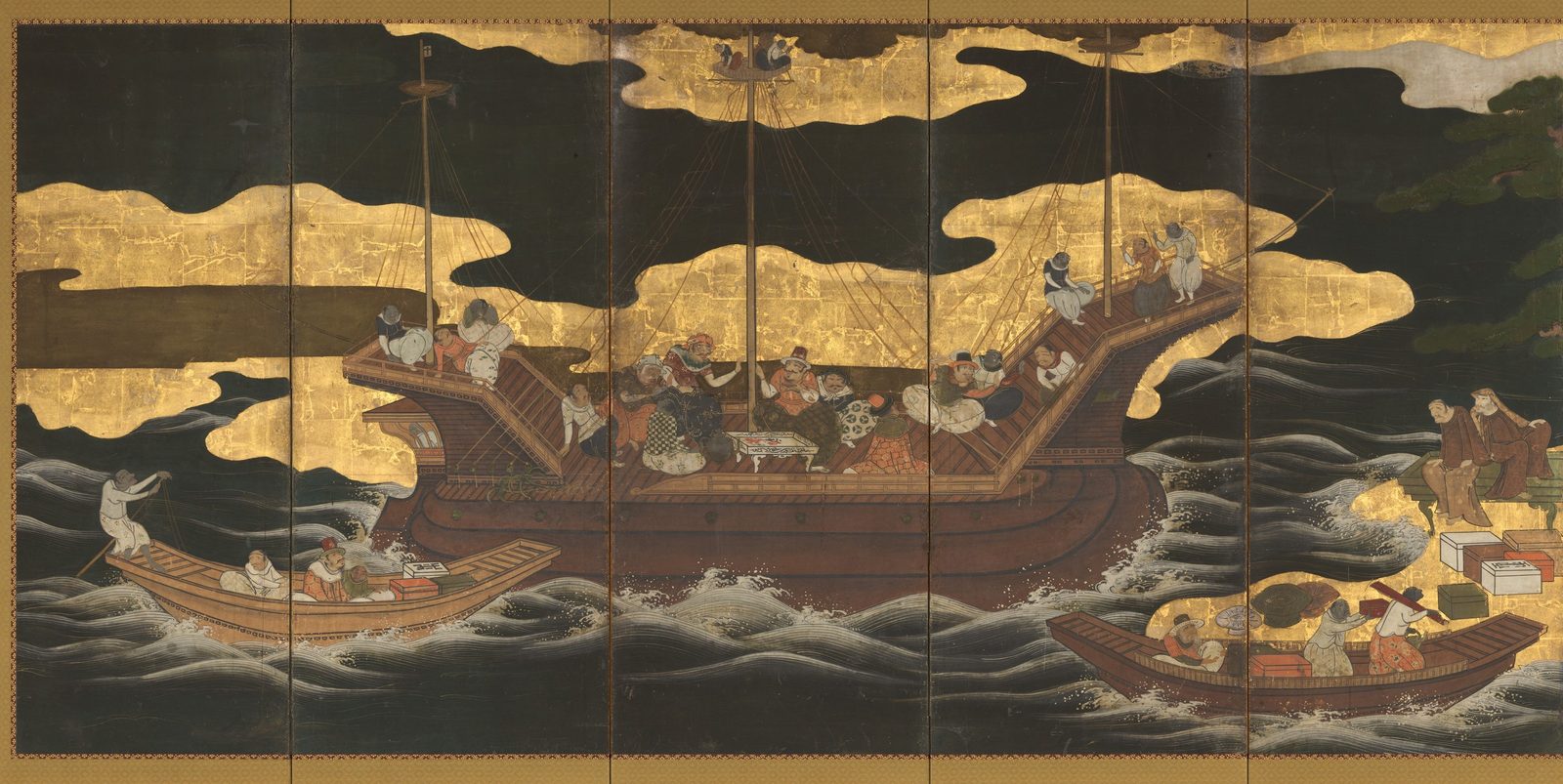
The Ticket
In the spring of any year between 1543 and 1639, a man standing on the wharf at Belém watching the great carracks load for the Indies was watching a wager being placed with his own life. If he boarded one of those ships, as a soldier, a merchant, a missionary, a fortune-hunter, or a convict exiled at royal expense because the prisons of Lisbon were full, he had, on a bad voyage, something close to a fifty fifty chance of dying.
These are not figures chosen for shock. They are the ordinary arithmetic of the longest regular sea road on earth, the line that joined the Tagus to the silver port of Nagasaki by way of the Carreira da Índia and its far-eastern extension through Malacca and Macau. And the strange fact at the heart of it is that men kept going. Every spring. For roughly a century and a half. The thing they were buying was the most profitable commercial route in the early modern world, and it was also the most weather-dependent, the most comprehensively lethal, and the most punishing piece of engineering anyone had yet attempted with sail and timber.
What follows is an attempt to describe the experience: the route and its winds, the food and water that turned to poison, the floating slum below decks, the diseases that killed, the society of strangers crammed into small spaces, and the question of what possessed anyone to do it at all. And because the Portuguese were only one of six seafaring traditions to run this gauntlet, the final reckoning compares how the Spanish, the Dutch, the English, the Chinese, and the merchant-pilots of the Indian Ocean crossed the very same water, and why so many of them did it so much better.
The Clock Made of Wind
The entire apparatus of European commerce in Asia ran on a timetable written by the seasonal reversal of the Indian Ocean winds. The southwest monsoon, from roughly April to September, carried ships eastward and northward; the northeast monsoon, from October to March, blew them home. To miss the window meant being stranded in a foreign port for a full year, or, worse, sailing against the wind through the most violent weather the hemisphere could produce. The journey from Lisbon to Japan was therefore never a single voyage. It was four voyages stitched together, each ruled by its own meteorological despot, and joined by layovers measured in weeks, months, and, at Macau, as much as an entire year.
The first leg, Lisbon to Goa, was the longest single passage, five to seven months of open water. Ships left in late February or April and did not creep down the African coast, where the windless calms of the Gulf of Guinea could hold a vessel motionless until its crew died of thirst. Instead they performed the great counterintuitive sweep known as the volta do mar, swinging far out into the South Atlantic toward the coast of Brazil to catch the prevailing westerlies of the southern latitudes, the band of wind sailors would later christen the Roaring Forties, before turning hard east to run down on the tip of Africa.
That tip was the most reliably terrifying obstacle of the outbound run. Bartolomeu Dias had named it the Cape of Storms before a more optimistic Portuguese Crown rebranded it the Cape of Good Hope, and the sailors who actually rounded it kept their own name, the Mouth of Hell. Where the Roaring Forties met the hot Agulhas Current and the cold Benguela, the sea produced storms of a particular savagery: the sky black at noon, lightning without pause, and swells that men described, with grim consistency, as mountains with snow on their caps, any one of which could sweep a deck clear of men and mast in a single heave.
Beyond the Cape lay Mozambique Island, the principal watering and reprovisioning stop, and a place so soaked in malaria and bilious fever that the Portuguese came to call it an açougue, a slaughterhouse, of their own people. From there a ship took either the inner passage up the Mozambique Channel or the outer route east of Madagascar, depending on how late in the season it had rounded the Cape, before riding the monsoon up to Goa.
At Goa the clock reset. A ship bound for Japan now waited, sometimes the better part of a year, for the correct wind, then crossed the Bay of Bengal to Malacca, the strategic throat of the eastern seas that Portugal had seized in 1511, and pushed on across the South China Sea to Macau through a maze of shoals, hidden coral, fog, and sudden storms. And at Macau the voyage simply stopped. For up to a year the ship sat at the wharf while its officers assembled a cargo of Chinese silk, waited, and bribed Chinese officials. Only then, in late June or July, did the great carrack, the Nau do Trato, run the fastest and richest leg of the entire journey, 14 days to Nagasaki on the last of the southwest monsoon, 30 if the weather turned.
The eastern seas had their own great killer, and it was not the storm but the tufão, a word the Portuguese took from the Chinese and Arabic tufan and the English later borrowed as typhoon. These Pacific cyclones tore across the China and Japan coasts from July to October, precisely during the Macau-to-Nagasaki window, with a destructive efficiency on a wholly different scale from the Atlantic. In 1573 a typhoon caught the ship of Dom António de Vilhena off Amakusa, dismasted her, and threw her onto the Japanese shore; 150 Portuguese drowned and a fortune in silver went to the bottom of the ocean.
The whole schedule, in other words, was a house of cards built on wind. A late departure from Lisbon meant a late Cape and the Agulhas Bank in midwinter; a delay at Goa meant missing the monsoon for Malacca; a delay at Macau meant running the typhoon season blind. To miss a wind entirely was to be forced to invernar, to winter, at an intermediate port, and to hold a crowded, half-starved crew at pestilential Mozambique for months was to turn the island into a mass grave. In 1608 the armada of the Conde de Feira was forced to winter there and lost 600 men to disease before it could sail on.
The Larder and the Cask
A standard outbound ship left Lisbon with a manifest that read like the inventory of a besieged city: hundreds of barrels of water, more than 100 barrels of wine, over 100,000 pounds of hardtack biscuit, salted beef and pork by the ton, sardines, cheese, oil, dried beans, almonds, garlic, onions, sugar, honey, and jars of preserves earmarked almost entirely for the sick and the wealthy. On deck went the livestock: chickens, sheep, and pigs, which were favored because they ate scraps and took little room. Pregnant sows were the most prized passengers of all, since a sow could farrow at sea, letting the crew eat the mother and raise her piglets for later. For the first fortnight this looked like an enormous quantity of food. For the last four months it was a floating compost heap.
The ordinary sailor's daily ration was generous on paper and a slow nutritional catastrophe in practice: about a pound and a half of biscuit, a measure of wine, a measure of water, and on meat days half a pound of heavily salted beef or pork. Because Catholic fasting rules followed the men onto the ocean, nearly half the voyage consisted of abstinence days, when the meat was swapped for salt cod, cheese, or chickpeas. There was no fresh fruit and no fresh vegetable, and no way to obtain either once the coast dropped below the horizon. The biscuit was baked twice to drive out the moisture and was consequently so hard it had to be soaked before a man could chew it, which was just as well, because in the tropical heat it filled with weevil beetles until a voyager in the 1550s swore the bread appeared to move on the plate. Men learned to eat it in the dark.
The water was worse than the food. Sealed in wooden casks, it began to spoil within weeks, turned yellow within two months, and grew its own worms within three. Passengers describe drinking it with their noses pinched and their eyes shut, or straining it through a handkerchief to keep the larger creatures out of their mouths. When supplies ran short in a calm, the ration collapsed and a single cup of foul water could sell aboard ship for a third of the Lisbon price of a whole chicken. Men paid. In the last extremity the maddened drank seawater or their own urine, and the rats that had gnawed through the casks became, in their turn, food.
At the captain's end of the ship a wholly different voyage was under way, because rank decided everything, including dinner. The captain, the master, the pilot, and the wealthier passengers dined at tables laid with cloth, ate from silver plate, and consumed fine white biscuit, fresh poultry and mutton from their private livestock, preserved quince, and decent wine, while the common sailors ate squatting on the deck under the eye of the boatswain. Even the medical comforts of the provisão do Rey, the King's provisions meant to heal the sick, were routinely hoarded by officers and sold back to the dying crew at a markup on a thriving shipboard black market.
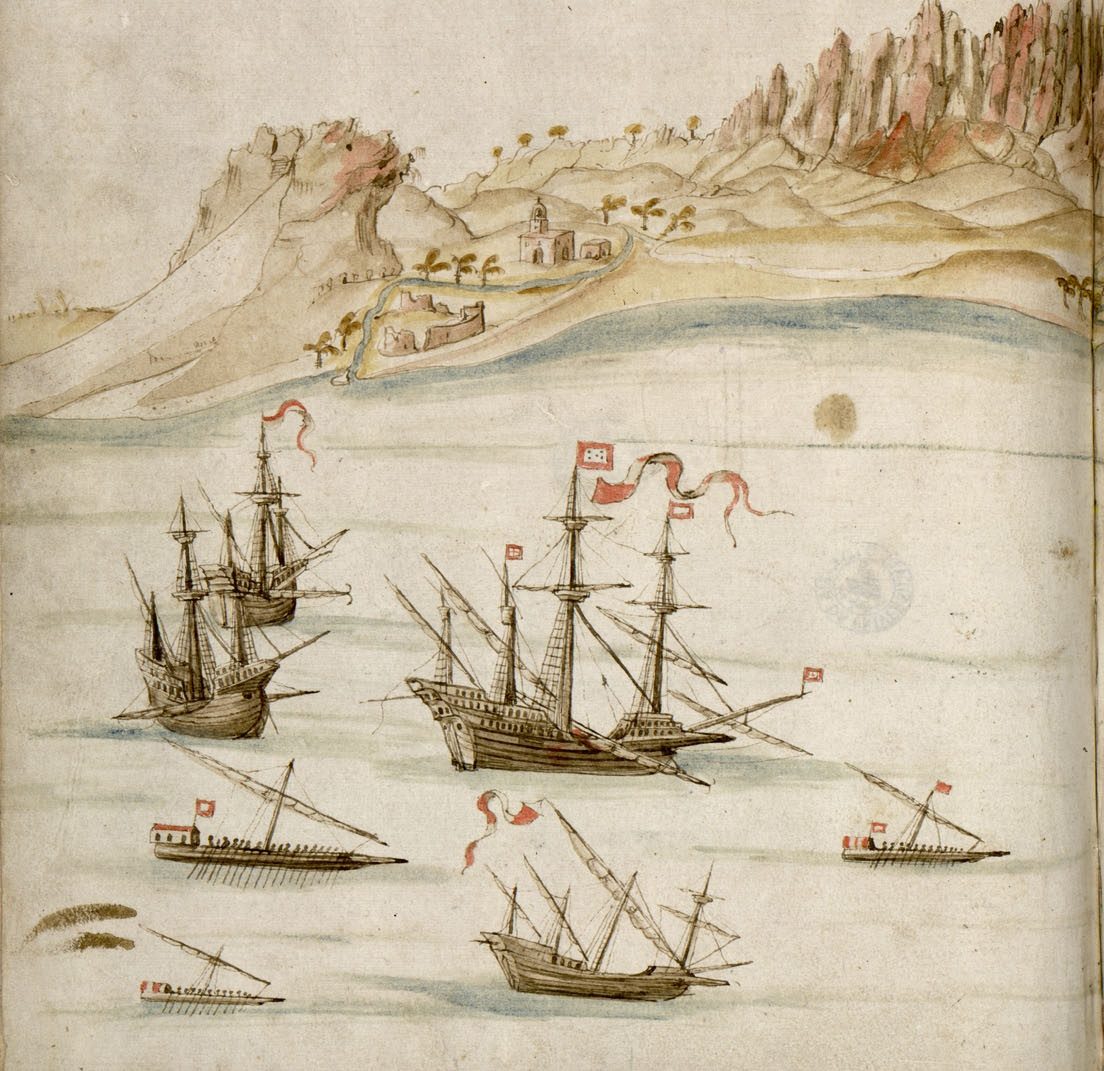
The Floating Slum
A 16th-century Portuguese writer described the pump well, the lowest part of the hull where the bilge collected, as a pestilential and darkest place, a hell where all the filth gathered. He intended this as a technical description, and it was accurate.
A large outbound carrack carried a crew of around 120 and anywhere from 400 to over 1,000 others, the usable space per person working out to roughly a square meter and a half, barely room to lie down. Officers and the rich took the cabins in the sterncastle. Everyone else slept on the open upper deck on a plank and a straw pallet, broiled by the sun, soaked by squalls, and driven below in bad weather into a hold with no ventilation whatsoever, where the air was a warm compound of unwashed bodies, fermenting cargo, vomit, bilge, and the breath of the sick, so thick that a man coming down the ladder might faint on it. The hammock, which the Iberians would eventually copy from the peoples of the Americas, had not yet reached these decks.
Washing was a luxury that did not exist, since the fresh water was for drinking and the sick. Men cleaned themselves, if at all, in seawater that left their skin crusted with salt and their clothes stiff as board. The clothes, unchanged for weeks, became habitat. The 16th-century Spanish writer Eugenio de Salazar, recording his own Atlantic crossing, joked that the ship's lice grew so large that some of them got seasick. The joke had a body count, because the body louse carried typhus.
The act of relieving oneself was a small daily adventure. To do so a man climbed over the rail and lowered himself onto one of the jardines, the little gardens, a crude wooden seat slung over the open water outside the ship's side, where in rough seas the spray was frigid and the grip occasionally fatal. There was a communal length of tar-soaked rope for the obvious purpose, shared by all hands. Anyone too weak to make the climb, which on a long voyage meant a great many people, simply fouled where they lay, and the sick lay in it and waited for someone to clean them, and often no one did. The lower decks became, in effect, an ideal apparatus for breeding and spreading disease.
The Long Dying
On any voyage of more than three months, the passengers began to die of scurvy, typhus, and dysentery.
Scurvy did the most work. The Portuguese called it the mal de Loanda, and in physiological terms it was simply a lack of vitamin C in a diet stripped of anything fresh. In lived experience it was a long and theatrical dismantling of the body. After about three months at sea a man's gums began to bleed and then to rot, swelling black and spongy over the teeth until the teeth loosened and fell out and the breath turned so foul that comrades shunned him. Old wounds, sword cuts and musket scars years healed, reopened and festered, as if the body were spontaneously undoing every repair it had ever made. The desperate sliced away their own putrefying gum tissue with their knives so that they could eat. Men dropped dead from the mild exertion of standing up, and the shrewd Portuguese remark that a man at sea aged 10 years in three months was not a metaphor. Vasco da Gama's prototype voyage of 1497 lost something like two-thirds of its crew, much of it to scurvy, and 150 years of practice did not meaningfully improve the figure. The great fleet of 1571 left Lisbon with 4,000 men and reached Asia with about 2,000. Between 1629 and 1634, of 5,228 soldiers sent out from Portugal, only 2,495 arrived alive, a death rate above half.
Typhus, the ship fever bred by the louse, did the rest, alongside the dysentery and fevers that men carried aboard at Mozambique, Goa, and Malacca. The dead were committed to the sea and became, as one writer put it, a meal for ferocious fishes, the sharks that learned to trail the ships and feed on the bodies pitched over the side each morning.
Medical care, where it existed, was usually worse than none. Royal regulation required a qualified physician aboard each Indiaman, but in practice a ship was lucky to carry an ignorant barber-surgeon, often a common sailor contracted into the role, whose skill ran to pulling teeth, dressing wounds, and opening veins. The whole apparatus rested on humoral theory, the belief that illness sprang from an imbalance of the four bodily humors, which made bloodletting the sovereign remedy for nearly everything. The practice was savage: diaries record barber-surgeons bleeding feverish men 10 or 12 times, draining the already dehydrated and the already starving, and so finishing off patients who might otherwise have pulled through. Scurvy sufferers, whose entire problem was that they were not getting enough of anything, were bled as a matter of policy. The medicine chest came stocked with hundreds of preparations, most spoiled by the tropical damp, and because illness was widely read as a punishment for sin, a patient was often required to confess to a priest before any earthly treatment touched him.
The strangest thing about all of this is that the cure had been in plain sight the whole time. The Portuguese themselves had noticed in the 16th century that oranges from Malindi worked wonders against the mal de Loanda, and slave traders at Cartagena by 1620 knew that the scorbutic could be revived with what they called cosas agrias, sour things. The knowledge stayed mere folk wisdom for two and a half centuries, beaten down at every turn by humoral dogma, by the misdiagnosis of scurvy as a contagion, and later by the self-defeating habit of boiling citrus juice to preserve it, which quietly destroyed the very vitamin that did the work. It would take the controlled trial run by the Scottish naval surgeon James Lind in 1747 and James Cook's scurvy-free circumnavigation of the 1770s, which paired fresh vegetables with relentless cleanliness and dry, aired decks, before the Royal Navy at last made citrus standard issue in 1795.
The Ship as a Society
A carrack was a rigid model of Iberian society afloat, and the gulf inside it ran as deep as the one ashore. Tellingly, both Portugal and Spain held the seaman's trade in contempt and ranked a soldier comfortably above a sailor, which produced the founding absurdity of the whole enterprise: the men in command frequently could not sail.
At the top stood the captain-major and the captain, almost always fidalgos, noblemen appointed by royal favor and often with no nautical experience at all. Their role was military command and the dispensing of justice; they lived in relative luxury with personal entourages and wielded near-absolute power. The actual sailing fell to the pilot, the highest technical authority aboard, solely responsible for navigation by astrolabe and chart, and yet almost always a man of humble birth denied the prestige of the nobles he carried to safety. Beneath him the master ran the economy of the ship, controlling the cargo, the provisions, and the keys, which made him the arbiter of who ate, and the boatswain was his enforcer, directing the sails with a whistle and discipline with a rope. Below them came the sailors, recruited from the lower classes and widely regarded as violent and uncouth, then the grumetes, teenagers who did the heaviest and most dangerous work aloft, and the pajens, boys of eight or 10 who scrubbed the decks, served the officers, watched the sandglass, and led the prayers. The young of the ship were also its punching bags, and worse.
Soldiers, who considered themselves superior to every sailor, brawled constantly over sleeping space and rigging lines. Enslaved people and free Black and mixed-race men supplemented the crew at the worst labor, the bilge pumps and the heavy hauling. Passengers ran the gamut from rich merchants to degredados, convicts shipped east because Portugal had run out of places to put them.
To hold hundreds of armed, desperate, frightened men in line, captains relied on a network of secret informers and a graded scale of punishment: the stocks and public flogging for small offenses, keelhauling beneath the barnacled hull or repeated dropping from the yardarm for serious ones, and death by hanging or drowning for mutiny. The justice, however, was openly biased by class. Captains were instructed that noblemen, gentlemen, pilots, and masters were exempt from execution or mutilation at sea and were merely to be confined and handed to the courts on arrival. The same logic governed catastrophe. When a ship went down, the few places in the boat were reserved by custom and by law for the captain, the officers, the nobility, and just enough sailors to row them. The lifeboat, in other words, was a class privilege, and the law that hanged a common man would not so much as scar a gentleman.
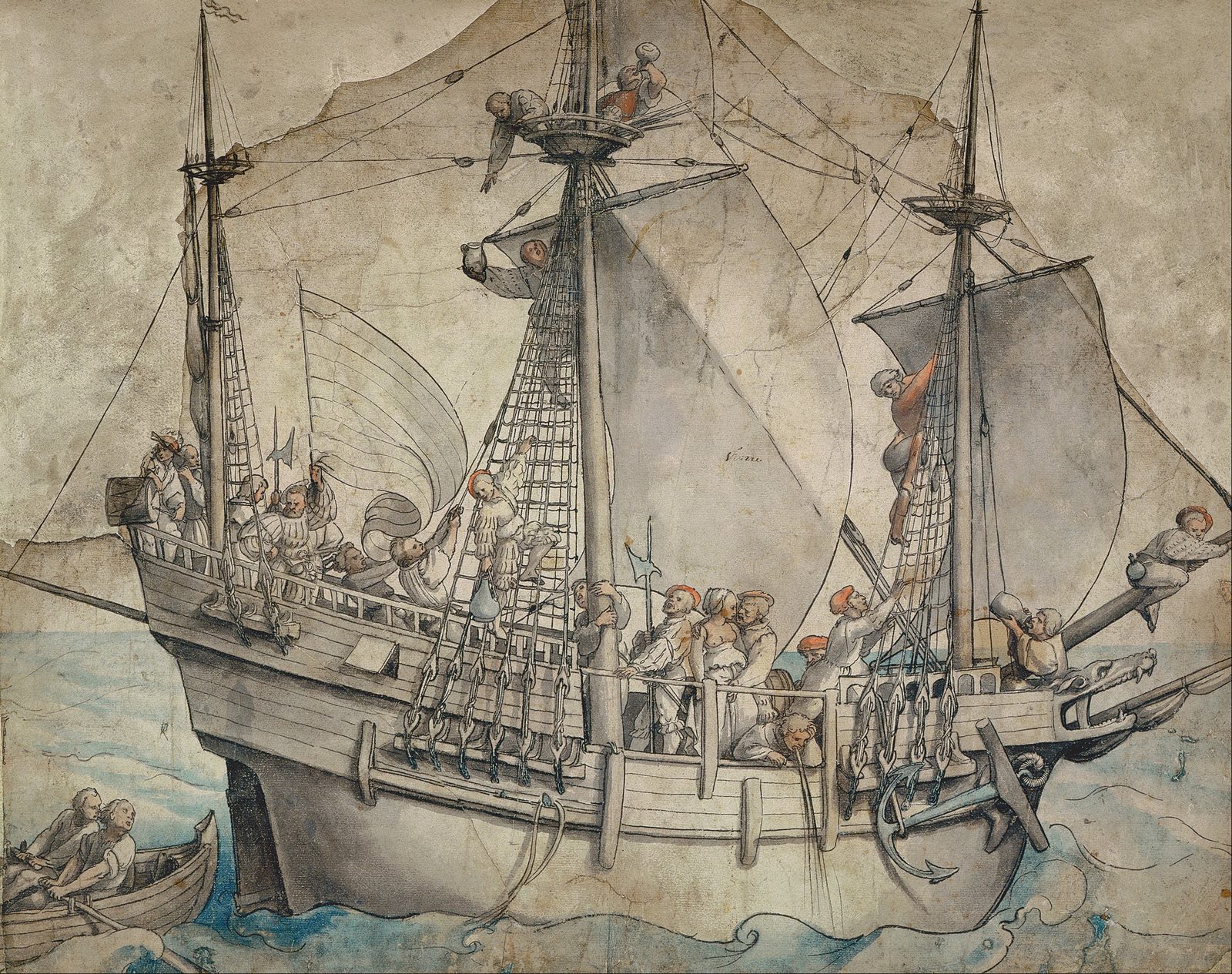
The Empty Weeks
Between the bouts of terror stretched long weeks of crushing monotony, days on a steady trade wind when the crew barely touched a sail, and the ship filled the time with ritual, vice, and improvised theater.
The day was ruled by the half-hour sandglass, the ampolleta, tended by the youngest pages, who turned it as the sand ran out and struck the bell, often with a little chant to swear the time had been kept honestly. The night was divided into watches, among them the much-hated modorra, the sleepy watch that broke the small hours in two. Religion framed everything: the pages chanted a communal good-morning at dawn and led the evening prayers at sunset, Saturday nights brought the Salve Regina to the Virgin, and feast days broke the routine with deck altars, processions, and salutes of artillery. Devotion peaked, predictably, in storms, when men vowed pilgrimages and flung relics into the waves, and ebbed the moment the sky cleared and the cards came back out.
The cards never stayed away for long. Gambling was banned by royal ordinance and was nonetheless the universal obsession of the ship; the constable made a quiet profit renting out decks and skimming a cut from the winners, and men played for ruinous stakes on their sea chests. Music filled the calms, ballads and the guitar and the flute, and on holy days the ship became a stage for plays in which sailors costumed as devils acted out the temptations of Christ across the forecastle. Fishing was both sport and survival; nearly every man kept hook and line in his chest and dropped it the moment the ship lay becalmed. And the crossing of a great geographic line, such as the equator, called for an exacted tribute that funded a raucous, drunken party briefly suspending the whole rigid hierarchy of the ship and letting the men blow off a year's worth of resentment at once.
A Ship of Men
The ships were overwhelmingly male, with gender ratios cited as steep as 50 men to a single woman, and that imbalance shaped a grim and largely undocumented social history. The few women aboard were mostly the servants of wealthy passengers or the Órfãs del Rei, the Orphans of the Crown, marriageable orphan girls dispatched by the Portuguese state with dowries in the form of colonial offices, sent out to marry and settle the empire. A handful of prostitutes were smuggled aboard as stowaways and, if discovered, were often made to pay for their passage, though the dread of syphilis tempered the trade.
The records also document a great deal of sexual violence. The vulnerable Órfãs were preyed upon by mariners and then pressured into silence, since to complain was to be branded ruined and rendered worthless on the colonial marriage market. Noblewomen, shielded by the threat of legal reprisal, barricaded themselves in their cabins or dressed as boys, and the young pages and grumetes were as exposed to abuse as anyone. Sodomy, the so-called nefarious sin, was condemned in doctrine as a crime worse than murder and punishable by burning, yet enforcement diverged sharply from the law, and the authorities, including the Inquisition at Goa, frequently recommended quiet penances over public execution to avoid scandal and keep a crew functioning. Some pragmatic captains simply locked the women and their daughters in a secure cabin and forbade any man to come within five spans of the door, a measure that says as much about the crew as it does about the captain.
God or Gold
To sail a Portuguese ship was to inhabit a world in which the ocean was not a physical system to be managed but a theater of divine judgment. Storms, calms, and epidemics were not read as weather and chance; they were the will of God, and more pointedly the punishment of God for the sins of the people aboard. This was not folk superstition at the margins but official doctrine: royal instructions to fleet commanders sometimes blamed the misfortunes of the Carreira da Índia squarely on the sins committed against God, and urged captains to prosecute vice as a means of protecting the fleet, putting the suppression of blasphemy and gambling on the same footing as sound rigging.
The logic ran in a closed and dangerous loop. If disaster was punishment for sin, the remedy for danger was repentance rather than effort. When a storm rose, the instinctive response was ritual and not seamanship: men raised altars on the heaving deck, chanted litanies, and made frantic vows to fund hospitals or donate the mainsail to the Virgin if they were spared. The Crown even issued its ships a Bandeira das Relíquias, a Banner of Relics, designed expressly to be hoisted in a storm to summon celestial protection. At the worst possible moment, this faith competed for the crew's hands. When the heavily loaded São Paulo was caught in a storm off Sumatra in 1561 and drifting onto a reef, the men abandoned their posts entirely, hoisted the banner, fell to their knees, and spent the ship's last chance weeping and praying for forgiveness. When the eerie electrical glow of St Elmo's fire crawled up the rigging, sailors took it for a visit from a consoling saint and dropped their work to stare and scream prayers, leaving the ship to fend for itself.
Nowhere did devotion collide more dangerously with safety than over the open flame. A wooden ship waterproofed with pitch and tar was a tinderbox, and the rules on fire were correspondingly strict: the galley fire was generally the only unenclosed flame allowed, was doused by late afternoon, and was forbidden outright in a storm; smoking below deck at night could cost a man 90 lashes; the single night lantern was locked inside pierced tin so no spark could escape. And yet intense piety routinely defeated all of it. In storms men lit blessed candles in the howling wind at their deck altars, and below decks they lit votive candles to their personal saints in cramped, pitch-soaked quarters, and forgot them, and burned entire ships to the waterline. The candle lit to beg a saint for protection was, all too often, the very thing that destroyed the ship.
So what was the calculation that kept men climbing aboard? For most it was profit, and the profit was real. The Nagasaki silk trade, in which the Portuguese sold an entire cargo to a Japanese merchant consortium at a pre-agreed bulk price under the pancada system, could return margins of well over 100 per cent on a round trip, and a single voyage of the Great Ship could make a captain wealthy for life. The ordinary sailor drew flat pay that his officers embezzled, and the convict drew nothing; what they shared was that the alternative to the voyage was a slower death in the slums and jails they were leaving behind. The missionaries were different again, intellectuals and diplomats who had chosen this far from comfortable options. Francis Xavier could have stayed in a Paris lecture hall and instead embraced discomfort to spread the word of God.
Five Other Ways to Cross an Ocean
Within a century Portuguese rivals had overtaken on almost every measure of survival, and the older maritime traditions of China and the Indian Ocean had built much of that safety in from the start. The differences were not luck. They flowed from how each society organized a voyage: who commanded, who paid, what the crew ate, and what they believed a sea passage was for.
| Portuguese | Spanish | Dutch (VOC) | English (EIC) | Chinese | Indian Ocean | |
|---|---|---|---|---|---|---|
| Ship | Top-heavy carrack, up to 2,000 tons | Carrack and galleon, Manila run | Nimbler fluyt, ~1,000 tons | Standardized, lifespan-capped | Huge junk, double hull, watertight bulkheads | Light sewn-hull dhow, teak |
| Command | Noble fidalgos, often no sea skill | Same Iberian noble-military model | Centralized company bureaucracy | Company masters, navy-style flogging | Working mariners | Expert Arab and Indian pilots |
| Food | Rotten biscuit, embezzled stores | Same Iberian ration, salt and biscuit | Structured three-meal menu | Heavy but unbalanced; later cured scurvy | Live herds and vegetables grown aboard | Variable, often grueling |
| Mortality | Often a third to a half | High, Iberian pattern | 6 to 15% in the 1600s | ~13.5% on the 1613 Clove | Low by design | Swift, relatively safe |
The Spanish ran the same Iberian system as the Portuguese and reaped much the same harvest. Command went to noblemen on the strength of their blood rather than their seamanship, the maritime trades were despised, the ration was the same salt and biscuit, and the discipline was the same blend of savagery and improvisation; it is a Spanish writer, Eugenio de Salazar, who left the sharpest picture of it all. Where the Spanish diverged was in geography. Their Asian artery ran the other way around the globe, the Manila galleon shuttling silver from Acapulco to the Philippines and Chinese silk back across the Pacific, one of the longest unbroken open-ocean passages ever attempted under sail, and quite as lethal as anything the Portuguese endured. It was a Spanish ship, the overloaded San Diego, that the much smaller Dutch Mauritius sent to the bottom of Manila Bay in 1600 with some 350 men aboard, swamped less by enemy fire than by her own top-heavy excess of soldiers and useless cannon, the same flaw that drowned so many Iberian carracks.
The Dutch did almost everything differently, and it showed in the figures. The Vereenigde Oost-Indische Compagnie was a joint-stock corporation answerable to investors and run with a bureaucratic rationality the Iberian Crowns never approached. It favored smaller, more manageable ships; it governed crews by detailed written articles read aloud at departure and signed against fixed-term contracts; and its discipline, though brutal, was at least consistent, applied so methodically that across nearly two centuries and some 4,700 voyages the Company recorded only around 45 mutinies. It fed its men a structured daily menu of groats, peas, salt meat on a fixed rotation, cheese, and a beer allowance, and it scrubbed its decks and designated a latrine. The payoff was a mortality rate of six to 15 per cent in the 17th century against up to 50 for the Portuguese, and a loss of only about two per cent of its ships outbound across that whole span.
The English, arriving last, combined commercial command with a flogging culture inherited from the Royal Navy, and on their early voyages they ate as badly as anyone, the 1613 voyage of the Clove to Japan living on biscuit, salt meat, and almost no fresh food, and burying roughly one man in seven over five months. But the English standardized their ships, capped their service lives to keep them sound, and, in the long run, were the ones who actually solved the killer through Lind and Cook, which made English voyages the safest of all by the end of the age. The English admiration for sound design ran so deep that in the 1630s the Portuguese Comptroller of Finances at Goa proposed scrapping the carrack altogether and copying the visiting English Indiamen. The Company's own Japanese venture, the short-lived factory at Hirado, and the intelligence that opened the eastern seas to northern Europe through the published reports of Jan Huyghen van Linschoten, are stories told elsewhere on this site.
The Chinese had, in a sense, solved the whole problem centuries before anyone in Europe thought to ask the question. Their junks were often many times the size of an early Portuguese ship, steered by a great central rudder, divided into watertight compartments by bulkheads that gave them a structural resilience European hulls would not match for generations, and coated against the shipworm that ate the bottoms out of European vessels in the tropics. Their battened sails could be worked by far smaller crews, which meant far less loss of life when a squall struck. And they carried live herds to slaughter at sea and grew fresh vegetables on board as an ordinary matter of habit, neutralizing scurvy long before any European navy reached for citrus. A regional run to Nagasaki might be crewed by only about 50 men in private quarters, generating none of the friction that came from cramming hundreds of resentful strangers into a single hull.
The merchant-pilots of the Indian Ocean, finally, had shaped their craft to a gentler and more predictable sea. Before the Europeans arrived as armed raiders, this had been a commercial zone with essentially no naval warfare and supremely reliable monsoon winds, and it rewarded light, cheap, fast vessels rather than expensive floating fortresses. Their dhows were built with sewn hulls, the planks bound together with coconut-fiber cord rather than iron, and guided by a sophisticated science of Arabic charts and star-named compass points. The Portuguese both preyed on this world and depended on it: Vasco da Gama crossed to India in 1498 only because the ruler of Malindi lent him an expert Gujarati pilot, and once the Portuguese saw how Indian teak outlasted European pine they began building their own Indiamen in teak at Goa and Cochin, and, as European mortality thinned their ranks, crewed the great carracks largely with lascars, the local deckhands and Eurasians and enslaved Africans who did the work under a handful of European officers.
The Iberian Crowns treated the voyage as an aristocratic, religious and military monopoly and paid for it in lives. The Dutch and English treated it as a corporation and engineered the death rate down. The Chinese and the Indian Ocean traditions, working with older technologies and a kinder sea, had already built much of that safety into their ships and their habits before the Europeans ever arrived to be impressed by it.
Sources & Further Reading
Boxer, C.R. The Tragic History of the Sea, 1589–1622: Narratives of the Shipwrecks of the Portuguese East Indiamen. Hakluyt Society, 1959. The essential English-language edition of the shipwreck narratives, with Boxer's mastery of the navigational and commercial context.
Boxer, C.R. From Lisbon to Goa, 1500–1750: Studies in Portuguese Maritime Enterprise. Variorum Reprints, 1984. Collected studies of the Carreira da Índia, with definitive treatments of provisions, mortality, and shipboard conditions.
Boxer, C.R. The Great Ship from Amacon: Annals of Macao and the Old Japan Trade, 1555–1640. Centro de Estudos Históricos Ultramarinos, 1959. The indispensable study of the Macau-to-Nagasaki carrack trade.
Brito, Bernardo Gomes de. História Trágico-Marítima. 2 vols., Lisbon, 1735–1736. The eighteenth-century compilation that gave the Portuguese shipwreck genre its name; the Hakluyt Society translations remain the best gateway in English.
Duffy, James. Shipwreck and Empire: Being an Account of Portuguese Maritime Disasters in a Century of Decline. Harvard University Press, 1955. Still valuable on why so many ships were lost between 1550 and 1650.
Lind, James. A Treatise of the Scurvy. Edinburgh, 1753. The foundational text of naval medicine; the controlled trial that should have ended the killing a generation before it did.
Pearson, M.N. The Indian Ocean. Routledge, 2003. The standard modern synthesis of Indian Ocean trade, navigation, and shipbuilding, essential for situating the European intrusion in its older context.
Pérez-Mallaína, Pablo E. Spain's Men of the Sea: Daily Life on the Indies Fleets in the Sixteenth Century. Johns Hopkins University Press, 1998. The best modern account of life aboard the Spanish Carrera de Indias, drawing heavily on Eugenio de Salazar and the everyday texture of an Iberian crossing.
Russell-Wood, A.J.R. A World on the Move: The Portuguese in Africa, Asia, and America, 1415–1808. Carcanet, 1992. Strong on the demographic history and lived experience of long-distance migration in the Portuguese empire.
Subrahmanyam, Sanjay. The Portuguese Empire in Asia, 1500–1700: A Political and Economic History. 2nd ed., Wiley-Blackwell, 2012. The standard account of the political and commercial architecture within which the voyage operated.
Pinto, Fernão Mendes. The Travels of Mendes Pinto. Trans. Rebecca Catz. University of Chicago Press, 1989. Unreliable on particulars, unmatched as a window into the texture of life aboard Portuguese ships in Asian waters.
Cite this page
Nanban.pt. “Sailing from Lisbon to Nagasaki: The Deadliest Journey in the World.” Last modified 25 September 2026. https://nanban.pt/articles/sailing-conditions-age-of-discovery/.
@misc{nanban-sailing-conditions-age-of-discovery,
  author = {Nanban.pt},
  title = {Sailing from Lisbon to Nagasaki: The Deadliest Journey in the World},
  year = {2026},
  url = "https://nanban.pt/articles/sailing-conditions-age-of-discovery/",
  note = {Last modified 2026-09-25}
}